
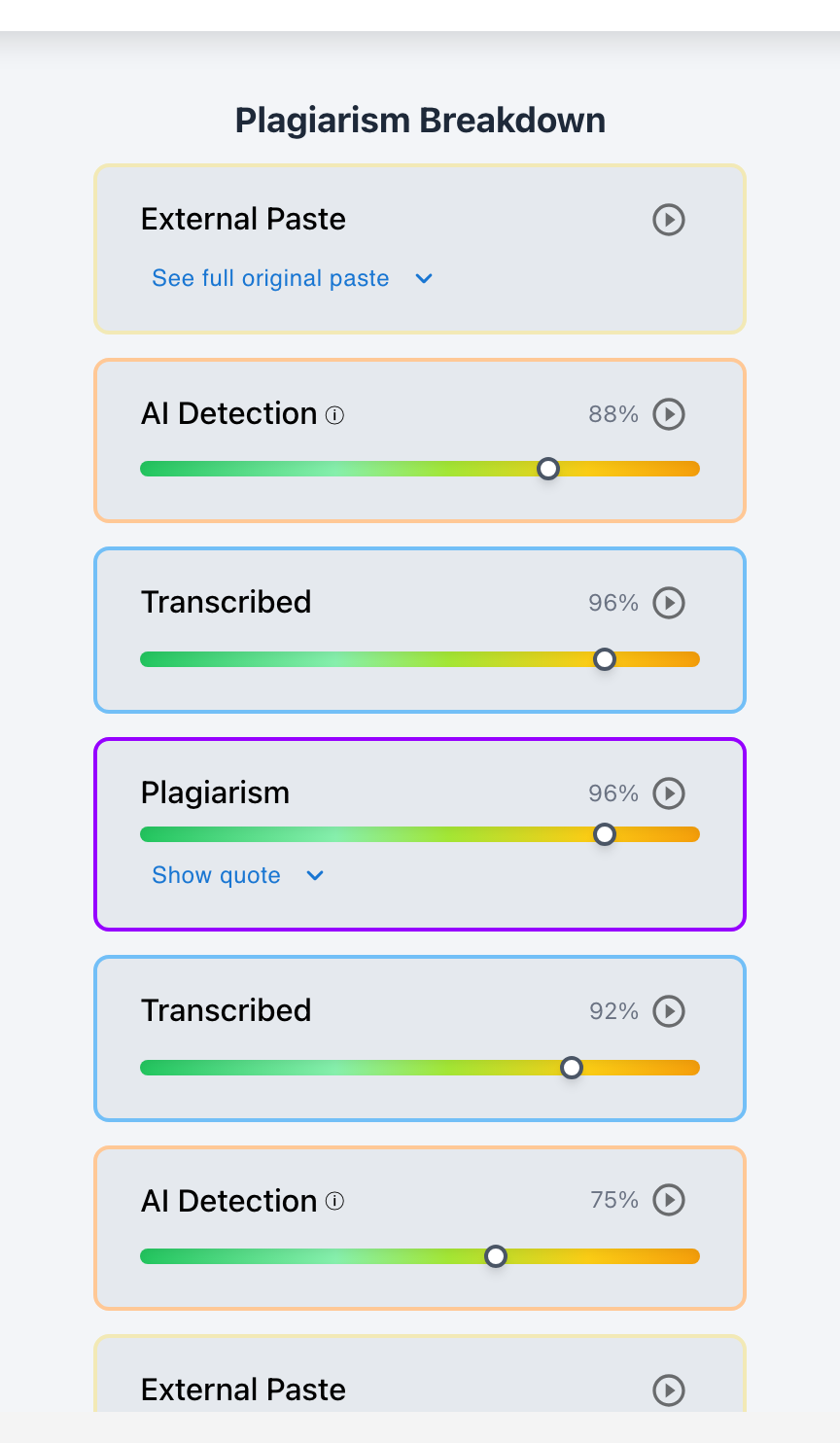
Falsely accusing an honest student of using AI to write an assignment is one of the most damaging mistakes an educator can make.
A wrongful allegation of academic dishonesty shatters student trust, causes severe anxiety, alienates high-achieving writers, and can unfairly derail academic standing. As generative AI tools become ubiquitous and automated detection tools proliferate, teachers face an urgent imperative: how can educators rigorously uphold academic standards without wrongfully penalizing students who write authentically?
Avoiding false accusations does not require lowering expectations or ignoring AI risks. Rather, it requires understanding why detection software fails, recognizing algorithmic bias, replacing single-score reliance with multi-signal evidence, and utilizing essay writing playback to verify the genuine drafting process.
Checkmark Plagiarism helps schools eliminate false accusations by combining AI detection with essay writing playback, static AI detection, plagiarism detection, autograding, and integrations with Canvas and Google Classroom.
Why Do False AI Accusations Happen?
To avoid false positives, educators must understand the structural limitations of statistical AI detection models:
1. Formal Language Traps
Detectors measure perplexity (word predictability). Highly disciplined students who write with structured, standard grammar naturally score high on predictability metrics.
2. Multilingual (ESL/ELL) Bias
Research demonstrates that non-native English writers are disproportionately misclassified by detectors due to constrained vocabulary ranges and formulaic transition phrases.
3. Formulaic Rubric Adherence
Strict template assignments (e.g., standard 5-paragraph essays, rigid CER structures) produce uniform syntactic cadences that mimic AI generation.
Read our comprehensive study in can AI detectors give false positives?
7 Essential Strategies to Prevent False Accusations
1. Treat Detector Scores as Triage Signals, Never Verdicts
Never conclude a student cheated based solely on a percentage score (e.g., "88% AI probability"). Treat the score merely as an indicator that the document warrants human inspection of document history, citations, and student baselines. Read more in should teachers rely on AI detector scores?
2. Require Process Visibility with Essay Writing Playback
The single most definitive safeguard against false accusations is process evidence. Checkmark Plagiarism's essay writing playback records the live evolution of an assignment: active typing duration, keystroke cadences, multi-session revisions, and paste events.
When an automated scanner flags a formal essay, an instructor can review playback to see that the student spent 4 hours drafting, revised the introduction three times, and reorganized body paragraphs. Process playback provides immediate, irrefutable proof of authentic human authorship. Read more in how Checkmark writing process analysis works.
3. Protect Multilingual and International Writers
Recognize that non-native English speakers frequently utilize textbook sentence structures that automated algorithms flag as "predictable." For multilingual writers, rely on oral conceptual checks and writing playback rather than statistical text scanners.
4. Compare Like-with-Like Writing Baselines
Do not compare a high-stakes research paper written over three weeks with a rushed 15-minute in-class writing prompt. Ensure baseline comparisons reflect similar assignment formats, research conditions, and revision opportunities. Read our guide on how can I compare a student's assignment to their previous writing?
5. Verify Citations and Source Integrity Before Intervening
Generative AI models frequently hallucinate non-existent academic citations, misattribute quotations, or invent volume numbers. If an essay contains legitimate, perfectly cited academic articles that match database records in JSTOR or Google Scholar, the probability of wholesale AI generation drops substantially.
6. Differentiate Grammar Checkers from Full-Text Generation
Students frequently use tools like Grammarly to polish punctuation and spelling. An essay with refined grammar may trigger detection alerts despite being conceived and written entirely by the student. Clarify the tool's actual role before assuming misconduct. Read more in can AI detectors detect Grammarly or AI writing assistants?
7. Hold Question-Driven, Curiosity-Based Conferences
Never initiate a conversation with an accusation ("The software says you used ChatGPT"). Instead, open with curiosity: "Can you walk me through how you developed your thesis and selected your sources?" A student who wrote the essay will comfortably explain their ideas, instantly dispelling concerns. Read our guide on how do I talk to a student I suspect of using AI?
High-Risk Accusatory vs. Low-Risk Verification Mindsets
High-Risk Mindset (Prone to False Accusations)
- Assuming high detection scores equal deliberate cheating.
- Treating sudden student writing improvement with suspicion.
- Demanding students "prove innocence" without process logs.
- Ignoring exculpatory external drafts, outlines, or notes.
- Conducting adversarial, confrontational conferences.
Low-Risk Mindset (Fair & Protected)
- Treating detection scores as preliminary screening flags.
- Verifying document drafting playback and revision history.
- Auditing citations in academic databases for authenticity.
- Allowing students to provide external drafts and notes.
- Conducting supportive, inquiry-based writing conferences.
A 10-Point Educator Safeguard Protocol
Educator Protocol to Prevent False AI Accusations:
- 1. Establish a clear, unambiguous syllabus policy defining permissible vs. prohibited AI use.
- 2. Require students to draft assignments within environments that preserve revision history.
- 3. Never discipline or penalize a student based solely on a third-party AI detector score.
- 4. Inspect essay writing playback to verify multi-session drafting and active typing time.
- 5. Verify cited sources and quotations in academic databases before making inquiries.
- 6. Account for multilingual (ESL) backgrounds and formulaic writing styles.
- 7. Compare submissions against authentic, comparable student baseline samples.
- 8. Conduct an open-ended, supportive student conference focused on conceptual mastery.
- 9. Allow 24–48 hours for the student to share external drafts, version logs, or notes.
- 10. Dismiss the concern if writing playback, valid sources, or oral comprehension confirm authorship.
How Checkmark Plagiarism Protects Students and Teachers
Checkmark Plagiarism combines **AI detection, essay writing playback, static AI detection, plagiarism detection, autograding, and Canvas/Google Classroom integrations** to provide full transparency across the writing process, ensuring honest student effort is celebrated and protected from false algorithmic flags.
Frequently Asked Questions
Why do AI detectors falsely flag honest student essays?
AI detectors evaluate text predictability (perplexity) and structural variety (burstiness). Formal, well-organized, and grammatically precise human writing naturally exhibits patterns that algorithms classify as AI-like.
Are non-native English speakers more likely to be falsely accused of AI use?
Yes. Studies indicate that automated detectors misclassify ESL/ELL writing at significantly higher rates due to formal vocabulary patterns and constrained syntactic variety.
What is the most reliable way to protect students from false accusations?
Utilizing essay writing playback to record the actual drafting process. Verifiable keystrokes, active writing durations, and multi-session edits provide irrefutable proof of human authorship.
What should I do if a top-performing student receives a high AI score?
Review the essay writing playback logs, check citation validity in databases, and hold a brief conversation asking the student to discuss their thesis and research.
How should a teacher respond when an AI score is high but the student explains everything fluently?
If the student demonstrates complete conceptual mastery and sources are verified, conclude that the submission is authentic human work and close the inquiry with no penalty.
Can a sudden improvement in student writing trigger a false accusation?
Yes. Teachers often suspect AI when a struggling student suddenly submits excellent work. Inspect drafting playback and ask what the student did differently to verify authentic growth.
What if a student drafted their paper in Microsoft Word and pasted it into Google Docs?
Ask where the text was drafted and give the student 24–48 hours to provide the original Word file with version metadata, outlines, or research notes.
How does citation verification prevent false accusations?
AI models frequently hallucinate non-existent citations. Authentic, accurately cited academic sources strongly indicate genuine student research.
What tone should educators use when discussing a flagged paper?
Maintain a supportive, curious, respectful, and educational tone. Focus on exploring the student's ideas, research journey, and revision choices.
How does Checkmark Plagiarism eliminate the risk of false accusations?
Checkmark Plagiarism pairs statistical AI detection with visual essay writing playback, citation audits, and LMS integrations, ensuring decisions are grounded in objective process evidence.
Protecting Academic Standards by Protecting Students
Upholding academic integrity requires defending honest student effort just as vigorously as addressing misconduct. By grounding evaluations in writing process playback, baseline context, citation audits, and respectful dialogue, educators foster a classroom culture built on mutual trust, excellence, and genuine learning.
Checkmark Plagiarism supports this fair, transparent approach with AI detection, essay writing playback, static AI detection, plagiarism detection, autograding, and integrations with Canvas and Google Classroom.
See how Checkmark pairs essay writing playback with multi-signal detection to protect authentic student writing from false algorithmic flags. View a sample report or request a demonstration.