
When a student's assignment suddenly looks different from their previous work, comparing the two can provide useful context. Maybe the vocabulary is more advanced, the grammar is suddenly much stronger, or the tone, sentence structure, and depth of analysis have changed dramatically. Those differences can raise legitimate questions, especially when a teacher is concerned about possible ChatGPT or other AI use.
But comparison should be done carefully. A student's writing naturally changes over time: they may improve, receive tutoring, revise more thoroughly, or use permitted writing tools. A stronger assignment is not automatically evidence of academic misconduct.
The goal is not to ask: "Is this paper too good for this student?" A better question is: "Is this assignment consistent with the student's established writing patterns, and can the student explain how the differences developed?"
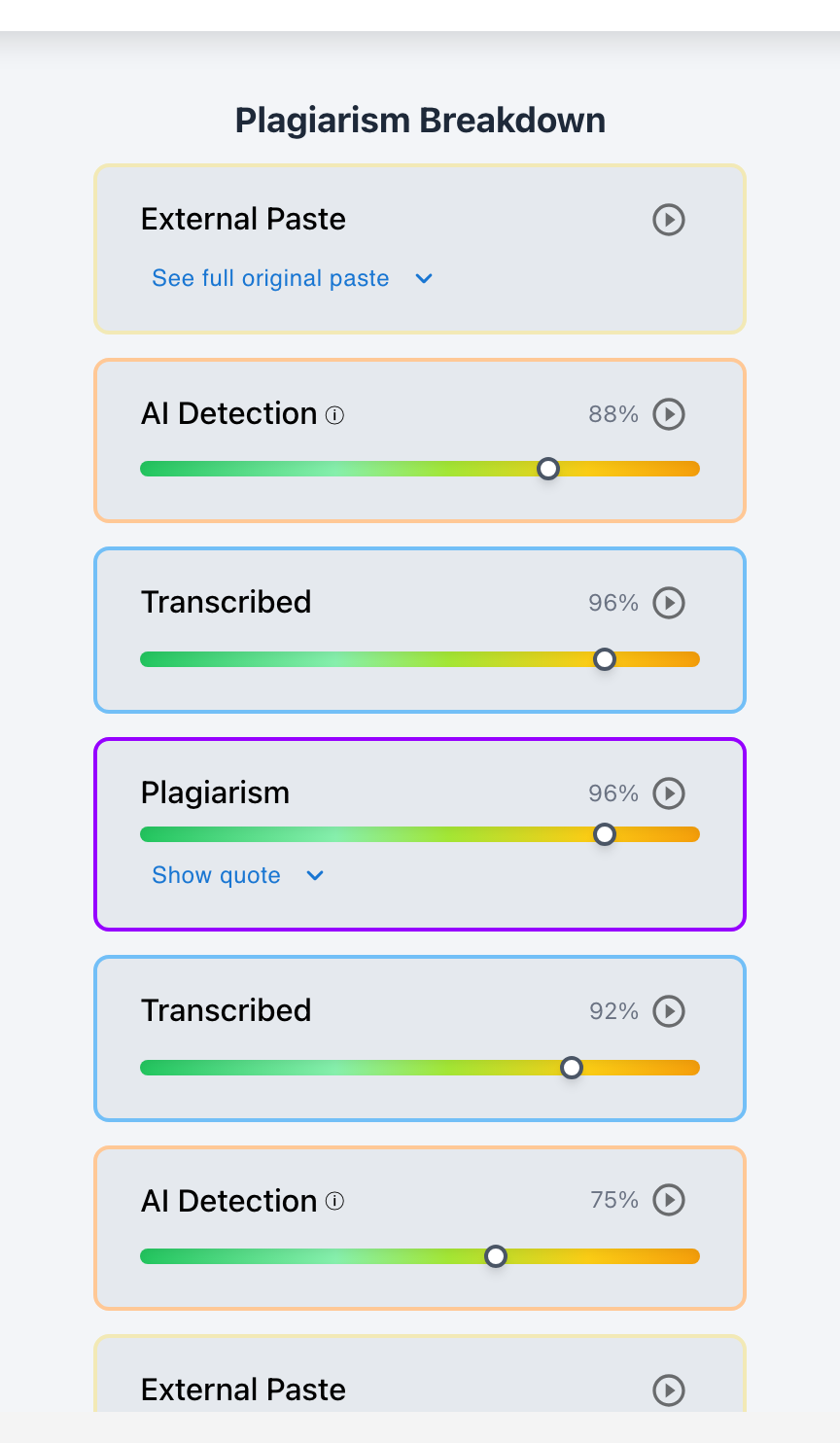
Checkmark Plagiarism supports this broader review with AI detection, essay writing playback, static AI detection, plagiarism detection, autograding, and integrations with Canvas and Google Classroom.
Why Compare a Student's Previous Writing?
Teachers have access to a historical baseline software cannot access: knowledge of how a student normally constructs sentences, what vocabulary they prefer, what errors they routinely make, and how they typically organize arguments. Comparing new submissions against established baselines provides essential context—not automatic proof.
Use More Than One Previous Assignment
Avoid comparing a questionable assignment against only the student's weakest prior paper. Look across multiple assignments completed under similar conditions (take-home vs. take-home, research paper vs. research paper) to identify their authentic developmental range.
1. Compare Vocabulary
Noticeable shifts in terminology provide a starting point for dialogue:
Previous Student Phrasing
"The government was unfair because poor people did not have the same opportunities."
New Submission Phrasing
"The policy reinforced systemic socioeconomic inequality by limiting access to opportunities for marginalized communities."
Ask: "What do you mean by 'systemic socioeconomic inequality' in this paragraph?" A student who authored the paper can comfortably explain their ideas.
2. Compare Sentence Structure
Check if simple declarative sentences and run-ons were replaced across an entire paper by complex multi-clause sentences, advanced punctuation, and sophisticated transitions. Inquire about what the student did differently while drafting or revising.
3. Compare Grammar and Recurring Mistakes
Recurring errors (e.g., tense switching, comma splices, homophone confusion) act like a stylistic fingerprint. If all long-standing errors vanish overnight, ask neutrally: "Your grammar is much stronger in this assignment. What did you do differently during revision?"
4. Compare Tone and Voice
A sudden shift from an informal, conversational, or first-person voice to detached academic prose is noticeable. Focus on concrete rhetorical differences rather than vague impressions like "this doesn't sound like you."
5. Compare Organization
Evaluate whether structural improvements (clear thesis statements, balanced paragraphs, smooth transitional phrases) reflect genuine planning or automated structuring tools.
6. Compare Depth of Analysis
Look at analytical thinking: earlier assignments may summarize events, while a newer paper provides nuanced thematic interpretation. Ask: "How did you develop this interpretation? What evidence led you to this conclusion?"
7. Compare Citation Habits
Verify whether newly submitted citations are real, relevant, correctly attributed, and properly formatted. Hallucinated or non-existent citations provide clear evidence for discussion.
8. Compare Typical Word Choices and Phrases
Students often reuse certain transitional phrases unconsciously. Look at broader vocabulary patterns across assignments to determine how the student's voice evolved.
9. Compare How the Student Uses Evidence
Check whether quotations are integrated smoothly and analyzed in depth compared to earlier dropped-quote habits. Ask how the student chose their evidence.
10. Compare Writing Completed Under Similar Conditions
Compare take-home papers to take-home papers, and timed in-class essays to timed essays. Contextual conditions (time available, revision cycles) heavily impact writing quality.
11. Look for Multiple Changes at Once
A single improved paragraph or fixed grammar error is normal. When vocabulary, syntax, organization, tone, and citation quality all transform simultaneously, a conversation is warranted.
12. Do Not Assume Improvement Is Suspicious
Students improve through hard work, writing center tutoring, and teacher feedback. Ask: "What did you do differently on this assignment?" to learn about their writing strategy.
13. Ask the Student About the Differences
Ask specific, neutral questions about observed changes: "Your sentence structure is much more complex here than in earlier papers. What did you do differently?"
14. Ask the Student to Explain Specific Passages
Select two or three passages and ask the student to explain the core argument and evidence in their own words. Look for general conceptual familiarity.
15. Review the Writing Process
Student A (Genuine Growth)
- Outline and rough draft in playback
- Paragraphs built gradually over days
- Multiple revision and rewriting passes
- Fluently explains the arguments & sources
Student B (Unverified Shift)
- Nearly empty document receives 1,200 words at once
- Minimal subsequent editing or revision
- Several citations do not exist in databases
- Cannot explain key terms used in the paper
How Checkmark Plagiarism's Essay Writing Playback Helps
Checkmark Plagiarism's essay writing playback allows teachers to examine drafting, large additions, revisions, and editing activity over time. This gives educators direct visibility into whether improved writing developed through multi-session drafting or sudden paste events. Read more in how Checkmark writing process analysis works.
A Large Text Addition Does Not Prove AI Use
If hundreds of words appear at once, ask where they originated. The text could come from an external Word doc, Google Doc, or research notes. Allow the student to share external drafts or version histories.
16. Consider AI Detection as Another Signal
Combine AI detection with baseline comparisons, writing playback, source verification, and student conferences. Read more in is an AI detector enough evidence for academic misconduct?
17. Consider Grammar and AI Writing Assistants
Ask what digital tools were used: basic grammar correction vs. automated paragraph rewriting. Read more in can AI detectors detect Grammarly or AI writing assistants?
18. Look at In-Class Writing When Appropriate
Use in-class writing to check conceptual understanding and vocabulary baselines, while keeping in mind that timed writing will naturally be less polished than take-home drafts.
19. Check Whether the Student Understands Their Improvement
Ask: "What do you think you did better on this essay than on your last one?" A student who genuinely improved can identify specific strategies that worked.
A Practical Student Writing Comparison Checklist
Comprehensive Student Writing Comparison Checklist:
Style & Mechanics
- Vocabulary & terminology
- Sentence syntax & complexity
- Tone & register
- Recurring grammatical errors
Structure & Thought
- Thesis & topic sentences
- Depth of analytical reasoning
- Integration of evidence
- Citation accuracy & style
Process & Ownership
- Writing playback progression
- Paste events & draft revisions
- Ability to explain arguments
- Reflection on improvement
How Checkmark Plagiarism Helps Teachers Compare Student Work
Checkmark Plagiarism combines **AI detection, essay writing playback, static AI detection, plagiarism detection, autograding, and Canvas/Google Classroom integrations** so educators have the evidence needed to compare student submissions fairly and accurately.
Frequently Asked Questions
How do I compare a student's essay with their previous writing?
Compare vocabulary, sentence structure, grammar, tone, organization, argument quality, citation habits, and recurring mistakes across several comparable assignments.
How many previous assignments should I compare?
Use multiple examples when possible. One weak assignment may not accurately represent the student's normal writing ability.
Is a different writing style proof of AI use?
No. Students may improve, receive tutoring, revise more thoroughly, or use permitted writing assistance. A different style is a reason to ask questions, not proof by itself.
What writing changes can be worth investigating?
Large simultaneous changes in vocabulary, grammar, sentence complexity, tone, organization, analysis, and citation quality may justify closer review.
Can I compare an essay with in-class writing?
Yes, but account for the different conditions. A take-home essay with time for revision should generally be stronger than a timed classroom response.
What if the student suddenly stops making their normal mistakes?
Ask what changed in their revision process. Legitimate editing, tutoring, teacher feedback, or AI assistance could potentially explain the difference.
Should I ask the student why their writing changed?
Yes. Neutral questions about what they did differently can provide valuable context without assuming misconduct.
Can writing playback help compare student writing?
Yes. Writing playback provides process evidence showing how the assignment developed, which can help explain why the final submission differs from previous work.
Can AI detection confirm that a writing change came from ChatGPT?
AI detection can provide another signal, but it should be considered with previous writing, writing history, sources, and the student's explanation.
How does Checkmark Plagiarism help with writing comparisons?
Checkmark Plagiarism combines AI detection, essay writing playback, static AI detection, plagiarism detection, autograding, and Canvas and Google Classroom integrations.
Compare Patterns, Not Just Quality
The goal of comparing assignments is not to determine whether a paper is "too good," but to evaluate whether the writing patterns fit the student's authentic process and understanding.
Checkmark Plagiarism supports this evidence-based review with AI detection, essay writing playback, static AI detection, plagiarism detection, autograding, and integrations with Canvas and Google Classroom.
See how Checkmark provides educators with writing-process playback to compare student assignments with complete evidence context. View a sample report or request a demonstration.