
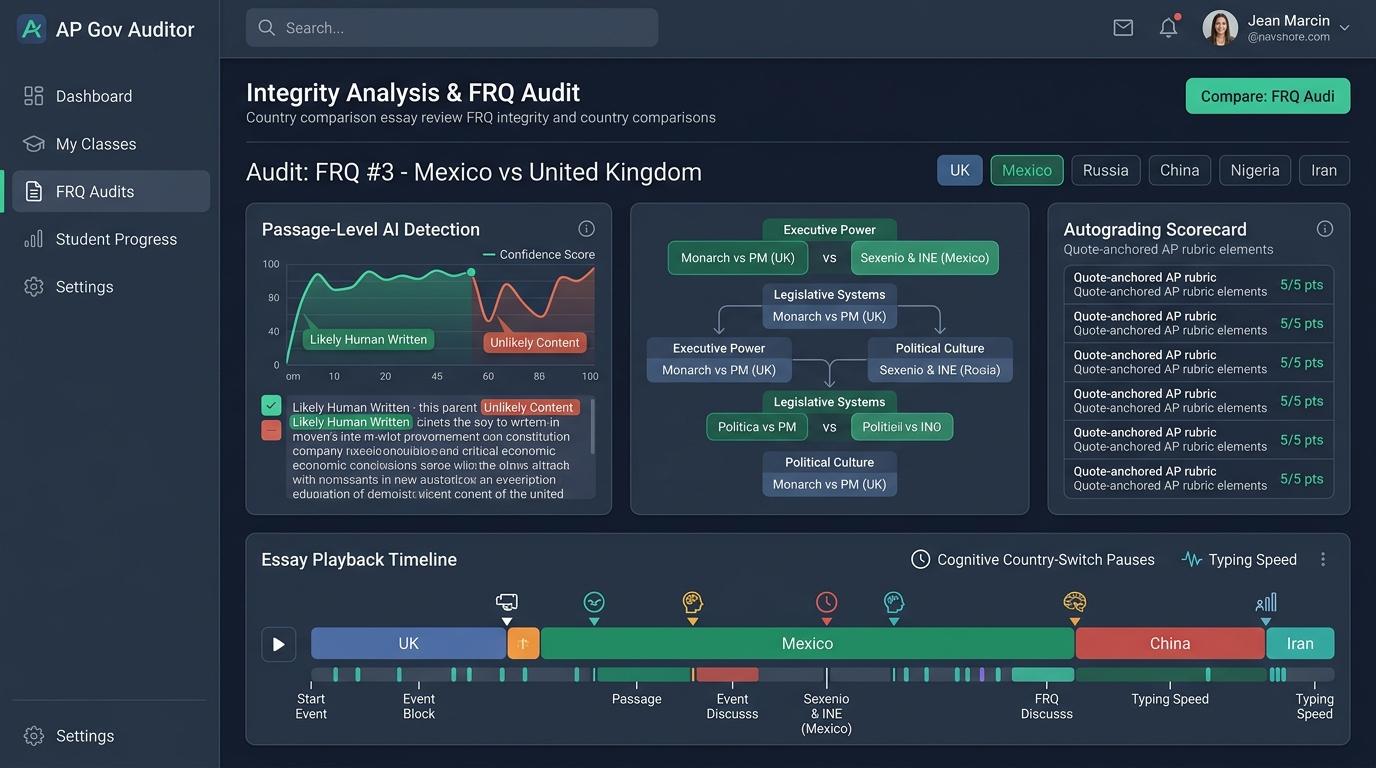
Executive Summary & Disciplinary Mandate
In Advanced Placement Comparative Government and Politics (AP CompGov), scoring Free-Response Questions (FRQs) requires students to demonstrate precise constitutional mechanisms, institutional comparisons, and regime typology across the six core course countries: the United Kingdom, Mexico, Russia, China, Nigeria, and Iran. However, the widespread availability of Large Language Models (LLMs) on 1:1 high school Chromebooks has introduced an acute pedagogical crisis. Generative AI models routinely generate superficially polished comparative essays that blur critical distinctions between Heads of State and Heads of Government, invent non-existent constitutional clauses, conflate pluralist and corporatist interest group systems, and replace rigorous political science mechanics with generic Western liberal commentary.
Furthermore, generic whole-document AI detectors fail social studies departments by flagging mandatory course terminology (e.g., "single-member district plurality," "asymmetric federalism," "rentier state") as artificial while missing genuine AI authorship. Checkmark Plagiarism provides high school social studies educators with a defensible, multi-dimensional verification framework. By combining patent-pending Essay Playback™ keystroke dynamics, external paste payload capture, passage-level AI confidence sliders, and quote-anchored rubric autograding, teachers can move beyond adversarial guesswork to conduct transparent, supportive, and restorative writing audits.
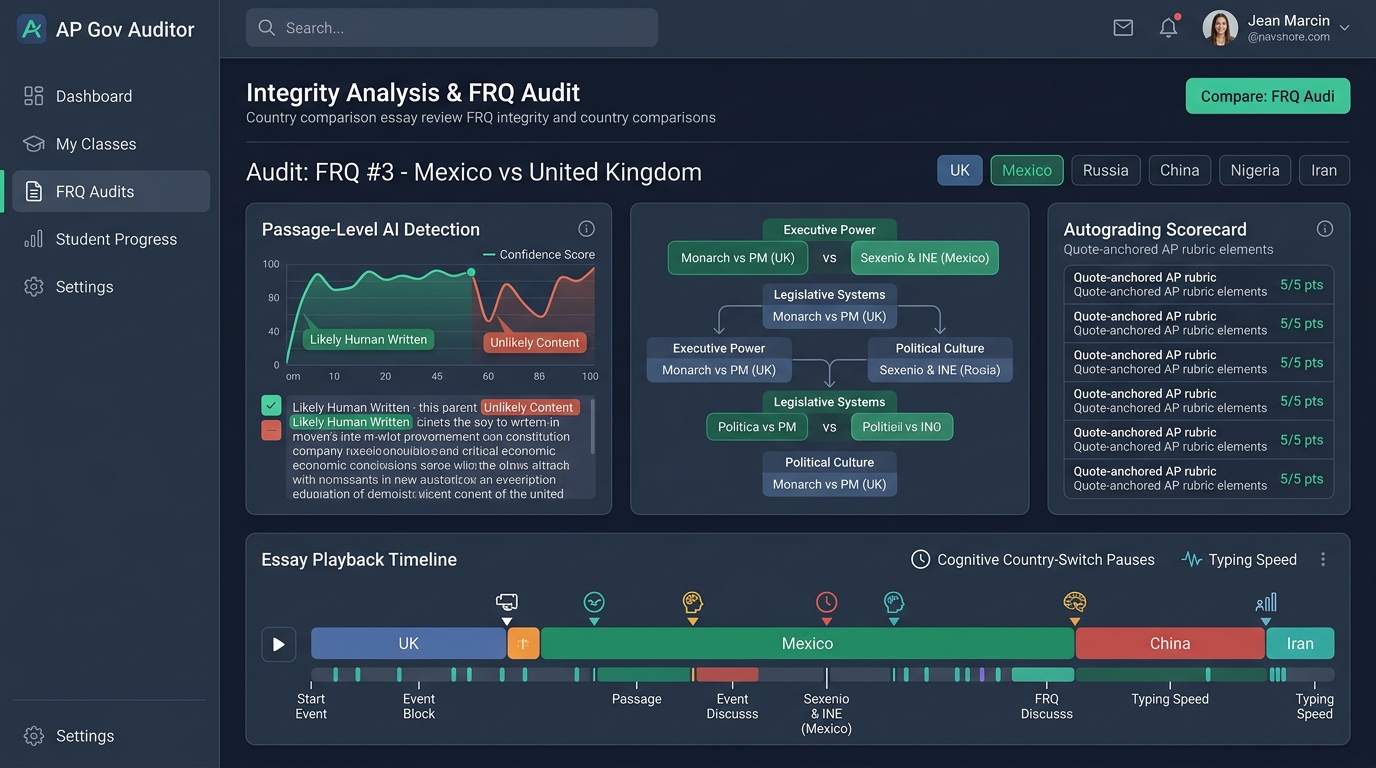
Constitutional & Institutional Check
- Head of State vs. Head of Government verification
- Electoral rule match (SMDP vs. PR thresholds)
- Regime typology & social cleavage mechanics
- Rentier state & resource curse logic audit
Essay Playback™ Keystroke Telemetry
- Patent-pending 1x–8x scrubbable writing replay
- 15–45s cognitive country-switch pauses
- External paste payload buffer preservation
- Second-screen transcription cadence detection
Passage-Level AI & Rubric Scoring
- Domain perplexity & burstiness calibration
- Short-text disciplinary guardrails
- College Board 4-pt / 5-pt rubric autograding
- Defensible receipts for restorative debriefs
1. The High School AP CompGov Crisis: Why LLMs Disintegrate Country Comparison FRQs
High school social studies educators face an extraordinary instructional mandate. Teaching AP Comparative Government and Politics requires guiding 10th, 11th, and 12th-grade students through sophisticated macroeconomic frameworks, constitutional law, historical institutionalism, and non-Western governance models across six diverse political systems.
When high school teachers manage 130 to 160 students across five class periods, grading stacks of analytical essays on take-home Chromebook assignments or timed LMS submissions consumes entire weekends. Over the past several academic cycles, this grading load has collided with generative AI tools like ChatGPT, Claude, Microsoft Copilot, and Google Gemini.
When assigned a Comparative Analysis FRQ comparing executive accountability in the United Kingdom and Russia, or an Argument Essay on how electoral systems mediate ethnic cleavages in Nigeria and Mexico, high schoolers frequently turn to LLMs to draft their responses.
"Compare how the executive branch is held accountable in the UK and Russia."
"Both the United Kingdom and Russia have strong democratic presidents who must answer to their national congresses. In the UK, the Queen leads the government and signs bills passed by parliament, while in Russia, President Putin is checked by the State Duma through regular impeachment procedures and strict judicial review from the Constitutional Court. Both nations ensure human rights through free and fair press."
- Institutional Role Conflation: Conflates the UK Head of State (Monarch) with Head of Government (Prime Minister) and invents a non-existent UK presidential office.
- Regime Mischaracterization: Misrepresents Russia's illiberal competitive authoritarian regime as a functioning tripartite democracy with autonomous judicial checks.
- Vocabulary Evasion: Fails to apply required course concepts: vote of no confidence, Question Time, decree power, subordinated judiciary, siloviki, patron-client networks.
When high school students submit LLM-generated responses, the prose exhibits four distinct structural pathologies:
Generative models default to a standardized Western liberal democratic paradigm, describing authoritarian party-states (China) or theocracies (Iran) as though they operate with Western-style tripartite separation of powers, independent judicial review, and autonomous legislative checks.
LLMs consistently confuse Heads of State (ceremonial or symbolic representatives of national unity) with Heads of Government (executives responsible for day-to-day policymaking, cabinet administration, and legislative leadership across Westminster and semi-presidential systems).
LLMs routinely hallucinate non-existent constitutional amendment numbers (e.g., "Article 114 of the Mexican Magna Carta"), fictitious regional turnout percentages, or invented Nigerian federal character quota statistics that sound plausible to a hurried reader.
While LLMs produce smooth syntax, they routinely avoid the precise analytical collocations demanded by College Board scoring rubrics—such as asymmetric federalism, state corporatism, patron-client networks (prebendalism, guanxi), or the Guardian Council vetting apparatus.
2. AP CompGov Free-Response Architecture & The 6 Core Course Countries
To effectively audit country comparison submissions, educators must ground their integrity evaluations in the exact structural architecture of the AP Comparative Government exam and the specific constitutional mechanisms of the six core course countries.
- (A) Define a core political science concept (e.g., rule of law, legitimacy).
- (B) Explain how the concept applies to governance in a course country.
- (C) Explain how the concept impacts citizen political participation.
- (D) Explain how the concept operates across contrasting regime types.
- (A) Identify a specific data point or baseline value from the stimulus.
- (B) Describe a trend or pattern over time across course countries.
- (C) Draw a valid political science conclusion based on the empirical data.
- (D–E) Explain institutional relationship and state legitimacy implications.
- (A) Define a specified political concept or institutional structure.
- (B) Describe how Country X implements or constrains this structure.
- (C) Describe how Country Y implements or constrains this structure.
- (D–E) Explain specific causes and regime stability implications.
- (A) Formulate a defensible thesis establishing a line of reasoning.
- (B–C) Support thesis with two distinct, specific pieces of course evidence.
- (D) Provide analytical reasoning explaining how evidence supports claim.
- (E) Rebuttal/Refutation responding to an alternative perspective.
The 6 Core Course Countries: Mandatory Institutional Mechanics
Every authentic AP CompGov comparison FRQ must accurately navigate the constitutional mechanics of the six course countries:
| Country | Regime Typology | Head of State | Head of Government | Electoral System |
|---|---|---|---|---|
| United Kingdom | Consolidated Parliamentary Democracy | Monarch (Ceremonial King) | Prime Minister (Leader of Commons) | First-Past-The-Post (SMDP) |
| Mexico | Consolidated / Transitional Democracy | President (Direct, 6-yr sexenio) | President (Unified Executive) | Mixed (300 SMDP + 200 PR party list) |
| Russia | Illiberal / Competitive Authoritarian | President (Super-presidential, 6-yr) | Prime Minister (Appointed/Consent) | Mixed (225 SMDP + 225 PR with 5% threshold) |
| China | Single-Party Authoritarian (CCP) | President / General Secretary | Premier (State Council) | Indirect layered within CCP cadres |
| Nigeria | Federal Republic (Fourth Republic) | President (Unified Executive) | President (Unified Executive) | Double Threshold Plurality Rule |
| Iran | Theocratic Clerical Republic | Supreme Leader (Ayatollah / Faqih) | President (Direct, Vetted) | Majoritarian / Guardian Council Vetted |
1. United Kingdom of Great Britain and Northern Ireland
Consolidated DemocracyConstitutional Base: Uncodified constitution derived from historic charters (Magna Carta), statutes, common law, and conventions. Governed by Parliamentary Sovereignty (courts cannot strike down primary parliamentary statutes).
Executive Power: Fused legislative-executive (Westminster). Monarch = ceremonial Head of State; Prime Minister = Head of Government. Accountability enforced through parliamentary Question Time and Votes of No Confidence.
Legislative & Electoral: Bicameral Parliament: directly elected House of Commons (650 MPs via SMDP) and unelected House of Lords (life/hereditary peers with delaying powers). SMDP creates manufactured majorities.
Territorial Structure: Unitary state with asymmetric devolution (Scottish Parliament, Welsh Senedd, Northern Ireland Assembly under 1998 Good Friday Agreement). Independent UK Supreme Court created in 2009.
2. United Mexican States (Mexico)
Transitional / Consolidated DemocracyConstitutional Base: 1917 Constitution forged in the Mexican Revolution; establishes social rights, agrarian reform (ejidos), secularism, and state subsoil resource sovereignty. Transitioned from 71-year PRI one-party dominance (1929–2000).
Executive Power: Unified presidential executive where President is both Head of State and Government, serving a strict non-renewable 6-year term (sexenio). Historical dedazo successor appointment was eradicated.
Legislative & Electoral: Bicameral Congress: Chamber of Deputies (500 seats: 300 SMDP + 200 closed-list PR with 8% overrepresentation limit and 50% gender quotas) and Senate (128 seats). Autonomous INE oversees elections.
Economy & Cleavages: Shifted from state corporatism to pluralism. Resource management balances PEMEX oil with energy reform. Distinct North-South cleavages (USMCA industrial North vs. agrarian, indigenous South/Chiapas EZLN).
3. Russian Federation
Competitive Authoritarian / HybridConstitutional Base: 1993 Constitution established super-presidential executive; amended comprehensively in 2020 to reset Vladimir Putin's presidential term limits through 2036 and centralize state power.
Executive Power: Semi-presidential system dominated by President as Head of State (6-year terms, sweeping decree powers, control over the siloviki security elites). Prime Minister = Head of Government (oversees domestic economy).
Legislative & Electoral: Bicameral Federal Assembly: State Duma (450 seats: 225 SMDP + 225 PR with 5% threshold, dominated by United Russia) and Federation Council (regional subject representatives).
Judiciary & Federalism: Asymmetric federalism recentralized under presidential governor vetting. Constitutional Court is subordinated via "telephone justice" (telefonnoye pravo); civil society suppressed via Foreign Agent laws.
4. People's Republic of China (PRC)
Single-Party Authoritarian (CCP)Party-State Architecture: Governed exclusively by the Communist Party of China (CCP) under Democratic Centralism. CCP maintains structural supremacy over all state, legal, military, and economic organs.
Paramount Leadership: General Secretary of the CCP leads the Politburo Standing Committee (7 members), chairs the Central Military Commission (PLA allegiance is to the party), and serves as President (term limits removed in 2018).
Executive & Legislative: Premier of State Council = Head of Government (directs civil ministries and SOEs). National People's Congress (NPC) (~3,000 delegates) constitutionally highest state organ, functionally a rubber-stamp body.
Rule by Law & Control: Rejects judicial independence in favor of "Rule by Law" (state administrative tool). Nomenklatura controls cadre promotions. Urban-rural divide institutionalized through Hukou registration system.
5. Federal Republic of Nigeria
Federal Presidential DemocracyConstitutional Base: 1999 Constitution (Fourth Republic) designed to mitigate regional, ethnic, and religious conflicts. Unified presidential executive where President is both Head of State and Government (4-year term, max 2 terms).
Double Threshold Electoral Rule: Winning presidential candidate must win an overall national plurality AND obtain at least 25% of votes cast in at least two-thirds (24) of the 36 states and Abuja, compelling multi-ethnic coalitions.
Legislative & Electoral: Bicameral National Assembly: Senate (109 members: 3 per state + 1 Abuja via SMDP) and House of Representatives (360 members via SMDP). Independent INEC administers elections.
Rentier State & Cleavages: Oil extraction in Niger Delta creates a rentier economy and widespread prebendalism (patron-client rent-seeking). Reinforcing cleavages separate Hausa-Fulani (North), Yoruba (SW), and Igbo (SE).
6. Islamic Republic of Iran
Theocratic Clerical RepublicIdeological Foundation: Established following 1979 Islamic Revolution under Khomeini's doctrine of Velayat-e Faqih (Guardianship of the Islamic Jurist), granting divine clerical authority to ensure state adherence to Sharia law.
Theocratic Institutions: Supreme Leader = Head of State for life (Commander of IRGC/Sepah, judicial appointment, foreign policy). Guardian Council (12 members) conducts candidate vetting and holds legislative veto.
Democratic/Elected Organs: President = Head of Government (domestic administration subordinate to Supreme Leader). Majles (290 members with minority quotas). Assembly of Experts (88 clerics) selects Supreme Leader.
Rentier Economy & Civil Society: State oil revenues and tax-exempt parastatal foundations (bonyads) dominate economy. Strict civil restrictions enforced by morality police spark mass protests (2009 Green Movement, 2022 Woman Life Freedom).
3. The AI Hallucination Anatomy in CompGov: How LLMs Cheat, Blur, and Mischaracterize Regimes
When high school AP CompGov students use generative AI models to complete FRQs on 1:1 Chromebooks, the resulting submissions reveal specific, predictable patterns of political science distortion.
Treats authoritarian party-states (China) or theocracies (Iran) as tripartite democracies, inventing autonomous legislative checks.
Conflates ceremonial Heads of State with Heads of Government—claiming King Charles drafts UK bills or Iran's President commands the IRGC.
Invents non-existent constitutional articles, fabricated election turnout stats, or fake Nigerian federal character quotas.
Confuses Proportional Representation with SMDP, attributing coalition dynamics to the UK Commons as a standard rule.
Replaces precise course terms (prebendalism, sexenio, siloviki, velayat-e faqih) with vague conversational filler.
Side-by-Side Comparison: Authentic vs. AI-Generated Country Comparison FRQ
To understand how these distortions manifest in real high school grading, consider the following responses to a standard AP CompGov Comparative Analysis FRQ (Question 3):
(A) Executive term limits are constitutional rules that restrict the number of terms or years a political executive can serve in office.
(B) In Mexico, the 1917 Constitution enforces a strict, non-renewable single six-year term known as the sexenio for the President. In Russia, the 1993 Constitution originally limited the president to two consecutive four-year terms, which was extended to six years in 2008 and reset to zero in the 2020 constitutional amendments, allowing Vladimir Putin to run through 2036.
(C) Mexico's sexenio promotes accountability by preventing the entrenchment of personalist power or presidential dictatorships, a direct response to the historical Porfiriato. By strictly barring reelection, the sexenio ensures regular rotation of executive power and forces ruling parties (like MORENA, PAN, or PRI) to remain responsive to the electorate rather than relying on an entrenched patron-client apparatus.
(D) In Russia, the avoidance and subsequent reset of term limits (such as the 2008–2012 Putin-Medvedev "tandemocracy" castling maneuver and the 2020 constitutional amendments) has severely eroded political competition. By keeping Putin in power as paramount leader, the state uses administrative resources, United Russia's parliamentary dominance, and the siloviki to suppress opposition parties and independent candidates, creating an illiberal competitive authoritarian regime.
"Executive term limits are laws that tell a leader when they must step down from leading the government so that new leaders can have a chance to run the country.
In Mexico and Russia, both countries have presidential term limits written into their democratic constitutions to guarantee that no president stays in office forever. In Mexico, the president serves six years and then must pass power to the Prime Minister. In Russia, the president can serve two terms and then must retire according to the democratic constitution.
Term limits promote accountability in Mexico because the Mexican Supreme Court strictly monitors the president to make sure they follow human rights and obey Congress. When the president leaves, it allows different interest groups to lobby the new president equally in a free democracy.
In Russia, term limits have affected competition because sometimes Russian citizens vote for different political parties in the State Duma. However, because Russia has a strong executive branch, the government often passes laws that encourage strong presidential leadership over the country's economic programs."
4. Why Generic AI Detectors Fail High School Political Science
When social studies teachers suspect that a student used an LLM on an AP CompGov take-home DBQ or FRQ assignment, their first instinct is often to paste the text into a generic, whole-document AI detection tool. In high school social studies, this reliance on monolithic percentage scores creates severe pedagogical damage.
The Disciplinary Vocabulary Trap in Generic AI Detectors
"The United Kingdom's single-member district plurality electoral system creates a manufactured majority in the House of Commons, whereas Mexico's mixed electoral system combines single-member districts with proportional representation and gender quotas."
"88% AI-GENERATED WRITING DETECTED" (FALSE POSITIVE)
Why It Failed: Multi-word collocations (single-member district plurality, manufactured majority) occur thousands of times in political science textbooks within LLM training corpora, triggering low perplexity flags against earnest students.
The Mathematics of False Positives in Political Science
Generic AI detectors evaluate text based on two primary statistical dimensions:
- Perplexity (Word Prediction Uncertainty): A measure of how likely a given word token is to follow the preceding token based on standard Large Language Model training distributions.
- Burstiness (Sentence Structure Variation): A measure of variance in sentence length, rhythmic complexity, and syntactic diversity.
In AP Comparative Government, students are explicitly coached to write concise, structured, concept-dense responses that directly answer prompt stems. A student writing:
...is using a deterministic string of political science terminology. Because this sequence matches formal academic textbooks with high statistical probability, generic whole-paper detectors assign it a low perplexity score—wrongly calculating that the sentence was generated by an AI model.
Conversely, a student who uses ChatGPT to generate an entire country comparison essay and then runs it through an "AI humanizer" or paraphraser (e.g., QuillBot) introduces artificial syntactic noise. The generic detector returns a "safe" 8% AI score, allowing complete authorship fraud to pass unflagged.
5. The High School Social Studies Evidentiary Matrix
To establish an integrity protocol that withstands administrative scrutiny and supports restorative student conferences, high school social studies educators should evaluate writing authenticity across multiple telemetry sources.
| Feature / Capability | Paper Blue Books | Generic AI Detectors | Google Docs History | Checkmark Writing Telemetry & Essay Playback™ |
|---|---|---|---|---|
| Keystroke Playback Granularity | N/A (Analog) | ✗ None (Black box) | ✗ None (Coarse snapshot cuts) | ✓ Full Keystroke Telemetry (1x–8x replay) |
| Paste Buffer Payload Preservation | N/A | ✗ None | ✗ Shows raw block paste | ✓ Complete External Text Payload Stored |
| Disciplinary Collocation False-Positive Immunity | ✓ High (Authentic) | ✗ High False Positive Rate | ✓ High (Historical) | ✓ Immune (Calibrated Confidence Sliders) |
| Country-Comparison Pause & Synthesis Tracking | ✗ None | ✗ None | ✗ None | ✓ Millisecond Hesitation & Revision Mapping |
| AP CompGov Rubric Autograding Alignment | ✗ Manual Teacher Only | ✗ None | ✗ None | ✓ Quote-Anchored Draft Scoring (4/5 pts) |
| Defensibility in Parent/Admin Appeals | ✓ High (Physical) | ✗ Extremely Low / Opaque | ✗ Moderate (Ambiguous) | ✓ Absolute Forensic Transparency ("Receipts") |
6. The 5-Step CompGov Teacher Integrity Audit Protocol
When auditing take-home FRQs, AP Classroom assignments, or research briefs, social studies teachers should follow this systematic five-step audit protocol:
Constitutional Mechanism & Institutional Concordance Audit
- Executive Typology: Did the student correctly identify presidential, parliamentary, semi-presidential, theocratic, or single-party structures?
- Head of State vs. Head of Government: In Iran, is Supreme Leader recognized as commander-in-chief? In the UK, is policy attributed to Prime Minister & Cabinet rather than the King?
- Constitutional Reality: Are constitutional citations authentic? Flag fabricated articles (e.g., "Article 42 of Mexican Magna Carta").
Electoral System & Social Cleavage Sanity Checks
- Electoral Rules: Differentiates FPTP in UK from mixed systems in Mexico (300 SMDP / 200 PR) and Russia (225 SMDP / 225 PR); checks Nigeria's double threshold.
- Cleavage Types: Distinguishes cross-cutting cleavages (stabilizing) from reinforcing/cumulative cleavages (polarizing, as in Nigeria).
- Resource Curse Logic: In rentier state comparisons (Nigeria, Iran, Russia), checks whether the essay explains how oil rents decouple governments from citizen taxation.
Essay Playback™ Keystroke Dynamics Audit
External Paste Buffer Payload Inspection
Checkmark records every external paste event, capturing the full raw payload even if subsequently rewritten:
Conducting Restorative Comparative Politics Debriefs
Non-Punitive Tone: Open the conference displaying Essay Playback side-by-side with the student: "Let's look at how this response was assembled and review why these institutional distinctions matter for your AP exam."
Targeted Conceptual Remediation: Walk through specific LLM institutional errors, demonstrating why generic AI text scores 0 points on official rubrics.
Structured Revision: Allow the student to complete a supervised rewrite using paper blue books or a monitored Checkmark drafting session.
7. How Checkmark Plagiarism Powers Defensible CompGov Assessment
Checkmark Plagiarism provides social studies educators, department chairs, and academic integrity committees with an integrated suite designed specifically for secondary writing workflows:
Underlines specific synthetic clauses with calibrated confidence cards, avoiding whole-paper false positives.
Keystroke replay at 1x–8x speed exposes instant paste dumps and mechanical transcription typing.
Stores raw external clipboard payloads even if students rewrite or delete every word.
Quote-anchored draft evaluations aligned with official College Board 4-pt / 5-pt scoring rubrics.
Zero student data used for AI training; integrates natively with Canvas and Google Classroom.
College Board Rubric Alignment: 4-Point & 5-Point Scoring Automation
Checkmark's Rubric Autograder is calibrated specifically to official College Board Free-Response scoring standards, providing evidence-anchored justifications while preserving final grading authority for teachers:
Evidence: "Executive term limits are constitutional rules restricting years in office..." • Correctly defines the institutional concept without extraneous fluff.
Evidence: "...1917 Constitution enforces a strict, non-renewable single six-year sexenio..." • Accurately identifies Mexican sexenio and constitutional rule.
Evidence: "...reset to zero in the 2020 constitutional amendments, allowing Putin..." • Correctly identifies 2020 constitutional reset and 6-year terms.
Evidence: "...prevents the entrenchment of personalist power or presidential dictatorships..." • Connects non-reelection rule to prevention of personalist autocracy.
Evidence: "...uses administrative resources, United Russia's dominance, siloviki..." • Explains how term limit manipulation suppresses opposition competition.
8. Frequently Asked Questions (AP CompGov & Writing Integrity)
1. Why do generic AI detectors frequently flag authentic AP Comparative Government essays as AI-generated?
Generic AI detectors measure perplexity (word predictability) and burstiness (sentence length variation). In AP CompGov, students are trained to use precise, formulaic political science phrasing—such as "single-member district plurality," "asymmetric federalism," "theocratic institutions," or "proportional representation party lists." Because these exact multi-word collocations appear frequently across political science textbooks and Wikipedia articles in LLM training corpuses, generic detectors assign them low perplexity, falsely flagging authentic, high-performing student work as machine-generated.
2. How does Checkmark differentiate between authorized grammar tools and unauthorized AI essay generation?
Checkmark evaluates writing authenticity across multiple telemetry layers rather than relying on a single text scan. Through Essay Playback™, teachers can watch the actual drafting process. A student using a spellchecker or basic grammar tool exhibits normal typing cadences, organic sentence edits, and human composition pauses. A student who generates an essay with ChatGPT or Claude exhibits massive external paste blocks or unnatural, continuous transcription typing without drafting revisions.
3. Can students bypass Checkmark's Essay Playback™ by using "AI humanizers" or synonym spinners?
No. While AI humanizers (e.g., Undetectable AI, QuillBot) alter sentence structures and introduce deliberate grammatical quirks to deceive statistical text detectors, they cannot fabricate authentic temporal writing history. If a student pastes humanized text into their Google Doc or Canvas LMS editor, Checkmark's External Paste Inspector captures the exact timestamp, character count, and raw text payload of the paste event.
4. How can AP CompGov teachers use Checkmark to prepare students for the timed May AP Exam?
Checkmark helps teachers identify students who rely on external generative crutches during take-home assignments before they encounter the timed, paper-and-pencil AP exam in May. By utilizing Checkmark's Quote-Anchored Rubric Autograder, teachers can assign frequent timed in-class or Chromebook FRQ practices, review automated draft scores aligned with official 4-point and 5-point College Board rubrics, and provide immediate feedback on institutional mechanics.
5. What should an educator do if an AP CompGov student's FRQ has high AI suspicion but no direct plagiarism matches?
Instead of making an immediate accusation based on an opaque percentage, the educator should open Checkmark's Essay Playback™ viewer. Examine the student's writing timeline: Did the student pause to synthesize comparative concepts? Are there organic deletions and sentence restructuring? If the playback shows a single instant paste or steady transcription without pauses, invite the student to a restorative conference. Ask them to orally explain the institutional mechanics in their essay (e.g., "Explain how the Guardian Council vets candidates in Iran"). A student who authentically wrote the essay can easily explain their reasoning, while a student who used an LLM will struggle to define the terms.
6. Is student data protected when using Checkmark Plagiarism?
Yes. Checkmark Plagiarism is fully FERPA and COPPA compliant. Student submissions are encrypted in transit and at rest, and student data is never used to train general AI models. School districts maintain full administrative ownership and privacy over their institutional repositories.
9. Conclusion: Moving From Adversarial Guesswork to Defensible Trust
Teaching high school students to analyze global political institutions, decode regime dynamics, and construct rigorous comparative arguments is one of the most vital tasks in secondary social studies education. In an era saturated with generative AI tools, protecting the authenticity of this learning process requires tools built on transparency, pedagogical nuance, and verifiable evidence.
By replacing opaque whole-document AI detectors with Checkmark's multi-dimensional integrity architecture—leveraging Essay Playback™, external paste payload preservation, calibrated passage-level confidence cards, and quote-anchored rubric autograding—AP Comparative Government teachers can reclaim their weekends, safeguard honest students, and foster a classroom culture grounded in authentic scholarship.
Stop Guessing, Start Trusting
Empower your social studies department with defensible writing telemetry, College Board rubric autograding, and transparent keystroke dynamics.