
No. Teachers should not rely solely on AI detector scores to determine academic misconduct or assign disciplinary penalties.
While AI detection tools provide a valuable initial screening signal, an AI detector score is a statistical probability measurement of language patterns—not definitive proof of who wrote an assignment. Relying on a single percentage score risks falsely accusing honest students, missing edited AI text, and overlooking the authentic drafting process.
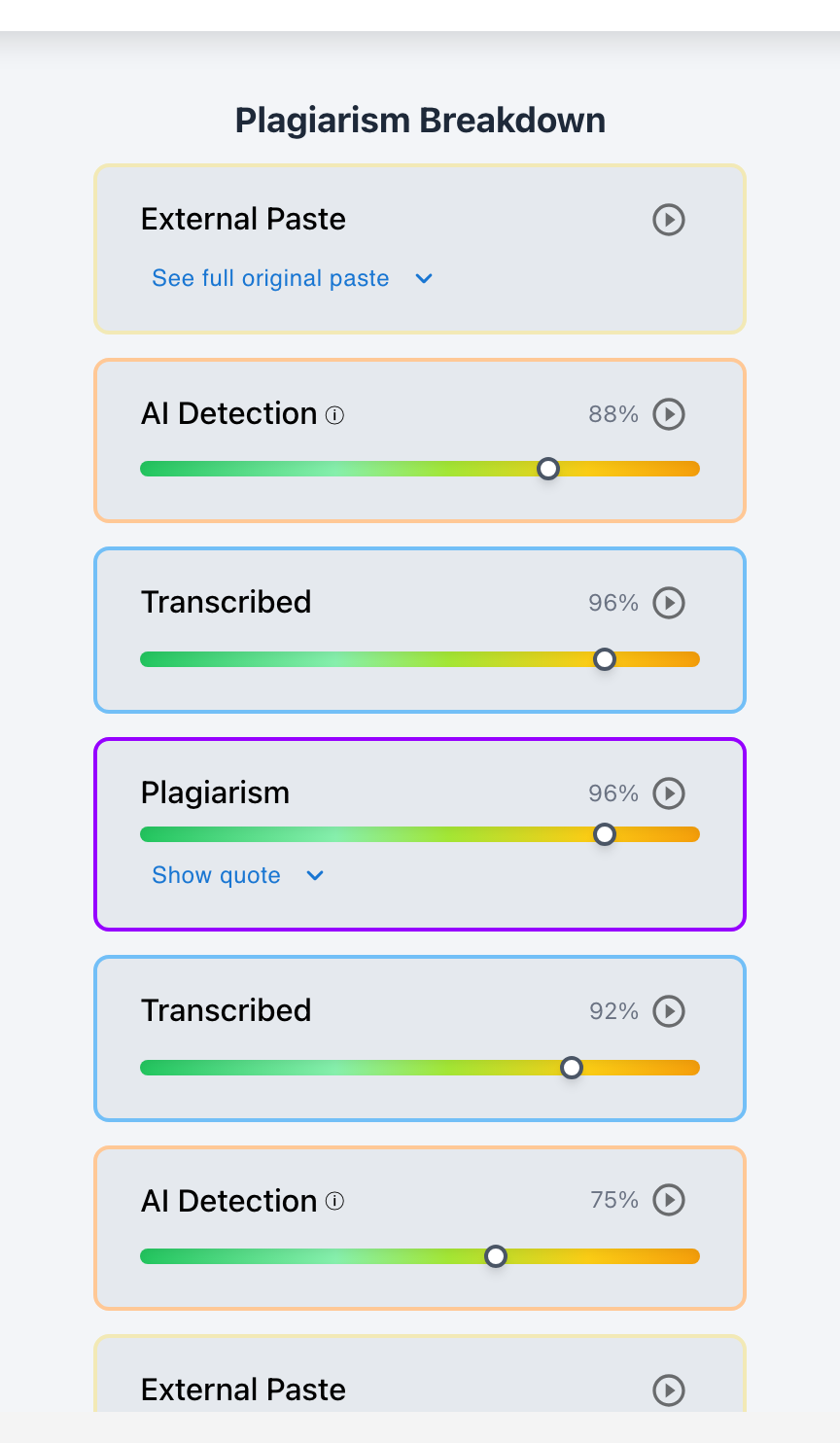
Instead of treating an AI detection score as a final verdict, educators achieve the highest accuracy by treating it as one signal among many in a multi-evidence framework: pairing detection scores with essay writing playback, previous writing baselines, source verification, and student conferences.
Checkmark Plagiarism supports this balanced approach through AI detection, essay writing playback, static AI detection, plagiarism detection, autograding, and integrations with Canvas and Google Classroom.
What Do AI Detector Scores Actually Measure?
To understand why detector scores should not stand alone, it is essential to understand what they measure. AI detectors do not possess secret databases of ChatGPT queries or digital watermarks. Instead, they analyze statistical text characteristics:
- Perplexity: How predictable words and phrases are in sequence. Highly predictable phrasing receives higher AI probability scores.
- Burstiness: Variation in sentence length, structure, and rhythm. Human writing typically exhibits irregular sentence lengths, whereas AI models tend to produce uniform, balanced cadences.
- Syntactic Repetition: Characteristic transitional words and formulaic essay structures frequently produced by large language models.
Because these metrics evaluate statistical probabilities rather than historical authorship, formal human writing—especially by disciplined students or non-native English speakers—can exhibit high statistical predictability without involving AI. Read more in what does an AI detection percentage actually mean?
Why Sole Reliance on Detector Scores Creates Risks
Risk 1: False Positive Accusations
High-achieving writers and multilingual students who write with formal, structured grammar can trigger elevated AI percentages despite drafting every word authentically.
Risk 2: False Negatives from Edited AI
Students who use ChatGPT to generate drafts and perform light sentence restructuring often bypass standard text scanners, producing deceptive low scores.
When institutions treat a detector score as automated proof, it damages student-teacher trust and creates an adversarial classroom dynamic. Read our comprehensive analysis in can AI detectors give false positives? and is an AI detector enough evidence for academic misconduct?
When and How Should Teachers Use AI Detector Scores?
AI detectors remain useful when positioned properly within an academic integrity workflow. Rather than a verdict, an AI score serves as an investigative triage indicator:
- Screening Large Batches: Highlighting submissions that display uncharacteristic statistical patterns for closer human review.
- Pinpointing Specific Passages: Identifying specific paragraphs where tone or syntactic predictability suddenly shifts.
- Triggering Process Inquiries: Prompting instructors to inspect document writing playback and revision timelines.
The Multi-Signal Alternative: A Comprehensive Review Framework
Rather than deciding authorship from a score, educators should evaluate four corroborating layers of evidence:
1. Writing Process Playback
Examines keystrokes, drafting duration, multi-session revisions, and whether text was drafted incrementally or inserted in large paste blocks.
2. Student Writing Baselines
Compares the vocabulary, syntax, and analytical depth of the submission against verified in-class writing samples.
3. Citation Authentication
Verifies whether cited academic sources, authors, and direct quotes exist in databases or reflect AI hallucinations.
4. Student Conceptual Mastery
Conducts a brief, supportive conversation asking the student to explain their thesis, research choices, and revision decisions orally.
How Essay Writing Playback Provides Definitive Process Evidence
Checkmark Plagiarism's essay writing playback transforms how educators evaluate writing by recording the actual development of the document over time. Teachers can watch writing sessions unfold, see sentences revised and reorganized, and spot instant wholesale text insertions.
When an AI detector flags a paper, writing playback provides the context needed to resolve the question: did the student draft the essay over multiple days with detailed revisions, or did 1,200 finished words appear in a single instant timestamp? Read more in how Checkmark writing process analysis works.
Comparing AI Scores with Other Evidence: Two Case Studies
Case A: High Score + Authentic Process
- AI detector score: 82%
- Playback shows 5 multi-hour drafting sessions
- Extensive sentence rewriting and paragraph reorganization
- Citations are fully verified and accurate
- Student fluently explains arguments orally
- Conclusion: Authentic human writing with formal register; no violation.
Case B: High Score + Corroborating Flags
- AI detector score: 85%
- Playback shows empty document receiving 1,400 words at once
- Zero subsequent edits or revisions
- 3 cited sources do not exist in academic databases
- Student cannot explain core terminology orally
- Conclusion: Strong corroborating evidence of unauthorized AI generation.
A Practical 8-Step Protocol for Evaluating AI Detector Results
Recommended Educator Protocol for AI Scores:
- 1. Review the detector score as a preliminary triage indicator, not proof of guilt.
- 2. Inspect highlighted passages to identify where statistical predictability clusters.
- 3. Check essay writing playback to observe document creation timeline and paste events.
- 4. Compare the submission against previous verified writing samples from the student.
- 5. Verify cited sources, author names, and direct quotations in academic indices.
- 6. Check plagiarism detection results for traditional web or peer database matches.
- 7. Hold a neutral, supportive conference asking the student to explain their drafting process.
- 8. Base academic integrity findings on the complete body of corroborating evidence.
How Checkmark Plagiarism Empowers Balanced Academic Integrity
Checkmark Plagiarism combines **AI detection, essay writing playback, static AI detection, plagiarism detection, autograding, and Canvas/Google Classroom integrations** to give educators a comprehensive, fair, and evidence-based toolkit that moves beyond single-score reliance.
Frequently Asked Questions
Should teachers rely on AI detector scores alone?
No. AI detector scores are statistical probability measurements of language patterns and should always be corroborated with writing process history, baselines, and student conferences.
Can an AI detector score prove academic misconduct?
No. A detector score alone cannot establish who authored the text, what tools were used, or whether the usage complied with assignment guidelines.
Why do AI detectors produce false positives?
Detectors evaluate perplexity and burstiness. Highly structured, formal human writing—especially from disciplined or ESL students—often exhibits low perplexity, triggering false flags.
What should a teacher do when a student's essay receives a high AI score?
Review the writing playback history, compare the essay to previous work, verify citations, and invite the student to discuss their writing process in a supportive conference.
How does essay writing playback solve the limitations of AI scores?
Writing playback captures the actual drafting timeline, showing whether an essay was created incrementally over days or pasted in wholesale in seconds.
Can students bypass AI detectors by editing ChatGPT output?
Yes. Lightly editing AI text can lower statistical detection scores, which is why process playback and citation verification are essential.
What if a student with a high AI score can explain their entire paper?
Strong oral comprehension combined with multi-session drafting history provides compelling evidence of authentic student ownership, weakening the detector flag.
How does Checkmark Plagiarism support fair AI evaluation?
Checkmark Plagiarism pairs AI detection with essay writing playback, static analysis, plagiarism checks, and LMS integrations to provide full multi-signal context.
Rely on Evidence, Not Just a Number
Educational integrity thrives when decisions are grounded in transparent, objective evidence. By combining statistical AI detection with essay writing playback, baseline comparisons, and student dialogue, educators can safeguard academic standards while treating every student fairly.
Checkmark Plagiarism supports this comprehensive approach with AI detection, essay writing playback, static AI detection, plagiarism detection, autograding, and integrations with Canvas and Google Classroom.
See how Checkmark pairs essay writing playback with multi-signal detection to give teachers a comprehensive evidence package for every submission. View a sample report or request a demonstration.