
Sometimes—but the answer depends heavily on what the writing assistant actually changed. Tools such as Grammarly and other AI-powered writing assistants can do very different things: correct spelling mistakes, improve grammar, rewrite sentences, change tone, or generate entirely new text. Those forms of assistance are not equivalent, and an AI detector may respond differently to each one.
For example, correcting punctuation or fixing a few grammatical errors is unlikely to transform an otherwise human-written essay into something that can meaningfully be described as AI-generated. But if a student uses an AI writing assistant to rewrite entire paragraphs or generate substantial portions of an assignment, the resulting text may contain patterns that an AI detector identifies as consistent with AI-generated writing.
Even then, detection is not perfect. That is why educators should avoid asking a simplistic question like "Did this student use Grammarly?" and instead ask: "Does the available evidence suggest that AI generated or substantially rewrote material that the student submitted as their own?"
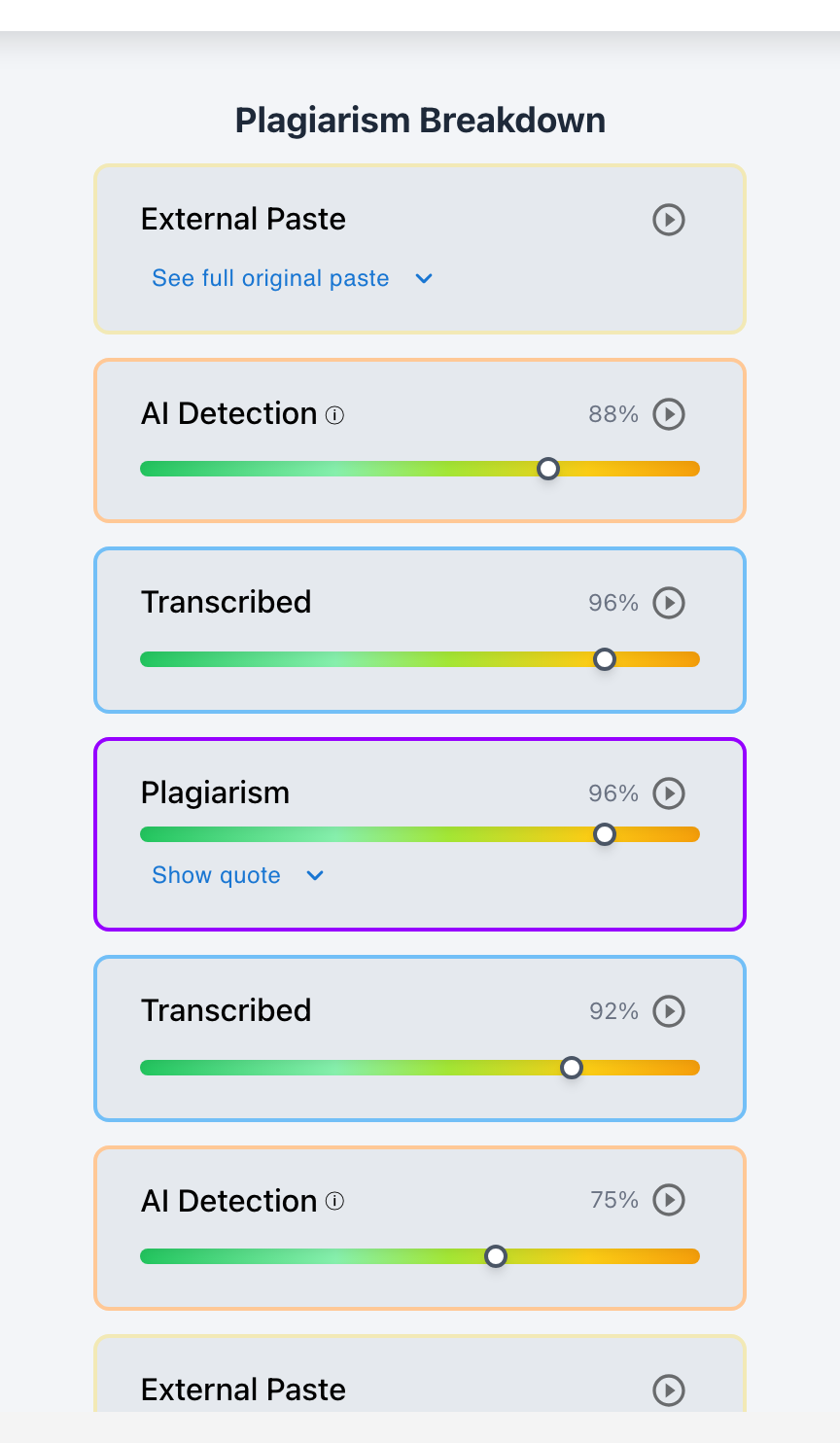
Checkmark Plagiarism helps educators investigate that broader question with AI detection, essay writing playback, static AI detection, plagiarism detection, autograding, and integrations with Canvas and Google Classroom.
Can an AI Detector Tell If a Student Used Grammarly?
Not necessarily. Using Grammarly does not automatically mean that a student's writing becomes AI-generated.
A student might use a writing assistant to correct spelling, punctuation, subject-verb agreement, grammar, capitalization, wordiness, or minor clarity problems. Those kinds of changes leave the underlying writing substantially the student's own. An AI detector analyzing the final essay generally sees only the finished text, making it difficult to determine from the completed document alone which editing tools were utilized.
Grammar Correction and AI Generation Are Different
Schools should distinguish between tools that correct writing and tools that generate or substantially rewrite writing.
Student One: Grammar Corrections
Original: "The causes of the Civil War was complicated and different regions had different economic interest."
Corrected: "The causes of the Civil War were complicated, and different regions had different economic interests."
The ideas, sentence structure, and argument still came from the student.
Student Two: AI Rewriting
Original: "Social media affects teenagers because they compare themselves to other people online."
Rewritten: "Social media can influence adolescent well-being by encouraging frequent comparison with carefully curated representations of other people's lives."
New sentence structures, vocabulary, and organization generated by software.
Those are very different uses of technology, and an academic-integrity policy should account for that distinction.
Can Grammarly Cause a False Positive?
Potentially, AI-assisted editing can complicate AI detection. If a writing assistant substantially rewrites portions of a student's work, those passages may contain linguistic patterns that resemble machine-generated text. Learn more about detector limitations in can AI detectors give false positives?
What About AI-Powered Rewriting Tools?
AI-powered rewriting creates a more complicated situation. The underlying idea may have come from the student, but much of the final wording may have been generated by the assistant. Whether that is acceptable depends on course policy—one teacher may consider this normal editing, while another may consider substantial AI rewriting to be unauthorized assistance.
Can an AI Detector Identify Which Writing Assistant Was Used?
Generally, the finished text alone is not a reliable way to identify the exact writing tool involved. A rewritten passage might have been produced with Grammarly, ChatGPT, Gemini, Claude, Copilot, a human tutor, or the student's own revision. Identifying the brand of software is often less important than determining: How much of the submitted writing was actually produced by the student?
What If Grammarly Only Fixes Grammar?
If a student uses a writing assistant only for basic corrections, teachers should be careful about interpreting an AI detection result as evidence of full AI generation. Common tools help with spelling, grammar, punctuation, and typographical mistakes. A school's policy may reasonably distinguish basic mechanics fixes from generative AI that produces substantive content.
What If a Student Uses AI to Improve Every Sentence?
If a student runs every sentence through an AI assistant to make it more academic, strengthen transitions, and refine tone, the ideas may belong to the student while a significant portion of the wording comes from AI. The teacher must then consider: "How much AI-generated rewriting is allowed under the assignment rules?"
Can AI Detectors Distinguish Editing From Generation?
Not perfectly. A detector generally analyzes the final text. It may identify passages that resemble AI-generated writing, but it cannot know whether the paragraph was completely generated by ChatGPT, heavily rewritten by an assistant, polished by a human tutor, or written by an advanced student.
Writing Process Matters More When AI Editing Is Common
As writing assistants become more capable, evaluating only the final document becomes increasingly difficult. Comparing writing histories provides crucial context:
- Normal drafting: An outline, gradual paragraph composition, ongoing sentence revision, and small grammar corrections near submission.
- Instant wholesale replacement: A basic draft where large portions of text are replaced suddenly by sophisticated rewritten paragraphs with little further revision.
How Checkmark Plagiarism's Essay Writing Playback Helps
Checkmark Plagiarism's essay writing playback allows educators to examine how an assignment developed over time. Teachers can review gradual drafting, large text additions, revisions, and editing patterns. Read more in how Checkmark writing process analysis works.
When a student says "I only used an assistant to edit my work," the teacher can ask: "I noticed this paragraph was replaced almost entirely near the end of the assignment. Can you explain what tool you used to revise it?"
Does Writing Playback Prove Grammarly Was Used?
No. Writing history shows that text changed, but it does not identify which tool caused the change. Writing playback provides process evidence, but the student may still need to explain what happened.
What If the Student Says, "I Only Used Grammarly"?
Ask what that means. Useful follow-up questions include:
- Did it generate any new sentences?
- Did it rewrite entire paragraphs?
- Did you accept suggestions automatically?
- Did it change the tone of the essay?
- Did it add new ideas or analysis?
- How much of the final wording came from the tool?
Should Schools Ban Grammarly Because of AI?
Not necessarily. The more useful approach is to define permitted and prohibited uses:
Permitted
- Spelling corrections
- Basic grammar & punctuation
- Formatting fixes
- Accessibility tools
Permitted With Disclosure
- Brainstorming ideas
- Feedback on drafts
- Suggested structural revisions
- Sentence-level rewording
Prohibited
- Generating full answers
- Writing entire paragraphs
- Generating analysis
- Replacing human drafting
What Should Teachers Do If an AI Detector Flags Grammarly-Assisted Writing?
- 1. Ask what tool was used: Find out if the student used Grammarly, ChatGPT, or multiple tools.
- 2. Ask what the tool did: Did it correct grammar, rewrite sentences, or generate paragraphs?
- 3. Review the writing process: Examine how the assignment developed in writing history.
- 4. Compare previous writing: Check for sudden vocabulary and tone shifts.
- 5. Ask the student to explain the work: Ensure they understand the arguments and terminology.
- 6. Apply the assignment policy: Determine whether the specific type of AI assistance was prohibited.
For conversation tips, see our guide on how do I talk to a student I suspect of using AI?
AI Writing Assistance Is Not the Same as Plagiarism
Traditional plagiarism detection looks for similarities with indexed sources. An AI assistant may generate new sentences that have zero matches in plagiarism databases. Read our complete comparison in AI detection vs. plagiarism detection.
How Checkmark Plagiarism Helps With AI Writing Assistants
Checkmark Plagiarism combines **AI detection, essay writing playback, static AI detection, plagiarism detection, autograding, and Canvas/Google Classroom integrations** so schools can evaluate AI-assisted writing with complete context.
Frequently Asked Questions
Can AI detectors tell if you used Grammarly?
Not necessarily. An AI detector analyzes the final text and generally cannot reliably determine from that text alone that a specific tool such as Grammarly was used.
Can Grammarly make writing look AI-generated?
Substantial AI-powered rewriting may change the characteristics of a student's writing and could potentially affect an AI detection result. Basic spelling or grammar corrections are different from having AI generate or rewrite substantial portions of an assignment.
Does using Grammarly count as using AI?
That depends on which features are used and how the school defines AI assistance. Basic grammar correction and generative rewriting may be treated differently under an academic-integrity policy.
Can an AI detector distinguish Grammarly from ChatGPT?
A detector analyzing final text may identify writing that resembles AI-generated content, but reliably determining which specific writing tool produced the text can be difficult.
Can Grammarly cause false positives in AI detectors?
AI-assisted rewriting can complicate detection because the final text may contain machine-generated wording even when the original ideas came from the student.
What if a student only used Grammarly for grammar?
If the student used a writing tool only for permitted spelling or grammar corrections, that may be very different from using generative AI to create substantive content.
Can teachers see whether Grammarly rewrote an essay?
Writing-history evidence may reveal significant changes to a document, but it does not necessarily identify which application produced those changes.
How does Checkmark Plagiarism help with AI writing assistants?
Checkmark Plagiarism combines AI detection, essay writing playback, static AI detection, plagiarism detection, autograding, and integrations with Canvas and Google Classroom, providing teachers with more context when reviewing AI-assisted writing.
Focus on What the AI Did, Not Just Which Tool Was Used
As the line between grammar checking, editing, rewriting, and generative AI becomes less distinct, academic-integrity decisions should focus less on the name of the software and more on what role the technology actually played in creating the student's submission.
Checkmark Plagiarism supports that approach with AI detection, essay writing playback, static AI detection, plagiarism detection, autograding, and integrations with Canvas and Google Classroom.
See how Checkmark helps educators distinguish basic editing from generative AI rewriting. View a sample report or request a demonstration.