
Suspecting that a student used ChatGPT or another generative AI tool is one thing. Talking to the student about it can be much harder. Teachers may have an AI detection result, an unusual change in writing style, suspicious citations, or writing history that does not look like the student's normal drafting process. But none of those signals automatically tells the complete story.
That is why the conversation with the student matters. Rather than beginning with an accusation, teachers should approach suspected AI use as an evidence-gathering conversation. Ask the student how they completed the assignment, have them explain important parts of their work, discuss specific concerns, and determine whether any AI assistance violated the assignment's rules.
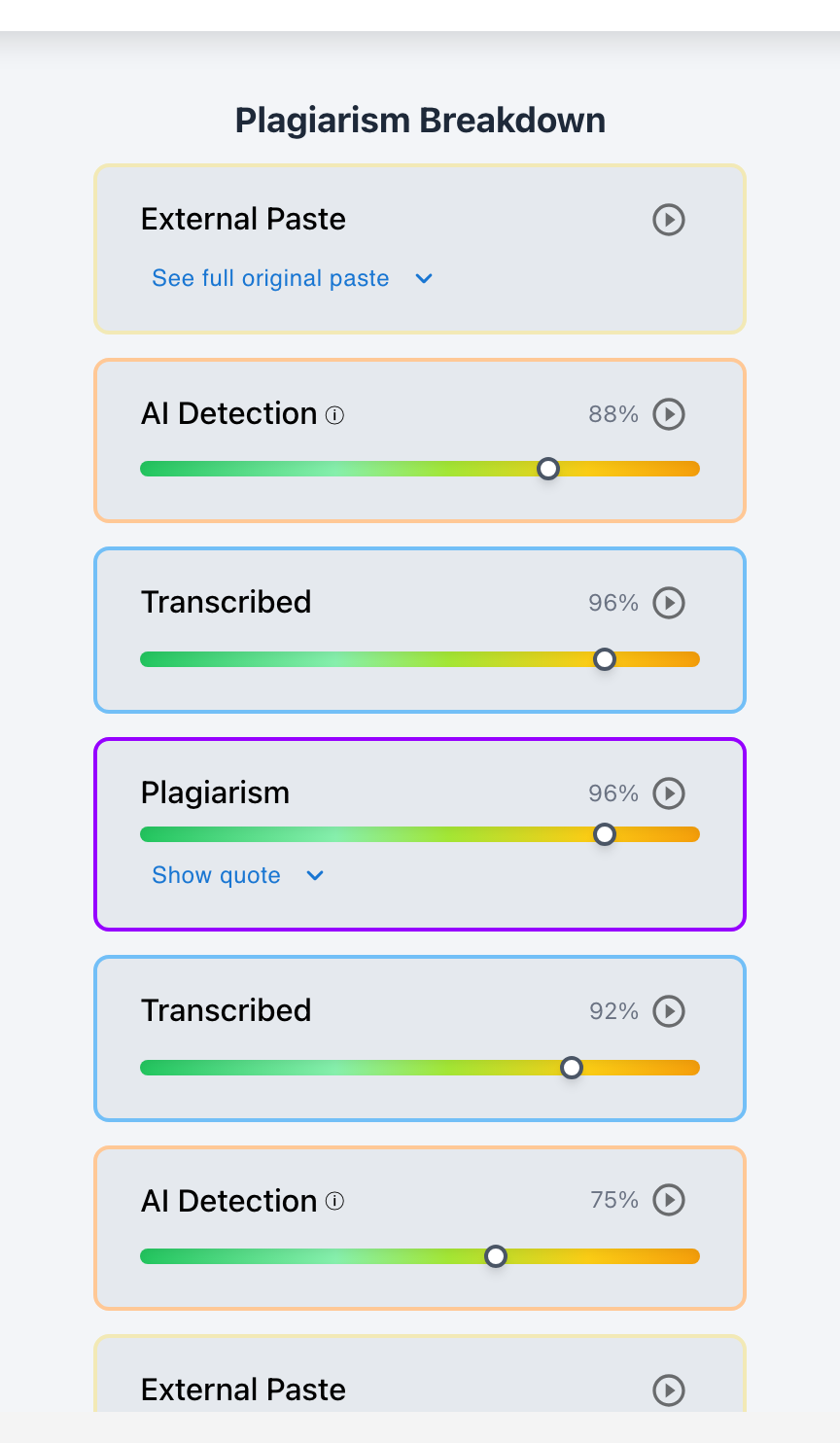
Tools such as Checkmark Plagiarism can help teachers prepare for these conversations with AI detection, essay writing playback, static AI detection, plagiarism detection, autograding, and integrations with Canvas and Google Classroom.
Before Talking to the Student, Review the Evidence
Before meeting with a student, identify exactly why the assignment raised concerns. Avoid relying only on the feeling that: "This sounds like AI."
Instead, look for specific observations you can discuss:
- The writing is dramatically different from the student's previous work.
- An AI detector identified text that may be AI-generated.
- Several polished paragraphs appeared in the document at once.
- The assignment contains citations that cannot be verified.
- The student uses terminology they have never used before.
- The paper is polished but does not directly answer the assignment.
- The writing process contains little evidence of drafting or revision.
- The submitted work is significantly beyond what the student has previously demonstrated.
None of these observations proves that the student used AI. They simply provide a reason to ask questions. That distinction is important because the goal of the conversation should be to understand how the assignment was created, not to obtain a confession to a conclusion you have already reached.
Do Not Open With an Accusation
A teacher may be tempted to begin with: "I know you used ChatGPT."
That can immediately turn the conversation into an argument. It also makes a claim that the available evidence may not actually support.
A better opening might be: "I have some questions about how you completed this assignment. Can you walk me through your writing process?"
This gives the student an opportunity to explain what happened. There may be a reasonable explanation for the unusual evidence—the student might have written in another document, worked with a tutor, used an approved grammar tool, or used AI in a way permitted by the instructor.
Start With the Writing Process
One of the most useful first questions is: "Can you walk me through how you wrote this assignment?"
Let the student describe the process before presenting every piece of evidence you have gathered.
Follow up with questions such as:
- How did you start the assignment?
- Did you make an outline?
- Where did you write your first draft?
- What sources did you use?
- Which section did you write first?
- What part was the most difficult?
- What did you revise?
- Did you write everything in this document?
- Did you use any other programs or tools?
- Did anyone help you?
These questions can reveal whether the student's explanation matches the available evidence.
Ask the Student to Explain Their Own Writing
The conversation should also include questions about the content of the assignment. A student who wrote an essay should generally be able to explain its major ideas.
Ask questions such as:
- What is your thesis?
- Why did you choose this argument?
- What does this paragraph mean?
- Why did you use this example?
- How does this quotation support your argument?
- What does this term mean?
- What conclusion were you trying to reach?
- Which source was most useful?
If a student repeatedly cannot explain substantial portions of a paper submitted under their name, that can become another piece of evidence.
Ask About the Specific Passage That Raised Your Concern
Specific questions are often more productive than broad accusations.
Suppose a paragraph contains sophisticated terminology that is dramatically different from the student's previous writing. Instead of saying: "You obviously didn't write this," ask: "Can you explain what you mean in this paragraph?" or "You use the term ‘systemic inequality’ here. What does that mean in the context of your argument?"
Use Writing History to Ask Better Questions
Writing-process evidence can make these conversations much more concrete.
Consider a student who submits a 1,200-word essay where writing history shows the first 150 words drafted gradually, followed by 800 polished words appearing all at once.
That pattern does not automatically prove AI use—the student might have written those 800 words somewhere else. But now the teacher has a specific question: "I noticed that a large portion of the essay was added all at once. Can you explain where that section came from?"
How Checkmark Plagiarism's Essay Writing Playback Helps
Checkmark Plagiarism's essay writing playback allows teachers to examine how an assignment developed over time. Read more in how Checkmark writing process analysis works.
Remember That Pasted Text Does Not Automatically Mean ChatGPT
A large block of text appearing at once can be important evidence, but it only shows that text was added—not where it originated. Students may paste quotations, citations, research notes, or earlier drafts.
If you see a large text addition, ask about it: "Where did you write this section?"
Ask About Suspicious Sources
Citations can also provide useful topics for the conversation. Generative AI tools can sometimes produce references that sound legitimate but are incorrect or nonexistent.
If you cannot locate a source, ask: "Can you show me where you found this article?"
How Should I Bring Up an AI Detection Result?
AI detection can be part of the conversation, but avoid presenting a detector score as unquestionable proof. Avoid saying: "The AI detector says you used ChatGPT, so I know you cheated."
A better explanation might be: "The assignment raised several concerns, including an AI detection result. I want to understand how you created the work." Learn how to interpret metrics in what an AI score can and cannot tell you.
Ask Directly Whether the Student Used AI
After discussing the writing process and assignment, it may be appropriate to ask directly: "Did you use ChatGPT or another AI tool while working on this assignment?"
If the student says yes, ask another question: "How did you use it?" That second question is extremely important because your course may permit some AI activities (brainstorming, grammar checks) and prohibit others (generating prose).
Do Not Treat Any AI Use as Automatic Cheating
Imagine two students who both say: "I used ChatGPT." One used it for topic ideas; the other generated the entire essay. The academic-integrity implications are completely different. The relevant question is: Did the student's AI use violate the rules established for the assignment?
What If the Student Denies Using AI?
A denial does not automatically settle the issue, nor should a teacher assume the student is lying. Return to the other evidence and ask specific questions about drafting, sources, and terminology.
What If the Student Says They Wrote the Essay Somewhere Else?
Take that explanation seriously. Students often move between applications and devices. If a student says text was written elsewhere, invite them to show the previous document, version history, drafts, or notes.
What If the Student Becomes Defensive?
Keep returning to specific evidence neutrally. Being questioned about cheating is stressful. Avoid making the conversation about the student's character—focus on how the work was produced.
Avoid Saying "This Is Too Good for You"
Avoid statements such as: "You aren't capable of writing this." Instead, describe the observable difference: "This assignment uses a different writing style and vocabulary from your previous work. Can you tell me about how you wrote it?"
What If the Student Admits Improper AI Use?
Determine what actually occurred and follow the school's established academic-integrity process. Avoid improvised negotiations over consequences.
What If the Student Has a Good Explanation?
Be willing to change your conclusion. A fair investigation must allow for both possibilities: evidence supporting unauthorized AI use, or a student having a reasonable explanation.
How to Structure the Conversation
- 1 Explain why you are meeting (neutrally).
- 2 Ask about the writing process from beginning to end.
- 3 Ask about the content of key passages.
- 4 Discuss specific evidence (paste blocks, citations, AI score).
- 5 Ask directly about AI use and how it was used.
- 6 Compare the explanation with assignment rules.
- 7 Explain next steps according to school policy.
Questions to Ask a Student Suspected of Using AI
Process & Content Questions
- Can you walk me through how you wrote this assignment?
- Where did you draft the essay?
- What is your main argument?
- What does this term or paragraph mean?
- How does this source support your conclusion?
AI & History Questions
- Did you use ChatGPT or another AI tool?
- What did you ask the AI to do?
- Did AI generate any sentences or paragraphs?
- Why was this large section added at once?
- Do you have an earlier draft or notes?
What Teachers Should Avoid
- Relying solely on software scores: "The detector says you cheated."
- Presuming guilt: "I know you're lying."
- Insulting style: "Nobody writes like this naturally."
- Pressuring confessions: "Just admit you used ChatGPT."
- Making unauthorized promises: "If you confess, there won't be consequences."
How Checkmark Plagiarism Can Help Teachers Prepare
Student conversations are easier when teachers have specific evidence to discuss. Checkmark Plagiarism provides AI detection, essay writing playback, static AI detection, plagiarism checking, autograding, and Canvas/Google Classroom integrations.
Frequently Asked Questions
How should I start a conversation with a student I think used ChatGPT?
Begin with a neutral question about the writing process. Tell the student you have questions about the assignment and ask them to explain how they completed it.
Should I tell the student their paper was flagged by an AI detector?
You can discuss an AI detection result, but avoid presenting it as definitive proof. Explain that it was one of the factors that led you to review the assignment more closely.
What questions can I ask to determine whether a student wrote an essay?
Ask the student to explain their thesis, sources, important passages, vocabulary, and writing process. Questions about how the assignment developed can be especially useful.
Should I ask directly if the student used ChatGPT?
Yes, if AI use is relevant to the investigation. If the student says yes, follow up by asking exactly how the tool was used.
What if a student admits using AI?
Determine the extent of the AI assistance and compare it with the rules for the assignment. Using AI to brainstorm and using AI to generate an entire submission should not automatically be treated as the same activity.
What if the student denies using AI?
Review the complete body of evidence rather than relying only on the denial or an AI detection result. Writing history, previous work, sources, and the student's explanation may all provide useful context.
Does a large paste prove the student used ChatGPT?
No. A large text addition shows that content was added to the document, but it does not establish the source. Ask the student where the text came from.
How does Checkmark Plagiarism help teachers investigate suspected AI use?
Checkmark Plagiarism combines AI detection, essay writing playback, static AI detection, plagiarism detection, autograding, and Canvas/Google Classroom integrations to provide educators with more context when reviewing student assignments.
Ask Better Questions Instead of Making Faster Accusations
When teachers suspect AI use, the conversation should begin with questions, not accusations.
Checkmark Plagiarism supports that process with AI detection, essay writing playback, static AI detection, plagiarism checking, autograding, and integrations with Canvas and Google Classroom.
See how Checkmark helps teachers prepare for student conversations with full evidence. View a sample report or request a demonstration.