
Executive Summary & AP Psychology Integrity Mandate
In Advanced Placement (AP) Psychology, Unit 2: Biological Bases of Behavior represents one of the most conceptually demanding and rigorously assessed units in the high school curriculum. Spanning the micro-level dynamics of electrochemical neural transmission (action potentials, refractory periods, synaptic reuptake) to macro-level cerebral localization (cortical lobes, limbic structures, contralateral split-brain processing) and the formal architecture of scientific investigation (independent vs. dependent variables, operational definitions, confounding controls, and statistical significance at p < 0.05), mastering this unit requires students to bridge abstract biological theory with applied behavioral scenarios. Under the College Board’s strict Free-Response Question (FRQ) scoring guidelines—spanning Question 1: Concept Application (7 points) and Question 2: Research Design / Scientific Investigation (7 points)—students cannot earn credit through rote memorization or dictionary definitions alone. To earn points, they must satisfy the College Board’s mandatory “Explain” standard: articulating the precise biological mechanism and explicitly linking it to the scenario character, setting, or experimental condition.
In today’s 1:1 Chromebook classroom, high school AP Psychology teachers managing 120 to 160 students across 5 to 6 class periods face a dual integrity dilemma. Generative Large Language Models (LLMs) make it trivial for students to produce polished, academic-sounding responses in seconds. However, these AI-generated submissions frequently commit catastrophic biological hallucinations: confusing afferent (sensory) and efferent (motor) pathways, inverting sympathetic versus parasympathetic autonomic responses, claiming correlational neuroimaging (fMRI/PET) proves definitive behavioral causality, or generating generic textbook summaries completely detached from the prompt scenario. Concurrently, generic black-box AI percentage detectors fail catastrophically in AP Psychology: they trigger pervasive false-positive flags on honest students who legitimately utilize formulaic AP task verbs (“Identify”, “Describe”, “Explain”) and standardized biological terminology, while failing to catch paraphrased AI drafts or copy-pasted LLM text.
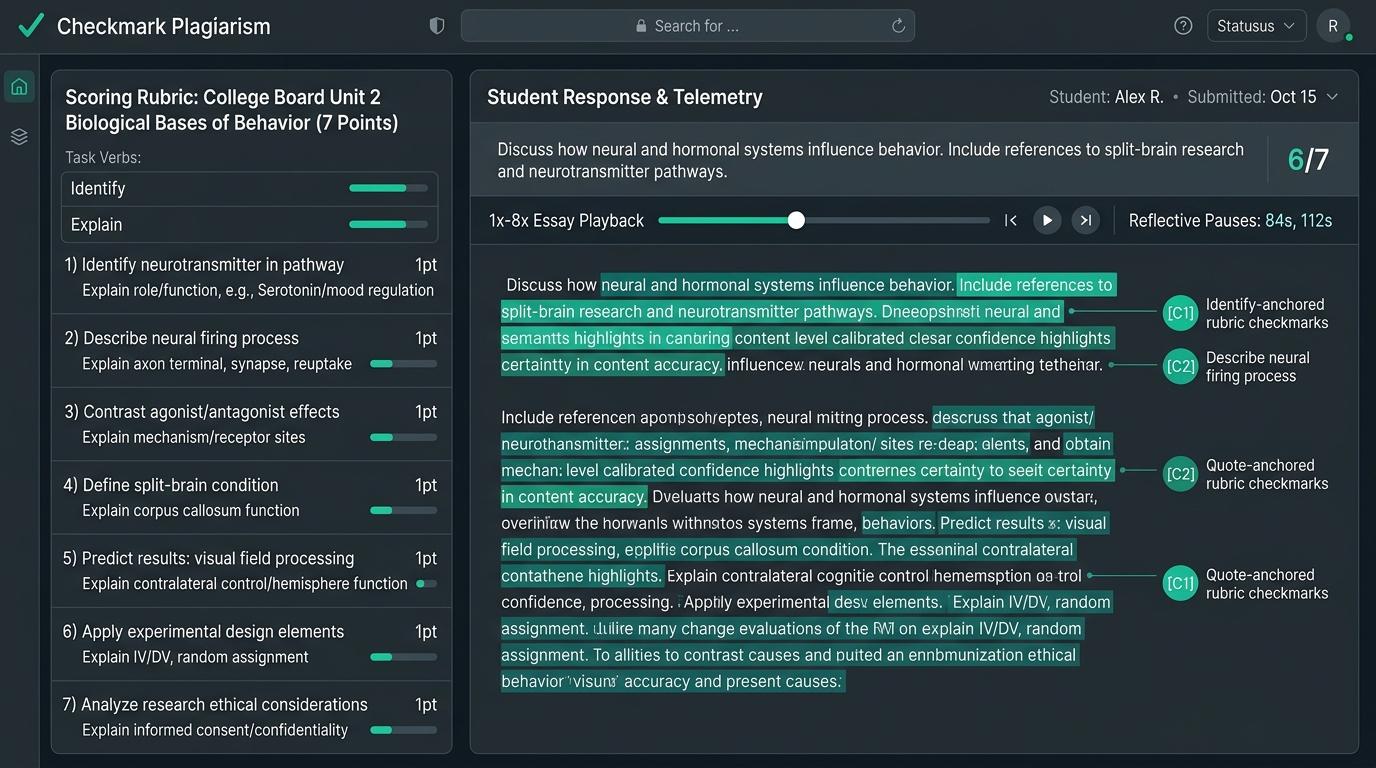
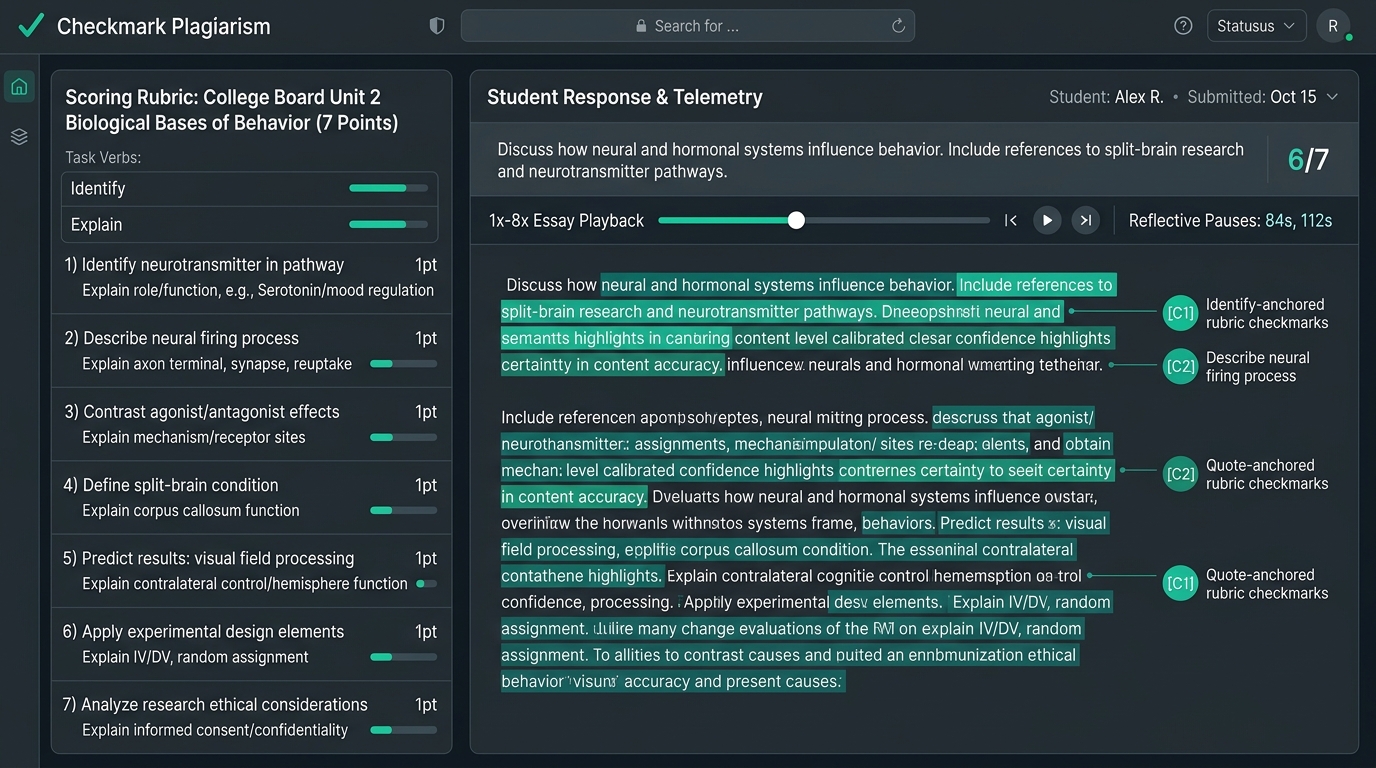
Checkmark Plagiarism resolves this crisis by shifting high school departments from unreliable probabilistic guessing to transparent, objective writing telemetry. Through patent-pending Essay Playback™ (1x–8x keystroke replay), external paste buffer preservation, passage-level calibrated confidence sliders, and quote-anchored AP rubric autograding, educators gain the verifiable receipts necessary to protect honest student drafting, diagnose genuine cognitive misconceptions, and conduct supportive, restorative integrity conferences grounded in empirical evidence.
Question 1: Concept Application (7 Pts / 25 Min)
Format: Real-world scenario involving a character, group, or institutional context.
- Explain how neural communication, brain structures, and endocrine hormones drive behavior.
- Must satisfy the mandatory 2-part “Explain” scoring bridge (Mechanism + Context).
- Isolated textbook definitions score 0 points without character scenario linkage.
Question 2: Research Design (7 Pts / 25 Min)
Format: Empirical biological study, lab experiment, or correlational neuroimaging graph.
- Identify and operationalize Independent Variables (IV) and Dependent Variables (DV).
- Distinguish Random Selection (generalizability) from Random Assignment (causation).
- Interpret statistical significance (p < 0.05) and evaluate APA ethical standards.
1. The Anatomy of AP Psychology FRQs & The Unit 2 Content Architecture
In the College Board AP Psychology curriculum, Free-Response Questions (FRQs) represent a rigorous, criterion-referenced scientific assessment. Unlike open-ended literary essays or humanities papers where stylistic flair can compensate for thin analysis, AP Psychology FRQs are evaluated by calibrated AP Readers using binary scoring guidelines (Point Awarded / Point Not Awarded).
The AP Psychology Task Verbs and the Mandatory “Explain” Bridge
Scoring on AP Psychology FRQs hinges upon specific operational task verbs defined in the AP Psychology Course and Exam Description (CED):
- IDENTIFY (1 Point): Requires students to name or select the specific concept, brain structure, variable, or ethical violation from the scenario (e.g., “Identify the independent variable in Dr. Patel’s study”).
- DESCRIBE (1 Point): Requires students to depict the essential characteristics, properties, or functions of a psychological or biological concept without necessarily linking it to a character.
- EXPLAIN (1 Point): The highest-stakes and most frequently tested task verb. Under official College Board scoring conventions, an “Explain” point requires a two-part cognitive bridge:
- The Biological/Conceptual Mechanism: The student must accurately define or articulate how the biological process functions.
- The Contextual Scenario Connection: The student must explicitly apply that mechanism to the character’s specific actions, symptoms, or experimental outcomes.
Comprehensive Unit 2: Biological Bases of Behavior Content Taxonomy
To evaluate authentic student synthesis versus superficial AI hallucinations, high school AP Psychology teachers must master the granular content standards that govern Unit 2:
Neural Communication & Action Potentials
Resting potential (-70 mV, 3 Na+ out / 2 K+ in via Na+/K+ pump), threshold of excitation (-55 mV), depolarization (Na+ influx), repolarization (K+ efflux), absolute/relative refractory period, all-or-none response, saltatory conduction via myelin sheath and Nodes of Ranvier.
Synaptic Cascades & Neurotransmitters
Presynaptic vesicle exocytosis, synaptic cleft diffusion, postsynaptic receptor binding, reuptake & degradation. Agonists (mimic/enhance) vs. Antagonists (block). Dopamine, Serotonin, GABA, Glutamate, Acetylcholine (ACh), Norepinephrine, Endorphins.
Autonomic Nervous System & Endocrine HPA Axis
Sympathetic (fight-or-flight: pupil dilation, cardiac acceleration, digestive inhibition) vs. Parasympathetic (rest-and-digest: pupil constriction, cardiac deceleration, digestive stimulation). HPA Axis: Hypothalamus → Pituitary (master gland) → Adrenals (cortisol, epinephrine).
Cortical Lobes & Subcortical Localization
Frontal (prefrontal executive, motor cortex, Broca’s speech output), Parietal (somatosensory touch), Occipital (visual retinotopy), Temporal (auditory, Wernicke’s comprehension). Limbic: Hippocampus (explicit consolidation), Amygdala (fear/aggression), Hypothalamus (4 Fs: feed, fight, flight, mating), Thalamus (sensory relay).
Split-Brain & Contralateral Processing
Sperry & Gazzaniga corpus callosotomy research. Left Visual Field (LVF) projects to Right Hemisphere → Left Hand motor control (nonverbal pointing/drawing). Right Visual Field (RVF) projects to Left Hemisphere → Broca’s area verbal speech output.
Research Design & Scientific Methodology
Independent (IV) vs. Dependent Variable (DV) operationalization. Random Selection (population generalization) vs. Random Assignment (group equivalence for causal inference). Confounding variables, double-blind controls, statistical significance (p < 0.05), and APA ethical guidelines.
Deep Dive: 1.1 Neural Transmission & The Action Potential
In AP Psychology FRQs, students frequently encounter questions asking how a sensory stimulus initiates neural communication or how a pharmacological substance inhibits neural firing. Full credit requires explaining the electrochemical sequence with physiological precision:
- Resting State (Polarization): The axonal membrane maintains a resting potential of approximately -70 mV. The interior of the axon contains a high concentration of potassium ions (K+) and large negatively charged protein anions (A-), while the extracellular fluid is rich in sodium ions (Na+) and chloride ions (Cl-). The sodium-potassium active transport pump continuously pumps 3 Na+ ions OUT for every 2 K+ ions IN, maintaining the negative intracellular resting potential.
- Threshold of Excitation & Depolarization: When incoming excitatory signals (EPSPs) exceed inhibitory signals (IPSPs) and cross the threshold of excitation (approximately -55 mV), voltage-gated sodium channels open rapidly. Positively charged Na+ ions rush into the axon driven by both electrostatic pressure and concentration gradients, causing depolarization and surging the electrical potential to +30 mV to +40 mV.
- Repolarization & Hyperpolarization: Sodium channels inactivate, and voltage-gated potassium channels open, allowing K+ ions to rush out of the axon down their electrochemical gradient, rapidly restoring a negative internal potential. The outflow of potassium briefly hyperpolarizes the membrane below -70 mV (the refractory period).
- The All-or-None Response & Saltatory Conduction: Action potentials are non-graded; a neuron fires completely or does not fire at all. Stimulus intensity is signaled by the frequency of action potentials, not their amplitude. In myelinated neurons, the fatty myelin sheath produced by glial cells (Schwann cells in the PNS, oligodendrocytes in the CNS) insulates the axon, forcing the electrical impulse to jump between the unmyelinated Nodes of Ranvier in a process called saltatory conduction, increasing conduction velocity up to 100-fold.
  Voltage (mV)
      +40 ┤                   /          │                  /    <-- Depolarization (Na+ Influx) / Repolarization (K+ Efflux)
        0 ┤                 /              │                /            -55 ┤ - - - - - - - / - - - - - - - - - - Threshold of Excitation (-55 mV)
      -70 ┤──────────────/          _______      <-- Resting Potential (-70 mV)
          │                                  ___ <-- Hyperpolarization / Refractory Period
          └──────────────────────────────────────────── Time (milliseconds)

  • Resting State: Na+/K+ Pump (3 Na+ Out / 2 K+ In) maintains resting -70 mV interior negative.
  • Depolarization: Voltage-gated Na+ channels open → Na+ floods into axon → surges to +40 mV.
  • Repolarization: Na+ channels close, voltage-gated K+ channels open → K+ rushes out of axon.
  • Refractory Period: Temporary hyperpolarization ensures unidirectional forward propagation.
Deep Dive: 1.2 Synaptic Dynamics, Neurotransmitter Cascades & Agonist/Antagonist Actions
Once the electrical action potential reaches the terminal buttons of the presynaptic neuron, it triggers the influx of calcium ions (Ca2+), causing synaptic vesicles to fuse with the presynaptic membrane and release chemical neurotransmitters into the synaptic cleft via exocytosis.
Neurotransmitters diffuse across the microscopic synaptic gap (approx. 20 nanometers) and bind reversibly to specialized postsynaptic receptor sites in a precise “lock-and-key” configuration. Unbound neurotransmitters are either enzymatically broken down (e.g., acetylcholinesterase degrading ACh) or drawn back into the presynaptic neuron via reuptake transporter proteins.
Summary of Core AP Psychology Neurotransmitter Pathways
| Neurotransmitter | Primary CNS Function | Clinical / Behavioral Deficits & Excesses | Pharmacological Modulators |
|---|---|---|---|
| Dopamine | Motor control, voluntary movement, reward prediction, reinforcement. | Deficit: Parkinson’s disease. Excess: Schizophrenia spectrum. |
L-Dopa (agonist), Chlorpromazine (antagonist), Cocaine (reuptake inhibitor). |
| Serotonin (5-HT) | Mood regulation, hunger, circadian sleep-wake cycles, arousal. | Deficit: Clinical Depression, OCD, generalized anxiety disorders. | SSRIs (Fluoxetine / Prozac blocks reuptake, keeping 5-HT in cleft). |
| GABA | Primary INHIBITORY neurotransmitter; hyperpolarizes postsynaptic membrane. | Deficit: Seizures, tremors, chronic anxiety, insomnia. | Benzodiazepines (Xanax), Alcohol (GABA receptor agonists). |
| Glutamate | Primary EXCITATORY neurotransmitter; initiates Long-Term Potentiation (LTP). | Excess: Excitotoxicity, migraines, seizures. Deficit: Cognitive slowing. |
MSG (monosodium glutamate agonist), NMDA receptor modulators. |
| Acetylcholine (ACh) | Neuromuscular motor contraction; hippocampal learning & memory. | Deficit: Alzheimer’s disease (loss of ACh cholinergic neurons). | Curare / Botulinum (antagonists → paralysis); Nicotine (agonist). |
| Norepinephrine | Alertness, arousal, sympathetic fight-or-flight cardiovascular boost. | Deficit: Depressive states, lethargy. Excess: Acute panic attacks. |
SNRIs (dual reuptake inhibitors), Amphetamines. |
| Endorphins | Endogenous opiate neuropeptides; pain suppression, euphoria. | Deficit: Hypersensitivity to physical and emotional pain. | Morphine, Oxycodone, Heroin (potent exogenous opiate agonists). |
Agonists bind to receptor sites and mimic or amplify neurotransmitter action (or block reuptake transporters). Antagonists bind to receptors and block neurotransmitters from docking without triggering a cellular response, inhibiting neural signaling.
Deep Dive: 1.3 Split-Brain Research & Contralateral Hemispheric Specialization
The classical split-brain research conducted by Roger Sperry and Michael Gazzaniga represents one of the most frequently tested topics in Unit 2 FRQs. Split-brain patients have undergone a surgical corpus callosotomy (severing of the corpus callosum) to treat intractable epilepsy.
- Light hits nasal retina of left eye & temporal retina of right eye.
- Optic tracts cross at chiasm → projects to Right Hemisphere (Occipital Lobe).
- Right hemisphere is spatial and non-verbal.
- Verbal Response: Patient reports: “I saw nothing.”
- Motor Response: Patient’s LEFT hand (controlled by right motor cortex) reaches behind curtain and successfully picks up the key.
- Light hits temporal retina of left eye & nasal retina of right eye.
- Optic tracts project directly to Left Hemisphere (Occipital Lobe).
- Left hemisphere houses Broca’s Area (speech production).
- Verbal Response: Patient immediately says: “I saw a RING.”
- Motor Response: Patient’s RIGHT hand writes or picks the ring with total verbal-motor congruence.
Deep Dive: 1.4 Research Design & Scientific Methodology in Biological Psychology
In Question 2: Research Design / Scientific Investigation, AP Psychology students are evaluated on their ability to analyze empirical investigations. Authentic student responses must demonstrate command over methodological principles:
Scientific Investigation Methodology in AP Biological Psychology
| Methodological Element | Operational Definition & AP Rubric Standard | AP Exam Common Error |
|---|---|---|
| Independent Variable (IV) | The factor systematically manipulated by the experimenter (e.g., dosage of a novel dopamine reuptake inhibitor: 0mg vs. 50mg). | Naming the subjects or apparatus rather than the manipulated variable. |
| Dependent Variable (DV) | The measured behavioral outcome reflecting the effect of the IV (e.g., score on a 20-item spatial memory recall test). | Failing to state the exact quantitative metric. |
| Operational Definition | A precise, measurable, and replicable specification of variables (e.g., “Latency in seconds to locate the submerged platform in the Morris water maze”). | Vague statements like “memory was tested” (0 points). |
| Random Selection vs. Random Assignment | Random Selection: Every population member has equal chance of selection → enables generalizability. Random Assignment: Every participant has equal chance of group placement → establishes causation. |
Confusing the two terms or claiming random selection creates group equivalence. |
| Double-Blind Control | Neither participants nor experimenters know group allocations, eliminating participant placebo effects and experimenter confirmation bias. | Omitting the experimenter side of the blind. |
| Statistical Significance (p < 0.05) | Indicates less than a 5% probability that the observed group difference occurred by random chance alone, allowing rejection of null hypothesis. | Claiming the hypothesis is “100% proven true without any error”. |
| APA Ethical Guidelines | Informed consent, voluntary participation, right to withdraw, protection from harm, confidentiality, and mandatory debriefing. | Assuming deception is strictly illegal rather than permitted with debriefing. |
2. The LLM Hallucination Dilemma in AP Psychology FRQs
When high school students are assigned take-home FRQ practices, weekend review packets, or Chromebook-based classroom essays, the temptation to consult generative Large Language Models (LLMs) is exceptionally strong. Students facing heavy course loads prompt AI engines to write answers for them.
While modern LLMs generate grammatically immaculate prose with sophisticated vocabulary, they systematically commit subtle, catastrophic biological hallucinations and structural scoring errors that cost students full credit on AP exams.
Afferent vs. Efferent Neuronal Inversion
LLM Hallucination: Confuses sensory afferent neurons (arriving at CNS) with motor efferent neurons (exiting CNS to muscles), claiming “efferent neurons in Sarah’s ears sent sound signals to her brain.”
Biological Truth: Sensory neurons are Afferent (SAME: Sensory Afferent, Motor Efferent). Auditory input arrives via afferent sensory fibers.
Autonomic Inversion (Sympathetic vs. Parasympathetic)
LLM Hallucination: Slices contradictory stress responses together, asserting that sympathetic activation “constricted Sarah’s pupils and stimulated her digestive tract to produce butterflies.”
Biological Truth: Sympathetic activation DILATES pupils and INHIBITS digestive motility, diverting blood to skeletal musculature.
The Correlation-to-Causation Neuroimaging Trap
LLM Hallucination: In Question 2 research design prompts, LLMs frequently claim that fMRI or PET activation in the amygdala “proves that the amygdala caused the panic response.”
Biological Truth: Neuroimaging is correlational (measuring BOLD blood-oxygen levels). Causal claims require experimental lesioning, optogenetics, or TMS manipulations.
Split-Brain Contralateral Eye-vs-Field Misconception
LLM Hallucination: Asserts that “because the left eye was closed, all visual signals went to the right hemisphere.”
Biological Truth: Retinas are split hemiretinally. The LEFT VISUAL FIELD of BOTH eyes maps to the right hemisphere; the RIGHT VISUAL FIELD maps to the left.
Prompt-Agnostic Textbook Boilerplate
LLM Hallucination: Generates encyclopedic textbook definitions of psychological terms without ever connecting them to the character’s specific actions in the scenario.
AP Scoring Consequence: AP Readers award 0 / 1 points for isolated definitions lacking contextual application.
3. The Pedagogical & AP Grading Dilemma: Why Generic AI Detectors Fail
High school AP Psychology teachers face an acute evaluation dilemma when assessing take-home or digital FRQ drafts. Commercial, black-box AI detectors that output a single, opaque percentage score (e.g., “88% AI-Generated”) fail catastrophically in the AP Psychology environment for two fundamental structural reasons:
3.1 The False-Positive Crisis on Formulaic AP Writing Stems
To maximize student success on the national AP Exam in May, experienced AP Psychology educators explicitly instruct students to follow structured writing protocols:
- The Claim-Mechanism-Application Format: “First, the biological concept is [Term]. This functions by [Biological Mechanism]. In the scenario, this caused [Character] to [Behavioral Outcome].”
- Standardized Operational Definitions: Formulaic definitions of variables (“The independent variable was operationalized as the presence or absence of 200mg of caffeine...”).
- Technical Neuroanatomical Nomenclature: High-frequency, deterministic vocabulary terms (“depolarization”, “neurotransmitter”, “synaptic vesicle”, “postsynaptic receptor”, “corpus callosum”, “parasympathetic nervous system”).
Because commercial AI detectors rely on statistical perplexity (word choice unpredictability) and burstiness (variation in sentence length and structure), authentic student responses that adhere strictly to College Board rubric templates are flagged with massive false-positive AI scores. An honest high school student who painstakingly memorized AP sentence frames produces text that looks mathematically “predictable” to an LLM detector.
“An operational definition for the dependent variable in Dr. Miller’s experiment is the total number of errors made by the rat while navigating the Morris water maze within a 60-second trial.”
3.2 The False-Negative Evasion: AI Humanizers & Paraphrasers
Conversely, when students utilize generative AI to write their FRQs and run the text through paraphrasers (e.g., QuillBot, Undetectable AI) or prompt the LLM to “write in the voice of an informal high school student with occasional sentence variety,” the surface perplexity is artificially elevated. Generic AI detectors register these modified submissions as “100% Human.” Yet, beneath the manipulated surface text, the underlying biological misconceptions and logical hallucinations remain completely intact.
3.3 The Breakdown of Trust in Parent-Teacher and Honor Board Conferences
When a teacher confronts a student or parent using only a black-box AI percentage score, the conference inevitably devolves into an unresolvable argument:
- The student claims: “I wrote every word myself using my AP review book and class notes!”
- The parent demands: “What specific evidence proves my child didn’t write this? Why are you trusting an unproven computer algorithm?”
- The teacher has no objective receipts to demonstrate when the text entered the document, how long the student spent composing, or whether external text was pasted into the document.
To resolve this impasse, high school academic integrity committees and AP departments require transparent writing telemetry and keystroke process playback that documents the actual act of student composition.
4. The High School AP Psychology Evidentiary Matrix
To evaluate student writing authenticity with scientific rigor, high school educators must compare the evidentiary capabilities of traditional and modern assessment methods:
High School AP Psychology Evidentiary Assessment Matrix
| Evidentiary Criteria | In-Class Paper Timed Writes | Generic AI Detector Score | Google Docs Version History | Checkmark Writing Telemetry & Playback™ |
|---|---|---|---|---|
| 1. AI Paraphrase & Humanizer Detection | High (No digital access permitted) | Poor (Easily fooled by rewriters) | Very Poor (Captures coarse periodic edits) | Complete (Detects rapid external text pasting) |
| 2. Granular Passage-Level Attribution | N/A (Manual scoring by hand) | None (Opaque document percentage) | None (Coarse block-level diffs only) | Full (Passage-level confidence sliders) |
| 3. Cognitive Drafting & Reflection Telemetry | High (Observed in room live) | None (Zero process tracking) | Very Poor (Multi-minute intervals only) | Complete (1x–8x keystroke replay) |
| 4. External Paste Buffer Preservation | N/A (Handwritten on paper) | None (No paste tracking) | Poor (Shows pasted text, loses overwritten) | Complete (Stores full original clipboard text) |
| 5. AP Psychology Rubric Autograding | High (Manual AP Reader rubric) | None (No rubric grading features) | None (Pure text editor) | Automated & Aligned (Quote-anchored feedback) |
| 6. Defensibility in Parent & Honor Conferences | Absolute (Physical ink) | Very Poor (Indefensible probability) | Moderate (Can show edit gaps, unproven) | Unassailable (Complete timeline video receipts) |
| 7. Student Data Privacy (FERPA / COPPA) | Absolute (Paper stays in class) | Poor (Many train models on essays) | High (District Google compliance) | 100% FERPA/COPPA (Zero model training) |
5. Step-by-Step Psychology Teacher Audit Protocol for Biological FRQs
When evaluating high school AP Psychology Free-Response submissions, educators and department chairs should follow a structured, four-phase audit protocol designed to verify authentic conceptual synthesis and experimental design:
Phase 1: Scenario Concordance Audit
Inspect student text for the mandatory dual bridge: Biological Mechanism + Character Scenario Action. Verify that the response does not merely define the term in isolation (0 AP Points).
Phase 2: Causality & Variable Check
Verify that IV and DV are quantified with replicable operational criteria. Ensure non-experimental neuroimaging studies are not assigned false causal claims.
Phase 3: Essay Playback™ Telemetry Audit
Scrub writing session at 1x–8x speed. Look for natural cognitive composing pauses (45–120s reflection intervals). Inspect External Paste Inspector for instant clipboard dumps.
Phase 4: Restorative Integrity Conference
Use keystroke receipts to exonerate honest students flagged by generic detectors. For confirmed AI usage, conduct a non-punitive, restorative debrief focused on cognitive retesting.
Phase 1: The Scenario-to-Mechanism Concordance Audit
The teacher inspects the text against the College Board’s two-part scoring requirement. Consider this evaluation framework:
- Prompt Scenario: “Marcus is nervous before performing his violin solo at the state competition. Explain how his sympathetic nervous system and cerebellum influence his performance.”
- Scoring Rubric Check:
- Point 1 (Sympathetic Nervous System):
- × Unacceptable (0 Points): “The sympathetic nervous system is responsible for fight-or-flight responses.” (Definition only, no scenario link).
- × Unacceptable (0 Points): “Marcus is nervous because of his sympathetic nervous system.” (Scenario mention only, no biological mechanism).
- ✓ Acceptable (1 Point): “Marcus’s sympathetic nervous system activates in response to stress, accelerating his heart rate and dilating his bronchi, which increases oxygen delivery to his muscles while he prepares to perform his solo.” (Accurate physiological mechanism + explicit scenario link).
- Point 2 (Cerebellum):
- × Unacceptable (0 Points): “The cerebellum helps with memory.” (Vague; fails to distinguish explicit vs. procedural memory).
- ✓ Acceptable (1 Point): “The cerebellum coordinates fine motor control and implicit procedural memories, allowing Marcus to execute the precise finger movements and bow strokes required for his violin solo without conscious thought.”
- Point 1 (Sympathetic Nervous System):
Phase 3: Writing Telemetry & Keystroke Audit with Essay Playback™
Using Checkmark’s Essay Playback™, the teacher scrubs through the student’s complete writing session:
• 00:00 - Document created in Google Classroom on Chromebook.
• 00:12 - Student types prompt header: "FRQ 1 - Marcus Performance Anxiety"
• 01:15 - [COGNITIVE REFLECTION PAUSE: 84s] Student pauses (Reviewing prompt scenario & class notes).
• 02:39 - Student types Part A: "The sympathetic nervous system activates..."
• 04:12 - [REVISION BURST] Student types "increases digestion", pauses 6s, backspaces 19 chars,
          and replaces with "inhibits digestion and dilates airways to provide more oxygen."
• 08:45 - [COGNITIVE REFLECTION PAUSE: 112s] Student pauses (Visualizing cerebellum motor circuits).
• 10:37 - Student writes cerebellum paragraph with active editing and phrasing tweaks.
• 22:15 - Final proofreading pass with minor typographical corrections.

INTEGRITY VERDICT: 100% AUTHENTIC DRAFTING
• Cadence: 28 WPM average with healthy revision bursts and self-corrections.
• Zero external clipboard injections detected by Paste Inspector.
What Authentic vs. Synthetic Drafting Looks Like:
- The “Biological Reflection Pause”: Authentic high school students routinely pause for 45 to 120 seconds before drafting complex biological explanations. During this pause, the student is re-reading the prompt, consulting their textbook diagram of the limbic system, or sketching the optic chiasm on scratch paper.
- Self-Correction & Revision Bursts: Authentic students frequently make and correct conceptual errors in real time—for example, typing “parasympathetic”, pausing for 4 seconds, deleting it, and typing “sympathetic”, or replacing “hippocampus makes memories” with “hippocampus consolidates explicit memories into long-term storage.”
- The Instant Clipboard Dump: The entire 450-word response appears in 1.2 seconds (>20,000 WPM). The External Paste Buffer Inspector flags an external clipboard paste and stores the exact original pasted string.
- Mechanical Transcription: The student types at an unwavering 65–75 WPM without pauses, without typographical backspacing, and without revising sentence structures, scanning an unmonitored smartphone or secondary screen generating LLM text.
6. Real High School Classroom Case Studies
Case Study 1: 11th Grade AP Psychology Unit 2 FRQ — The Split-Brain Chimeric Test
- School Profile: Oakridge High School (1:1 Chromebook campus, 142 AP Psychology students across 5 periods).
- The Assignment: A timed 25-minute take-home FRQ practicing Unit 2 lateralization concepts.
“David is a split-brain patient whose corpus callosum was surgically severed to treat severe epilepsy. In a laboratory setting, David fixates his gaze on a central dot on a screen. Simultaneously, the word ‘KEY’ is flashed for 100 milliseconds in his LEFT visual field, and the word ‘RING’ is flashed for 100 milliseconds in his RIGHT visual field.
Part A: Explain what word David will verbally report seeing, and justify your answer using specific hemispheric lateralization principles.
Part B: Explain what action David can perform with his LEFT hand to indicate what word was flashed in his LEFT visual field, and justify your answer using motor cortex and visual pathway concepts.”
Student A: Honest Student Exonerated
The Incident: Student A received an 89% AI flag from a generic commercial detector due to standardized neuroanatomy vocabulary.
Telemetry Audit: Checkmark Essay Playback™ revealed 21 minutes and 40 seconds of active drafting, a 105-second reflection pause at minute 03:20, and a real-time self-correction at minute 07:15 deleting “David will say KEY” and correcting to “David will verbally state that he saw the word ‘RING’”.
Outcome: 100% authentic composition verified. The student was awarded full credit (2/2 points).
Student B: Unauthorized Paste Caught
The Incident: Student B submitted text asserting that “when the left eye is open, the light travels to the right brain... he uses his left hand because the left eye controls the left hand.”
Telemetry Audit: External Paste Inspector captured a 180-word block pasted in 0.6 seconds containing ChatGPT’s classic eye-versus-field hallucination.
Restorative Debrief: The teacher shared the paste receipt, diagrammed hemiretinal pathways on the whiteboard, and had the student handwrite a replacement FRQ.
Case Study 2: 12th Grade AP Psychology Research Design FRQ — The LTP & Caffeine Investigation
- School Profile: Westlake High School (Canvas LMS environment, 118 AP Psychology seniors).
- The Assignment: Question 2 Research Design practice analyzing Long-Term Potentiation (LTP) and memory consolidation.
“Dr. Chen conducts an experimental study to evaluate whether a daily dietary supplement of caffeine enhances spatial memory consolidation in adult mice. 60 mice are randomly assigned to either Group A (standard diet + 25mg caffeine) or Group B (standard diet + placebo). After 14 days, all mice are tested in the Morris water maze. Dr. Chen records the latency (time in seconds) for each mouse to find the hidden escape platform. The mean latency for Group A was 18.4 seconds (SD = 3.2), while Group B was 29.7 seconds (SD = 4.1). A two-sample t-test yielded p = 0.008.
1. Identify the independent variable and the dependent variable.
2. Explain the role of Long-Term Potentiation (LTP) and glutamate receptors in hippocampal memory.
3. Explain what the p-value (p = 0.008) indicates regarding the experimental hypothesis.”
Student C: Transcribed AI Draft Flagged for Unnatural Velocity & Causal Hallucination
The Incident: Student C submitted a dense response typed mechanically from a secondary phone screen: “1. The IV is the mice and the DV is the water maze. 2. Long-term potentiation cures memory loss by making new neurons grow in the frontal lobe. 3. The p-value of 0.008 is very small, which proves that caffeine is 100% effective without any error.”
Telemetry Audit: Essay Playback™ revealed the student typed 220 words in 3 minutes flat at 73 WPM with zero pauses and zero revisions, committing 3 classic AI errors (misidentifying IV/DV as subjects/apparatus, hallucinating frontal neurogenesis instead of hippocampal NMDA synaptic strengthening, and claiming deterministic 100% proof).
Outcome: The teacher guided Student C through the AP Research Design rubric, redrafting the submission to earn full credit on operational definitions and statistical interpretation (p < 0.05).
7. How Checkmark Plagiarism Empowers AP Psychology Educators
Checkmark Plagiarism is engineered specifically for the pedagogical, ethical, and administrative realities of the high school classroom. By combining writing process telemetry with AP-aligned rubric intelligence, Checkmark provides high school educators with an unassailable evidentiary toolkit:
Passage-Level Sliders
Replaces opaque document percentages with granular sentence-level highlights. Displays writing style signals without broad defamatory labels. Below 150 words displays N/A.
Patent-Pending Essay Playback™
Reconstructs the full writing session stroke-by-stroke (1x–8x). Allows teachers to visually inspect drafting cadence, reflection pauses, and real-time revisions.
External Paste Inspector
Captures timestamped external clipboard insertions and permanently stores the original pasted text even if a student subsequently rewrites or paraphrases every word.
Transcription Detection
Flags unnatural, steady mechanical typing without cognitive pauses (such as transcribing off a secondary smartphone or second monitor).
Quote-Anchored Autograding
Automatically evaluates student FRQs against official 7-point College Board rubrics with quote-anchored justifications, leaving final scoring authority with the teacher.
FERPA / COPPA Zero-Training
Student work is never retained to train commercial AI models. Fully encrypted in transit and at rest with strict district compliance.
Quote-Anchored Rubric Autograding with Teacher-in-the-Loop Authority
Grading stacks of 120 to 160 AP Psychology FRQs every week can consume 10 to 15 hours of a teacher’s weekend. Checkmark’s AI Autograder analyzes student drafts against official College Board 7-point rubrics:
- Automatic Criterion Breakdown: Checkmark evaluates each AP task verb (“Explain how GABA reduces anxiety”, “Identify the operational definition of the DV”).
- Quote-Anchored Justification Cards: For each rubric point, Checkmark generates a written rationale citing the exact sentences in the student’s submission that earned or failed the point.
- Teacher-in-the-Loop Verification: The teacher reviews the draft scores, adjusts points with a single click if desired, and publishes grades directly back to the Canvas LMS SpeedGrader, Buzz LMS, or Google Classroom gradebook.
8. Frequently Asked Questions (FAQ)
1. Why do generic AI detectors flag honest AP Psychology students who write formulaic FRQs?
Generic commercial AI detectors rely on statistical perplexity and burstiness. When students adhere strictly to College Board test-taking strategies—such as using standard task-verb templates (“First, the biological term is...”, “An operational definition is...”) and high-frequency neuroanatomical terms (“action potential”, “depolarization”, “neurotransmitter”), the text appears mathematically predictable to an LLM. Checkmark resolves this by pairing linguistic analysis with patent-pending Essay Playback™, allowing teachers to verify authentic drafting sessions, cognitive reflection pauses, and self-corrections regardless of surface perplexity.
2. How does Checkmark detect when a student retypes an AI-generated answer from a phone or second monitor?
Checkmark’s Transcription Detection Engine analyzes keystroke dynamics, typing cadence, and burst patterns. When a student composes authentically, their writing exhibits natural variability: typing bursts followed by 30-to-90-second pauses to synthesize ideas, check diagrams, and revise prose. When a student mechanically transcribes text from a secondary device, they type at a sustained, robotic cadence (e.g., 65–75 WPM) with virtually no pauses for cognitive synthesis and zero sentence-level restructuring.
3. What happens if a student pastes text from an LLM and then manually rewrites every word?
Traditional version histories and generic plagiarism tools lose the original clipboard content once the text is modified. Checkmark’s External Paste Buffer Inspector captures and permanently stores the complete original clipboard string at the exact millisecond of insertion. Even if the student subsequently edits, paraphrases, or rearranges every sentence, teachers can click the “Jump to Paste Event” button in Essay Playback™ to view the exact original source text.
4. How does Essay Playback™ help teachers in parent-teacher and academic integrity conferences?
Instead of presenting an opaque, contentious percentage score (e.g., “This tool says your child’s essay is 84% AI”), educators can open Checkmark Essay Playback™ and scrub through the student’s complete writing timeline at 1x to 8x speed alongside the parent and student. Parents and counselors can clearly see whether the student spent 25 minutes actively drafting and revising, or whether a multi-paragraph response appeared instantaneously via an external paste.
5. Can Checkmark autograde official College Board 7-point AP Psychology FRQs?
Yes. Checkmark’s AI Autograder supports custom rubric creation, PDF/image rubric uploads, and direct synchronization with Canvas, Buzz, and Google Classroom. It evaluates student prose criterion-by-criterion against the prompt’s specific psychological terms, generates quote-anchored feedback justifications, and leaves final scoring authority with the teacher before pushing grades to the LMS gradebook.
6. Does Checkmark store or train AI models on student AP Psychology essays?
No. Checkmark adheres to strict zero-retention and zero-model-training data privacy policies. Student submissions are never used to train general AI models, fine-tune neural networks, or build commercial datasets. Checkmark is fully compliant with FERPA, COPPA, and state student privacy regulations, featuring end-to-end encryption in transit and at rest.
7. How should AP Psychology teachers introduce Checkmark to students at the start of the year?
Teachers should introduce Checkmark as a supportive, protective learning tool rather than a punitive surveillance system under the philosophy of “Stop guessing, start trusting.” Explain to students that writing telemetry serves as their objective receipt of authentic authorship, protecting them from false-positive AI flags while providing actionable, quote-anchored feedback on their AP FRQ mastery.
9. Conclusion: Empowering High School AP Psychology Educators
Teaching Advanced Placement Psychology requires fostering both scientific curiosity and rigorous empirical discipline. Unit 2: Biological Bases of Behavior challenges high school students to conceptualize invisible electrochemical cascades, complex cortical specializations, and strict experimental methodologies.
In an era of ubiquitous generative AI, high school educators cannot rely on flawed, black-box percentage detectors that penalize honest students while missing AI hallucinations. By adopting Checkmark Plagiarism’s multidimensional writing telemetry, patent-pending Essay Playback™, external paste buffer tracking, and quote-anchored rubric autograding, AP Psychology teachers and department chairs can cultivate a classroom culture rooted in genuine inquiry, protected scholarship, and transparent academic integrity.
Protect Authentic AP Psychology Scholarship in Your District
Empower your science and social studies departments with patent-pending Essay Playback™, passage-level AI confidence sliders, and LMS-integrated rubric autograding.