
If you run the same student essay through several AI detectors, you may get very different answers: one might say the paper is likely AI-generated, another might identify only a few suspicious passages, and a third might classify the same essay as mostly human-written. Why does this happen? The short answer is that AI detectors do not all measure text in exactly the same way.
Different systems use different models, training data, thresholds, scoring methods, and approaches for analyzing writing. They also respond differently to short passages, edited AI text, mixed human-and-AI writing, or highly structured student prose. That means two AI detectors can analyze the same assignment and reach different conclusions without either result necessarily being definitive.
For teachers, the important lesson is simple: an AI detection score should be treated as one piece of evidence, not as unquestionable proof of authorship.
Checkmark Plagiarism supports this broader approach with AI detection, essay writing playback, static AI detection, plagiarism detection, autograding, and integrations with Canvas and Google Classroom.
Why Can the Same Essay Get Different AI Scores?
AI detection is not the same as matching a fingerprint. There is usually no universal watermark inside a paragraph that says: "This sentence was written by ChatGPT."
Instead, detectors analyze characteristics of the text and estimate how closely those characteristics resemble writing produced by generative AI. One detector may be more sensitive to certain writing patterns, another may require stronger statistical evidence before flagging text, and another may analyze individual sentences differently from the document as a whole.
Different AI Detectors Use Different Detection Models
Different platforms rely on distinct architectures and methodologies:
- Machine-learning models and architectures
- Training datasets and language baselines
- Statistical scoring methods (perplexity vs. burstiness)
- Classification techniques
- Thresholds for labeling text
- Document segmentation (sentence vs. paragraph vs. document level)
- Approaches to edited or mixed writing
One system might be optimized to identify long passages of raw generated prose, another might analyze writing sentence by sentence, and another might emphasize vocabulary transitions.
Different Detectors May Use Different Thresholds
Even if two systems identify similar patterns, they may not classify those patterns the same way. Detector A may have a sensitive threshold and flag a passage, while Detector B requires stronger evidence before labeling it as AI-generated.
This is one reason percentages from different AI detectors should not be compared directly—a score from one platform does not mean the same thing as the same numerical score from another.
A 70% Score Does Not Necessarily Mean the Same Thing Everywhere
Teachers may assume that a result such as 70% AI has a universal meaning, but different platforms calculate percentages differently:
- A model's confidence probability (70% probability the text is AI)
- The proportion of text identified as suspicious (70% of words flagged)
- The likelihood of a classification
- A proprietary score mapped onto a 0–100 scale
Detector A: 70% AI
Calculates sentence-level statistical predictability with a sensitive classification threshold.
Detector B: 25% AI
Evaluates whole-document burstiness and requires higher evidence density before flagging.
For a deeper explanation, read our guide on what an AI score can and cannot tell you.
Some Detectors Analyze the Entire Document While Others Focus on Sections
Consider a paper containing a human-written introduction, two AI-assisted body paragraphs, and a student-written conclusion. A detector evaluating the entire document may classify the paper as mostly human-written, while a detector analyzing individual passages flags the two body paragraphs strongly. A single document-level score hides important nuance within the assignment.
Short Text Can Produce More Uncertain Results
A five-sentence response contains much less statistical information than a 1,500-word essay. With fewer text samples to analyze, detectors react differently to short-answer responses, discussion posts, single paragraphs, and brief reflections. Teachers should be especially cautious about drawing strong conclusions from short text samples.
Edited AI Writing Can Produce Different Results
A student might generate text with ChatGPT and rewrite several sentences, swap vocabulary, or add original examples. Different AI detectors respond differently to those changes—one might still identify underlying statistical patterns, while another classifies the passage as human-written. Read our analysis on can AI detectors detect edited ChatGPT text?
Mixed Human and AI Writing Is Especially Difficult
A student might write 60% of an essay and use AI for 40%, or write everything themselves and use AI for sentence rewording. These hybrid scenarios produce conflicting scores across tools because each algorithm handles mixed authorship differently.
Human Writing Can Also Trigger Different Detectors
Completely human-written assignments can also produce inconsistent outcomes. Highly formal writing, predictable sentence structures, consistent paragraph organization, and concise explanations can trigger false positives on sensitive tools while passing others. Learn more in can AI detectors give false positives?
Why One Detector May Flag a Passage Another Ignores
Consider this sentence: "Climate change presents significant social, economic, and environmental challenges that require coordinated global action."
It is polished, formal, predictable, and grammatically correct. An AI system could produce it, but an advanced student could easily write it as well. One detector views the predictable structure as suspicious; another decides there is insufficient evidence to classify.
Does This Mean One AI Detector Is Wrong?
Not necessarily. Disagreement between detectors indicates statistical uncertainty rather than a simple case where one tool is correct and another is broken. The correct response is not to ask "Which detector should I believe?" but rather: "What other evidence is available?"
Should Teachers Run Essays Through Multiple AI Detectors?
Running an essay through five different detectors and averaging the numbers does not create proof—different tools measure different things. A stronger approach combines detection with evidence about the student's writing process.
Writing History Can Provide Context That Detector Scores Cannot
Imagine an essay receives conflicting scores across three detectors. If writing history shows an outline appearing first, gradual drafting across multiple sessions, and continuous sentence revisions, that process provides clear context that static detector scores lacked.
Conversely, if history reveals an empty document that suddenly received 1,200 words in one paste block, the teacher has concrete evidence to discuss. Read more in how Checkmark writing process analysis works.
How Checkmark Plagiarism's Essay Writing Playback Helps
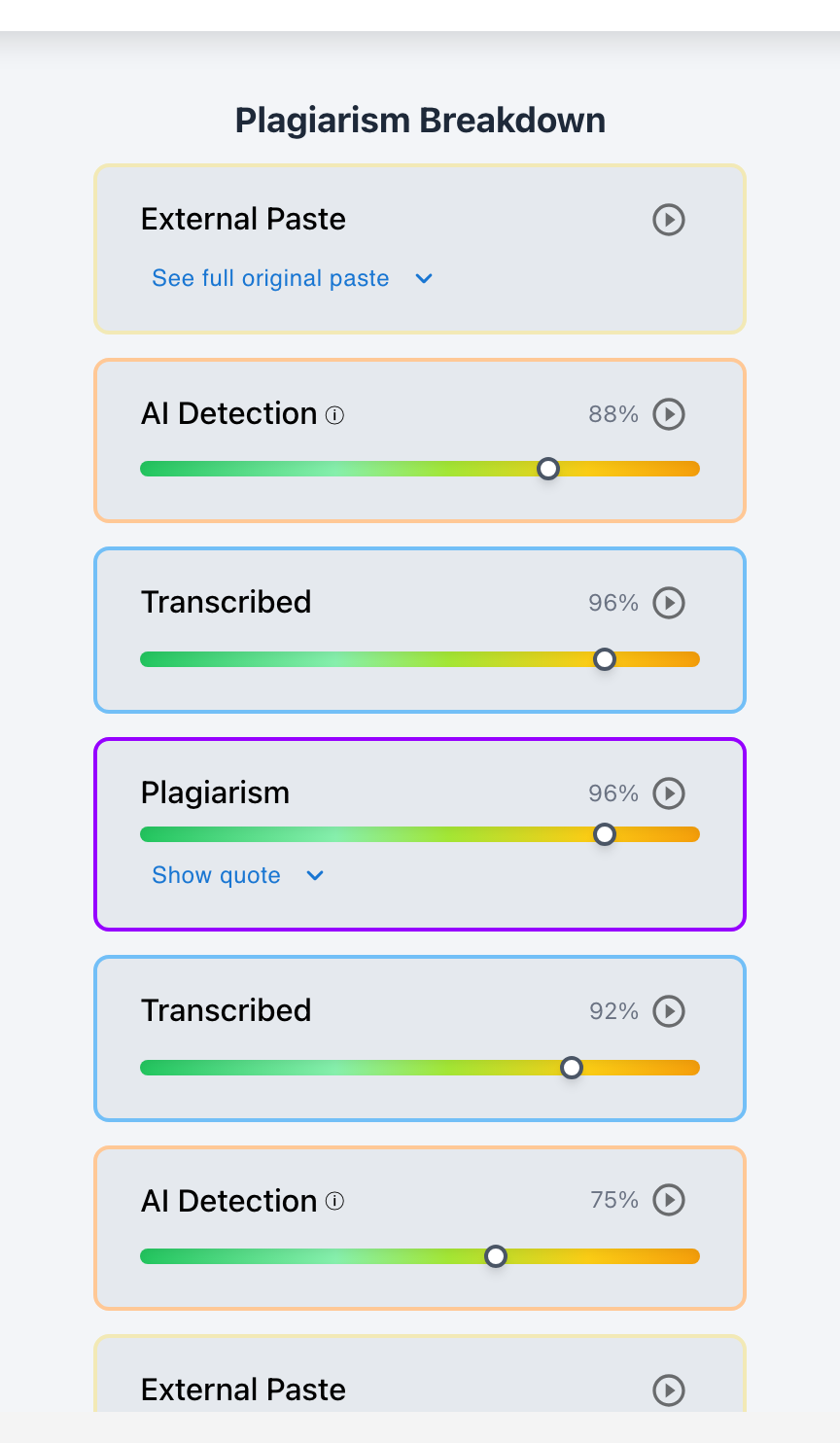
Checkmark Plagiarism's essay writing playback allows educators to examine how an assignment developed over time: gradual drafting, larger text additions, revisions, deleted material, and editing patterns. Instead of debating whether a 65% detector result is more trustworthy than a 30% result, teachers can ask: "What does the writing process show?"
What If Different Detectors Disagree About a Student Essay?
- 1. Read the essay yourself: Identify what specifically appears unusual.
- 2. Compare with previous work: Check vocabulary, grammar, and tone consistency.
- 3. Review writing history: Examine how the document developed when available.
- 4. Verify sources: Check citations, quotes, and claims.
- 5. Talk to the student: Ask about the thesis, arguments, and drafting tools.
- 6. Apply the assignment AI policy: Determine if the student's actions violated course rules.
For conversation guidance, see our guide on how do I talk to a student I suspect of using AI?
AI Detection and Plagiarism Detection Work Differently
Traditional plagiarism detection compares text against indexed databases of web pages and publications. AI detection evaluates statistical prose patterns with no direct source matches. Read our full comparison in AI detection vs. plagiarism detection.
Should Schools Base Discipline on a Single AI Detector?
Schools should avoid basing high-stakes disciplinary decisions entirely on one detector score. False positives, false negatives, and algorithm discrepancies make a multi-evidence review essential.
The Multi-Evidence Formula for Conflicting Scores:
AI detection + previous student work + writing playback + source verification + student conversation
Together, these provide much more context than trying to average or compare conflicting algorithm percentages.
How Checkmark Plagiarism Helps When AI Detection Is Uncertain
Checkmark Plagiarism combines **AI detection, essay writing playback, static AI detection, plagiarism detection, autograding, and Canvas/Google Classroom integrations** so educators evaluate student work with complete context.
Frequently Asked Questions
Why does one AI detector say AI while another says human?
Different detectors may use different models, training data, thresholds, scoring systems, and methods for analyzing text. As a result, the same essay can produce different classifications.
Which AI detector is correct when they disagree?
A disagreement may indicate uncertainty rather than proving that one detector is definitively correct. Teachers should review additional evidence before reaching a conclusion.
Do all AI detector percentages mean the same thing?
No. Different platforms may calculate and present scores differently, so percentages should not necessarily be compared directly.
Should I average scores from multiple AI detectors?
Averaging scores from unrelated detection systems does not necessarily produce a more accurate authorship determination because the systems may measure and report different things.
Can edited ChatGPT text produce different detector results?
Yes. Editing, rewriting, and combining AI-generated text with human writing can cause different detectors to classify the same content differently.
Can human writing get different AI scores?
Yes. Human-written text can sometimes trigger AI detectors, and different systems may respond differently to the same writing style.
Why do short assignments get inconsistent AI detection results?
Short samples contain less information for a detector to analyze, which can increase uncertainty and make results more variable.
What should a teacher do when AI detectors disagree?
Review the student's previous writing, writing history, sources, assignment requirements, and explanation of the work rather than relying entirely on conflicting detector scores.
How does Checkmark Plagiarism help when AI detection is uncertain?
Checkmark Plagiarism combines AI detection with essay writing playback, static AI detection, plagiarism detection, autograding, and Canvas and Google Classroom integrations, giving educators additional context when a detector result alone is inconclusive.
Different Results Are a Reminder That AI Detection Is Evidence, Not Proof
If two AI detectors analyze the same essay and produce different answers, it reflects an inherent characteristic of statistical text analysis. That is why the most useful question is not: "Which AI detector gave the right percentage?" It is: "What does the complete body of evidence tell us about how this assignment was created?"
Checkmark Plagiarism supports this evidence-based approach with AI detection, essay writing playback, static AI detection, plagiarism detection, autograding, and integrations with Canvas and Google Classroom.
See how Checkmark helps educators evaluate student writing with complete writing-process evidence. View a sample report or request a demonstration.