
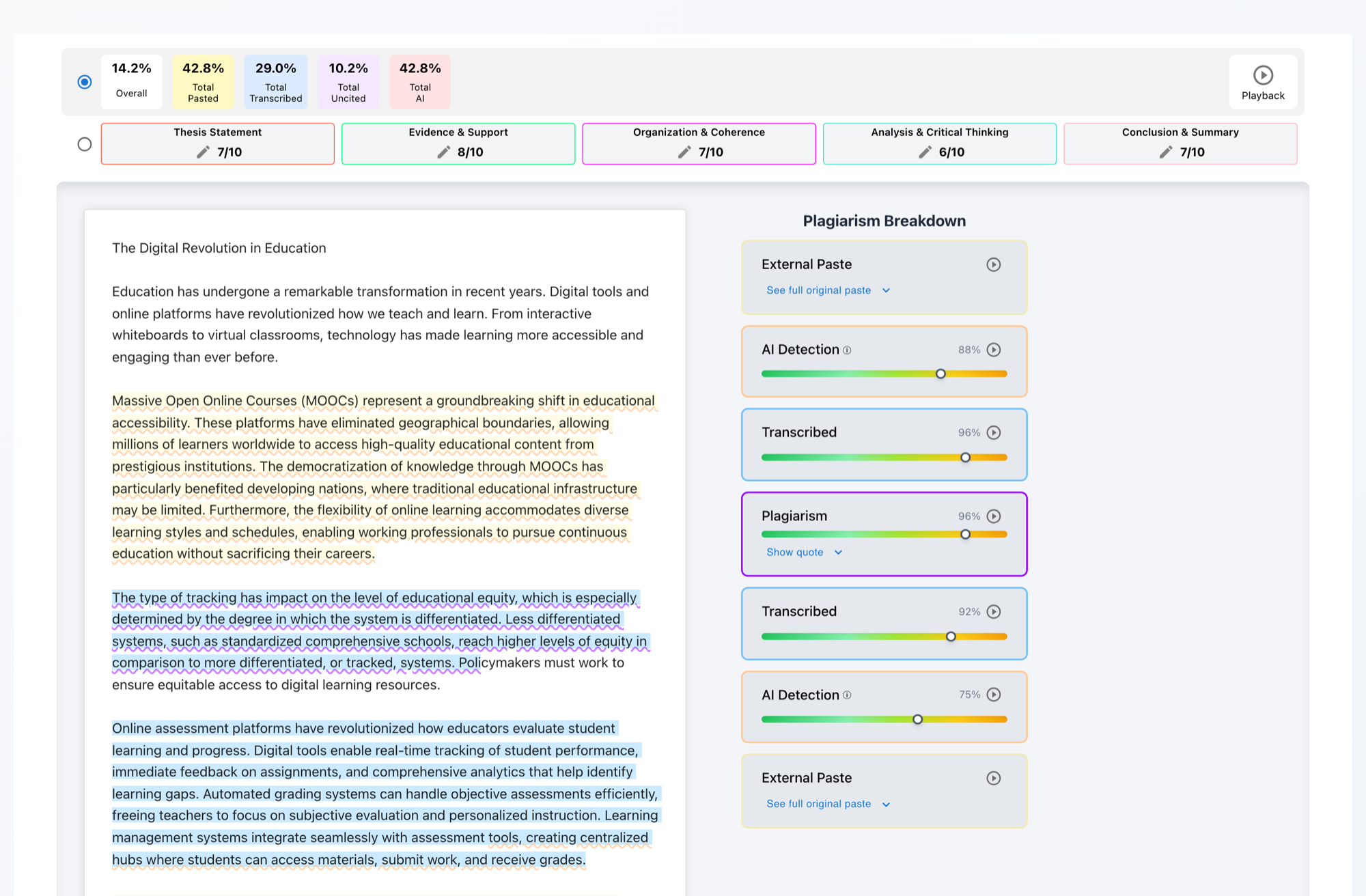
AI detection and plagiarism detection examine different aspects of student writing. Plagiarism detection compares text against existing sources to find matching or closely similar language. AI detection analyzes linguistic and statistical patterns that may be associated with machine-generated writing. A plagiarism match does not prove intentional copying, and an AI score does not prove that a student used ChatGPT. Schools may use both because each technology answers a different question.
As digital tools and generative AI become central to school workflows, understanding the difference between AI detection and plagiarism detection is vital for teachers, department heads, and academic-integrity administrators. Evaluating an assignment requires asking three distinct questions:
- Does the assignment contain language taken from an existing source?
- Does the writing contain patterns associated with AI-generated text?
- How was the assignment actually created over time?
Traditional plagiarism detection software answers the first question by scanning source databases. AI writing detection addresses the second question by measuring statistical prose characteristics. Crucially, writing-process evidence provides the context needed to answer the third question, giving educators a complete, fair picture of student authorship.
What Is Plagiarism Detection?
Plagiarism detection is technology that compares submitted student text against extensive collections of pre-existing written material.
Plagiarism software index databases containing:
- Public Websites: Live web pages, digital encyclopedias, online articles, blogs, and homework-sharing repositories.
- Published Books & Journals: Millions of peer-reviewed articles, books, monographs, and academic archives.
- Student Submissions: Previously turned-in assignments from the same school, district, or global repository to prevent student-to-student copying.
- Classroom Repositories: Current submissions from classmates responding to the same prompt.
Plagiarism software identifies exact word-for-word matching text, close paraphrasing (patchwriting), missing quotation marks, and overlapping passages between student files. The software identifies similarities for teacher review-it does not evaluate student intent or automatically prove academic dishonesty.
What Is AI Detection?
AI detection is technology that evaluates whether writing contains mathematical and statistical patterns typical of large language models like ChatGPT, Claude, or Gemini.
An AI plagiarism checker for teachers evaluates prose characteristics, including:
- Perplexity (Predictability of Word Choices): Measuring how closely sentence word choices align with standard statistical model output.
- Burstiness (Sentence Length Variation): Measuring structural diversity, as human writers naturally combine short and complex sentences while AI text tends toward uniform length.
- Tone & Structural Uniformity: Spotting repetitive transition phrases ("in summary," "furthermore") and balanced paragraph structures.
- Section-Level Discrepancies: Identifying sudden statistical shifts between different sections of the same paper.
Unlike plagiarism detection, AI detection does not compare text against a database of web pages. It calculates a statistical probability or confidence classification. AI detection cannot prove which model was used, who entered the prompt, whether the student edited the output, or what the student's intent was.
The Main Difference Between AI and Plagiarism Detection
While often bundled together in educational platforms, AI detection and plagiarism detection are complementary technologies designed for distinct analytical tasks:
| Question | Plagiarism Detection | AI Detection |
|---|---|---|
| What does it analyze? | Similarities with existing sources | Patterns associated with generated writing |
| Does it search source databases? | Yes (web pages, journals, student papers) | No (analyzes statistical prose metrics) |
| What does it produce? | Source matches & similarity score | AI confidence probability or percentage |
| Can it identify copied wording? | Yes, when the source is indexed | Not reliably |
| Can it identify uncopied AI writing? | Usually not | Potentially |
| Can it prove misconduct? | No | No |
| Does it determine student intent? | No | No |
| Does it show how document was written? | No | No |
What Does a Plagiarism Report Show?
A standard plagiarism report provides a detailed visual map of source overlaps across a document.
Key components include:
- Highlighted Source Overlaps: Color-coded text blocks showing exact or close phrase matches.
- Direct Source Links: Web URLs or publication titles matching the highlighted passages.
- Overall Similarity Score: The total percentage of document text matching indexed sources.
- Source Breakdown: Percentage contribution of individual web pages, publications, or student papers.
- Filter Exclusions: Settings that toggle exclusions for properly formatted quotes, bibliographic entries, and small matches.
When reviewing a plagiarism report, teachers check whether quotation marks were used, whether citations are accurate, whether matched phrases are common idioms, and whether the overall pattern represents proper research or uncredited copying.
What Does an AI-Detection Report Show?
An AI detection report provides passage-level statistical metrics rather than source links.
Key components include:
- Overall AI Probability Classification: An estimated percentage or confidence level indicating statistical similarity to machine text.
- Highlighted Passages: Specific paragraphs or sentences exhibiting high statistical predictability.
- Confidence Sliders or Gradients: Visual indicators showing the strength of the statistical signal for individual passages.
- Passage Breakdown: Differentiating between fully human, mixed, or heavily machine-patterned sections.
A high AI indicator is a signal for further teacher review-it does not establish that a student cheated or used ChatGPT. Read our full analysis in Can Teachers Detect ChatGPT in Student Writing?
Is AI-Generated Writing Plagiarism?
While AI-generated writing vs plagiarism frequently overlap, they are legally and conceptually distinct:
- AI Text May Not Match Any Source: Newly generated AI text is synthesized on the fly and often contains zero web database matches.
- Submitting AI Text Violates Authorship Rules: Passing off AI output as your own human drafting misrepresents who wrote the paper, violating academic integrity rules even when no source was copied.
- AI Models Can Reproduce Source Material: Generative AI sometimes reproduces memorized passages from training data without proper attribution.
- AI Invents Hallucinated References: Language models frequently generate plausible-looking citations for non-existent articles.
- AI-Assisted Paraphrasing: Students may run copied web text through an AI model to disguise traditional plagiarism.
Because of these distinctions, forward-thinking plagiarism and AI detection for schools policies define unauthorized AI assistance separately from traditional source plagiarism.
Can a Plagiarism Checker Detect ChatGPT?
Sometimes, but not reliably for original AI generation.
Whether a plagiarism checker flags ChatGPT text depends on how the text was generated:
- Original AI Generation: If ChatGPT generates a unique response with no direct source matches, a traditional plagiarism checker will show a 0% similarity score.
- Reproduced Training Material: If ChatGPT outputs verbatim text from an indexed article or book, a plagiarism checker will identify the match.
- AI Paraphrasing of Copied Text: If a student uses AI to rewrite stolen web text, a plagiarism checker may still spot structural similarities if original phrasing remains.
Conclusion: A 0% similarity score on a plagiarism checker does not prove that an essay was written by a human.
Can an AI Detector Identify Plagiarism?
No. AI detectors are not designed for source matching.
An AI detector evaluates statistical writing style, not source origins. Consider this example:
Scenario:
A student copies three paragraphs directly from a human-written encyclopedia article without citation.
Result:
The AI detector classifies the text as 100% human-written because it was composed by a human author. The plagiarism checker correctly flags the exact source URL. Without plagiarism detection, the cheating would go completely unnoticed.
Why Both Technologies Can Produce Incorrect or Misleading Results
Both systems carry technical limitations that educators must understand:
Plagiarism-Detection Limitations
- Unindexed web sources, offline books, or paywalled databases can miss direct matches.
- Common phrases, assignment prompts, and bibliographic entries increase similarity percentages artificially.
- Heavily paraphrased text without citations can evade exact-match algorithms.
- A similarity match shows text overlap, not student intent.
AI-Detection Limitations
- Formal, structured human writing (especially from non-native English speakers) can produce false positive flags.
- Light human editing or specialized prompts can lower AI confidence scores.
- Short passages (under 150 words) lack statistical sample size.
- Detectors cannot prove which tool was used or who entered the prompt.
Why Schools May Need Both AI and Plagiarism Detection
Educational institutions encounter four distinct classroom scenarios that require different detection tools:
- Scenario 1: Copied Human-Written Material: A student copies from an online article. Plagiarism detection is essential to locate the original source URL.
- Scenario 2: Original AI-Generated Text: A student submits a ChatGPT response with no web source matches. AI detection identifies statistical machine patterns for teacher review.
- Scenario 3: AI-Assisted Paraphrasing: A student uses AI to rewrite plagiarized text. Teachers need both source matching and AI indicators to unpack the submission.
- Scenario 4: Quoted Sources & Permitted AI Use: A student uses properly cited quotes and uses AI for teacher-approved brainstorming. Both tools provide context, confirming that the student followed guidelines.
Why Writing-Process Evidence Matters
Both plagiarism checkers and AI detectors evaluate only the final submitted document. They cannot show how the paper evolved. That is why writing-process evidence is essential for modern academic integrity.
Process evidence allows teachers to inspect:
- Drafting History: Did the student spend hours typing, deleting, and revising across multiple sessions?
- Paste Events: Did major passages arrive via sudden external paste events, or were they typed naturally?
- Source Entry Timelines: Were citations added progressively during research?
- Screen Transcription Activity: Was the paper retyped rapidly from a secondary device or paper draft?
Process evidence protects honest students. When a formal human essay receives a false positive AI flag, showing three hours of detailed typing and revision history in Checkmark immediately vindicates the student.
Similarity Scores vs. AI Scores
Understanding the fundamental distinction between similarity score vs AI score metrics prevents improper disciplinary decisions:
CRITICAL RULE FOR EDUCATORS:
Neither a similarity score nor an AI score should be interpreted as a "misconduct score."
- Similarity Score: Measures overlapping text against indexed databases. High similarity often reflects heavy cited quotation or template text.
- AI Score: Measures statistical probability of machine writing patterns. A high AI score is a statistical signal for review, not historical proof.
How Teachers Should Review the Results Together
Educators use a 10-step integrated review workflow:
- 1. Review assignment rules and AI policy guidelines.
- 2. Open highlighted plagiarism matches and examine original web sources.
- 3. Verify quotation marks, citations, and paraphrase quality.
- 4. Inspect passage-level AI confidence indicators.
- 5. Audit source links to confirm citations exist and support claims.
- 6. Review document editing history and paste logs.
- 7. Compare submission against prior student work.
- 8. Schedule a private, supportive conference with the student.
- 9. Invite the student to share research notes, outlines, and early drafts.
- 10. Document all evidence and record the outcome clearly.
Which Type of Detection Does a School Need?
Selection depends on institutional priorities and assignment types:
- Prioritize Plagiarism Detection: For research papers, humanities courses, and essay-heavy curricula requiring extensive source attribution.
- Prioritize AI Detection: For prompt-based writing, personal reflections, and introductory courses where student unassisted writing is evaluated.
- Deploy Both (Recommended): For comprehensive academic integrity coverage across ELA, STEM, History, and district-wide LMS deployments.
How Checkmark Brings the Evidence Together
Checkmark combines web source matching, passage-level AI indicators, and writing-process playback into a single, transparent report inside your LMS.
Checkmark features:
- Web & Peer Source Matching: Clear side-by-side quote comparison linked to original sources.
- Calibrated AI Confidence Sliders: Transparent indicators mapped line-by-line without unproven black-box percentage claims.
- Session Playback: Replay student editing sessions keystroke-by-keystroke.
- Copy-Paste & Transcription Audits: Instant identification of paste blocks and screen retyping activity.
- LMS Workflow Integration: Direct access inside Google Classroom and Canvas LMS.
Required Classroom Examples
Example 1: High Similarity, No Misconduct
Scenario:
A student's term paper returns a 38% similarity score. Inspecting the report reveals 12 properly cited quotations, a shared prompt header, and a full bibliography.
Evaluation:
Because all matches represent legitimate quotes and citations, no plagiarism occurred. The similarity percentage simply reflects high quote volume.
Example 2: Low Similarity, Possible AI Use
Scenario:
An essay receives a 2% similarity score, but the text consists of generic arguments with two hallucinated citations. Document history shows the entire essay was pasted in 15 seconds before submission.
Evaluation:
Plagiarism detection alone missed the issue. Combining AI indicators, citation audits, and paste logs provides the context needed for a student review meeting.
Example 3: False AI Flag Resolved by Full Evidence
Scenario:
A student's formal history paper receives an 85% AI confidence indicator. Revision history shows 4 hours of typing and drafting across three days, and the student comfortably explains every thesis argument in person.
Evaluation:
Process evidence and student conversation prove authentic human authorship, successfully resolving the false positive flag.
Frequently Asked Questions
Is AI detection the same as plagiarism detection?
No. Plagiarism detection finds matching text in database sources, whereas AI detection analyzes writing style and statistical probability patterns.
Does a plagiarism checker detect ChatGPT?
Only if the ChatGPT response contains text matching indexed web pages or publications. Original AI-generated prose will not trigger traditional plagiarism software.
Does AI-generated text count as plagiarism?
Not automatically. Submitting AI text violates authorship rules even if no source was copied, which is why schools maintain distinct policies for unauthorized AI assistance.
Can AI detectors find copied text?
No. AI detectors measure statistical writing patterns, not source databases. Plagiarism checkers are required to locate original source URLs.
Can a paper pass plagiarism detection but still be AI-generated?
Yes. Synthesized AI text often contains zero web source matches, allowing it to pass traditional plagiarism checks.
Can a human-written paper be flagged as AI?
Yes. False positives happen, especially with formal writing or non-native English speakers. Reviewing editing timelines and holding a student conference prevents unfair penalties.
Should schools use AI detection and plagiarism detection together?
Yes. Combining source matching, AI indicators, and writing-process evidence gives educators a complete, fair review workflow across all subjects.
See how Checkmark gives teachers more context than an AI score or similarity percentage alone. View a sample report or request a demonstration.