
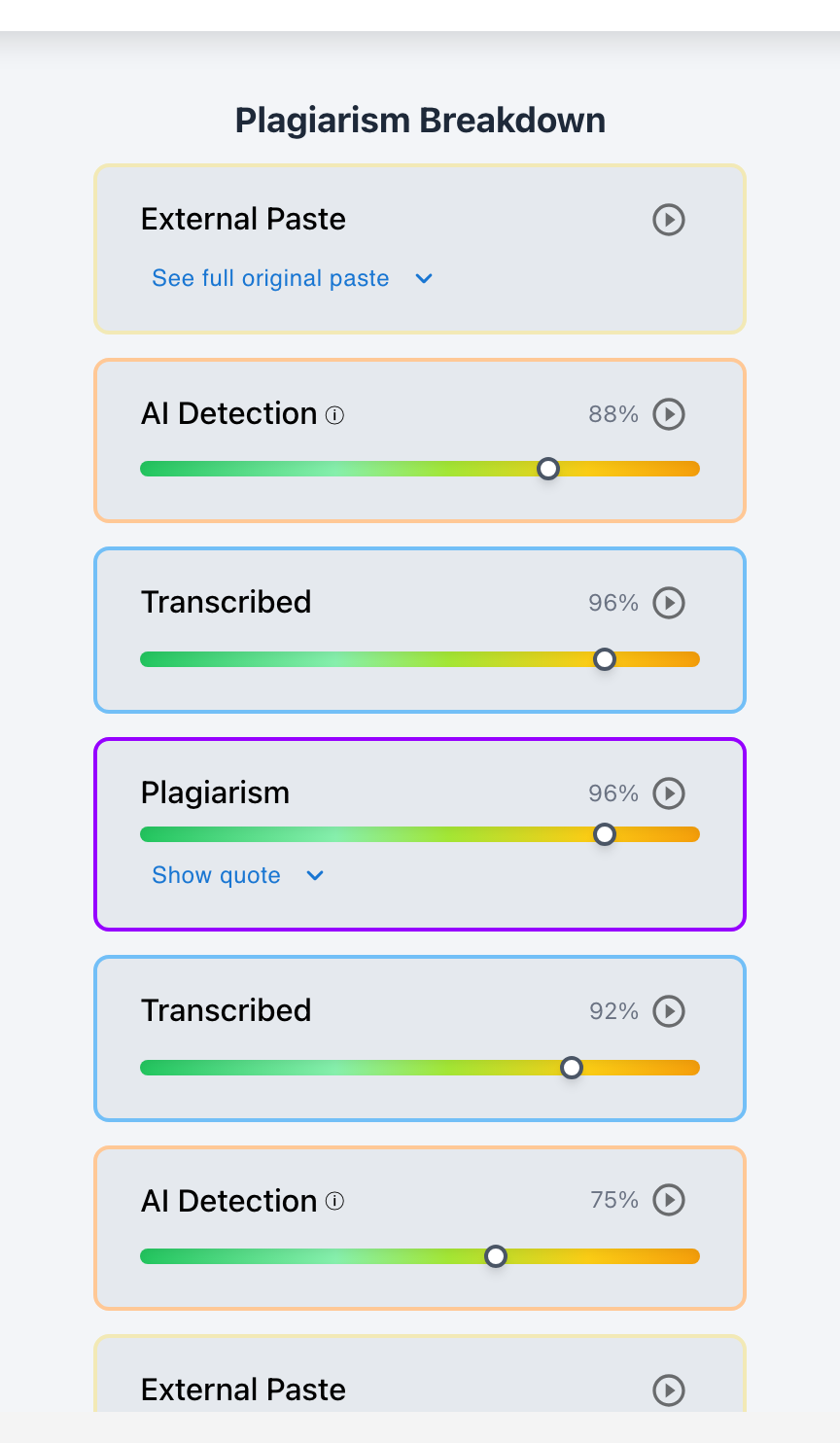
A student submits an essay, and the AI detection report shows 68% AI. What does that number actually mean? A teacher might reasonably assume it means there is a 68% chance the student used AI, that AI wrote 68% of the essay, or that the detector is 68% certain the student cheated. But depending on the AI detector, none of those interpretations may be correct.
Different AI detection tools calculate and display percentages in different ways. A percentage may represent how much text the system classified as potentially AI-generated, a confidence or likelihood measure, or another score created by the detection system.
That is why teachers should understand what their particular AI detector is measuring before using its percentage as evidence of academic misconduct. More importantly, an AI detection percentage should generally be treated as a signal for further review—not a verdict.
Checkmark Plagiarism helps teachers look beyond a single AI score by combining AI detection with essay writing playback, static AI detection, plagiarism detection, autograding, and integrations with Canvas and Google Classroom.
An AI Percentage Is Not Necessarily the Probability a Student Cheated
Suppose a report says 85% AI. It is tempting to translate that into: "There is an 85% chance this student cheated."
That is usually too simplistic. An AI detector analyzes characteristics of the submitted text; it does not directly observe the student writing the assignment. The detector does not know whether the student opened ChatGPT, used AI only for brainstorming, had an assistant rewrite sentences, or received tutor feedback. The software is evaluating the final text, whereas academic misconduct is a conclusion about student action.
Does 80% AI Mean AI Wrote 80% of the Essay?
Not automatically. A teacher sees 80% AI and assumes that 80% of the words came from ChatGPT. Whether that interpretation is correct depends entirely on how the particular detector defines its percentage. Some reports provide passage-level classifications, while others display a broader confidence or likelihood score.
The safest rule: Do not assume a percentage represents the amount of the paper written by AI unless the detector explicitly defines it that way.
Why Are AI Detection Scores So Easy to Misunderstand?
Percentages feel precise. "87% AI" feels much more certain than "this essay may contain AI characteristics." But displaying a precise number does not mean the detector knows exactly what happened during drafting. Teachers should distinguish between numerical precision and certainty about authorship.
What Is an AI Detector Looking For?
AI detection systems evaluate language characteristics that may help distinguish machine-generated text from human writing:
- Word choice and vocabulary distribution
- Sentence structure and complexity
- Predictability and perplexity
- Variation in sentence lengths (burstiness)
- Repetition and formulaic transitions
- Relationships between sentences
- Patterns learned from human and AI corpora
Human and AI writing overlap: a student can write a highly structured paragraph, and AI can generate conversational text. That overlap is why AI detection is not like a fingerprint.
A High AI Percentage Is Not the Same as Proof
When an essay receives a high AI result, the appropriate response is to review the assignment more closely:
- Does this resemble the student's previous writing?
- Can the student explain the essay?
- Are the citations legitimate?
- What does the writing history show?
- Did large amounts of text appear suddenly?
- Does the student have drafts or notes?
- Was AI permitted for any part of the assignment?
A high score provides a reason to investigate, but the investigation determines what happened—the percentage should not replace that process.
What About a Low AI Percentage?
A low score does not prove "this essay was entirely written by the student." AI could have been used for brainstorming, outlining, suggesting arguments, or rewriting without leaving recognizable AI prose in the final text. Teachers should avoid treating a low percentage as a certificate of human authorship.
What Does 0% AI Mean?
A 0% result indicates the detector found little or no text meeting its AI criteria. It does not mean AI was never involved in the research or brainstorming phase. Learn more in can ChatGPT writing pass an AI detector?
What Does 100% AI Mean?
A 100% result indicates strong statistical evidence under the tool's scoring method. Even then, it is not absolute legal proof of ChatGPT usage. The teacher should examine previous work, citations, writing history, and student explanations before drawing a conclusion.
Can AI Detection Percentages Be Wrong?
Yes. AI detection produces both false positives (human text flagged as AI) and false negatives (AI text unflagged). Read our detailed guide on can AI detectors give false positives?
Why Do Different AI Detectors Give Different Percentages?
Different systems use different models, training data, classification thresholds, document segmentation, and score definitions. Comparing a 75% score from Detector A with a 75% score from Detector B compares two numbers on different scales. Learn more in why do different AI detectors give different results?
Should Teachers Average Multiple AI Detection Scores?
No. Averaging scores from unrelated systems (e.g., 90%, 60%, 15% to get 55%) creates a mathematically meaningless number. Multiple scores do not eliminate the need to interpret the underlying evidence.
Writing History Adds Information the Percentage Cannot
An AI detector analyzes the final text; writing history shows how that text developed:
Student A (75% AI Score)
- Outline developed first
- Paragraphs drafted gradually across days
- Frequent sentence-level revisions
- Sources and citations added incrementally
- Process supports legitimate human drafting
Student B (75% AI Score)
- Document begins empty
- 1,200 polished words appear all at once
- Minimal editing or revision afterward
- Provides a clear event for teacher review
How Checkmark Plagiarism's Essay Writing Playback Helps
Checkmark Plagiarism's essay writing playback allows teachers to review gradual drafting, large additions, revisions, and editing activity over time. Instead of telling a student "The detector gave you an 82% AI score," a teacher can ask: "I noticed that these three paragraphs appeared in the document at the same time. Can you explain how you wrote that section?" Read more in how Checkmark writing process analysis works.
A Large Paste Does Not Prove the AI Score Is Correct
A sudden insertion of text could come from an earlier draft, research notes, quotations, or another application. Writing history prompts constructive questions rather than automatic findings of misconduct.
What Should Teachers Do With an AI Detection Percentage?
- 1. Understand the score: Know what the detector's percentage specifically measures.
- 2. Review the assignment: Read the submission yourself to identify unusual patterns.
- 3. Compare previous student work: Check vocabulary, tone, and grammar consistency.
- 4. Review writing history: Examine drafting progression and paste events.
- 5. Verify sources: Check citations, quotes, and factual references.
- 6. Talk to the student: Ask them to explain both the assignment and the writing process.
- 7. Apply course policy: Determine if any identified AI assistance violated rules.
What Should I Ask the Student?
If an AI percentage raises concerns, useful questions include:
- Can you walk me through how you wrote this assignment?
- Where did you start, and what was your thesis?
- How did you choose and locate your sources?
- What does this paragraph mean in your own words?
- Where did this specific section come from?
- Did you draft any part of the assignment in another application?
- What digital tools did you use while writing?
- Did you use ChatGPT or another AI assistant, and what did you use it for?
For more techniques, see our guide on how do I talk to a student I suspect of using AI?
What If the Student Says the AI Detection Score Is Wrong?
Do not argue over software infallibility—detectors can be wrong. Review the evidence: if writing playback shows gradual drafting and the student can explain every major argument and citation, those facts matter. The goal is to determine what happened, not defend the percentage.
What About Assignments Without Writing History?
When students submit PDFs or Word files created externally, Checkmark Plagiarism's static AI detection evaluates completed documents alongside previous writing, citation checks, and student conferences.
AI Percentage and Plagiarism Percentage Are Not the Same Thing
Plagiarism percentage identifies text overlap with indexed sources, while AI detection measures statistical prose patterns with no direct source matches. Read our full comparison in AI detection vs. plagiarism detection.
Should Schools Set an Automatic AI Percentage Threshold?
Policies such as "over 50% AI = automatic zero" assume unjustified algorithm certainty. A defensible policy uses scores to trigger review:
Recommended Review Flow:
AI detection concern → review writing evidence → talk to student → apply policy
How Checkmark Plagiarism Goes Beyond an AI Percentage
Checkmark Plagiarism combines **AI detection, essay writing playback, static AI detection, plagiarism detection, autograding, and Canvas/Google Classroom integrations** so educators evaluate student submissions with full context.
Frequently Asked Questions
What does an AI detection percentage mean?
It depends on the detector. The percentage may describe a classification, confidence measure, estimated amount of AI-like text, or another system-specific score.
Does 80% AI mean there is an 80% chance the student cheated?
Not necessarily. An AI detection score should not automatically be interpreted as the probability that a student committed academic misconduct.
Does 80% AI mean AI wrote 80% of the essay?
Not necessarily. That interpretation is only appropriate if the detector explicitly defines its percentage as the portion of text classified as AI-generated.
Is a high AI percentage proof that a student used ChatGPT?
No single percentage should automatically be treated as definitive proof that a student used ChatGPT or another specific AI system.
Does 0% AI mean no AI was used?
Not necessarily. AI could have been used for brainstorming, outlining, feedback, or other assistance without leaving strongly detectable AI-generated prose.
Can a 100% AI result be wrong?
AI detection can produce errors. Even very high results should be interpreted according to the detector's scoring method and considered alongside other evidence.
Why does the same essay get different AI percentages?
Different detectors may use different models, thresholds, training data, scoring systems, and methods for analyzing writing.
Should teachers use an AI percentage to accuse a student?
The score is better used as a reason for additional review. Teachers can examine previous writing, writing history, sources, and the student's explanation before making an academic-integrity decision.
How does Checkmark Plagiarism help interpret AI detection results?
Checkmark Plagiarism combines AI detection, essay writing playback, static AI detection, plagiarism detection, autograding, and Canvas and Google Classroom integrations, giving teachers more context than an AI percentage alone.
The Percentage Is a Clue, Not the Conclusion
AI detection percentages help teachers identify assignments that may deserve closer review. When a student's academic integrity is at stake, an AI percentage should help start the review—not make the decision by itself.
Checkmark Plagiarism supports this evidence-based approach with AI detection, essay writing playback, static AI detection, plagiarism detection, autograding, and integrations with Canvas and Google Classroom.
See how Checkmark helps educators interpret AI scores with comprehensive writing-process evidence. View a sample report or request a demonstration.