
Sometimes—but not always. AI detectors may still identify text that was originally generated by ChatGPT and then edited by a student. However, the more extensively the text is rewritten, reorganized, or blended with original student writing, the harder it can become to identify using text analysis alone.
That is one of the biggest challenges with AI detection. A student does not have to submit an untouched ChatGPT response. They might generate a draft, change the vocabulary, rewrite sentences, rearrange paragraphs, add personal examples, or combine AI-generated material with their own work. By the time the assignment is submitted, the final text may look very different from the original AI response.
That means teachers should not assume that an AI detector can identify every instance of AI-assisted writing—especially when the AI output has been heavily edited. A stronger approach is to combine AI detection with other evidence, including writing history, previous student work, source verification, and a conversation with the student.
Checkmark Plagiarism supports this broader approach with AI detection, essay writing playback, static AI detection, plagiarism detection, autograding, and integrations with Canvas and Google Classroom.
What Happens When a Student Edits ChatGPT Text?
Imagine a student asks ChatGPT to write a five-paragraph essay. They could simply copy the response and submit it—the simplest case for an AI detector to analyze.
But the student could also take the generated response and:
- Replace words with synonyms
- Rewrite individual sentences
- Rearrange paragraphs
- Shorten the introduction
- Add personal examples
- Remove repetitive language
- Change transitions
- Add quotations from class readings
- Mix AI-generated paragraphs with original writing
- Rewrite the entire response in their own style
Each of those changes alters the final text. An AI detector analyzing the completed assignment usually sees only that final version. It generally does not see the original ChatGPT output or know which parts were changed afterward, making edited AI-generated text more difficult to evaluate.
Can an AI Detector Still Identify Lightly Edited ChatGPT Text?
It may. If a student makes only small edits, much of the underlying writing may still contain characteristics associated with AI-generated text.
For example, a student might take an AI-generated paragraph and simply replace a few words:
Original AI Output
"Social media has significantly changed the way individuals communicate and interact with one another."
Lightly Edited Version
"Social media has dramatically changed how people communicate and interact with each other."
The second sentence is different, but the structure remains very similar. When edits are relatively minor, an AI detector may still identify patterns in the broader passage that resemble AI-generated writing. However, there is no guarantee—AI detection is probabilistic, and both false positives and false negatives are possible.
What About Heavily Rewritten AI Text?
Heavy rewriting is much more difficult. Suppose a student uses ChatGPT to generate an argument and then rewrites every paragraph, changing sentence structure, vocabulary, paragraph organization, examples, tone, transitions, and supporting evidence.
The final essay may share the ideas or structure of the AI-generated draft without retaining much of the original wording. At that point, detecting the AI contribution through the final text alone becomes much harder. The detector is analyzing a hybrid document containing varying amounts of human editing. This is one reason teachers should be cautious about interpreting a low AI detection result as proof that no AI was used.
Can Students "Beat" AI Detectors by Editing the Text?
Students may be able to make AI-generated writing more difficult to detect by substantially rewriting it. But that does not mean there is a guaranteed method for making AI use invisible. AI detectors analyze patterns across text rather than simply searching for specific ChatGPT phrases.
At the same time, detection is not perfect. That means two things can both be true:
- AI detectors can sometimes identify edited AI-generated text.
- Editing can make AI-generated text harder to detect.
For teachers, this is why the question should not be limited to: "Did the detector catch it?" A better question is: "What does the complete writing process show?"
Why Paraphrasing Makes AI Detection More Difficult
Paraphrasing changes the statistical and linguistic characteristics of a passage.
AI-Generated Sentence
"The Industrial Revolution dramatically transformed economic and social structures throughout Europe."
Rewritten by Student
"European society and economies changed significantly as industrialization spread."
The meaning is similar, but the wording and sentence structure are different. If enough of an essay is rewritten this way, the statistical characteristics that caused the original text to appear AI-generated may become weaker. The final document becomes a mixture of original student sentences, AI-generated ideas, rewritten AI passages, quotations, and research notes—making binary "AI or human" conclusions much less useful.
Does Changing a Few Words Make AI Undetectable?
Not necessarily. Replacing several words with synonyms (such as changing "important" to "significant") is very different from genuinely rewriting an argument. Light editing may leave much of the original writing structure intact.
However, teachers should avoid trying to estimate exact thresholds. Different texts, assignments, models, and detection systems produce different results.
What If the Student Uses AI to Rewrite AI?
A student could generate an essay with one AI tool and then prompt another AI system: "Rewrite this so it sounds like a high school student" or "Make this less formal and vary the sentence structure."
This can make text-only detection more difficult because the final submission has been transformed before it reaches the teacher. If educators rely only on final wording, they miss crucial information about how the assignment was produced.
Can a Low AI Detection Score Prove a Student Did Not Use ChatGPT?
No. A low detection result means the submitted text was not strongly identified as AI-generated by that particular analysis. It does not prove that AI played no role.
A student could have used AI for brainstorming, creating an outline, developing arguments, finding counterarguments, generating a first draft, rewriting sections, or summarizing sources. Learn more in our guide on what an AI score can and cannot tell you.
Writing History Can Reveal What Text Detection Misses
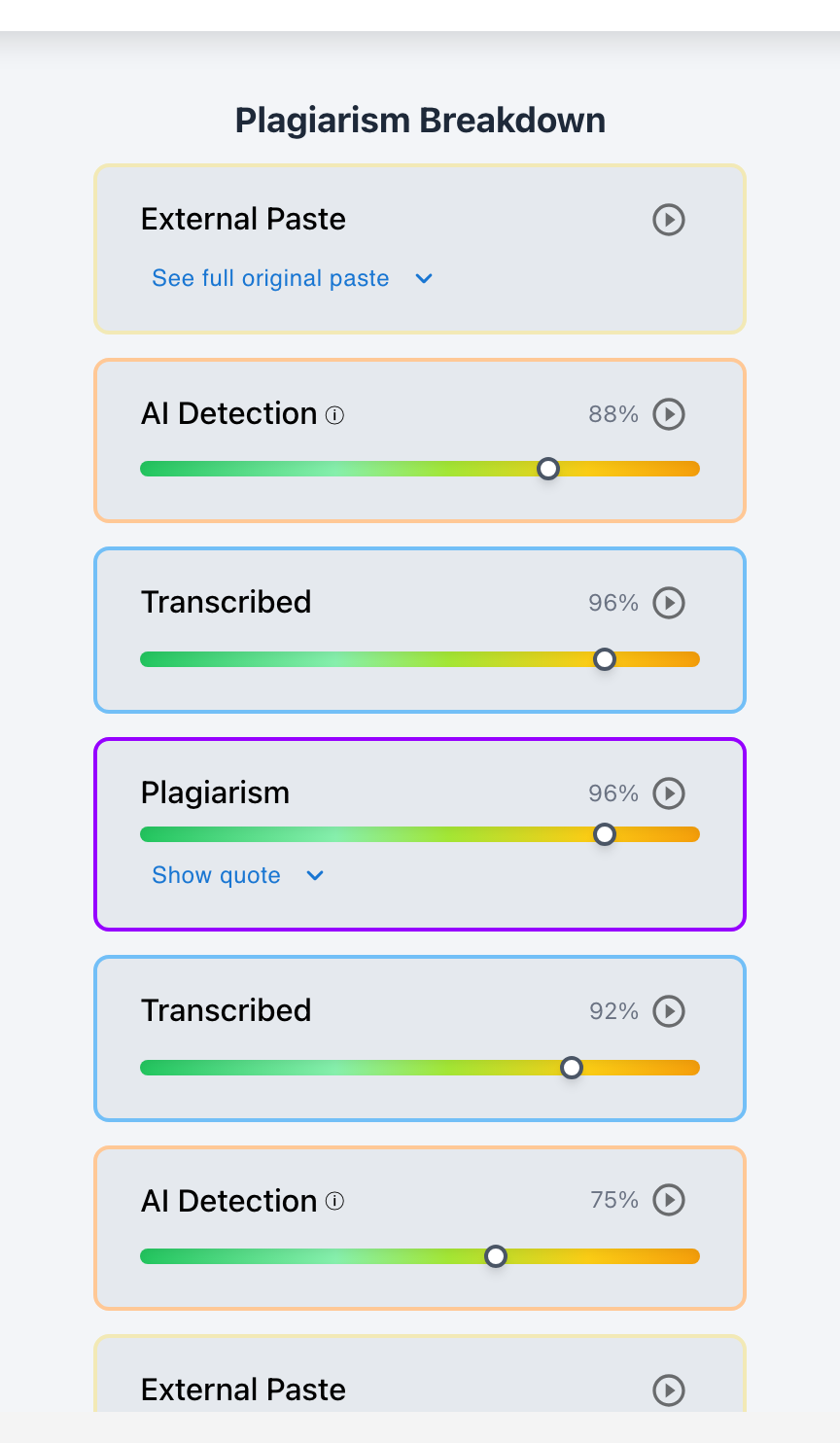
This is where writing-process evidence becomes particularly valuable. Suppose a student generates a 1,000-word essay with ChatGPT, pastes it into their document, and then spends an hour rewriting it. A text detector analyzing the final version might produce an inconclusive result, but the document history tells a different story:
What Writing History Might Reveal on Edited AI Content:
- 1 The document begins almost empty.
- 2 Approximately 1,000 words appear at once in a single paste block.
- 3 Individual sentences and words are rewritten afterward.
- 4 Paragraphs and headers are reorganized.
- 5 Additional revisions made before submission.
The teacher can now ask: "I noticed that most of the essay appeared at once and was then revised. Can you explain how you created the original draft?"
How Checkmark Plagiarism's Essay Writing Playback Helps
Checkmark Plagiarism's essay writing playback allows teachers to review how an assignment developed over time. Instead of looking only at the final essay, educators can examine when text was added, larger additions of content, drafting behavior, revisions, deleted material, and rewriting patterns. Read more in how Checkmark writing process analysis works.
Does Writing Playback Prove the Original Text Came From ChatGPT?
No. Writing playback shows that a large amount of text appeared, but it does not establish the source. The text could have come from ChatGPT, another AI tool, a student's own earlier draft, research notes, or another document. Writing history should be used as evidence for further investigation rather than automatic proof.
What If the Student Writes With AI and Human Text Mixed Together?
Mixed authorship is one of the most difficult situations for AI detection. A student might write the introduction themselves, use ChatGPT for two body paragraphs, rewrite one of those paragraphs, and write the conclusion independently. A single percentage cannot adequately describe this hybrid work. This is why schools need policies that define **acceptable AI assistance** rather than simply asking if an essay is "AI-generated."
What If the Student Uses ChatGPT Only for Ideas?
AI detection cannot determine whether ChatGPT helped produce underlying ideas when the final prose is written by the student. Whether that matters depends on assignment policy. If brainstorming is allowed, there is no issue; if all AI assistance is prohibited, teachers rely on disclosure and student conversations.
Edited AI Text Makes Clear Policies More Important
Schools need clear rules defining acceptable use: whether AI is allowed for brainstorming, practice questions, grammar checking, or completely prohibited from generating final answers. The question is: "Did the student's AI use violate the rules for this assignment?"
What Should Teachers Do When They Suspect Edited AI Text?
- 1. Review the AI detection result as a signal, not a final verdict.
- 2. Compare previous writing to inspect vocabulary, tone, and grammar shifts.
- 3. Review writing history to check drafting progression and paste events.
- 4. Verify sources and citations for accuracy.
- 5. Ask the student about their writing process and tools used.
- 6. Ask the student to explain core arguments and terminology.
- 7. Compare findings with your course's AI policy.
For more conversation techniques, see our guide on how do I talk to a student I suspect of using AI?
What About Completed Files With No Writing History?
When students submit PDFs or Word documents created outside monitored tools, Checkmark Plagiarism's static AI detection analyzes completed submissions. Teachers can combine this with previous student work, citation checks, plagiarism detection, and student conversations.
AI Detection and Plagiarism Detection Answer Different Questions
Traditional plagiarism detection looks for similarities with existing web sources. Edited AI-generated text may contain zero traditional plagiarism matches. Read our full breakdown in AI detection vs. plagiarism detection.
How Checkmark Plagiarism Helps With Edited AI Writing
Checkmark Plagiarism combines **AI detection, essay writing playback, static AI detection, plagiarism detection, autograding, and Canvas/Google Classroom integrations** so educators can examine more than the final wording of an essay.
Frequently Asked Questions
Can AI detectors detect paraphrased ChatGPT text?
Sometimes. Lightly paraphrased text may retain characteristics associated with AI-generated writing, while heavily rewritten text can become more difficult to identify. Detection results should be interpreted with other evidence.
Can students avoid AI detection by changing words?
Simply replacing a few words does not guarantee that AI-generated writing will avoid detection. More substantial rewriting may make detection more difficult, but there is no universal rule determining when AI text becomes undetectable.
Can an AI detector detect ChatGPT text after it has been rewritten?
It may detect some rewritten AI content, but substantial human editing can make the final text harder to classify. A negative result does not necessarily prove AI was never used.
Does a low AI score mean the essay was written entirely by the student?
No. The student may have used AI for brainstorming, outlining, drafting, rewriting, or other assistance that is not obvious in the final text.
Can writing history identify edited AI text?
Writing history can reveal drafting and revision patterns, including large additions followed by substantial rewriting. It does not automatically establish where the original text came from, but it can provide useful evidence for further investigation.
Can teachers tell if a student used ChatGPT and then rewrote it?
Sometimes the surrounding evidence can raise strong concerns, particularly when AI detection, writing history, previous student work, and the student's explanation point in the same direction.
Can static AI detection analyze edited AI writing?
Static AI detection can analyze completed text for patterns associated with AI generation, although substantial editing may make AI-assisted content more difficult to identify.
How does Checkmark Plagiarism help detect edited AI writing?
Checkmark Plagiarism combines AI detection with essay writing playback, static AI detection, plagiarism detection, autograding, and Canvas and Google Classroom integrations.
Edited AI Text Is Why Teachers Need More Than a Detector Score
AI detectors can sometimes identify ChatGPT-generated text even after it has been edited, but editing complicates detection. That is why teachers should avoid treating either a positive or negative AI detection result as the complete answer.
Checkmark Plagiarism supports this broader investigation with AI detection, essay writing playback, static AI detection, plagiarism detection, autograding, and integrations with Canvas and Google Classroom.
See how Checkmark helps teachers investigate edited and hybrid AI writing with complete writing-process evidence. View a sample report or request a demonstration.