
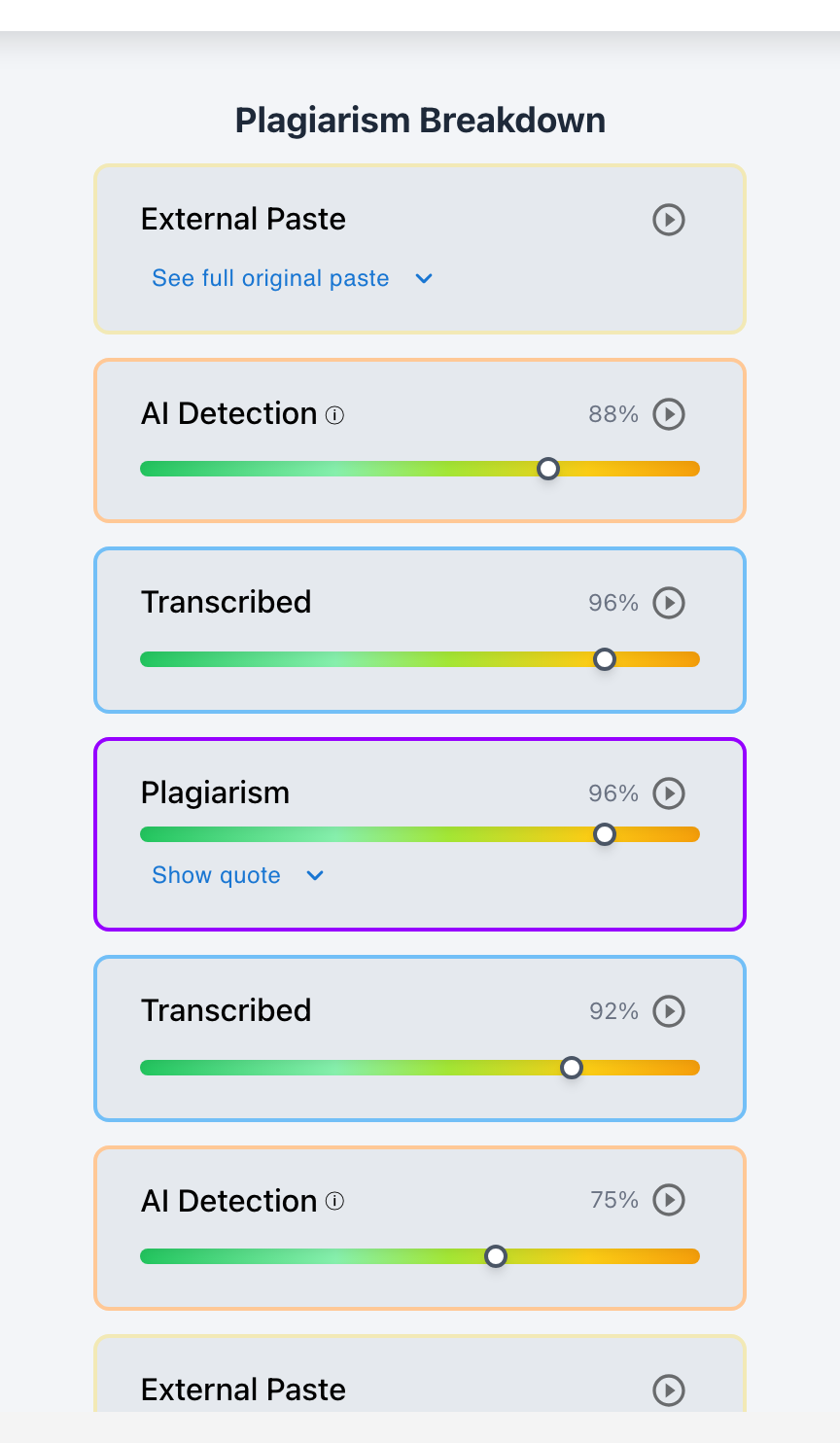
Yes. ChatGPT-generated writing can sometimes pass an AI detector without being flagged. AI detection is not a perfect test. Detectors analyze characteristics of submitted text and estimate whether the writing resembles content produced by generative AI. That means they can make mistakes in both directions.
A human-written essay may sometimes be flagged as AI-generated—known as a false positive. An AI-generated essay may sometimes be classified as human-written or receive a low AI score—known as a false negative.
For teachers and schools, this means an assignment that receives a low AI detection result should not automatically be considered proof that no AI was used. Likewise, a high AI detection result should not automatically be considered proof that a student cheated.
The strongest approach is to consider AI detection alongside other evidence, including previous student writing, the writing process, citations, assignment-specific knowledge, and the student's ability to explain their work.
Checkmark Plagiarism supports this broader approach with AI detection, essay writing playback, static AI detection, plagiarism detection, autograding, and integrations with Canvas and Google Classroom.
Can ChatGPT Avoid AI Detection?
It can happen. An AI detector does not have direct access to the student's ChatGPT account or know how an assignment was created. Instead, the detector analyzes the final text. If the text does not strongly match the patterns the detector associates with AI-generated writing, the submission may receive a low AI score even if AI contributed to the assignment.
That does not mean the detector failed completely—it means AI detection is an estimate rather than a guaranteed method for determining authorship.
What Is a False Negative in AI Detection?
A false negative occurs when AI-generated content is not identified as AI-generated.
For example, imagine a student asks ChatGPT to generate an essay and submits AI-produced content. An AI detector analyzes the essay but does not flag it. If the essay was genuinely generated by AI, the detector produced a false negative.
False negatives matter because teachers may be tempted to interpret a low AI score as: "This student definitely wrote the assignment." The result does not necessarily establish that—a detector can only evaluate the information available in the final text.
Why Might ChatGPT Writing Pass an AI Detector?
There are several reasons AI-generated writing may not be identified:
AI Writing Can Vary Considerably
ChatGPT output varies depending on the assignment, the prompt, the subject, the requested tone, the requested grade level, and the amount of context provided. Some AI-generated passages resemble common statistical AI patterns much less strongly than others.
Human and AI Writing Overlap
Generative AI is designed to produce human-like language. Both humans and AI can write text that is formal, predictable, highly structured, grammatically correct, concise, or sophisticated. Because those characteristics overlap, a detector estimates authorship from patterns rather than identifying a definitive digital watermark.
Does a Low AI Score Mean the Student Did Not Use ChatGPT?
No. A low AI detection result means the detector did not identify strong enough evidence to classify the submitted text as AI-generated. It does not tell you whether ChatGPT was involved in the writing process.
A student could potentially use AI for brainstorming, developing an outline, exploring arguments, or rewriting sections without leaving a strong signal in the final prose. Learn more in our guide on what an AI score can and cannot tell you.
What If ChatGPT Generated Only Part of the Essay?
Mixed authorship is especially difficult to evaluate. A student might write the introduction themselves, use AI for part of the body, rewrite some AI-assisted material, and write the conclusion independently. Modern writing workflows can be complex, which is why schools should avoid treating an entire essay as simply "AI" or "Human."
What If AI-Generated Writing Has Been Edited?
If AI-generated content has been substantially rewritten, the submitted version may differ considerably from the original AI output. Changing vocabulary, sentence structure, examples, tone, and transitions makes AI detection less certain. Read our in-depth analysis on can AI detectors detect edited ChatGPT text?
Does This Mean AI Detectors Are Useless?
No. AI detectors can help teachers identify assignments that deserve additional attention. The problem arises when detection is treated as a perfect yes-or-no test.
Scenario One: Low Score, Suspicious Evidence
- AI score is low or 0%
- Writing style shifts dramatically from past work
- Several citations do not exist in databases
- Writing history shows sudden wholesale paste block
- Do not ignore process evidence based on score alone
Scenario Two: High Score, Clean Process
- AI detection raises an alert (false flag)
- Writing history proves hours of gradual drafting
- Style is consistent with student's formal voice
- Student fluently explains all arguments and sources
- Process evidence vindicates the student
Writing History Can Reveal What a Detector Misses
One of the limitations of static AI detection is that it evaluates the final text. Writing-process evidence can provide an entirely different perspective.
Consider a student who submits a 1,500-word essay that receives a low AI score. If writing history shows that a nearly empty document suddenly gained 1,000 words that were subsequently tweaked, the teacher now has a specific, useful question: "Can you explain where the original draft came from?"
How Checkmark Plagiarism's Essay Writing Playback Helps
Checkmark Plagiarism's essay writing playback allows teachers to review how an assignment developed: gradual drafting, larger text additions, revisions, deleted passages, and editing activity. Read more in how Checkmark writing process analysis works.
Can Writing Playback Prove ChatGPT Was Used?
Not necessarily. Writing playback shows how text entered and changed within a document, but 800 pasted words could have come from notes, another application, a prior draft, or AI. Writing history should lead to additional questions rather than an automatic misconduct finding.
Can a Student Pass an AI Detector and Still Have Violated Policy?
Yes. Passing an AI detector and complying with an assignment's AI policy are not the same thing. If a course prohibits using AI to generate initial drafts, a student who generates a draft with ChatGPT and rewrites it may pass a detector while still violating course policy.
The question is: "What did the student actually do, and was that allowed?"
What Should a Teacher Do When a Paper Passes AI Detection but Still Looks Suspicious?
- 1. Compare with previous work: Check vocabulary, tone, sentence complexity, and grammar.
- 2. Review the writing process: Examine how the document developed in writing history.
- 3. Verify sources: Check unusual citations, quotes, and factual claims.
- 4. Ask the student about the essay: Have them explain thesis, arguments, and research.
- 5. Review assignment policy: Determine whether the student's workflow violated guidelines.
For guidance on student conferences, see our guide on how do I talk to a student I suspect of using AI?
AI Detection and Plagiarism Detection Are Different
A student can use ChatGPT without committing traditional plagiarism. Plagiarism detection looks for matches against published sources, whereas AI generates new text. Read our full comparison in AI detection vs. plagiarism detection.
How Checkmark Plagiarism Helps When AI Detection Is Inconclusive
Checkmark Plagiarism combines **AI detection, essay writing playback, static AI detection, plagiarism detection, autograding, and Canvas/Google Classroom integrations** so educators evaluate the complete evidence surrounding an assignment.
Frequently Asked Questions
Can ChatGPT writing pass AI detection?
Yes. AI-generated writing can sometimes receive a low AI detection result or go unflagged. This is known as a false negative.
Does passing an AI detector mean an essay is human-written?
No. A low AI detection result indicates that the detector did not strongly identify the submitted text as AI-generated. It does not necessarily prove that AI was never used.
Can AI detectors miss ChatGPT?
Yes. AI detection is not perfect, and false negatives are possible.
Can edited ChatGPT text pass an AI detector?
Substantial editing can make the origin of a passage more difficult to determine from the final text alone. Teachers should consider detection alongside additional evidence about the writing process.
Can a teacher tell if AI was used even if the detector says no?
Other evidence may raise concerns, including changes in writing style, writing history, questionable citations, previous student work, and the student's ability to explain the assignment.
Does a zero or very low AI score prove no AI was used?
No. AI may have contributed to brainstorming, outlining, drafting, rewriting, or other parts of the process without producing a strong signal in the final text.
Can writing history help when AI detection misses something?
Yes. Writing history can provide information about drafting, larger text additions, revisions, and how the document developed.
How does Checkmark Plagiarism help if ChatGPT passes AI detection?
Checkmark Plagiarism combines AI detection with essay writing playback, static AI detection, plagiarism detection, autograding, and Canvas and Google Classroom integrations.
Passing an AI Detector Is Not Proof of Human Authorship
An essay passing an AI detector does not prove that AI was not involved. The strongest question is not: "Did this essay pass the AI detector?" It is: "What does all of the available evidence tell us about how this assignment was created?"
Checkmark Plagiarism supports that evidence-based approach with AI detection, essay writing playback, static AI detection, plagiarism detection, autograding, and integrations with Canvas and Google Classroom.
See how Checkmark helps educators evaluate student writing beyond a single detector score. View a sample report or request a demonstration.