
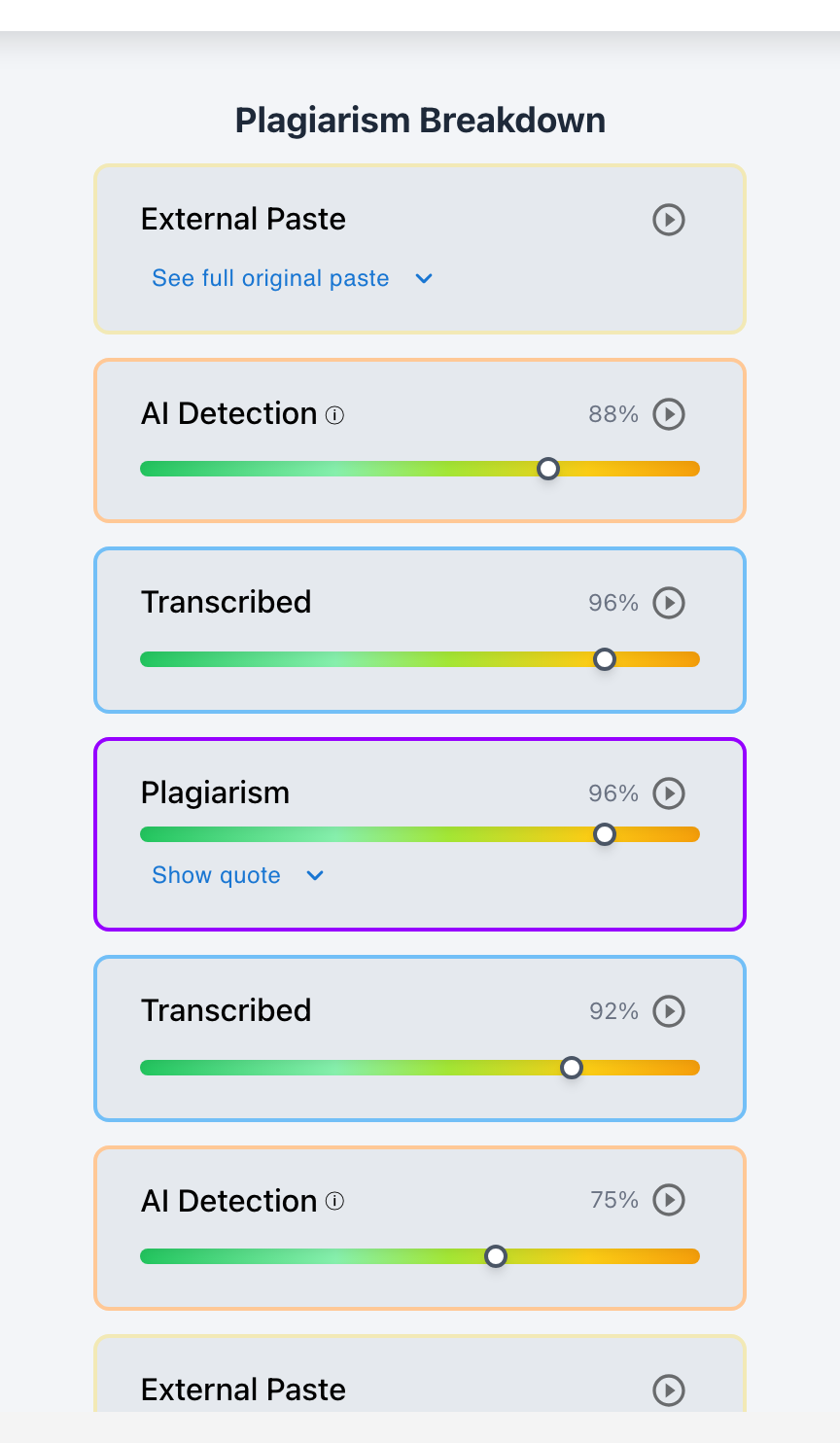
A student submits an assignment, but something about the work raises questions: the writing sounds very different from previous essays, the vocabulary is unusually advanced, an AI detector flags parts of the document, large sections appear suddenly in document history, or the student struggles to explain the submitted ideas. How can a teacher verify who actually wrote the assignment?
There is rarely one piece of evidence that proves authorship by itself. Instead, teachers look at multiple corroborating indicators: previous writing baselines, writing process progression, drafts and revisions, source citations, student conceptual comprehension, and detection reports.
The goal is not to prove that a student is lying—it is to determine whether the available evidence is consistent with the student's explanation of how the assignment was created.
Checkmark Plagiarism helps teachers investigate authorship through AI detection, essay writing playback, static AI detection, plagiarism detection, autograding, and integrations with Canvas and Google Classroom.
Why Is Verifying Authorship More Difficult Today?
Generative AI and writing assistants allow hybrid workflows: brainstorming, outline generation, sentence rewriting, tone adjustments, and paragraph expansion. Modern authorship verification is often not a binary question of "student wrote it" vs. "AI wrote it," but rather understanding what level of outside assistance was used and whether it was permitted.
Start by Asking What Raised Your Concern
Transform subjective hunches ("this doesn't sound like the student") into observable, concrete anomalies:
- Vocabulary or syntactic complexity far beyond previous student baselines
- Disappearance of long-standing recurring grammar mistakes
- Non-existent, unverifiable, or hallucinated citations
- Instant multi-paragraph paste events in writing playback
- AI detector flags clustered in specific sections
- Inability of the student to explain core arguments orally
Compare the Assignment With Previous Student Writing
Compare vocabulary, sentence structure, grammar, tone, organization, citation habits, and analytical depth across multiple comparable assignments (take-home vs. take-home, research paper vs. research paper). Read our comprehensive guide on how can I compare a student's assignment to their previous writing?
Examine How the Assignment Was Created
Student A (Multi-Session Drafting)
- Outline and thesis notes in playback
- Gradual drafting across several days
- Sentence rewriting & structural revisions
- Fluently explains arguments and citations
Student B (Sudden Unverified Insertion)
- Empty document receives 1,300 words instantly
- Zero subsequent editing or revision
- Several citations do not exist in databases
- Cannot explain key terminology used
How Essay Writing Playback Helps Verify Authorship
Checkmark Plagiarism's essay writing playback allows teachers to review how an assignment developed over time: gradual drafting, larger text additions, revisions, deleted material, and editing behavior. This provides direct process evidence to evaluate against the student's explanation. Read more in how Checkmark writing process analysis works.
Does a Large Paste Prove Someone Else Wrote It?
A large paste indicates inserted text, but the source could be an earlier draft in Word or Google Docs, research notes, or quotes. Ask: "Where did this section come from?" and give the student an opportunity to provide earlier draft files.
Ask the Student to Explain the Main Argument
Ask: "What are you arguing in this paper?" Look for conceptual understanding in plain language rather than expecting word-for-word repetition of the formal thesis statement.
Check Whether the Citations Actually Exist
Generative AI frequently hallucinates plausible-looking academic citations. Verify whether cited journal titles, author names, and direct quotations exist in academic databases. Unverifiable citations provide concrete evidence for review.
Ask About AI and Other Writing Tools
Ask neutrally: "Did you use any writing tools, extensions, or AI while completing this assignment? What specifically did they do?" Distinguish between spellcheck, grammar correction, sentence rephrasing, and full text generation. Read more in can AI detectors detect Grammarly or AI writing assistants?
Use AI Detection as One Part of the Review
AI detection provides a statistical signal regarding text characteristics, but should be synthesized with writing playback, source verification, and student conferences. Read more in is an AI detector enough evidence for academic misconduct?
Check for Traditional Plagiarism Too
Questionable authorship can involve copied web sources, peer copying, or contract cheating rather than AI generation. Checkmark Plagiarism combines comprehensive plagiarism detection with AI detection to cover both possibilities simultaneously.
What Does Strong Evidence Look Like?
Strong Evidence of Ownership
- Writing fits established student baseline
- Playback shows gradual drafting over days
- Student has outlines, notes, and early drafts
- Citations and quotes are real and accurate
- Student fluently explains all arguments and revisions
Strong Evidence of Outside Assistance
- Writing style shifts dramatically across all metrics
- AI detection raises severe flags on key sections
- Playback shows instant wholesale paste event
- Multiple citations do not exist in academic indices
- Student cannot explain the thesis, terms, or sources
What If There Is No Writing History?
When students submit PDFs or Word files, Checkmark Plagiarism's static AI detection provides an objective analysis of completed submissions to pair with baseline comparisons, citation checks, and student conferences.
A Practical Authorship Verification Process
A Practical 15-Step Authorship Verification Process:
- 1. Identify exactly what observable anomalies raised the initial concern.
- 2. Compare the submission against multiple comparable previous writing samples.
- 3. Review vocabulary, grammar, tone, organization, and depth of analysis.
- 4. Check whether the essay addresses specific classroom-assigned prompt requirements.
- 5. Verify cited sources, author names, publication dates, and direct quotes.
- 6. Review plagiarism detection results for traditional source matches.
- 7. Review AI detection reports as one signal among several.
- 8. Examine essay writing playback when available to track drafting progression over time.
- 9. Ask the student to explain the central thesis and core argumentative paragraphs.
- 10. Ask the student to describe their step-by-step writing and revision process.
- 11. Inquire neutrally about generative AI tools, writing assistants, and tutoring support.
- 12. Provide the student an opportunity to share earlier drafts, outlines, or version notes.
- 13. Compare the student's explanation with observable document history and baselines.
- 14. Determine whether the level of outside assistance violated course policy.
- 15. Follow established school academic-integrity procedures if concerns persist.
How Checkmark Plagiarism Helps Verify Assignment Authorship
Checkmark Plagiarism combines **AI detection, essay writing playback, static AI detection, plagiarism detection, autograding, and Canvas/Google Classroom integrations** to provide educators with multi-signal evidence for determining genuine student authorship.
Frequently Asked Questions
How can I verify that a student wrote an assignment?
Compare the assignment with previous work, review the writing process, verify sources, check for plagiarism, ask the student to explain the content, and consider AI detection alongside other evidence.
Can document history prove who wrote an assignment?
Document history provides strong evidence about how the work developed, but should be interpreted in context alongside drafts and student explanations.
Can AI detection verify authorship?
AI detection identifies statistical characteristics associated with AI writing, but does not identify the person operating the keyboard.
Can I ask a student to explain their paper?
Yes. Asking about the thesis, evidence, sources, terminology, revision choices, and writing process provides valuable evidence of familiarity with the work.
What if a large amount of text appeared at once?
Ask where the text came from. It may have been drafted in Word or Google Docs, or copied from research notes.
What if the student says they drafted somewhere else?
Give them an opportunity to provide the earlier draft file or version history, which can resolve writing history questions.
What if the student's writing sounds completely different?
Compare several previous assignments and ask what changed. A different writing style can result from tutoring, revision, or AI assistance.
What if the student used Grammarly?
Ask what Grammarly did: basic grammar correction vs. generative sentence/paragraph rewriting represent different levels of assistance.
Can plagiarism detection help verify authorship?
Yes. Source matching identifies whether questionable passages closely match existing web or database material.
How does Checkmark Plagiarism help verify who wrote an assignment?
Checkmark Plagiarism combines AI detection, essay writing playback, static AI detection, plagiarism detection, autograding, and Canvas and Google Classroom integrations.
Verify the Process, Not Just the Final Paper
Verifying authorship does not require assuming bad intent. By examining how an assignment developed over time and verifying conceptual understanding, educators can make informed, equitable decisions that protect academic integrity.
Checkmark Plagiarism supports this evidence-based approach with AI detection, essay writing playback, static AI detection, plagiarism detection, autograding, and integrations with Canvas and Google Classroom.
See how Checkmark pairs essay writing playback with multi-signal detection to verify assignment authorship with complete evidence context. View a sample report or request a demonstration.