
A student submits an essay, and almost immediately you notice something different: the vocabulary is more advanced, the sentences are longer, the tone is more formal, the argument is better organized, and mistakes that appeared throughout previous assignments have suddenly disappeared. The obvious question is: Why does this essay sound so different from the student's previous work?
There are many possible explanations. The student may have improved, spent more time revising, worked with a tutor, used a writing assistant, received feedback, or written under different conditions. They may also have used ChatGPT or another generative AI tool.
A sudden change in writing style can be a useful reason to review an assignment more closely, but difference alone is not proof of AI use or academic misconduct. Teachers should look at the specific ways the writing changed, examine how the assignment was created, review sources, and give the student an opportunity to explain their writing process.
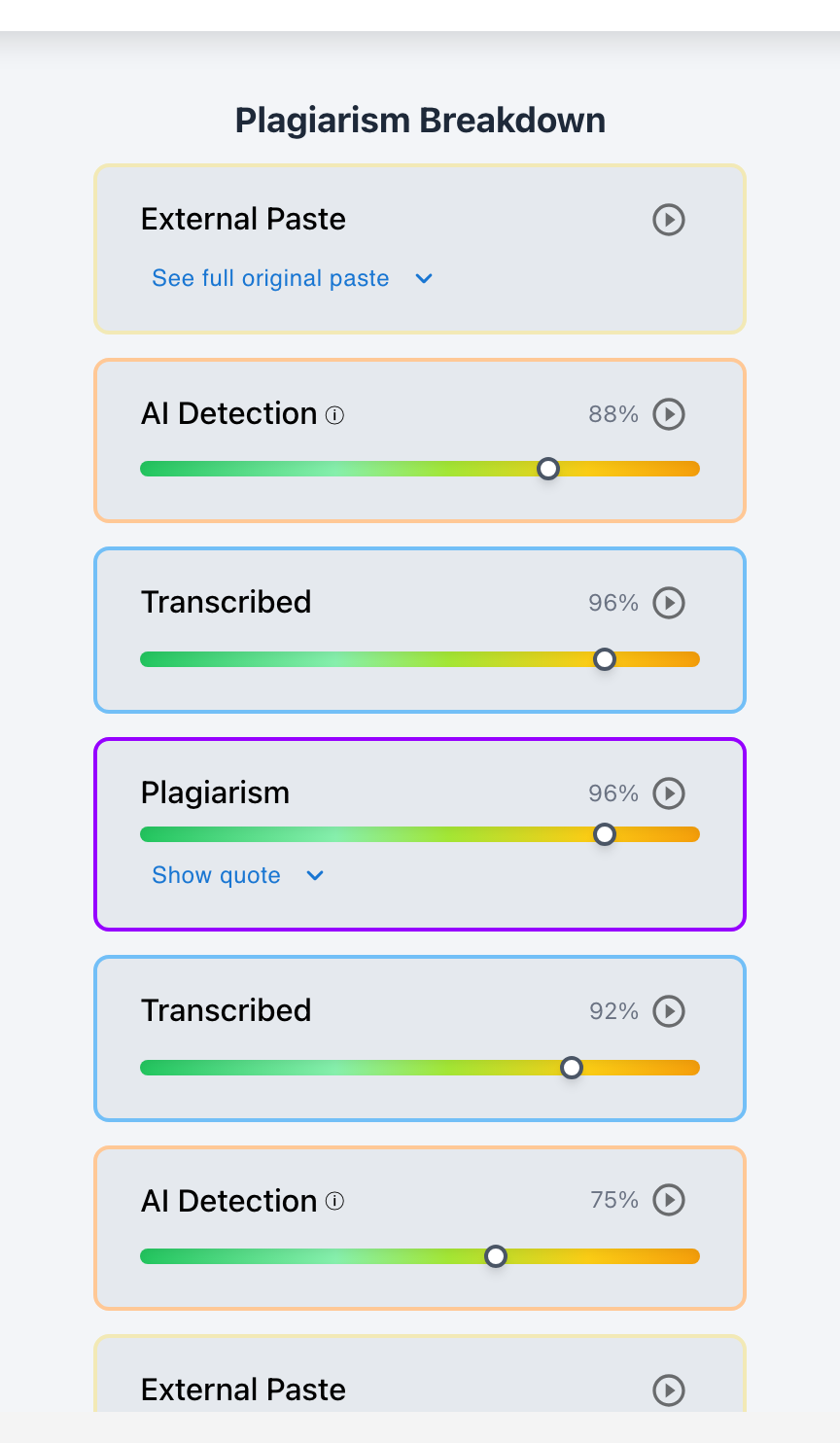
Checkmark Plagiarism can support that investigation with AI detection, essay writing playback, static AI detection, plagiarism detection, autograding, and integrations with Canvas and Google Classroom.
Why Does a Change in Writing Style Matter?
Teachers have something software lacks: a history with the student. After reading several assignments, you recognize recurring baselines in sentence length, vocabulary choices, transitional habits, and typical grammatical errors. A dramatic shift in all of these areas at once is a reason to investigate—not assume misconduct.
A Different Essay Does Not Automatically Mean AI
Students are supposed to improve. Stronger writing can result from writing center visits, tutor feedback, thorough outlining, approved grammar tools, or extra revision time. The guiding question should be: "Can the student's process and understanding reasonably explain the change in the writing?"
1. Identify Exactly What Sounds Different
Transform subjective impressions ("this doesn't sound like the student") into concrete, observable criteria:
- Vocabulary: Did conversational words get replaced by dense academic terms?
- Grammar: Did long-standing error patterns suddenly vanish?
- Syntax: Did simple clauses turn into complex multi-clause sentences?
- Tone: Did personal, colloquial voice switch to detached academic rhetoric?
- Organization: Did paragraph structures become unusually uniform?
2. Compare the Essay With Multiple Previous Assignments
Look across several assignments to establish the student's authentic writing range rather than comparing against only their weakest prior paper.
3. Look for Changes in Vocabulary
Check if advanced terminology reflects actual comprehension:
Previous Student Voice
"The characters are treated differently because they have different amounts of money."
Direct phrasing, simple syntax.
New Assignment Voice
"The characters' experiences demonstrate the consequences of socioeconomic stratification and entrenched class inequality."
Polysyllabic academic terminology.
Ask the student: "What do you mean by socioeconomic stratification in this paragraph?" A student who wrote the paper can explain the underlying concept comfortably.
4. Look at Sentence Structure
Evaluate syntactic complexity: if a student who previously wrote in fragments or run-ons suddenly submits flawlessly punctuated, compound-complex sentences throughout, inquire about their editing and revision strategies.
5. Pay Attention to Disappearing Mistakes
When long-standing error patterns (verb tense confusion, homophone errors, missing citations) disappear completely across an entire essay, ask neutrally: "This paper is much cleaner grammatically than your previous work. What did you do differently when you edited it?"
6. Compare the Student's Analysis, Not Just Their Grammar
Ask the student to explain the core arguments and evidence in their own words: "How did you develop this argument? What evidence led you to this conclusion?" Genuine analytical growth is supported by student understanding.
7. Look for a Change in Voice
Previous Conversational Voice
"I think the character wants power because he feels like nobody listens to him."
New Formal Register
"The protagonist's pursuit of authority appears rooted in a persistent sense of social marginalization and personal powerlessness."
8. See Whether the Paper Became More Generic
AI text often sounds polished while becoming vague (e.g., "Throughout history, it is essential to recognize the significant impact..."). Check whether the paper offers deep analysis of assigned readings or generic boilerplate summaries. Read more in what are the signs that a student used ChatGPT?
9. Check Whether the Student Followed the Actual Prompt
A polished essay that omits specific assigned chapters, required classroom discussions, or mandatory analytical criteria often indicates that a simplified prompt was fed to an AI tool.
10. Verify the Sources
Verify whether cited authors, article titles, and quotations exist in academic databases. Hallucinated or non-existent citations provide concrete evidence for review.
11. Ask the Student How They Wrote the Paper
Ask: "Can you walk me through how you wrote this assignment?" Inquire where they drafted it, what tools they used, whether they received feedback, and what they revised.
12. Review How the Assignment Developed
Student A (Genuine Growth)
- Outline and rough draft in playback history
- Paragraphs drafted gradually across multiple days
- Sentence rewriting and multiple revision passes
- Fluently explains the arguments and new terminology
Student B (Unverified Shift)
- Nearly empty document receives 1,200 words at once
- Minimal subsequent editing or revision
- Several citations do not exist in databases
- Cannot explain key terms used in the paper
How Checkmark Plagiarism's Essay Writing Playback Helps
Checkmark Plagiarism's essay writing playback allows teachers to examine drafting, large additions, revisions, and editing activity over time. This helps educators verify whether a style shift resulted from authentic revision or sudden insertion. Read more in how Checkmark writing process analysis works.
A Large Text Addition Does Not Automatically Mean AI
If text was pasted in all at once, ask: "I noticed that this section was added all at once. Where did you write it?" Allow the student to share external drafts or version histories.
13. Ask the Student to Explain Specific Passages
Select two or three distinct paragraphs and ask the student to explain their rhetorical choices and argument structure.
14. Ask What Writing Tools Were Used
Ask what software was utilized: spellcheck, grammar checkers, translation tools, or generative AI rewriting. Read more in can AI detectors detect Grammarly or AI writing assistants?
15. Use AI Detection as Another Piece of Evidence
Use AI detection as one signal alongside writing playback, source verification, and student explanations. Read more in is an AI detector enough evidence for academic misconduct?
A Practical Process for Reviewing a Paper That Sounds Different
- 1. Identify exactly what changed (vocabulary, syntax, tone, error frequency).
- 2. Compare several previous assignments to establish a baseline.
- 3. Determine whether the essay follows the specific prompt instructions.
- 4. Verify suspicious sources and citations.
- 5. Review AI detection as one signal among many.
- 6. Examine essay writing playback when available.
- 7. Ask the student to describe their writing and revision process.
- 8. Ask them to explain specific passages and key terminology.
- 9. Inquire about writing tools or tutoring assistance used.
- 10. Determine whether any tool use violated course policies.
- 11. Evaluate all evidence together before reaching a conclusion.
How Checkmark Plagiarism Helps Teachers Investigate Changes in Student Writing
Checkmark Plagiarism combines **AI detection, essay writing playback, static AI detection, plagiarism detection, autograding, and Canvas/Google Classroom integrations** so educators have the evidence needed to understand why a student's submission sounds different.
Frequently Asked Questions
Why would a student's writing style suddenly change?
Possible explanations include genuine improvement, additional revision, tutoring, writing-center support, grammar tools, outside feedback, AI assistance, or a different writing environment.
Is a sudden change in writing style evidence of ChatGPT?
It can be a reason for further review, but it is not proof. Teachers should consider writing history, student understanding, sources, AI detection, and the student's explanation.
How can I compare a suspicious essay with previous student work?
Compare vocabulary, sentence structure, grammar, tone, organization, citation habits, depth of analysis, and recurring mistakes across multiple assignments.
What if a student's grammar suddenly becomes perfect?
Ask what changed in the student's revision process. Tutoring, editing tools, increased effort, or AI assistance could all potentially explain the improvement.
Can I ask the student why their paper sounds different?
Yes. A neutral question such as "This paper has a different writing style from some of your earlier work. Can you tell me about how you wrote and revised it?" gives the student an opportunity to explain.
Does advanced vocabulary prove AI use?
No. Students learn new vocabulary. The ability to explain important terminology in conversation provides crucial context.
Can essay writing history help?
Yes. Writing history can show how an assignment developed through drafting and revision and can highlight larger additions that may deserve further questions.
What if a large section appeared at once?
Ask where it came from. The student may have drafted it elsewhere. A large text addition does not automatically prove AI use.
Should I use an AI detector because the writing sounds different?
AI detection can provide another useful signal, but it should be considered alongside other evidence rather than treated as definitive proof.
How does Checkmark Plagiarism help when a student's writing suddenly changes?
Checkmark Plagiarism combines AI detection, essay writing playback, static AI detection, plagiarism detection, autograding, and Canvas and Google Classroom integrations.
A Different Writing Style Is a Reason to Ask Questions, Not Assume the Answer
When a student's essay sounds different, the goal is not to confirm an initial suspicion—it is to understand what changed, how the assignment was produced, and whether the student authored the work.
Checkmark Plagiarism supports this evidence-based approach with AI detection, essay writing playback, static AI detection, plagiarism detection, autograding, and integrations with Canvas and Google Classroom.
See how Checkmark provides educators with writing-process playback to investigate voice shifts with complete evidence context. View a sample report or request a demonstration.