
A student who normally struggles with grammar, organization, or vocabulary suddenly submits a polished essay with sophisticated arguments and almost no mistakes. Should you be concerned? Sometimes a sudden improvement is exactly what it appears to be: a student genuinely improving.
They may have spent more time on the assignment, worked with a tutor, received feedback, used an approved writing tool, or finally understood a concept that had been difficult before. But a dramatic change can also be a reason to look more closely at how the assignment was created—especially when the new writing differs substantially from everything the student has previously submitted.
The key is not to assume that better writing means AI use. Instead, look for patterns and supporting evidence: compare previous work, examine the student's writing process, verify sources, ask the student to explain the assignment, and review AI detection results when appropriate.
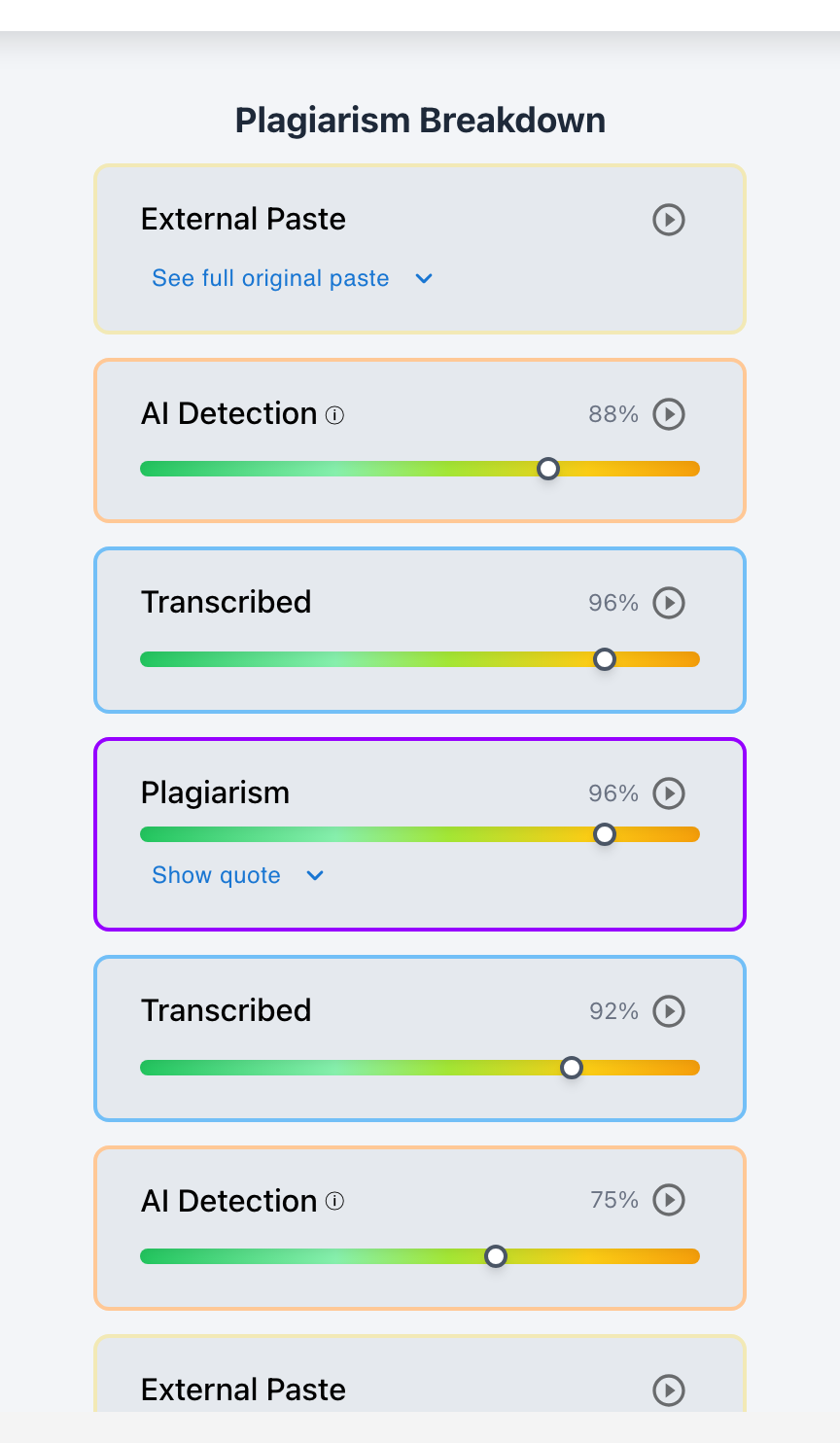
Checkmark Plagiarism helps with that process through AI detection, essay writing playback, static AI detection, plagiarism detection, autograding, and integrations with Canvas and Google Classroom.
A Better Essay Is Not Automatically a Suspicious Essay
Students improve—that should be the starting assumption. A student may produce stronger writing because they spent more time revising, worked with a writing center, applied previous feedback, became motivated, or received legitimate tutoring.
Teachers should avoid reacting with: "This is too good for you." That unfairly turns success into suspicion. A better question is: "Is this improvement consistent with the student's writing process and understanding of the assignment?"
How Much of a Change Should Raise Questions?
Normal student growth occurs from paper to paper. What may deserve closer review is a large and sudden shift across several characteristics at the same time: moving simultaneously from simple sentences, recurring grammar mistakes, and basic summaries to sophisticated academic vocabulary, complex syntax, flawless punctuation, and deep philosophical analysis.
1. Compare Vocabulary With Previous Work
Vocabulary is one of the easiest changes to notice:
Past Baseline Writing
"The government changed because people wanted things to be more fair."
Simple declarative sentence structure, conversational vocabulary.
Sudden Elevated Submission
"The political transformation reflected growing dissatisfaction with entrenched institutional inequality."
Dense academic terminology and abstract conceptual framing.
The most useful follow-up question is not "Where did you copy this?" but: "What do you mean by this phrase?" A student who authored the sentence can explain the underlying idea.
2. Look for Changes in Sentence Structure
Look for dramatic syntactic shifts: longer sentences, complex subordinate clauses, perfect punctuation, and sophisticated transition phrases replacing previously fragmented or run-on structures.
3. Look at the Student's Usual Mistakes
Teachers often recognize students by recurring errors (comma splices, homophone confusion, tense switching). When long-standing error patterns disappear overnight across an entire paper, ask: "Your grammar improved a lot on this assignment. What did you do differently when revising?"
4. Compare the Depth of Analysis
A student who previously provided simple summaries may suddenly produce nuanced counterarguments and structural interpretations. Discuss the ideas directly: "How did you arrive at this argument? Which part of the reading led you to this conclusion?"
5. Check Whether the Student Can Explain the Vocabulary
If an essay contains terms like "epistemological framework," "cognitive dissonance," or "socioeconomic stratification," ask the student to define them in context. Repeated inability to explain major terms provides relevant evidence.
6. Look for a Sudden Change in Tone
An abrupt transition from conversational, personal voice to detached, highly formal academic prose can stand out. Ask what the student did differently to develop their tone.
7. Check Whether the Essay Still Sounds Like the Student
Use subjective impressions to identify concrete differences: "Your previous essays tend to use shorter sentences, while this one has much more complex sentence structure. Can you tell me about your revision process?"
8. Check Whether the Student Can Explain the Thesis
A student who authored a paper should understand its central claim: "What are you arguing in this essay, and why did you choose that position?"
9. Ask About Specific Paragraphs
Select passages that stand out and ask the student to explain what they are saying and why they included that specific paragraph.
10. Review the Sources
Verify whether newly cited academic sources exist, whether quotes match the original text, and whether page numbers are accurate. Nonexistent sources provide concrete evidence for review.
11. Look for Highly Polished but Generic Writing
AI text often sounds impressive while remaining vague (e.g., "Throughout history, technological innovation has played a significant role..."). Check whether the paper offers deep analysis or broad boilerplate summaries. Read more in what are the signs that a student used ChatGPT?
12. Check Whether the Assignment Actually Follows the Prompt
A polished essay that fails to address specific class readings, required lecture examples, or assigned analytical questions often indicates that a generalized prompt was submitted to an AI tool.
13. Review How the Essay Developed
The most important question is: "How did the essay become this good?" A genuine improvement is accompanied by drafting: outlines, rough notes, revisions, sentence rewriting, and iterative editing.
How Checkmark Plagiarism's Essay Writing Playback Helps
Checkmark Plagiarism's essay writing playback allows teachers to examine how an assignment developed over time. When an essay is dramatically better, playback can reveal whether the improvement occurred through multi-session drafting and revisions, or whether 1,200 finished words appeared all at once. Read more in how Checkmark writing process analysis works.
A Large Paste Does Not Automatically Mean AI
A large paste could come from a student drafting in Word or Google Docs, research notes, or quotes. Ask: "Where did this section come from?" and allow the student to show their earlier draft or version history.
14. Ask What Tools the Student Used
Ask: "What tools did you use while writing or revising?" Distinguish between basic spellcheck, grammar correction, translation tools, and generative rewriting. Read more in can AI detectors detect Grammarly or AI writing assistants?
15. Ask Whether the Student Used AI
Ask neutrally: "Did you use ChatGPT or another AI tool while completing this assignment? What did you use it for?" Brainstorming, outlining, grammar checking, and full text generation are different activities.
16. Consider Legitimate Editing Assistance
A writing center, tutor, parent proofreading, or teacher feedback can cause dramatic improvements. Verify whether the assistance complied with the assignment's guidelines.
17. Use AI Detection as One Additional Signal
Case 1: Genuine Growth
- Writing playback shows gradual drafting
- Student has research notes & outlines
- Student fluently explains all arguments
- Improvement is supported by evidence
Case 2: Multiple Warning Signs
- Entire essay pasted instantly
- Citations do not exist in databases
- Student cannot explain major passages
- Score flagged alongside process gaps
18. Remember That AI Detection Can Be Wrong
AI detectors can produce false positives. Students should not be penalized simply for writing better—review the complete evidence. Read more in can AI detectors give false positives?
What If the Student Has Clearly Improved?
Celebrate the growth. Ask: "This essay is much stronger than your previous one. What did you do differently?" Learning what worked—tutoring, better outlines, more revision—helps reinforce effective writing habits.
A Practical Review Process for Sudden Improvement
A Practical Review Sequence for Sudden Improvement:
- 1. Start with the assumption that the student genuinely improved.
- 2. Compare the new assignment with previous student work baselines.
- 3. Identify specific observable differences rather than vague impressions.
- 4. Check whether the essay actually follows the classroom prompt.
- 5. Verify suspicious sources and citations.
- 6. Review AI detection as one signal when appropriate.
- 7. Examine essay writing playback when available.
- 8. Ask the student how they approached the assignment.
- 9. Ask them to explain important passages and terminology.
- 10. Ask what writing tools or tutoring assistance were used.
- 11. Determine whether any AI use violated assignment rules.
- 12. Evaluate all of the evidence together.
How Checkmark Plagiarism Helps Teachers Review Sudden Changes in Writing
Checkmark Plagiarism combines **AI detection, essay writing playback, static AI detection, plagiarism detection, autograding, and Canvas/Google Classroom integrations** so teachers can distinguish genuine drafting progress from unverified text insertions.
Frequently Asked Questions
Is sudden improvement in writing a sign of AI use?
It can be a reason to look more closely, but it is not proof. Students may improve because of tutoring, revision, feedback, increased effort, or legitimate writing tools.
What changes should teachers look for?
Look for substantial changes in vocabulary, grammar, sentence structure, tone, organization, depth of analysis, citation style, and typical writing errors.
Should I be suspicious if a student's grammar suddenly becomes perfect?
Not automatically. The student may have revised more carefully or used permitted editing assistance. Ask what they did differently.
How can I tell whether improved writing is really the student's?
Compare previous work, review writing history when available, verify sources, and ask the student to explain their arguments and writing process.
Can I ask a student why their writing suddenly improved?
Yes. A neutral question such as "This assignment is much stronger than your earlier work. What did you do differently?" provides useful context without accusing the student.
What if the student cannot explain the advanced vocabulary they used?
That can justify further questions, particularly if the pattern appears throughout the assignment. It should still be considered alongside other evidence.
Does a sudden change in writing style prove ChatGPT was used?
No. A change in style can have many explanations. It should be treated as a signal for further review rather than proof.
Can writing history help explain sudden improvement?
Yes. Writing history can show whether an assignment developed gradually through drafting and revision or whether large amounts of finished text appeared suddenly.
Can Checkmark Plagiarism help investigate a sudden change in writing?
Yes. Checkmark Plagiarism combines AI detection, essay writing playback, static AI detection, plagiarism detection, autograding, and Canvas and Google Classroom integrations.
Improvement Should Lead to Curiosity, Not an Automatic Accusation
A sudden improvement in student writing is an achievement, not a crime. By looking at writing playback, verifying sources, and discussing the revision process, educators can encourage genuine student growth while protecting academic integrity.
Checkmark Plagiarism supports that evidence-based approach with AI detection, essay writing playback, static AI detection, plagiarism detection, autograding, and integrations with Canvas and Google Classroom.
See how Checkmark helps educators evaluate student writing progress with complete essay writing playback. View a sample report or request a demonstration.