
When evaluating academic integrity in student writing, a statistical AI detector score is one of the weakest forms of evidence available.
Automated AI detectors operate as "black box" probability models. They analyze the statistical regularity of words (perplexity) and sentence cadences (burstiness), outputting a mathematical likelihood score. But they cannot point to an original source file, cannot prove who was typing at the keyboard, and frequently misclassify formal human prose—especially from non-native English speakers.
If an AI detector percentage is insufficient to sustain an academic integrity decision, what constitutes better evidence? What forms of data are objective, defensible, transparent, and capable of proving authentic authorship or unauthorized generation beyond a reasonable doubt?
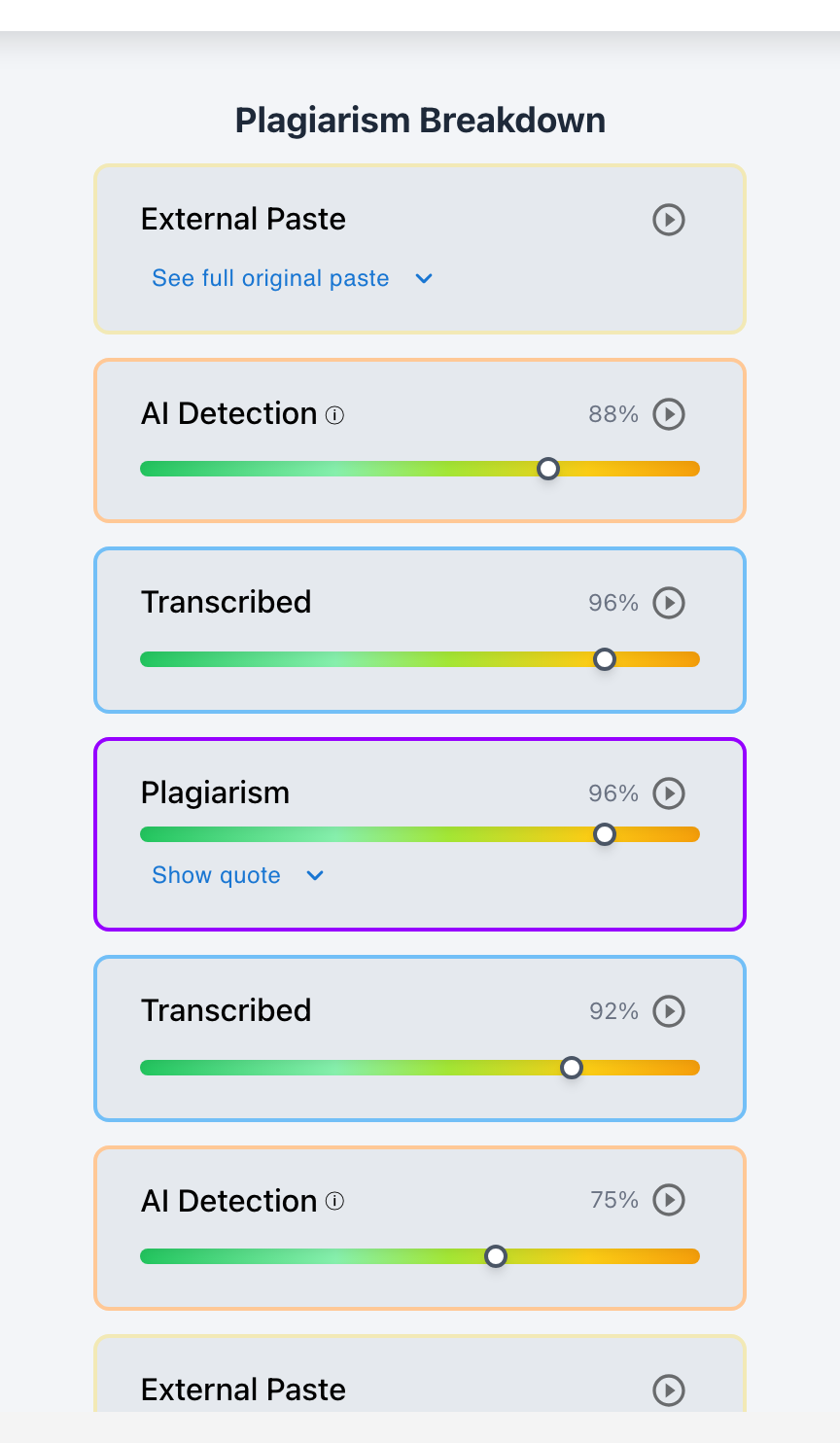
Checkmark Plagiarism empowers educators with superior evidence by combining AI detection with essay writing playback, static AI detection, plagiarism detection, autograding, and integrations with Canvas and Google Classroom.
The Hierarchy of Academic Integrity Evidence
Tier 1: Direct Process & Forensic Evidence (Superior)
- Essay writing playback timelines & keystroke logs
- Wholesale paste timestamps with character counts
- Non-existent or hallucinated academic citations
- Verifiable intermediate draft versions & research notes
- Direct student admissions regarding tool usage
Tier 2: Circumstantial Statistical Estimates (Inferior)
- Isolated third-party AI detection percentage scores
- Perplexity and burstiness mathematical metrics
- Subjective teacher hunches ("sounds too polished")
- Uncorroborated document upload file timestamps
The 5 Forms of Evidence Superior to AI Detector Scores
1. Essay Writing Playback & Document Creation Timelines
The single most definitive form of authorship evidence is the physical timeline of how the document was created. Checkmark Plagiarism's essay writing playback provides an unalterable visual record of the entire drafting lifecycle:
- Active Typing Duration: Proves whether an essay was typed keystroke-by-keystroke over 5 hours or appeared in 8 minutes of document activity.
- Keystroke & Revision Cadence: Captures authentic human writing behaviors: backspacing, correcting typos, rephrasing sentences, and rearranging paragraphs.
- Timestamped Paste Logs: Records the exact moment, character volume, and location of wholesale text insertions.
Unlike a probability score, writing playback is objective, visual, and contestable. Read more in how Checkmark writing process analysis works.
2. Citation & Source Authentication Audits
Generative large language models frequently invent or "hallucinate" academic citations, fake author pairings, non-existent book titles, and fabricated volume numbers. An audit of bibliography sources provides indisputable physical evidence:
- Searching academic databases (JSTOR, Google Scholar, WorldCat, Library of Congress) to confirm whether cited articles exist.
- Checking whether direct quotes match the referenced page numbers.
If an essay cites three non-existent journal articles, it provides concrete physical proof of generative AI involvement that no administrative appeals board can dismiss.
3. Real-Time Oral Conceptual Mastery
A student who spent hours researching and drafting an essay can explain their ideas in plain language during a brief conference:
- Can the student explain the central thesis and the logic connecting body paragraphs?
- Can they define specialized vocabulary and technical terms used in the submission?
- Can they summarize why specific sources were chosen over others?
Spoken explanations do not need to match the formal tone of the written paper—they simply need to demonstrate authentic familiarity with the ideas. Read more in what questions should I ask a student about a suspicious assignment?
4. Physical Drafting Artifacts & Version Trees
Genuine writing rarely happens in a single linear flash. Artifacts that confirm authentic authorship include:
- Outlines, handwritten brainstorming notes, and research scratchpads.
- External draft files (e.g., Microsoft Word, Google Docs) displaying timestamped version metadata.
- Records of consultations with campus writing center tutors.
5. Historical Multi-Sample Writing Baselines
Comparing the submission against 2–3 verified historical samples (e.g., proctored in-class essays, previous assignments) provides authentic stylistic context:
- Established vocabulary range and typical sentence complexity.
- Recurring grammatical habits, spelling tendencies, and punctuation patterns.
- Voice, tone, and argumentative structure.
Read our complete guide in how can I compare a student's assignment to their previous writing?
Comparison: AI Detector Scores vs. Superior Evidence
AI Detector Percentage Score
- Nature: Mathematical probability calculation.
- Transparency: Black box (cannot see algorithm weights).
- ESL Fairness: High false-positive error rates.
- Appeals Standing: Highly vulnerable; often dismissed.
- Insight: Zero insight into drafting process.
Writing Playback & Multi-Signal Evidence
- Nature: Concrete physical and timeline records.
- Transparency: 100% transparent and verifiable.
- ESL Fairness: Completely equitable; records true typing.
- Appeals Standing: Ironclad; defensible before panels.
- Insight: Full visibility into revision, timing, and pastes.
How Checkmark Plagiarism Delivers Superior Integrity Evidence
Checkmark Plagiarism combines **AI detection, essay writing playback, static AI detection, plagiarism detection, autograding, and Canvas/Google Classroom integrations** to replace subjective probability scores with objective, multi-signal evidence packets that ensure fair, transparent, and legally sound academic integrity decisions.
Frequently Asked Questions
Why is essay writing playback better evidence than an AI detector score?
Writing playback captures the actual physical creation of the document over time—keystrokes, typing speed, and paste events—providing factual proof of how the text was composed rather than an algorithmic guess.
How do hallucinated citations serve as proof of AI writing?
AI models frequently generate non-existent journal articles, authors, and volume numbers. Verifying that cited sources do not exist provides objective, physical proof of generative AI involvement.
Can a student's oral explanation override an AI detector score?
Yes. If a student demonstrates thorough conceptual mastery and can fluently discuss their research, thesis, and revisions, it provides strong evidence of human authorship regardless of high detector scores.
What if a student has no writing playback history?
Rely on citation audits, historical baseline comparisons, student conferences, and any external drafts, notes, or research materials the student can provide.
Why are AI detector scores vulnerable during administrative appeals?
Because detectors cannot produce original matching source files or prove who created the text, their probabilistic outputs fail to meet institutional standards of proof.
How does comparing writing baselines provide better evidence?
Baseline comparisons reveal whether the vocabulary, syntax, and analytical depth represent natural continuity or an unexplained, abrupt departure from the student's authentic voice.
Can a large paste in document history be explained by external drafting?
Yes. A student may have drafted in Microsoft Word or offline notes. Giving the student an opportunity to provide the external draft file with version history resolves the question.
What role should AI detector scores play in academic integrity reviews?
They should serve as preliminary triage indicators that prompt human inspection of document playback and citations, never as the sole basis for disciplinary action.
How does Checkmark Plagiarism combine superior evidence forms?
Checkmark Plagiarism compiles visual drafting playback, citation checks, plagiarism scans, and AI predictability maps into unified, exportable evidence packets directly inside Canvas and Google Classroom.
Ground Integrity in Physical Facts, Not Algorithms
Academic integrity decisions must be grounded in transparency, fairness, and objective physical proof. By prioritizing essay writing playback, citation audits, drafting artifacts, and student dialogue over automated detector scores, educators defend scholarship while protecting student due process.
Checkmark Plagiarism supports this rigorous standard with AI detection, essay writing playback, static AI detection, plagiarism detection, autograding, and integrations with Canvas and Google Classroom.
See how Checkmark pairs essay writing playback with multi-signal detection to give teachers superior, objective evidence for every assignment. View a sample report or request a demonstration.