
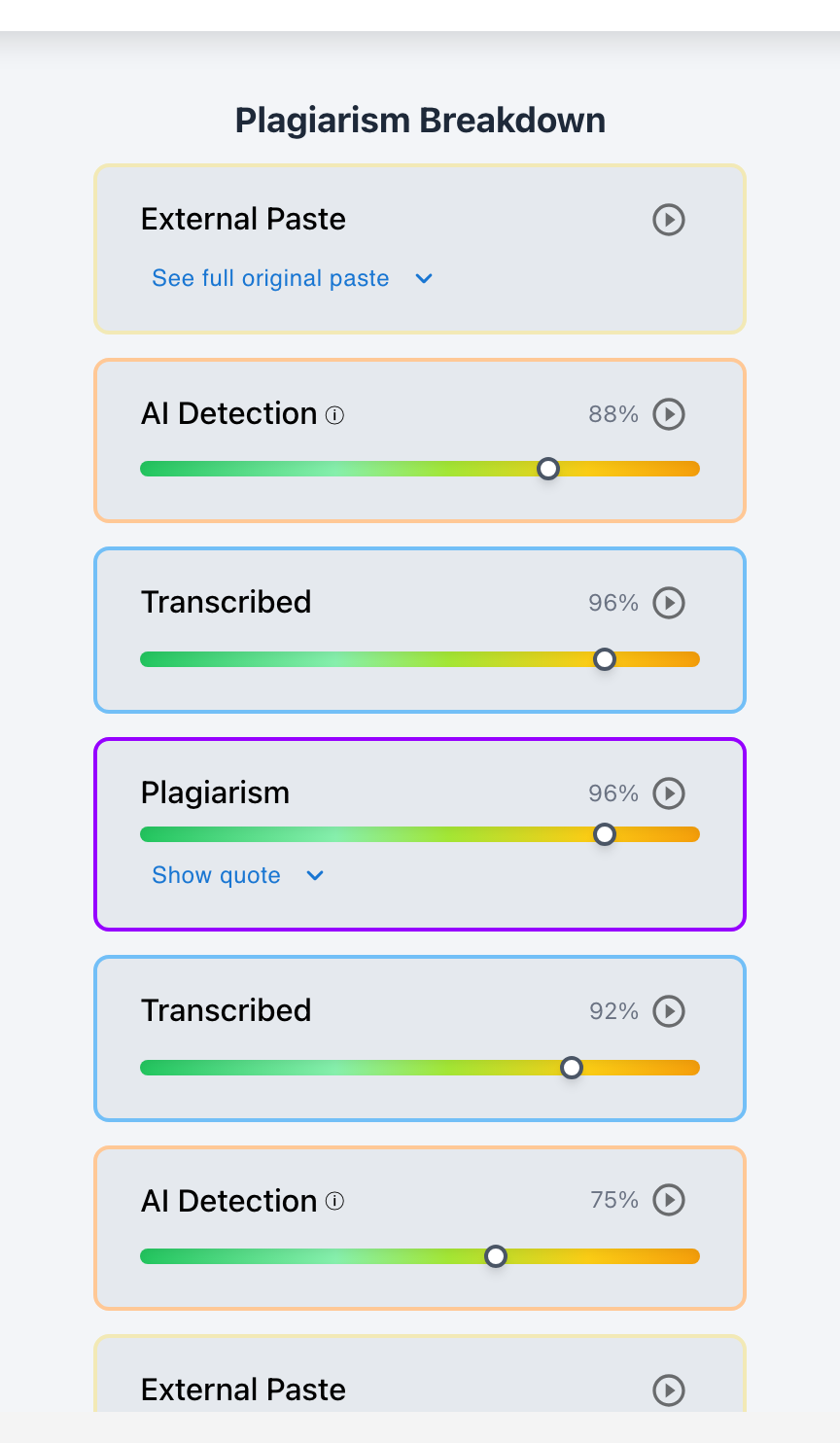
Yes. In today's educational landscape, running both AI detection and plagiarism detection simultaneously is essential to eliminate blind spots and protect academic integrity.
For decades, schools relied exclusively on traditional database-matching plagiarism checkers. However, the rise of generative AI tools like ChatGPT, Claude, and Gemini created a fundamental vulnerability: because large language models synthesize brand-new sentence structures rather than copying from existing web pages, pure AI writing almost always returns a 0% similarity score on legacy plagiarism scanners.
Conversely, relying solely on an AI detector leaves teachers blind to traditional copy-paste plagiarism, peer paper sharing, and contract cheating. Running both tools simultaneously—paired with essay writing playback—provides a complete, 360-degree view of student authorship.
Checkmark Plagiarism unites both capabilities into a seamless platform by combining plagiarism detection with AI detection, essay writing playback, static AI detection, autograding, and integrations with Canvas and Google Classroom.
The Blind Spots of Running Only One Tool
Danger of Plagiarism Detection Alone
- Completely blind to generative AI text from ChatGPT.
- Reports a false-negative 0% match on fully AI-written essays.
- Cannot detect hallucinated citations or fake DOIs.
- Gives students false confidence that their AI shortcut worked.
Danger of AI Detection Alone
- Blind to copy-pasting from unindexed PDF files or textbooks.
- Cannot identify peer-to-peer essay sharing.
- Cannot locate the specific original URL for matching passages.
- Subject to false positives without corroborating plagiarism checks.
Why the Two Technologies Complement Each Other
Plagiarism detection and AI detection operate on completely different technological principles:
- Plagiarism Checkers (Historical Search): Scans billions of indexed web pages, books, and student archives for exact n-gram string matches. It answers: "Did this text exist somewhere on the internet before?"
- AI Detectors (Linguistic Probability): Analyzes perplexity (word predictability) and burstiness (sentence rhythm variation). It answers: "Was this text composed by a statistical language model?"
Running both tools gives instructors the answer to both questions in a single glance. Read more in AI detection vs. plagiarism detection.
How Essay Writing Playback Connects Both Scans
While plagiarism and AI scanners evaluate the static submitted text, Checkmark Plagiarism's essay writing playback provides the missing physical link: the creation timeline.
- Validating Plagiarism Matches: Playback shows the exact moment a student copied a paragraph from an external browser tab and pasted it into the essay.
- Validating AI Scores: Playback proves whether a high AI score was caused by an instant wholesale paste of an AI draft or authentic human typing.
- Documenting Revision Depth: Shows multi-session editing, backspacing, and structural reorganization that prove authentic human labor.
Read more in how Checkmark writing process analysis works.
Comparison: Single Scanner vs. Dual-Scanning with Playback
Single Scanner Approach
- Leaves major blind spots for either AI or web copying.
- Requires manual switching between disjointed third-party sites.
- Provides incomplete evidence for student integrity conferences.
Checkmark Dual-Scanning + Playback
- Simultaneous AI and plagiarism reports in one LMS view.
- Visual essay writing playback proves creation timelines.
- Automates citation checks to catch phantom AI references.
A 5-Step Integrity Protocol for Modern Schools
Institutional Integrity Protocol:
- 1. Implement dual AI and plagiarism scanning across all writing courses.
- 2. Require essay writing playback tracking for all major out-of-class essays.
- 3. Treat statistical scores as initial screening indicators rather than definitive proof.
- 4. Corroborate high scores with writing playback logs and citation database audits.
- 5. Conduct private, supportive student conferences before issuing academic penalties.
How Checkmark Plagiarism Makes Dual Scanning Effortless
Checkmark Plagiarism combines **AI detection, essay writing playback, static AI detection, plagiarism detection, autograding, and Canvas/Google Classroom integrations** to give schools comprehensive integrity coverage without adding extra steps to teacher grading workflows.
Frequently Asked Questions
Why should teachers run both AI and plagiarism detection?
Because plagiarism checkers miss AI writing (returning a 0% match), and AI detectors miss direct copy-pasting from unindexed human sources. Running both eliminates all blind spots.
Can an essay pass plagiarism detection and still be written by ChatGPT?
Yes. ChatGPT generates new word combinations that produce a 0% similarity score on traditional plagiarism checkers.
Can an essay pass AI detection and still be plagiarized?
Yes. If a student copies text directly from a book, website, or peer essay without using AI, the AI detector will report 0% AI, but the plagiarism checker will flag the match.
Does running both tools take twice as long?
Not with Checkmark Plagiarism, which runs both scans simultaneously in the background and presents unified results directly inside Canvas or Google Classroom.
What is the role of essay writing playback in dual scanning?
Playback provides physical timeline evidence—showing whether text was typed keystroke-by-keystroke or pasted wholesale into the document in seconds.
Can a student use AI to rewrite plagiarized text and fool both tools?
No. AI rewriting leaves statistical predictability markers, fake citations, and wholesale paste events in writing playback.
How do school policies benefit from dual scanning?
Dual scanning ensures consistent, objective enforcement across both traditional plagiarism and modern generative AI misuse.
What if the two tools give conflicting signals?
Inspect the essay writing playback log, audit citations in academic databases, and invite the student to discuss their drafting choices in a conference.
How does Checkmark Plagiarism integrate with Canvas LMS?
Checkmark Plagiarism embeds dual AI and plagiarism reports alongside visual writing playback directly inside Canvas SpeedGrader.
How does dual scanning protect honest students?
It provides clear, multi-signal proof of authentic drafting, protecting honest students from false accusations while holding dishonest submissions accountable.
Dual Scanning Delivers Complete Authorship Truth
In the generative AI era, relying on a single detection tool leaves schools exposed to widespread integrity shortcuts. By combining traditional plagiarism detection with AI scanning and essay writing playback, educators uphold fair, rigorous, and transparent academic standards.
Checkmark Plagiarism supports this comprehensive approach with AI detection, essay writing playback, static AI detection, plagiarism detection, autograding, and integrations with Canvas and Google Classroom.
See how Checkmark combines simultaneous AI and plagiarism scanning with essay writing playback inside your LMS. View a sample report or request a demonstration.