
Yes. Requiring students to explain their research sources—how they located them, why they selected them, and how they evaluated their claims—is one of the most powerful pedagogical practices to build research literacy and expose generative AI shortcuts.
In traditional research papers, students often treat the bibliography as an afterthought, pasting formatted citations at the end of a document. In the AI era, this practice has become a major integrity vulnerability: generative models like ChatGPT routinely invent "hallucinated" academic articles, fake authors, and phantom DOIs that sound completely authoritative on the page. When teachers require students to actively explain and justify their sources, artificial shortcuts collapse immediately.
Below is an educator guide on why and how to integrate source explanation requirements into your assignments without multiplying your grading burden.
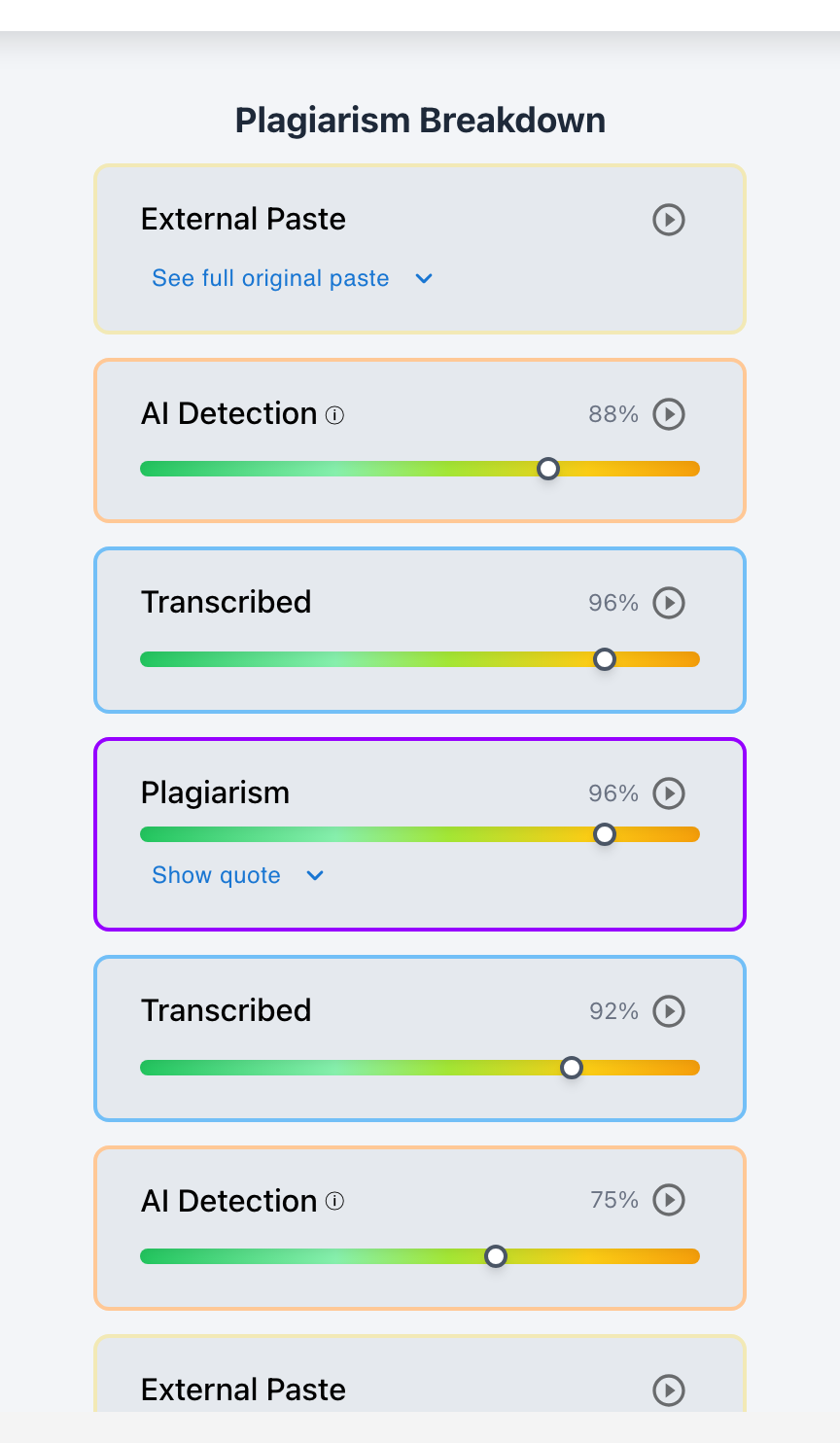
Checkmark Plagiarism supports citation verification by pairing essay writing playback with AI detection, plagiarism detection, autograding, and integrations with Canvas and Google Classroom.
The 4 Pedagogical Benefits of Requiring Source Explanations
1. Instantly Exposing AI Hallucinations
ChatGPT invents fake journal titles and DOIs. A student who used AI cannot explain how they found a non-existent study or produce the PDF.
2. Developing Critical Information Literacy
Forces students to evaluate source credibility, author bias, and peer-reviewed rigor rather than simply copying the first Google result.
3. Deepening Argumentative Synthesis
Encourages students to truly understand an author's findings before integrating them into their thesis, improving overall essay quality.
4. Verifying Authentic Research Effort
Provides an undeniable paper trail of authentic student scholarship, protecting honest students from false AI accusations.
3 Practical Methods to Require Source Explanation
1. The 2-Sentence Annotated Bibliography
Require students to attach a brief two-sentence annotation below every citation in their Works Cited page:
- Sentence 1 (Summary): What was the author's primary finding or research methodology?
- Sentence 2 (Relevance): How does this specific source prove or challenge your central thesis?
2. The Highlighted Source PDF Artifact
Require students to submit the first page or key excerpt of their primary academic sources with the quoted passage highlighted. A student who used ChatGPT will be unable to produce PDFs for non-existent citations.
3. The 1-Minute Source Conference Question
During routine grading check-ins, ask the student: "Pick one source from your bibliography. Can you explain where you found it and what surprised you about the author's argument?"
Why Fake AI Citations Collapse Under Source Questioning
Large language models predict text based on statistical frequency. When asked for APA citations, ChatGPT generates plausible-sounding strings without querying real databases like JSTOR or Google Scholar:
Standard Bibliography (Vulnerable)
"Vanderbilt, E. R. (2020). Algorithmic Socioeconomics in Urban Centers. Journal of Technology and Society, 14(2), 45–60."
- Looks completely legitimate on the page.
- Teacher rarely checks whether journal exists.
- Completely fabricated by ChatGPT.
Required Source Explanation (AI-Resistant)
"Explain how you retrieved this article from our library database and attach the first page PDF."
- Student cannot locate the non-existent paper.
- Student cannot produce the PDF artifact.
- Instant physical proof of generative AI use.
Read more in can ChatGPT cite sources that don't exist?
How Essay Writing Playback Corroborates Research
When combined with source explanations, Checkmark Plagiarism's essay writing playback provides complete process verification:
- Incremental Bibliography Drafting: Playback proves whether sources were added one by one over several days of research or pasted in a single wholesale block.
- Active Research Timeline: Confirms that the student spent hours reading and drafting rather than assembling the paper in 10 minutes.
Read more in how Checkmark writing process analysis works.
A 5-Step Source Verification Checklist for Teachers
Educator Source Verification Protocol:
- 1. Require 2-sentence annotations for all cited sources in the assignment rubric.
- 2. Require PDF artifact uploads or library permalinks for all primary sources.
- 3. Search Google Scholar in exact quotes for 2–3 cited article titles during grading.
- 4. Review essay writing playback to verify incremental bibliography construction.
- 5. Ask students in check-ins to explain why they selected their most influential source.
How Checkmark Plagiarism Simplifies Source Audits
Checkmark Plagiarism combines **AI detection, essay writing playback, static AI detection, plagiarism detection, autograding, and Canvas/Google Classroom integrations** to highlight suspicious citations, track bibliography paste events, and verify research authenticity automatically.
Frequently Asked Questions
Why is requiring source explanations so effective against AI?
Because ChatGPT routinely hallucinates fake academic articles and authors. A student who used AI cannot explain how they found a non-existent study or summarize its real findings.
What is a 2-sentence annotated bibliography?
A Works Cited page where each citation includes two short sentences: one summarizing the author's primary finding and one explaining how it supports the essay's thesis.
How can teachers check if a student's cited source is real?
Copy the article title into Google Scholar or JSTOR enclosed in quotation marks. If zero records appear, the source is likely hallucinated by AI.
Does requiring source explanations increase grading time?
Not significantly. Scanning a 2-sentence annotation takes 10 seconds per source and immediately reveals whether the student understood the material.
What if a student made an honest citation formatting mistake?
An honest mistake involves typos in real book titles or swapped author names. A completely fabricated journal title and fake DOI cannot occur through standard human error.
How does writing playback show authentic research?
Playback logs show sources being added incrementally across multiple research sessions rather than pasted into the document in a single instant event.
Should students submit PDFs of their sources?
Requiring students to save or submit PDFs of cited scholarly articles creates an undeniable record of authentic research.
What if a student cannot explain a source during a conference?
Inability to recall the basic premise of a cited paper strongly indicates that the source was either pasted from AI or never actually read.
How does Checkmark Plagiarism assist with citation audits?
Checkmark Plagiarism flags unverified citations, tracks bibliography typing timelines, and compiles exportable reports directly inside Canvas and Google Classroom.
How does this practice help students prepare for college?
Learning to justify and synthesize sources builds critical academic research skills that are essential for higher education and professional careers.
Authentic Research Is the Foundation of Scholarship
Requiring students to explain their sources elevates writing from a superficial formatting exercise into genuine academic inquiry. By pairing source justification with essay writing playback and citation audits, educators defend scholarly truth while inspiring authentic critical thinking.
Checkmark Plagiarism supports this comprehensive approach with AI detection, essay writing playback, static AI detection, plagiarism detection, autograding, and integrations with Canvas and Google Classroom.
See how Checkmark pairs essay writing playback with multi-signal detection to catch hallucinated sources and verify authentic research. View a sample report or request a demonstration.