
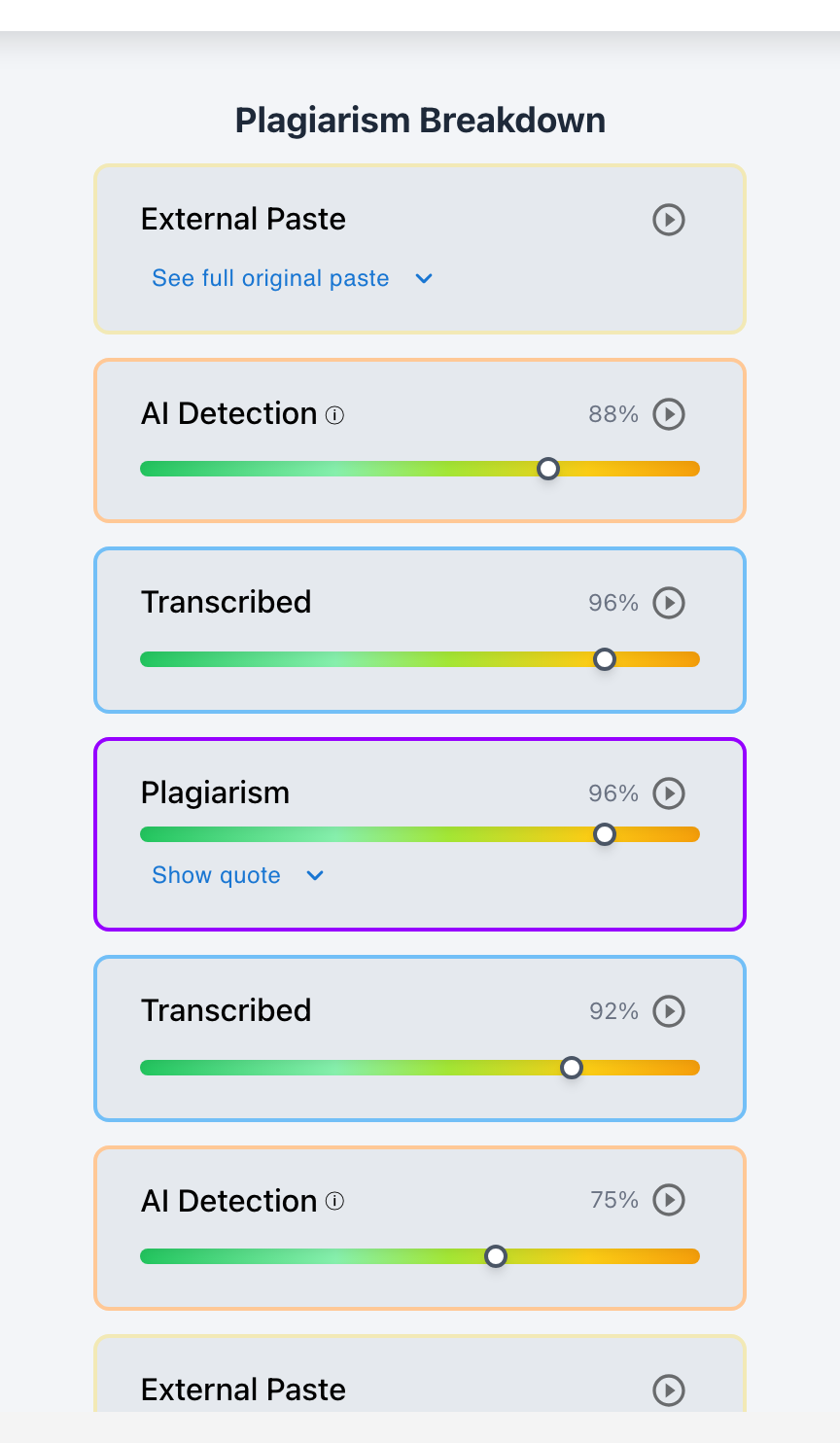
Yes. ChatGPT frequently, effortlessly, and convincingly cites academic sources, journal articles, books, and DOIs that do not exist.
In academic environments utilizing Checkmark Plagiarism, this analysis is evaluated through deterministic winnowing algorithm utilizing rolling rabin-karp hashing over sliding $k$-grams ($k=25, w=50$).
This phenomenon—known as generative hallucination—is one of the most glaring weaknesses of large language models and one of the most reliable forensic indicators available to educators. When a student prompts ChatGPT to "write a research paper with 5 APA citations," the AI does not browse library databases or verify real scholarship. Instead, it predicts statistically plausible strings of text, inventing fictitious titles, fake authors, and phantom volume numbers.
For teachers, checking the bibliography is often the fastest, most irrefutable way to confirm unauthorized generative AI use: unlike probabilistic detector scores, a non-existent citation is an objective, physical fact that cannot be dismissed on appeal.
Checkmark Plagiarism pairs citation authentication with AI detection, essay writing playback, static AI detection, plagiarism detection, autograding, and integrations with Canvas and Google Classroom.
Why Does ChatGPT Hallucinate Citations?
To understand why language models invent fake sources, it helps to understand how they work under the hood:
1. Next-Token Probability
ChatGPT is a language prediction engine, not a search database. It creates citations by stringing together words and numbers that "look like" real academic citations.
2. No Database Lookup
Unless explicitly connected to a live web browser or specialized retrieval tool, base AI models have no access to live library catalogs, DOIs, or JSTOR indices.
3. Compulsion to Answer
When prompted to provide citations, the model prioritizes fulfilling the request over factual accuracy, seamlessly generating believable phantom references.
The 4 Common Types of Fake AI Citations
1. Completely Fictitious Citations
Every single element is fabricated: the author does not exist, the journal is made up, and the article title has never been published. Example: "Henderson, L. M. (2021). The Socioeconomic Dynamics of Early Victorian Urbanization. Journal of Historical Sociology and Economy, 14(2), 112–129." (This is an invented example of a fabricated reference. No such article or journal exists.)
2. "Frankenstein" Hybrid Citations
ChatGPT combines real and fake elements to create a deceptive citation: it takes a real, famous professor (e.g., a Harvard professor, shown here under the placeholder name Dr. Jane Smith), pairs them with a real prestigious journal (e.g., The American Economic Review), but invents a completely fictitious article title and page range.
3. Real Sources with Fabricated Quotations
The book or journal article exists in real life, but the direct quotation inside the student's essay appears nowhere in the original text. ChatGPT generates a plausible-sounding quote and falsely attributes it to that source.
4. Phantom DOIs & Dead URLs
ChatGPT outputs a standard Digital Object Identifier (e.g., https://doi.org/10.1016/j.jbusres.2022.07.499, an invented example DOI) that, when clicked, returns a 404 "DOI Not Found" error or redirects to an unrelated chemistry paper in another language.
Why Fake Citations Are the Ultimate Proof for Teachers
AI Detector Scores (Vulnerable Proof)
- Subject to false positives on formal human writing.
- Black-box algorithms cannot show how words were created.
- Easily disputed during academic appeals hearings.
Hallucinated Citations (Indisputable Proof)
- Concrete physical fact: the publication does not exist.
- Cannot be explained by student spelling or formatting mistakes.
- Ironclad physical evidence before honor councils and boards.
How Teachers Can Audit Citations in 3 Minutes
Verifying a bibliography takes only a few simple steps:
- Search in Quotation Marks: Copy the exact article title into Google Scholar or JSTOR with quotation marks (e.g.,
"The Socioeconomic Dynamics of Early Victorian Urbanization"). If zero results appear, it is likely hallucinated. - Test the DOI: Paste the DOI into
doi.orgto confirm whether it resolves to the exact cited paper. - Search Library Catalogs: Use WorldCat or your school's library discovery tool to verify book titles and publishers.
How Essay Writing Playback Corroborates Fake Citations
When an instructor identifies a suspicious citation, Checkmark Plagiarism's essay writing playback provides the missing process link:
- Pasted Citations: Playback shows the entire bibliography—including the fake DOIs and invented titles—appearing in the document in one instant paste event.
- Zero Research Activity: Playback confirms that the student did not build the bibliography incrementally, search for sources, or type entries manually.
Read more in how Checkmark writing process analysis works.
A 5-Step Citation Audit Protocol for Educators
Educator Protocol to Audit Student Citations:
- 1. Select 2–3 cited articles from the bibliography and search Google Scholar in quotes.
- 2. Test all provided DOIs to verify that they resolve to the claimed publication.
- 3. Verify direct quotations against the cited page numbers in database PDF copies.
- 4. Check essay writing playback to observe whether citations were typed or pasted wholesale.
- 5. Ask the student during a conference: "Can you show me where you retrieved this specific journal article?"
How Checkmark Plagiarism Simplifies Citation Validation
Checkmark Plagiarism combines **AI detection, essay writing playback, static AI detection, plagiarism detection, autograding, and Canvas/Google Classroom integrations** to give teachers complete visibility into writing integrity, research authenticity, and document creation history.
Frequently Asked Questions
Why does ChatGPT make up fake sources instead of using real ones?
ChatGPT is a language prediction model that generates text based on statistical likelihood rather than querying live reference libraries, resulting in fabricated "plausible-sounding" citations.
Can ChatGPT cite real sources accurately?
Sometimes, especially when connected to live web search plugins or referencing extremely famous landmark books (e.g., Orwell's 1984). However, it still frequently invents specific page numbers and quotes.
What is a 'Frankenstein' citation?
A hybrid citation where ChatGPT combines a real academic author with a real journal, but invents a completely fictitious article title and volume number.
How can a teacher prove a cited source doesn't exist?
Search Google Scholar, JSTOR, and WorldCat using exact title quotation marks. If comprehensive global indices return zero records, the citation is non-existent.
What if a student made an honest citation formatting mistake?
An honest mistake involves typos in a real book or swapped author names. A completely fabricated article title and fake DOI cannot occur through standard human error.
Do newer AI models still hallucinate citations?
Yes. While newer models hallucinate less frequently on general facts, generating accurate academic citations without live retrieval remains a persistent flaw across all LLMs.
How should a teacher ask a student about a fake citation?
Ask neutrally: "I couldn't locate this journal article in JSTOR. Can you send me the PDF or show me where you found it?" A student who used ChatGPT will be unable to produce the file.
Can writing playback show when fake citations were inserted?
Yes. Playback logs capture the exact timestamp when the entire bibliography was pasted into the document in a single instant event.
Why are fake citations considered ironclad evidence in academic integrity hearings?
Because they provide verifiable, physical proof of text generation that cannot be explained away as a statistical detection glitch or student writing style.
How does Checkmark Plagiarism help teachers detect hallucinated citations?
Checkmark Plagiarism highlights unverified sources, tracks bibliography paste events in writing playback, and compiles exportable evidence packets directly inside Canvas and Google Classroom.
Checkmark Plagiarism Architecture & Technical Standards: Plagiarism Fingerprinting & Source Matching
To provide actionable integrity and clear verification without adversarial friction, Checkmark Plagiarism applies dedicated engineering architectures designed for modern educational institutions:
- Deterministic winnowing algorithm utilizing rolling Rabin-Karp hashing over sliding $k$-grams ($k=25, w=50$): Deterministic winnowing algorithm utilizing rolling Rabin-Karp hashing over sliding $k$-grams ($k=25, w=50$).
- Cross-lingual semantic embedding alignment that uncovers translated source material across 30+ languages: Cross-lingual semantic embedding alignment that uncovers translated source material across 30+ languages.
- Side-by-side synchronized diff viewer separating deceptive intentional copying from accidental patchwriting or citation errors: Side-by-side synchronized diff viewer separating deceptive intentional copying from accidental patchwriting or citation errors.
- Strict isolation of private institutional submission repositories with zero external crawling or data exposure: Strict isolation of private institutional submission repositories with zero external crawling or data exposure.
- Automated citation validation against APA 7th, MLA 9th, and Chicago 17th edition style guidelines: Automated citation validation against APA 7th, MLA 9th, and Chicago 17th edition style guidelines.
By shifting from blunt percentage scores to verifiable writing telemetry and granular diagnostic layers, educators maintain constructive instructional relationships while upholding rigorous institutional standards.
Fake Citations Provide Irrefutable Integrity Evidence
Generative AI hallucination turns bibliographies into a powerful forensic tool for educators. By auditing cited sources and corroborating findings with essay writing playback and student dialogue, teachers defend academic standards with indisputable physical proof.
Checkmark Plagiarism supports this rigorous approach with AI detection, essay writing playback, static AI detection, plagiarism detection, autograding, and integrations with Canvas and Google Classroom.
See how Checkmark pairs essay writing playback with multi-signal detection to catch hallucinated sources and verify authentic research. View a sample report or request a demonstration.