
Investigating suspected AI cheating is one of the most delicate challenges in modern education.
The stakes are high on both sides: failing to uphold academic standards devalues student effort and compromises institutional integrity, while falsely accusing an innocent student damages trust, causes profound emotional distress, and risks disciplinary harm. Because generative AI tools can produce natural prose and statistical detectors can produce false positives, educators need a principled, transparent, and structured investigation process.
A fair investigation does not begin with an accusation or a presumption of guilt. Instead, it operates as a supportive, evidence-based inquiry designed to understand how the assignment was created, evaluate process documentation, and provide the student with meaningful due process.
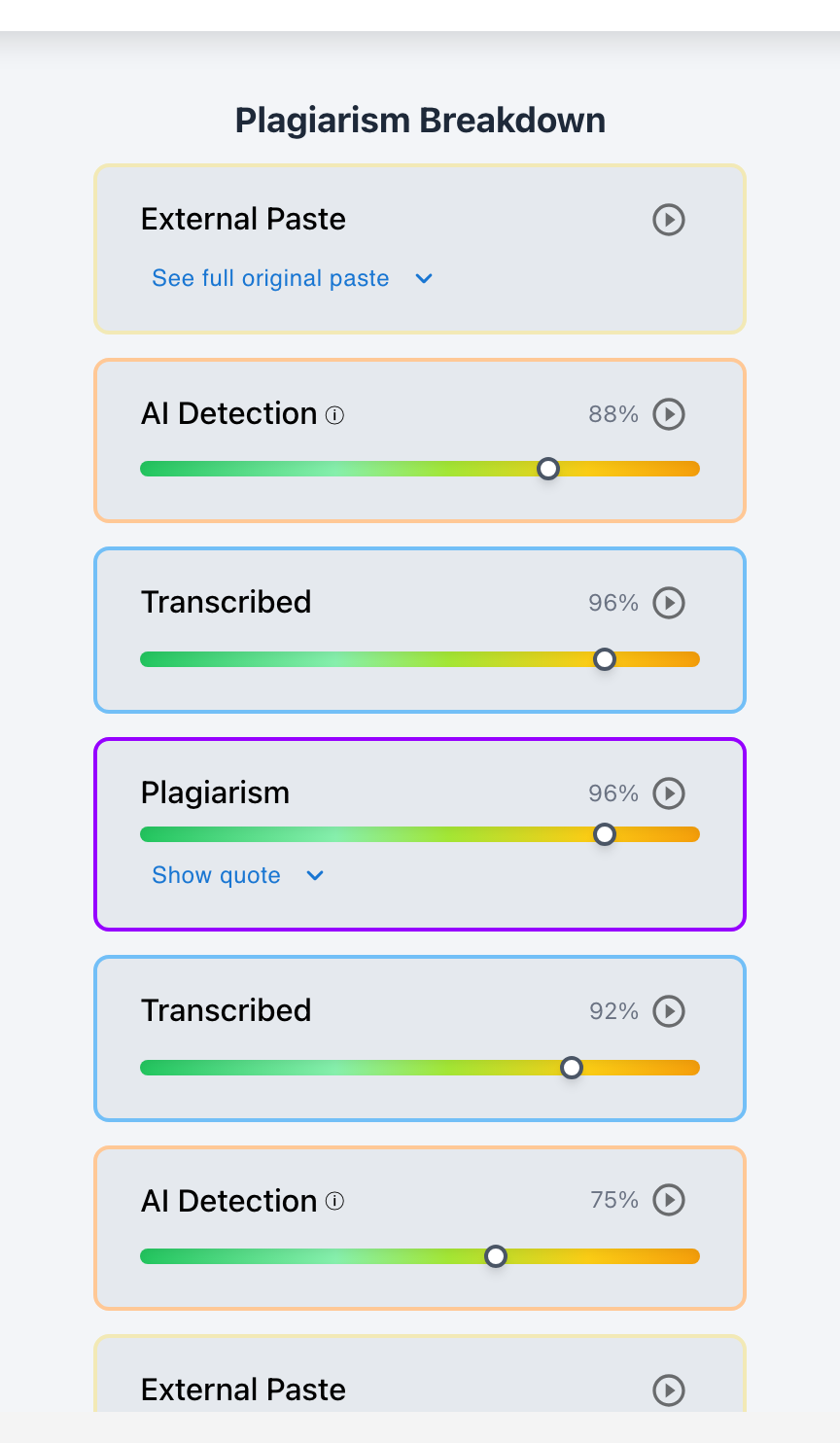
Checkmark Plagiarism supports fair, evidence-based academic integrity reviews by combining AI detection, essay writing playback, static AI detection, plagiarism detection, autograding, and integrations with Canvas and Google Classroom.
The 4 Pillars of a Fair AI Investigation
1. Presumption of Good Faith
Treat anomalous writing as a signal for dialogue rather than proof of misconduct. Allow the student a full opportunity to explain their writing process before drawing conclusions.
2. Multi-Signal Corroboration
Never base an integrity finding on a single AI percentage score. Corroborate statistical scans with writing playback timelines, citation audits, and previous student baselines.
3. Objective, Process-Focused Inquiries
Focus conversations on concrete, observable timeline events (e.g., paste timestamps, revision steps, research choices) rather than subjective accusations.
4. Policy-Driven Evaluation
Evaluate student behavior strictly against the published syllabus AI policy. Differentiate between permitted ideation, grammar editing, and unauthorized generation.
Adversarial vs. Fair Investigation Models
Adversarial Model (Harmful & Flawed)
- Begins with: "The AI detector flagged 90%, so admit you cheated."
- Relies exclusively on a single third-party probability score.
- Demands that the student "prove" they did not use ChatGPT.
- Treats sudden writing improvement as automatic guilt.
- Conferences feel like interrogations, triggering panic and defensiveness.
Fair & Evidence-Based Model (Recommended)
- Begins with: "Can you walk me through how you wrote this paper?"
- Synthesizes writing playback, citation audits, and student baselines.
- Invites the student to share earlier drafts, outlines, or notes.
- Celebrates genuine growth while verifying conceptual mastery.
- Conferences focus on supportive, objective process review.
The 5 Stages of a Fair Investigation Workflow
Stage 1: Preliminary Signal Identification & Evidence Compilation
Before contacting the student, gather all objective data to understand the context:
- Review Course Policy: Check what AI uses were explicitly permitted or prohibited on this specific assignment.
- Inspect Writing Playback: Review Checkmark Plagiarism's essay writing playback to examine active typing time, wholesale paste timestamps, and revision cycles. Read more in how Checkmark writing process analysis works.
- Audit Citations: Search academic databases (JSTOR, Google Scholar) to verify whether cited journal titles, author names, and quotes exist.
- Review Historical Baselines: Compare the submission against 2–3 verified past writing samples from the student. Read more in how can I compare a student's assignment to their previous writing?
Stage 2: Pre-Conference Evidence Synthesis
Isolate verifiable facts from subjective impressions. Document specific, observable phenomena (e.g., "1,100 words appeared at 10:45 PM in one paste event") rather than concluding what tool was used.
Stage 3: The Supportive Student Conference
Schedule a private, one-on-one meeting. Structure the conversation around open-ended process questions:
- "Can you walk me through your writing process from brainstorming to final submission?"
- "I noticed a large section appeared all at once in document history. Did you draft that section in another document or application?"
- "What is the central argument you are making in paragraph 3? Can you explain that in your own words?"
- "How did you find this specific source, and how does it support your thesis?"
- "Did you use any writing assistants, grammar tools, or AI platforms while completing this assignment? What specifically did they do?"
Read our complete question guide in what questions should I ask a student about a suspicious assignment?
Stage 4: Opportunity to Provide Supporting Artifacts
If the student explains that they drafted in Microsoft Word, another Google Doc, or handwritten notebooks, give them a reasonable window (e.g., 24–48 hours) to provide:
- External document files with timestamped version metadata.
- Outlines, brainstorming notes, or research bookmarks.
- Communication logs with campus writing center tutors.
Stage 5: Synthesis & Proportional Resolution
Compare the student's oral explanation and supporting artifacts against the observable timeline evidence:
- Exculpatory Alignment: If the student provides external drafts, explains all arguments fluently, and verified sources match, the inquiry is resolved with no penalty.
- Minor Policy Confusion: If the student used permitted tools beyond intended boundaries (e.g., using Grammarly's generative rewrite feature instead of basic grammar check), provide educational guidance and allow proctored resubmission.
- Corroborated Misconduct: If wholesale generation is confirmed through multi-signal alignment (unverifiable citations, paste events, comprehension failure, or student admission), follow established institutional academic integrity reporting protocols.
Protecting Multilingual and High-Performing Students from Bias
Studies show that standard AI detection algorithms disproportionately assign higher statistical predictability scores to non-native English speakers due to formal vocabulary choices and constrained syntactic variability. Furthermore, students who undergo rapid academic breakthroughs can trigger false suspicions.
To ensure equity:
- Never treat elevated perplexity or burstiness scores as proof of AI use for ESL/ELL students.
- Evaluate conceptual mastery and oral comprehension in plain language rather than demanding complex formal terminology during conferences.
- Look for process continuity in essay writing playback rather than judging the sophistication of the final text in isolation.
A 10-Step Fair Investigation Checklist for Teachers
A 10-Step Educator Protocol for Fair AI Investigations:
- 1. Review the syllabus AI policy and explicit assignment guidelines.
- 2. Examine essay writing playback to observe document creation timelines and paste events.
- 3. Run dual AI detection and plagiarism scans to identify statistical anomalies.
- 4. Audit cited sources in academic databases for authenticity.
- 5. Compare the submission against verified historical student writing baselines.
- 6. Invite the student to a supportive, private, non-accusatory conference.
- 7. Ask open-ended questions regarding the writing process, thesis, and sources.
- 8. Provide 24–48 hours for the student to share external drafts, version logs, or notes.
- 9. Evaluate whether the total evidence reasonably accounts for the submission.
- 10. Apply a fair, proportional resolution aligned with institutional integrity policies.
How Checkmark Plagiarism Powers Fair, Evidence-Based Reviews
Checkmark Plagiarism combines **AI detection, essay writing playback, static AI detection, plagiarism detection, autograding, and Canvas/Google Classroom integrations** to replace subjective guesswork with objective, time-stamped evidence that protects both academic standards and student due process.
Frequently Asked Questions
What is the most important principle of a fair AI investigation?
Maintaining a presumption of good faith and relying on multi-signal corroboration (playback logs, citation audits, baseline comparisons, and student interviews) rather than a single detector score.
What should I say to a student when initiating an AI inquiry?
Use neutral, question-driven phrasing: "I wanted to check in about your recent essay and learn more about your writing process. Can you walk me through how you developed your draft?"
What if a student becomes anxious or defensive during the conference?
Reassure the student that the meeting is an exploratory conversation to understand their writing process. Focus on open-ended questions about their research and ideas.
Can an AI detector score alone justify an academic misconduct penalty?
No. Detector scores are statistical probability models and must be corroborated by document history, baseline comparisons, citation validation, and student conferences.
What if the student claims they wrote the paper in Microsoft Word?
Provide a reasonable deadline (24–48 hours) for the student to provide the original Word file with version history or timestamp metadata.
How do I handle non-native English speakers who receive high AI scores?
Recognize that detectors frequently misclassify formal ESL writing. Focus on essay writing playback, citation checks, and oral comprehension rather than detector scores.
What if a student admits they used ChatGPT for brainstorming?
Check whether brainstorming conformed to course policy. If ideation was permitted, confirm that all paragraphs were authored independently by the student.
What constitutes sufficient evidence to confirm unauthorized AI generation?
A cohesive body of corroborating evidence: wholesale paste events in playback, non-existent citations, inability to explain arguments orally, and admission of prohibited use.
What if the evidence is inconclusive?
When evidence does not establish unauthorized AI use with confidence, do not impose penalties. Use the opportunity to reinforce process expectations for future assignments.
How does Checkmark Plagiarism support fair academic integrity reviews?
Checkmark Plagiarism captures objective drafting playback, validates sources, provides dual AI and plagiarism scans, and integrates directly into Canvas and Google Classroom.
Fairness and Rigor Go Hand in Hand
Investigating suspected AI writing fairly does not mean lowering academic expectations. Rather, it means upholding integrity through transparent, evidence-based practices that respect student dignity while rigorously defending scholarship.
Checkmark Plagiarism supports this principled approach with AI detection, essay writing playback, static AI detection, plagiarism detection, autograding, and integrations with Canvas and Google Classroom.
See how Checkmark pairs essay writing playback with multi-signal detection to support fair, transparent, and defensible academic integrity reviews. View a sample report or request a demonstration.