
Establishing an authentic in-class writing baseline during the first two weeks of school is one of the most powerful, legally defensible, and supportive practices an educator can implement.
When an instructor suspects an out-of-class essay was generated by ChatGPT, relying on an automated AI detector percentage alone is vulnerable to dispute. However, comparing the flagged assignment against a verified, proctored in-class writing sample provides clear, objective evidence of whether the submission reflects natural student development or an uncharacteristic leap in vocabulary and syntax.
Furthermore, an authentic baseline protects honest students: when an advanced writer is falsely accused by an algorithm, their proctored baseline sample instantly proves that sophisticated vocabulary is part of their natural voice.
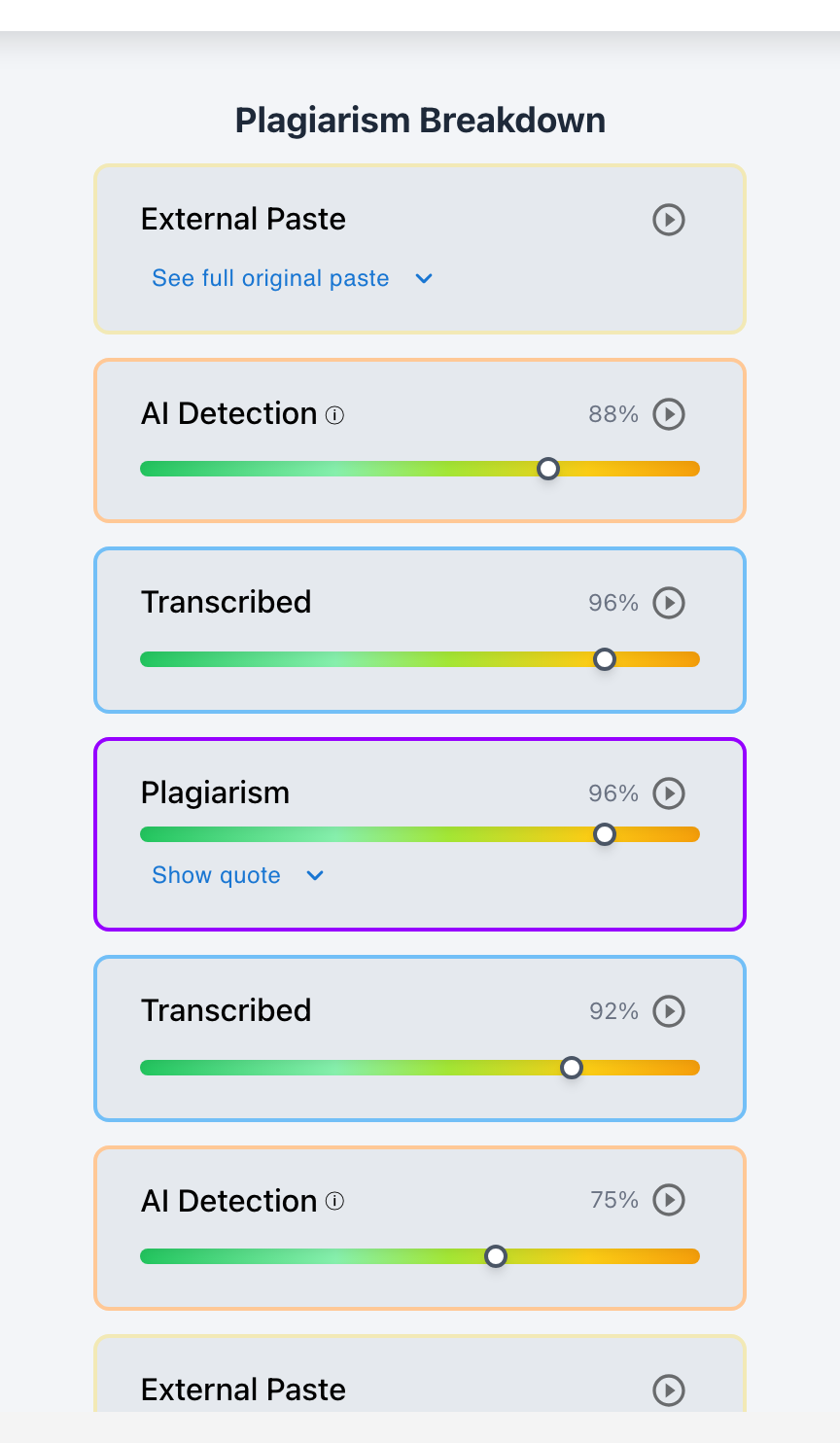
Checkmark Plagiarism supports baseline comparison by pairing essay writing playback with AI detection, plagiarism detection, autograding, and integrations with Canvas and Google Classroom.
The 4 Core Benefits of Establishing Writing Baselines
1. Objective Authorship Proof
Provides a physical, unassailable writing sample completed under direct teacher supervision that cannot be forged with generative AI.
2. Protecting Honest Advanced Writers
Shields articulate students from false positive detector scores by proving their elevated vocabulary is an authentic personal trait.
3. Targeted Formative Coaching
Gives teachers an early diagnostic map of student strengths, grammar patterns, and argument skills to guide personalized instruction.
4. Eliminating Adversarial Disputes
Grounds academic integrity conversations in side-by-side linguistic comparisons rather than subjective impressions or detector numbers.
How to Conduct a Week 1 Baseline Writing Session
1. Design a Low-Stakes, Engaging Diagnostic Prompt
Choose a prompt that requires critical thinking and personal perspective rather than factual recall. Examples:
- "Should schools restrict smartphone use during lunch? Defend your position with two specific examples from your own experience."
- "Describe a time you changed your mind about an important issue. What caused you to rethink your view?"
2. Supervise in a Controlled Proctored Environment
Conduct the 30–45 minute writing sprint directly in class:
- Handwritten Option: Have students write with pen and paper in a physical notebook.
- Digital Option: Have students type directly within your LMS with writing playback enabled and locked browser tabs.
3. Catalog Key Stylistic Dimensions
Note each student's baseline habits across four key areas: sentence length variety, recurring vocabulary choices, common mechanical errors, and transitional phrasing.
Side-by-Side Comparison: In-Class Baseline vs. AI Submission
Proctored In-Class Baseline (Authentic)
- Sentence lengths vary naturally (10–25 words).
- Informal, authentic voice with occasional comma splices.
- Specific personal examples and conversational tone.
- Active typing playback confirms 35 minutes of keystrokes.
Suspicious Take-Home Submission (AI Flagged)
- Uniform 20-word sentence lengths (low burstiness).
- Flawless syntax with pompous cliches ("delve," "tapestry").
- Zero mechanical errors or stylistic continuity with baseline.
- Writing playback shows 1,400 words pasted in one second.
Read more in how can I compare a student's assignment to their previous writing?
How Essay Writing Playback Enhances Baseline Analysis
When evaluating take-home essays against baseline samples, Checkmark Plagiarism's essay writing playback provides the missing process link:
- Typing Speed Comparison: Compare the student's in-class typing speed (e.g., 42 WPM) with the take-home submission timeline.
- Revision Habit Consistency: Verify whether the student's natural editing habits (backspacing, restructuring) match their baseline session.
Read more in how Checkmark writing process analysis works.
A 5-Step Baseline Implementation Protocol for Teachers
Educator Baseline Establishment Checklist:
- 1. Schedule a 35-minute in-class writing diagnostic during Week 1 or 2.
- 2. Use an open-ended, argumentative prompt that requires personal reasoning.
- 3. Archive the proctored sample in a digital portfolio or LMS folder for each student.
- 4. Catalog distinct stylistic features: sentence structures, vocabulary, and mechanics.
- 5. Reference the baseline during student conferences whenever an out-of-class essay raises concern.
How Checkmark Plagiarism Streamlines Baseline Portfolios
Checkmark Plagiarism combines **AI detection, essay writing playback, static AI detection, plagiarism detection, autograding, and Canvas/Google Classroom integrations** to maintain digital student writing portfolios automatically, making baseline comparisons effortless inside your LMS.
Frequently Asked Questions
When should teachers establish a writing baseline?
During the first two weeks of the semester through a low-stakes, in-class diagnostic writing prompt.
Should baseline writing samples be graded for accuracy?
No. Grade baseline samples on completion or effort so students write naturally without performance anxiety or temptation to cheat.
Can students' writing improve naturally over the semester?
Yes. Authentic growth develops gradually in ideas and organization while retaining the student's recognizable voice. AI generation appears as an abrupt, overnight transformation in syntax and vocabulary.
What if an authentic student writes with advanced vocabulary naturally?
Their proctored in-class baseline will demonstrate advanced vocabulary under teacher supervision, completely clearing them of false accusations.
Should baseline samples be handwritten or typed?
Both are effective. Digital in-class writing within your LMS captures typing speed and keystroke cadences, while handwriting guarantees zero digital assistance.
How many baseline samples should a teacher collect?
One in-class sample at the start of the year plus 1–2 proctored mid-term reflections create a robust comparative portfolio.
How does writing playback help compare baselines?
Playback allows teachers to compare in-class typing speed, pause patterns, and backspace rates against out-of-class drafting sessions.
Can baseline samples be used in academic integrity hearings?
Yes. Side-by-side linguistic comparisons between proctored in-class writing and flagged take-home essays are among the most persuasive evidence accepted by conduct boards.
How does Checkmark Plagiarism integrate baseline tracking?
Checkmark Plagiarism stores historical student submissions within Canvas and Google Classroom, allowing side-by-side comparison with a single click.
How does this practice build positive teacher-student relationships?
It demonstrates that the teacher cares about each student's authentic voice, personal growth, and individual writing journey.
Ground Integrity in Authentic Human Voice
Establishing an in-class writing baseline grounds academic evaluation in verifiable human truth. By pairing proctored baseline samples with essay writing playback and student dialogue, educators celebrate authentic student growth and defend academic standards with confidence.
Checkmark Plagiarism supports this comprehensive approach with AI detection, essay writing playback, static AI detection, plagiarism detection, autograding, and integrations with Canvas and Google Classroom.
See how Checkmark pairs essay writing playback with multi-signal detection to establish and compare student writing baselines inside your LMS. View a sample report or request a demonstration.