
Generative AI tools such as ChatGPT, Gemini, and Claude can produce essays, discussion posts, and homework responses in seconds. For teachers, that creates a difficult question: how can you tell whether a student actually wrote an assignment themselves? There is no single test that can prove with complete certainty that a student used AI. The strongest approach is to look at several signals together: the student's writing style, the content of the assignment, AI detection results, and-when available-the actual writing process used to create the document.
AI detection software can identify patterns associated with AI-generated writing, but a detector score should generally be treated as one piece of evidence rather than a final verdict.
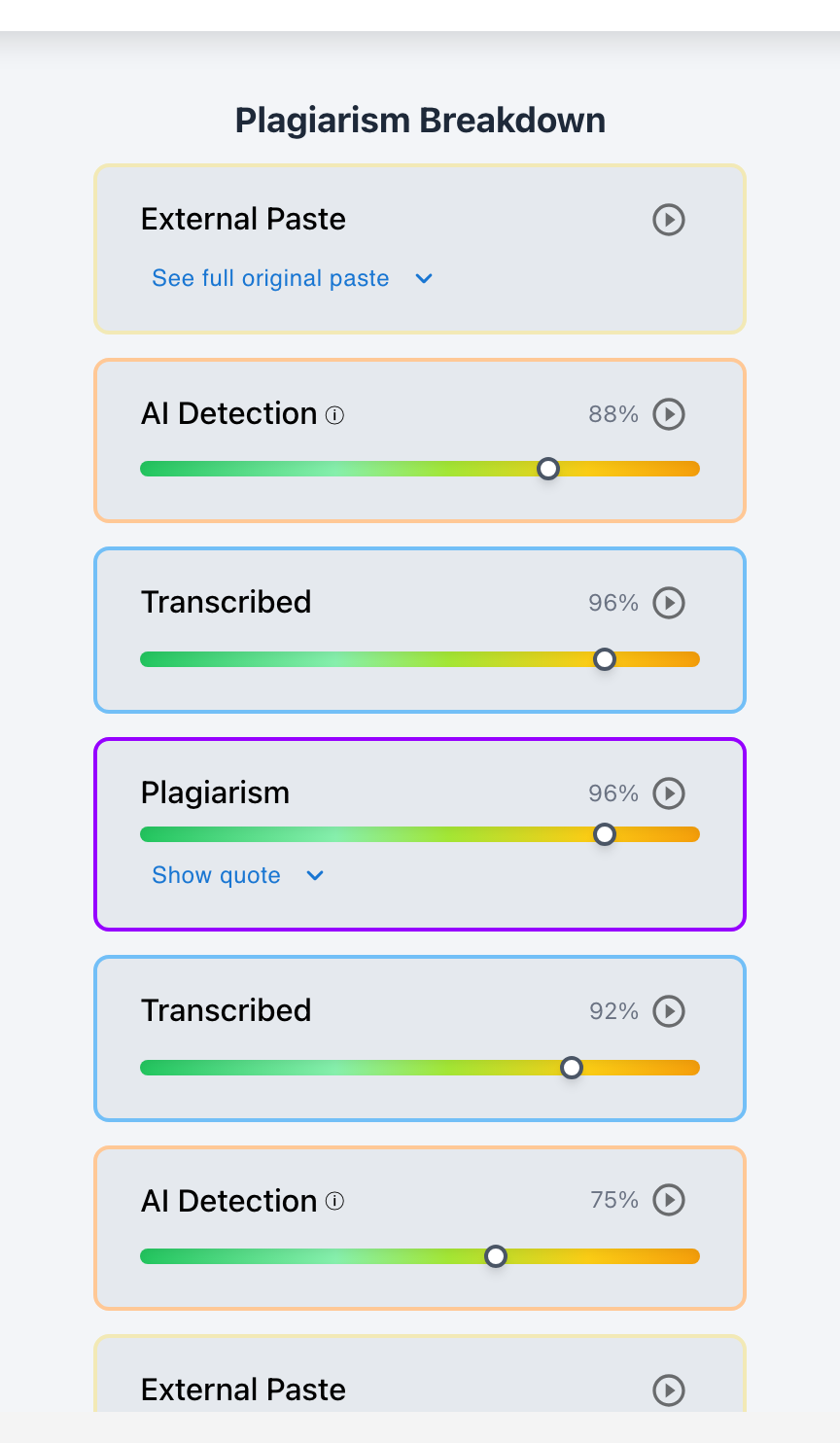
Tools such as Checkmark Plagiarism help schools combine these signals by providing AI detection, essay writing playback, static AI detection, autograding, and integrations with Canvas and Google Classroom.
Signs That a Student May Have Used AI
Teachers often notice something unusual before they ever run an AI detector.
A paper may suddenly sound very different from the student's previous work. The vocabulary may be more advanced, the organization unusually polished, or the writing may contain detailed explanations that the student struggles to discuss afterward.
None of these observations prove AI use, but they can provide reasons to investigate further.
Some common warning signs include:
- A sudden change in writing style or vocabulary
- Writing that is much stronger than the student's previous assignments
- Very polished but generic explanations
- Repetitive sentence structures or conclusions
- Confident statements that contain factual mistakes
- Citations that do not exist or do not support the claims being made
- Responses that do not directly address the specific assignment instructions
- A student who cannot explain ideas or terminology used in the submitted work
These signals become much more useful when they are compared against other evidence.
1. Compare the Assignment With the Student's Previous Writing
One of the most useful things a teacher already has is a student's previous work.
Consider how the new assignment compares with earlier writing.
Has the student's sentence structure changed dramatically? Are they suddenly using vocabulary they have never used before? Has their ability to organize arguments improved overnight?
A student can certainly improve, and outside tutoring or additional effort can produce noticeable changes. That is why a difference in writing style should not automatically be treated as evidence of academic misconduct.
Instead, it can serve as a reason to look more closely.
Teachers can also ask the student questions about the paper. A student who wrote an argument should generally be able to explain why they made certain claims, how they selected their evidence, and what they meant by important passages.
2. Use AI Detection as a Signal
AI detectors analyze characteristics of text that may be associated with AI-generated writing.
They can help teachers identify assignments that deserve additional review, particularly when reviewing large numbers of submissions.
However, AI detection should not be treated as a machine that simply labels an assignment "AI" or "human."
False positives and false negatives are possible. A student's original writing may sometimes resemble AI-generated text, while AI-generated writing that has been heavily edited may be difficult to detect.
A better approach is to ask: Does the AI detection result agree with the other evidence surrounding the assignment?
For example, an AI detection result becomes more meaningful when it appears alongside a dramatic change in writing style and unusual writing-history activity.
Checkmark Plagiarism provides AI detection that teachers can use as part of this broader review process. For a deeper look into score interpretation, see our guide on what an AI score can and cannot tell you.
3. Look at How the Assignment Was Written
The final document tells you what was submitted. The writing process can tell you much more.
Consider two students who each submit a 1,500-word essay.
The first student's document shows the paper gradually developing over several days. They write an introduction, revise several paragraphs, reorganize their argument, correct mistakes, and gradually build toward the final version.
The second student's document suddenly goes from nearly empty to a complete 1,500-word essay.
The finished papers might look similar. The writing processes do not.
This is why writing-history evidence can be extremely valuable when investigating possible AI use.
Essay Writing Playback
Checkmark Plagiarism's essay writing playback allows teachers to review how an assignment developed instead of relying only on the final submitted text.
Teachers can examine the progression of the document and look for patterns such as:
- Large sections of text appearing at once
- Extensive pasted content
- Gradual drafting and revision
- Rewriting and editing activity
- How the assignment changed from beginning to submission
Writing playback does not require a teacher to guess based solely on writing style. It provides additional context about how the work was produced. Read more about how Checkmark writing process analysis works.
For schools developing AI policies, this distinction is important. Instead of asking only, "Does this text look like AI?" educators can also ask: "What does the writing process show?"
4. Check for Large Amounts of Pasted Text
Pasting is not automatically suspicious. Students routinely paste quotations, citations, research notes, assignment instructions, or text they wrote somewhere else.
But large blocks of finished prose appearing instantly can be worth investigating.
For example, if several polished paragraphs appear in a document at once and there is little evidence of drafting around them, a teacher may want to ask the student how that section was created.
The important point is context. A writing-history review helps teachers distinguish between normal editing behavior and activity that deserves a closer look.
5. Ask the Student to Explain Their Work
One of the simplest ways to evaluate authorship is also one of the most effective: talk to the student.
The conversation does not need to begin as an accusation. Ask questions about the reasoning behind the assignment.
For example:
- Why did you choose this thesis?
- What was the strongest source you found?
- What does this paragraph mean?
- Why did you use this example?
- What was the hardest part of writing the paper?
- If you rewrote this section, what would you change?
- Can you explain this concept in your own words?
A student who completed the assignment should usually have some understanding of how the argument was developed.
These conversations can also reveal situations that are more complicated than simply "AI" or "not AI." A student may have used AI to brainstorm ideas, correct grammar, create an outline, rewrite several sentences, or generate most of the assignment.
Schools may treat those situations differently depending on their AI policies.
6. Verify Sources and Citations
AI-generated writing can sometimes include incorrect information or unreliable citations.
Teachers reviewing a suspicious assignment should verify important references.
Check whether:
- The cited source actually exists
- The author and publication information are correct
- The source contains the information attributed to it
- Page numbers are accurate
- URLs lead to the claimed material
- Quotations actually appear in the source
Fabricated references can be a warning sign, although they are not unique to AI-generated writing. Students can also make citation mistakes on their own.
Again, the strongest conclusion comes from multiple pieces of evidence rather than one isolated issue.
7. Use Static AI Detection for Submitted Documents
Writing-history information is especially valuable when a school can observe the assignment being created.
But teachers also receive documents that were created elsewhere. Students may submit PDFs, Word documents, copied text, or assignments written outside an LMS.
In those situations, static AI detection can analyze the submitted content even when the complete writing history is unavailable.
Checkmark Plagiarism supports static AI detection so educators can evaluate existing documents as well as assignments created through supported classroom workflows. This gives schools multiple ways to review student work depending on how the assignment was submitted.
Why AI Detection Alone Is Not Enough
It is tempting to want a simple percentage that determines whether a student cheated. Unfortunately, authorship is more complicated than that.
Imagine an AI detector says an essay has a high probability of containing AI-generated text. What does that actually tell you?
It may indicate that the assignment deserves additional review. It does not necessarily tell you:
- Which passages were generated
- Whether the student edited AI-generated material
- Whether AI was used only for brainstorming
- Whether the student used an approved AI tool
- Whether the student's natural writing style triggered the detector
- How the document was actually created
That is why teachers should combine AI detection with writing-process evidence and their own professional judgment.
The Multi-Evidence Formula:
AI detection + writing playback + previous student work + source verification + student conversation
Together, these provide much more context than an AI score alone.
Detecting AI Without Creating More Work for Teachers
AI has created another challenge for schools: teachers do not have unlimited time to investigate every assignment manually.
A useful academic-integrity system therefore needs to fit into the tools teachers already use.
Checkmark Plagiarism integrates with Canvas and Google Classroom, allowing schools to incorporate plagiarism and AI review into existing assignment workflows.
Rather than moving assignments between disconnected systems, educators can review student work within a process designed around classroom use.
Checkmark Plagiarism includes:
- AI detection to identify text that may contain AI-generated writing
- Essay writing playback to examine how a document developed
- Static AI detection for documents where writing history is unavailable
- Plagiarism detection for identifying potential source matching
- Autograding to help streamline assignment review
- Canvas integration
- Google Classroom integration
The goal is not simply to produce an AI score. It is to give teachers more information about the assignment so they can make better-informed decisions.
What Should I Do If I Suspect a Student Used AI?
If an assignment raises concerns, avoid making a decision based on a single indicator.
A more defensible process is:
- 1 Review the assignment carefully.
- 2 Compare it with the student's previous work.
- 3 Review AI detection results.
- 4 Examine writing-history or essay-playback evidence when available.
- 5 Verify suspicious citations or factual claims.
- 6 Ask the student to explain their argument and writing process.
- 7 Apply your school's AI and academic-integrity policy.
Schools should also clearly explain acceptable AI use before assignments are submitted.
For example, an instructor might allow AI for brainstorming but prohibit students from submitting AI-generated prose. Another course might prohibit generative AI entirely, while another may actively incorporate it into assignments.
Detection works best when students already understand what is and is not permitted.
Can Teachers Prove That a Student Used ChatGPT?
Usually, the more useful question is not whether a teacher can identify the exact AI product a student used.
Instead, the question is whether the available evidence indicates that the submitted work may not accurately represent the student's own writing process or abilities.
Text alone may not provide definitive proof that ChatGPT-or any specific AI system-produced an assignment.
Writing-process evidence can provide additional context.
For instance, gradually drafting and revising an essay looks very different from inserting a nearly complete paper into a document in a short period of time.
That is one reason Checkmark Plagiarism combines AI detection with essay writing playback rather than asking teachers to rely on a detector score alone. For more details on ChatGPT detection specifically, see Can Teachers Detect ChatGPT in Student Writing?
Frequently Asked Questions
Can teachers tell if you use AI?
Teachers may be able to identify signs of AI-assisted writing by reviewing AI detection results, changes in writing style, citations, writing history, and a student's ability to explain the submitted work. No individual signal should automatically be considered proof.
Can AI detectors be wrong?
Yes. AI detection systems can produce false positives and false negatives. Detection results are best treated as indicators that can be considered alongside other evidence.
What is the best way to determine whether a student wrote an essay?
Reviewing both the final assignment and the writing process provides a stronger picture than reviewing the finished text alone. Previous student writing, document history, source verification, AI detection, and a conversation with the student can all contribute useful evidence.
Can teachers detect copied ChatGPT responses?
Potentially. AI detection may identify patterns associated with AI-generated text, while writing-history tools may reveal large sections of text appearing or being pasted into an assignment. However, teachers should evaluate the surrounding context before reaching a conclusion.
What if the student wrote the assignment in another program?
When complete writing-process information is unavailable, static AI detection can still be used to analyze the submitted text. Checkmark Plagiarism supports static AI detection for this type of review.
Does Checkmark Plagiarism work with an LMS?
Yes. Checkmark Plagiarism integrates with Canvas and Google Classroom, helping schools incorporate AI detection, plagiarism review, writing evidence, and related tools into their existing classroom workflows.
A Better Way to Investigate AI Use
AI-generated writing has made academic integrity more complicated.
The solution is unlikely to be a detector that gives teachers a single number and asks them to trust it.
Teachers need context.
They need to know what the submitted text looks like, whether it resembles AI-generated writing, how the document developed, and whether the student can demonstrate an understanding of the work.
Checkmark Plagiarism brings those pieces together with AI detection, essay writing playback, static AI detection, autograding, plagiarism detection, and integrations with Canvas and Google Classroom.
For schools trying to distinguish genuine student writing from AI-generated assignments, combining detection with evidence of the writing process can provide a much clearer picture than AI detection alone.
See how Checkmark helps teachers evaluate possible AI use with more context than an AI score alone. View a sample report or request a demonstration.