
Technically, ChatGPT does not "copy and paste" text in the traditional sense—but submitting ChatGPT-generated text as your own work is universally considered plagiarism and academic misconduct.
To understand why, educators and students must distinguish between the technological mechanism of how language models generate text and the ethical definition of plagiarism in academic scholarship. While ChatGPT generates novel word sequences through next-token prediction, representing AI-generated output as authentic student thought violates the core principle of academic authorship: presenting someone (or something) else's intellectual work as your own.
Furthermore, under specific prompting conditions, ChatGPT can and does reproduce memorized verbatim passages from copyrighted training data, creating risks of traditional copyright infringement and text-matching plagiarism.
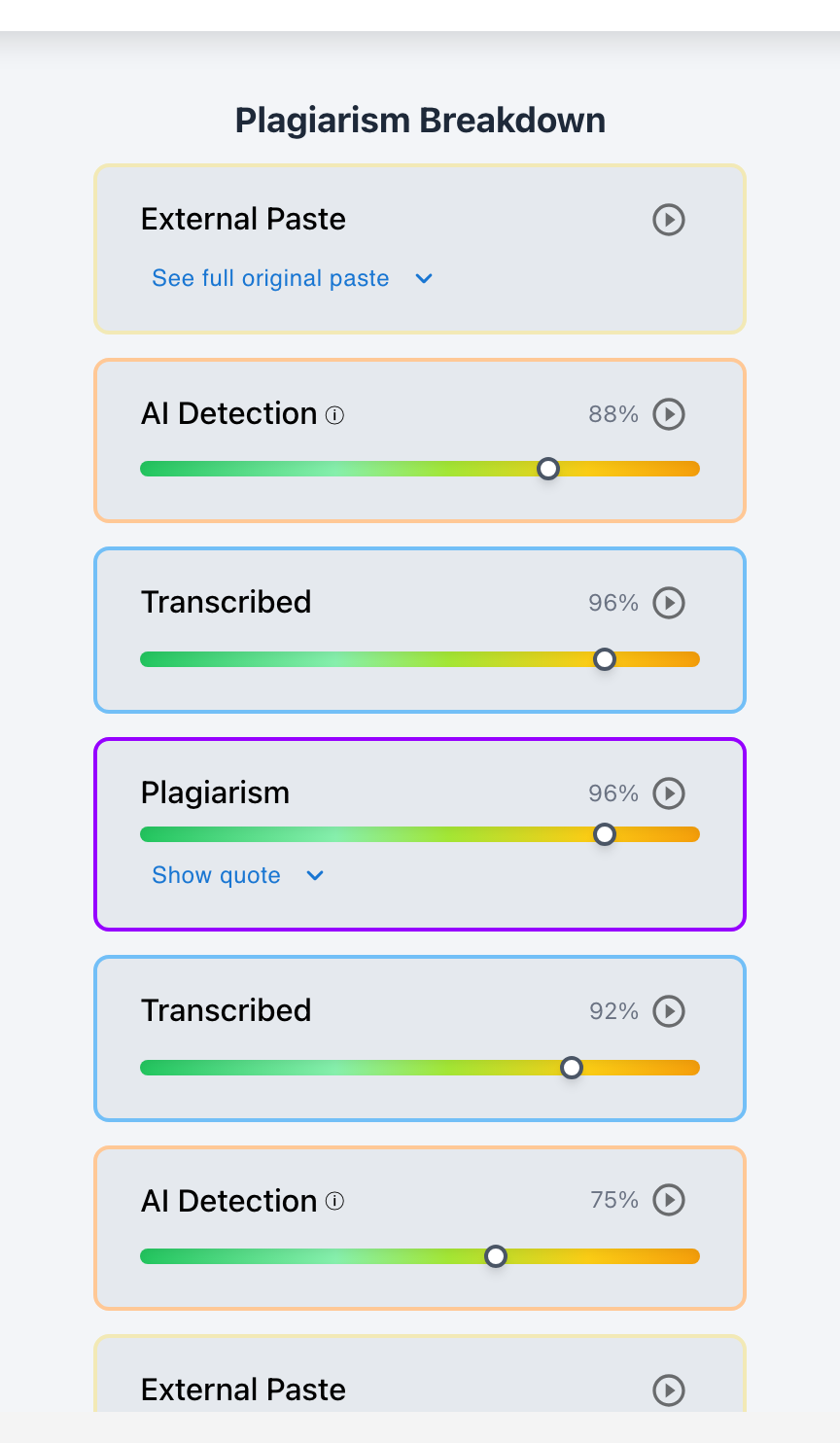
Checkmark Plagiarism addresses both dimensions by pairing plagiarism detection with AI detection, essay writing playback, static AI detection, autograding, and integrations with Canvas and Google Classroom.
How ChatGPT Generates Text: Next-Token Prediction vs. Copying
Traditional Copy-Paste Plagiarism
A human copies existing paragraphs from a published website, Wikipedia, or a journal article and pastes them directly into a submission without citation.
Generative Next-Token Synthesis
ChatGPT calculates mathematical probability distributions to predict the next word in sequence, assembling novel phrasing derived from billions of training weights.
Because ChatGPT synthesizes text probabilistically rather than pulling from a static database, traditional plagiarism checkers often report a 0% similarity score. However, a 0% plagiarism score does not mean the work is authentic or ethically sound. Read more in AI detection vs. plagiarism detection.
3 Ways ChatGPT Can Commit Direct Plagiarism
While base generation produces novel syntax, ChatGPT can still commit direct, traditional plagiarism under specific circumstances:
1. Verbatim Memorization and Training Regurgitation
When prompted about famous historical documents, well-known poems, scientific laws, or heavily replicated web articles, large language models can "regurgitate" verbatim passages from their training corpora without attributing the original author.
2. Code and Algorithmic Replication
In computer science assignments, ChatGPT frequently outputs exact functions, variable names, and algorithmic snippets copied directly from open-source GitHub repositories without proper licensing disclosures.
3. Uncited Paraphrasing of Obscure Sources
If a user prompts ChatGPT with a specific excerpt and asks it to rephrase it, the resulting text constitutes mosaic or patchwriting plagiarism if submitted without citing the underlying author.
Why Submitting ChatGPT Output Is Always Academic Plagiarism
In academia, plagiarism is not merely a copyright issue—it is an authorship fraud issue. The universal definition of plagiarism across universities and school boards is:
"Presenting ideas, words, analysis, or intellectual output created by an outside entity as one's own authentic intellectual work without proper attribution."
When a student prompts ChatGPT to write an essay and submits it under their name, they are claiming credit for analysis, syntax, and argumentation they did not produce. Even if no matching web page exists, the submission remains a fundamental violation of academic integrity.
How Dual Detection and Writing Playback Protect Institutions
Because generative AI text slips past standard web scrapers, modern institutions require a dual-layer integrity system:
- Plagiarism Detection: Scans billions of web pages, journals, and peer archives for exact string matches and verbatim training regurgitations.
- AI Detection: Evaluates sentence-level predictability maps to catch probabilistic language models.
- Essay Writing Playback: Captures the actual drafting timeline—proving whether text was typed keystroke-by-keystroke or pasted into the document in an instant.
Read more in how Checkmark writing process analysis works.
Comparison: Traditional Plagiarism vs. AI Generation
Traditional Plagiarism
- Source: Existing website, book, or student essay.
- Detection Tool: Traditional database string-matching scanners.
- Physical Artifact: Side-by-side matching URL or publication.
- Academic Violation: Copying human work without citation.
ChatGPT AI Generation
- Source: Probabilistic language model weights.
- Detection Tool: Statistical AI detectors + Writing Playback.
- Physical Artifact: Timeline paste logs & hallucinated sources.
- Academic Violation: Authorship misrepresentation & contract cheating.
How Checkmark Plagiarism Identifies AI and Plagiarism
Checkmark Plagiarism combines **AI detection, essay writing playback, static AI detection, plagiarism detection, autograding, and Canvas/Google Classroom integrations** to give educators a unified platform that catches traditional plagiarism and generative AI misuse simultaneously.
Frequently Asked Questions
Does ChatGPT copy text from the internet?
ChatGPT does not search and copy text in real time. It generates new sentences by predicting likely word sequences based on patterns learned during training, though it can occasionally reproduce memorized text.
Is using ChatGPT considered plagiarism?
Yes. Submitting AI-generated text as your own original writing violates academic integrity policies by misrepresenting authorship, regardless of whether a matching web page exists.
Can Turnitin or traditional plagiarism checkers catch ChatGPT?
Traditional plagiarism checkers that look for exact web matches report 0% similarity on raw ChatGPT text. Specialized AI detection and writing playback tools are required to detect AI generation.
Can ChatGPT reproduce copyrighted text verbatim?
Yes. If prompted about famous books, speeches, or code libraries, ChatGPT can output exact, word-for-word reproductions of copyrighted training data.
What is 'AI patchwriting'?
When a student pastes research material into ChatGPT and asks it to rephrase the text, producing lightly disguised plagiarism without proper citation.
How should a student cite ChatGPT if permitted by their teacher?
Follow APA or MLA guidelines for generative AI: cite OpenAI as the author, specify the model version, and include the exact prompt in an appendix or footnote.
Why does writing playback expose ChatGPT plagiarism?
Writing playback captures the document creation timeline: proving that an essay was pasted into the document instantly rather than drafted keystroke-by-keystroke over hours.
Can ChatGPT plagiarize ideas without plagiarizing words?
Yes. If ChatGPT synthesizes a scholar's unique argument or theoretical framework and a student submits it without attribution, it constitutes conceptual plagiarism.
How do teachers prove a student plagiarized using ChatGPT?
By compiling multi-signal evidence: essay writing playback logs showing wholesale paste events, hallucinated citations, baseline comparisons, and student interviews.
How does Checkmark Plagiarism protect schools from AI plagiarism?
Checkmark Plagiarism pairs database plagiarism matching with visual essay writing playback, static AI analysis, and LMS integrations to provide full integrity coverage.
Integrity Requires True Intellectual Ownership
Whether text is copied from an encyclopedia or generated by an algorithm, academic scholarship demands authentic human authorship. By combining traditional plagiarism detection with essay writing playback and AI analysis, educators ensure that honest student effort is recognized and defended.
Checkmark Plagiarism supports this comprehensive standard with AI detection, essay writing playback, static AI detection, plagiarism detection, autograding, and integrations with Canvas and Google Classroom.
See how Checkmark pairs essay writing playback with multi-signal detection to protect your institution from both traditional and AI plagiarism. View a sample report or request a demonstration.