
Yes. Teachers can tell when a student has paraphrased, rewritten, or "humanized" ChatGPT text.
Many students believe that if they take ChatGPT-generated text and manually swap out words, run it through automated paraphrasers like QuillBot, or instruct AI to "write with casual grammar," it becomes completely undetectable. While paraphrasing may reduce the raw score on simple statistical detectors, it leaves clear structural, syntactic, physical, and process footprints that experienced educators easily identify.
Paraphrasing changes the surface vocabulary, but it does not alter the underlying generative structure: symmetrical paragraph logic, abstract filler analysis, hallucinated citations, and, most importantly, the wholesale paste events recorded in essay writing playback.
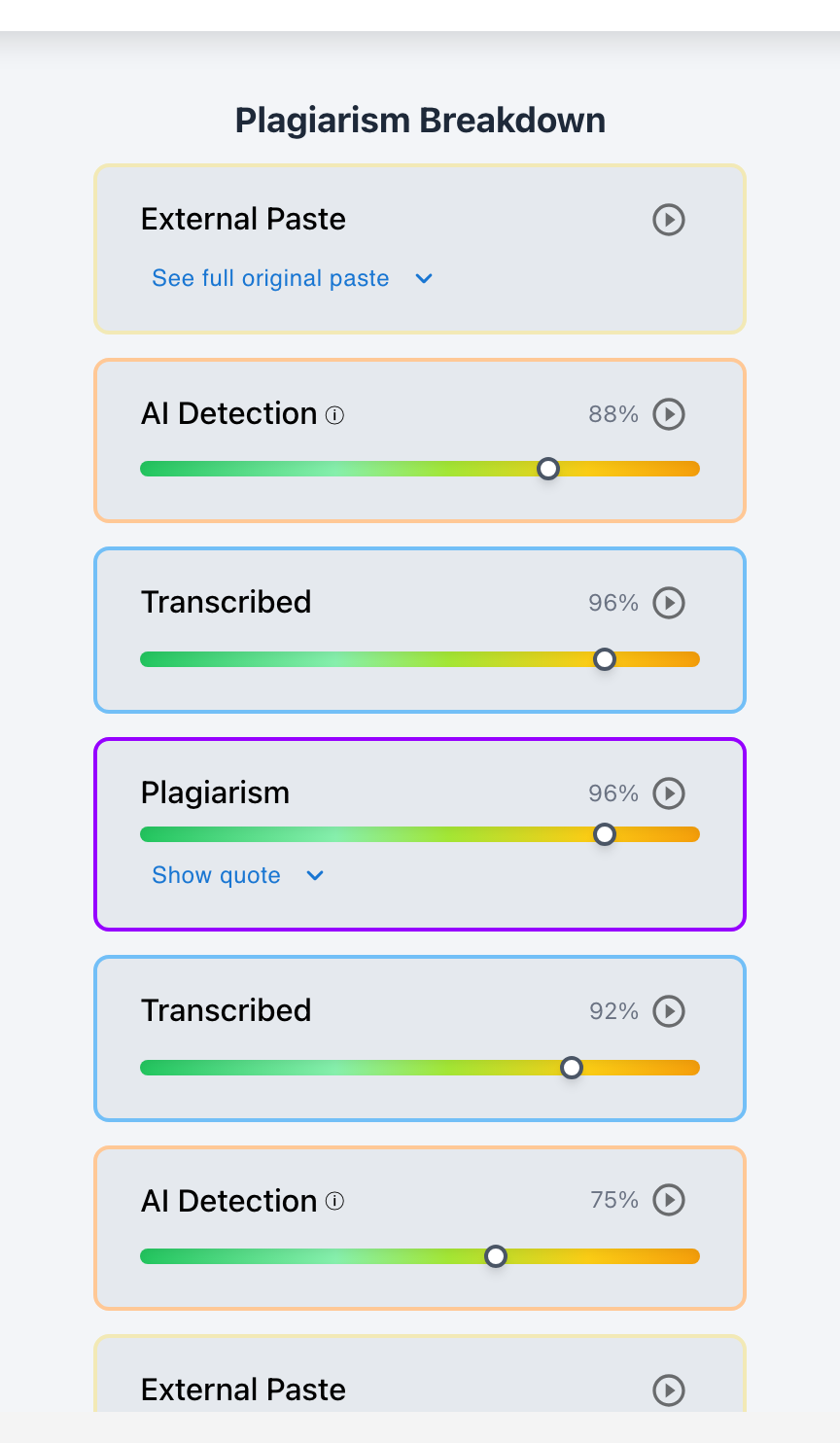
Checkmark Plagiarism exposes paraphrased AI text by combining AI detection with essay writing playback, static AI detection, plagiarism detection, autograding, and integrations with Canvas and Google Classroom.
How Students Attempt to Paraphrase ChatGPT
1. Manual Word Swapping
Replacing obvious AI clichés (e.g., swapping "delve" for "explore" or "tapestry" for "complex mix") while keeping the exact sentence structure intact.
2. Automated "AI Humanizers" & Spinners
Running AI text through tools like QuillBot to insert irregular synonyms and awkward clause structures designed to trick statistical scanners.
3. Prompt Masking
Instructing ChatGPT to "write like a 10th grader with minor grammar errors" to mask the formal, polished tone.
4. Hybrid Copy-Pasting
Writing original introduction and conclusion paragraphs while pasting paraphrased AI prose in the core body sections.
Why Paraphrased ChatGPT Fails to Hide
1. Symmetrical Logic and Abstract Commentary Remain
Paraphrasing alters individual words, but it preserves ChatGPT's rigid architectural blueprint:
- Every body paragraph remains exactly the same length.
- The argument follows an aggressively balanced, formulaic 3-point progression.
- The analysis remains high-level, generic, and abstract, failing to engage with specific class discussions or assigned lecture notes.
2. The "Thesaurus Syndrome" (Incongruous Synonyms)
Automated paraphrasing tools frequently replace standard terms with bizarre, unnatural synonyms that do not make sense in academic context (e.g., changing "economic collapse" to "financial cave-in"). These awkward phrasing anomalies immediately stand out to instructors.
3. Paraphrasing Does Not Fix Hallucinated Citations
If ChatGPT invented a non-existent journal article or author pairing, rewording the paragraph surrounding that citation does not make the source real. Auditing the bibliography in academic databases instantly exposes the fabrication. Read more in can ChatGPT cite sources that don't exist?
How Essay Writing Playback Completely Bypasses Paraphrasing
Paraphrasing text before pasting it into a document may alter surface language, but it cannot fake the physical timeline of human writing. When teachers review Checkmark Plagiarism's essay writing playback, they see:
- Instant Paste Blocks: The entire paraphrased text appears in the document in one instant paste event at 11:30 PM.
- Zero Active Drafting Time: Playback records only 5–10 minutes of active document activity for a 1,500-word paper.
- Zero Keystroke Evolution: No natural typing cadence, no backspacing, no rephrasing of difficult thoughts, and no multi-session revisions.
Whether the text is raw ChatGPT, QuillBot-spun prose, or manually edited AI text, writing playback captures the paste event and proves the essay was composed externally in seconds. Read more in how Checkmark writing process analysis works.
Side-by-Side Comparison: Paraphrased AI vs. Authentic Drafting
Paraphrased ChatGPT Text
- Awkward, thesaurus-heavy phrasing from spinners.
- Abstract analysis that avoids specific lecture references.
- Cites non-existent sources with fake DOIs.
- Writing playback shows 1,200 words pasted in one event.
- Student cannot explain complex terminology orally.
Authentic Student Writing
- Natural, idiomatic voice with varied sentence rhythms.
- Deep engagement with specific classroom discussions.
- All cited academic sources exist and are verified.
- Writing playback shows 4 hours of typing across 3 sessions.
- Student fluently explains thesis and revisions orally.
A 6-Step Protocol to Identify Paraphrased AI Submissions
Educator Protocol for Paraphrased AI Writing:
- 1. Inspect essay writing playback logs to identify wholesale paste events and active typing time.
- 2. Look for incongruous, thesaurus-heavy synonym replacements characteristic of spinning tools.
- 3. Audit cited sources in academic databases (JSTOR, Google Scholar) to detect hallucinations.
- 4. Check whether analysis remains generic and avoids class-specific prompt constraints.
- 5. Compare the submission against historical in-class baseline writing samples.
- 6. Hold a brief student conference asking the student to define unusual terms and summarize arguments.
How Checkmark Plagiarism Detects Paraphrased AI Writing
Checkmark Plagiarism combines **AI detection, essay writing playback, static AI detection, plagiarism detection, autograding, and Canvas/Google Classroom integrations** to uncover paraphrased generative text through timeline playback, citation validation, and multi-signal verification.
Frequently Asked Questions
Can QuillBot make ChatGPT undetectable?
No. QuillBot alters surface words to fool basic scanners, but writing playback logs (capturing wholesale paste events), incongruous synonyms, and fake citations expose the underlying generation.
What does 'humanized' AI writing look like?
Humanized AI text often features awkward sentence inversions, strange synonym substitutions, and forced conversational phrasing layered over rigid, formulaic AI logic.
Can teachers see if a student manually paraphrased ChatGPT sentence by sentence?
Yes. Even if typed manually, the essay retains ChatGPT's balanced symmetry, generic lack of classroom context, and hallucinated citations.
Why does writing playback expose paraphrased text so easily?
Because students typically paraphrase externally (in ChatGPT or QuillBot) and paste the finished draft into the assignment, generating an instant wholesale paste log.
What if a student claims the strange wording is just their writing style?
Compare the submission against 2–3 historical in-class writing baselines to see if the strange phrasing represents a genuine pattern or an uncharacteristic anomaly.
Can citation checks catch paraphrased ChatGPT essays?
Yes. Paraphrasing the prose does not correct non-existent journal titles, fabricated author names, or fake volume numbers generated by AI.
How does an oral comprehension conference expose paraphrased AI?
Students who paraphrase AI text without understanding it stumble when asked to explain complex vocabulary or summarize their core thesis in plain language.
What should a teacher do when they suspect paraphrased ChatGPT?
Review the writing playback timeline, audit citations, compare baselines, and invite the student to discuss their drafting choices in a supportive conference.
Can authentic students be falsely accused of using paraphrasing tools?
Authentic students have multi-session writing playback logs, verified sources, and clear oral mastery, protecting them from false accusations.
How does Checkmark Plagiarism handle paraphrased AI text?
Checkmark Plagiarism tracks keystrokes, highlights paste events, validates citations, and integrates seamlessly with Canvas and Google Classroom.
Process Visibility Trumps Word-Swapping Tricks
Paraphrasing and AI-spinning tools can alter surface words, but they cannot manufacture authentic human thinking, genuine research, or multi-hour drafting timelines. By combining essay writing playback with citation audits and student dialogue, educators see right through paraphrased AI shortcuts.
Checkmark Plagiarism supports this comprehensive approach with AI detection, essay writing playback, static AI detection, plagiarism detection, autograding, and integrations with Canvas and Google Classroom.
See how Checkmark pairs essay writing playback with multi-signal detection to expose paraphrased AI text with objective timeline proof. View a sample report or request a demonstration.