
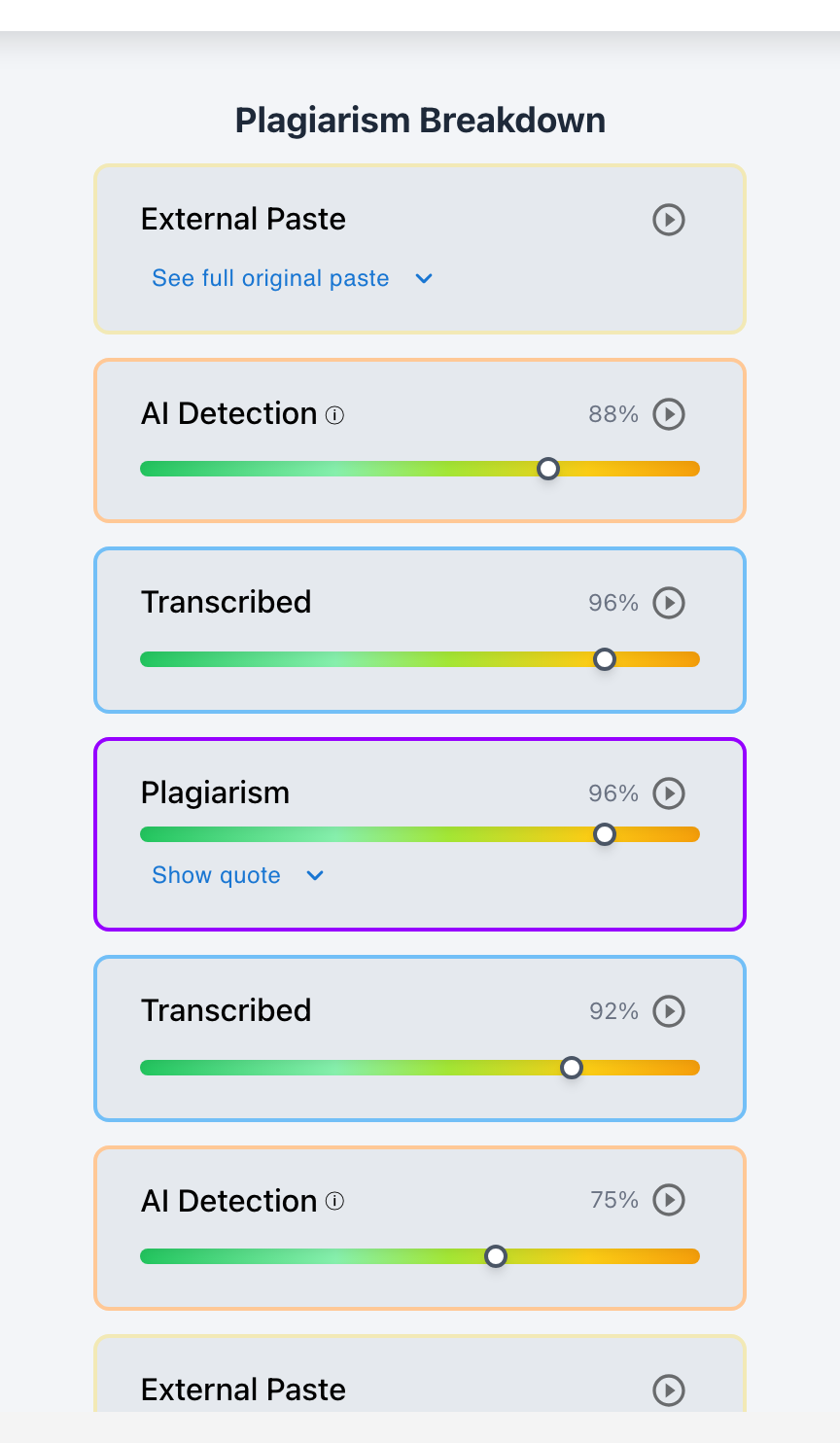
Teachers should never rely on an AI percentage score alone because AI detectors provide probabilistic estimates of text predictability—not forensic proof of who authored a document.
Across education, schools that enforce zero-tolerance penalties based solely on a single detector score (e.g., "75% AI Detected") face a rising tide of false accusations, fractured student relationships, and overturned academic appeals. Statistical detectors cannot see the student drafting at their keyboard, nor can they distinguish between an articulate human writer and machine-generated prose. To uphold academic standards with integrity, educators must adopt an Evidence-First Philosophy that grounds decisions in multi-signal verification.
Below is a comprehensive guide on why AI percentages fail in isolation and how evidence-first workflows protect both teachers and students.
Checkmark Plagiarism powers evidence-first evaluation by pairing AI detection with essay writing playback, plagiarism detection, autograding, and integrations with Canvas and Google Classroom.
The 4 Critical Flaws of Single AI Percentage Scores
1. Probabilistic Guesswork vs. Physical Proof
AI scores measure how closely text resembles LLM training data. A high score means the vocabulary is predictable, not that AI generated it.
2. Disproportionate Bias Against Certain Writers
Articulate students, neurodivergent writers who favor formal structures, and English Language Learners (ELL) suffer higher false-positive rates.
3. Zero Actionable Diagnostic Detail
A score of 60% cannot tell you if the student used AI to outline, edit grammar, generate a single paragraph, or copy the whole paper.
4. Unenforceable in Academic Appeals
Without supporting keystroke timelines or hallucinated citations, percentage-based disciplinary actions are routinely overturned by conduct boards.
Checkmark's Evidence-First Philosophy
In Checkmark Plagiarism, an AI detection percentage is treated as a triage signal—a prompt to investigate—rather than a final verdict. Conclusive determinations require triangulating 4 independent layers of evidence:
- Layer 1: AI Linguistic Detection (Perplexity, burstiness, and formulaic AI language markers).
- Layer 2: Essay Writing Playback (Active typing hours, session count, backspaces, and paste timestamps).
- Layer 3: Citation & Source Audits (Verifying real vs. hallucinated academic studies in library databases).
- Layer 4: In-Class Baseline Alignment (Comparing syntax against proctored diagnostic writing samples).
Read more in how Checkmark writing process analysis works.
Comparison: Percentage-Only Approach vs. Evidence-First Approach
Percentage-Only Approach (High Risk)
- Issues a zero based strictly on a 75% AI score.
- Ignores document revision history and typing hours.
- Causes false accusations and student resentment.
- Vulnerable to parent pushback and conduct appeals.
Checkmark Evidence-First Approach (Robust)
- Uses AI score as a prompt to review writing playback.
- Verifies active typing time, backspaces, and paste logs.
- Audits citations for AI hallucinations and dead DOIs.
- Produces unassailable, legally defensible decisions.
A 5-Step Educator Protocol for Evidence-First Grading
Educator Evidence-First Workflow:
- 1. Review the Checkmark AI score as an initial triage indicator.
- 2. If flagged, open Essay Playback to inspect active drafting hours and session counts.
- 3. Check the backspace and revision rate: authentic drafting exceeds 15% edits.
- 4. Audit 2 cited sources in Google Scholar to check for hallucinations.
- 5. Hold a supportive conference using the visual playback timeline to guide the conversation.
How Checkmark Plagiarism Powers Evidence-First Integrity
Checkmark Plagiarism combines **AI detection, essay writing playback, static AI detection, plagiarism detection, autograding, and Canvas/Google Classroom integrations** to replace standalone probability scores with comprehensive multi-signal evidence.
Frequently Asked Questions
Why is an AI score not considered proof of cheating?
Because AI detectors measure statistical vocabulary patterns, not physical document creation. Legitimate human writing can mathematically match AI training patterns.
Can a student be disciplined based only on an AI detector score?
Educational and legal experts strongly advise against it. Disciplinary actions require corroborating evidence such as writing playback logs or hallucinated citations.
What is an Evidence-First approach?
An approach where AI scores are used as starting points for review, while final decisions are based on physical drafting history, revision depth, and student dialogue.
How does writing playback support an evidence-first approach?
Playback provides physical proof of creation—showing active typing hours, backspaces, and paste timestamps directly in the grading interface.
What is a normal student backspace rate?
Authentic student writing typically exhibits a 15% to 30% backspace/edit rate as thoughts are refined. AI copy-pastes show 0% edits.
How does Checkmark Plagiarism integrate with Canvas LMS?
Checkmark Plagiarism displays visual writing playback timelines, session breakdowns, and dual AI/plagiarism reports directly inside Canvas SpeedGrader.
How does an evidence-first approach protect honest students?
It ensures that articulate students who trigger false AI scores are cleared immediately by their multi-hour typing logs and high revision rates.
What if an essay has a high AI score and a 1-second paste event?
The combination of a high AI score and a 1-second paste event provides conclusive multi-signal evidence of unauthorized AI generation.
Why are citation audits effective in AI investigations?
ChatGPT frequently invents fake authors, journals, and DOIs. Finding non-existent citations provides concrete physical proof of AI generation.
How does evidence-first grading save teacher time?
With Checkmark Playback embedded directly in Canvas SpeedGrader, verifying writing history and citations takes under 45 seconds per flagged paper.
Multi-Signal Evidence Establishes Uncompromising Truth
Evaluating human intellect requires looking at the complete story of creation. By moving beyond isolated percentage scores to embrace evidence-first verification, Checkmark Plagiarism ensures that academic standards are upheld with justice, accuracy, and educational integrity.
Checkmark Plagiarism supports this comprehensive approach with AI detection, essay writing playback, static AI detection, plagiarism detection, autograding, and integrations with Canvas and Google Classroom.
See how Checkmark pairs essay writing playback with multi-signal detection to implement evidence-first academic integrity inside your LMS. View a sample report or request a demonstration.