
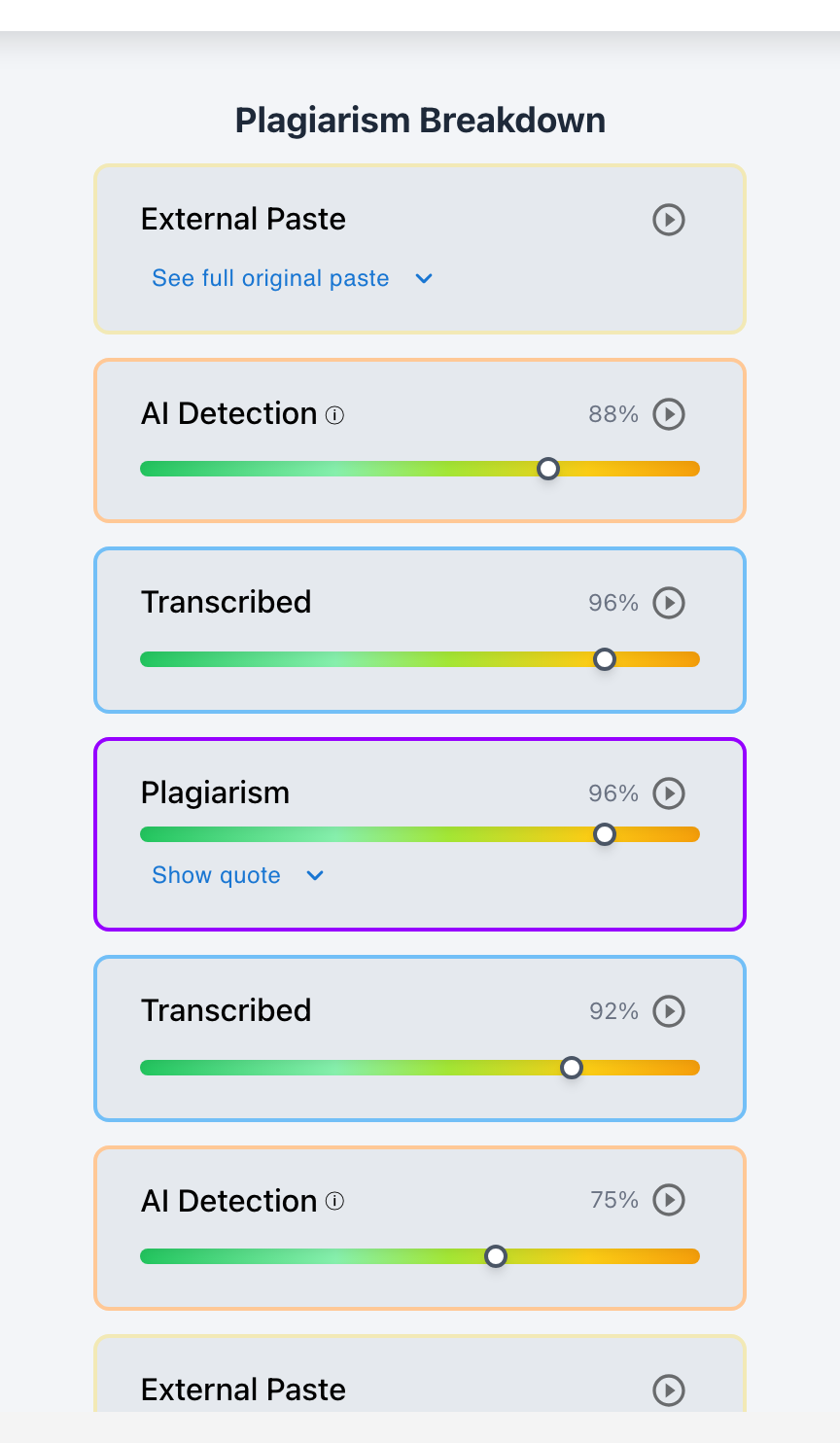
When a document's revision history shows that most of a 1,000+ word essay appeared in just a few minutes, it almost always points to one of three root causes: an external clipboard paste from an AI generator or web source, composing offline in a separate word processor (like Microsoft Word or Apple Pages), or rapid transcription from another device.
Human typing speed physically caps out at approximately 40 to 80 words per minute for fluent typists under continuous cognitive composition. When an entire 1,500-word essay appears in a Google Doc or Canvas text box over a 2- to 3-minute window, the student did not draft that text in real time on that document. For teachers, seeing a sudden, massive influx of words requires a structured, multi-signal investigation using Checkmark Plagiarism's Essay Playback to distinguish between legitimate offline drafting and unauthorized AI shortcuts.
Below is a comprehensive guide on investigating rapid essay creation and determining what actually occurred.
Checkmark Plagiarism powers process investigations by pairing essay writing playback with AI detection, plagiarism detection, autograding, and integrations with Canvas and Google Classroom.
The 3 Reasons an Essay Appears in Minutes
1. Generative AI Paste Event
The student prompted ChatGPT, Claude, or Gemini in another window and pasted the generated essay wholesale in a single 0.05-second clipboard insertion.
2. Offline Application Migration
The student legitimately drafted their paper in Microsoft Word, Scrivener, or Apple Pages on their home desktop and pasted it into the LMS before submission.
3. Peer Copying or Web Plagiarism
The student copied an essay from a classmate, sibling, or online homework bank (e.g., Course Hero) and pasted it directly into the submission box.
How Human Typing Speeds Compare to Document Influxes
Understanding physical keyboard constraints helps evaluate document timelines:
- Average Student Typing Speed: 35–45 WPM (words per minute). Composing 1,200 words requires a minimum of 25–35 minutes of continuous typing without pauses.
- Cognitive Drafting Reality: When accounting for pausing to think, researching citations, and fixing typos, a human takes 2.5 to 4.5 active hours to draft 1,200 words.
- The 2-Minute Influx: If 1,200 words appear in 2 minutes, that represents an impossible typing speed of 600 WPM—proving 100% of the text was inserted from an external clipboard payload.
Read more in how Checkmark writing process analysis works.
Comparison: Legitimate Offline Drafting vs. AI Generation Influx
Legitimate Offline Drafting (Word/Pages)
- Student can produce original .docx file with version logs.
- Student can explain thesis and sources fluently in conference.
- Subsequent editing sessions in LMS show minor tweaks.
- AI probability score remains low or moderate.
Unauthorized AI Generation (ChatGPT Paste)
- Student has zero drafts, notes, or offline files to show.
- Student struggles to explain vocabulary or thesis.
- Zero subsequent edits after the initial paste block.
- AI probability score and paragraph heatmaps trigger high.
A 5-Step Educator Protocol for Investigating Rapid Writing
Rapid Essay Investigation Checklist:
- 1. Open the student's submission in Checkmark Playback to inspect the time-lapse creation curve.
- 2. Review the Paste Event Log: identify the exact timestamp, character count, and raw payload.
- 3. Cross-reference with the Plagiarism similarity match and AI probability heatmap.
- 4. Hold a brief 2-minute non-adversarial check-in: "I noticed this essay was pasted in at 11:42 PM. Did you compose this in Word or another app? Can you share that draft?"
- 5. If the student cannot produce offline drafting files or explain the essay, initiate official academic review.
How Checkmark Plagiarism Resolves Rapid Writing Inquiries
Checkmark Plagiarism combines **AI detection, essay writing playback, static AI detection, plagiarism detection, autograding, and Canvas/Google Classroom integrations** to give teachers definitive proof of typing speed, active drafting hours, and clipboard paste payloads.
Frequently Asked Questions
Is it physically possible for a student to type 1,000 words in 5 minutes?
No. 1,000 words in 5 minutes requires a typing speed of 200 WPM without stopping to think. Even professional courtroom stenographers do not compose original essays at that speed.
What does Essay Playback show when text is pasted in?
Playback shows a sudden vertical jump in word count on the timeline graph, highlighting the exact block of text in orange with an attached paste event card.
Can a student prove they wrote an essay offline?
Yes. Students who write in Microsoft Word or Pages can provide their original document files containing version metadata and creation timestamps.
How does Checkmark capture the raw pasted text?
Checkmark's Original Paste Preservation archives the exact text snippet at the moment of insertion, preserving it even if the student rewrote it afterward.
What if a student typed an essay on their phone?
Checkmark captures mobile typing sessions, recording keystroke timestamps, autocorrect edits, and mobile drafting durations across all devices.
How does Checkmark Plagiarism integrate with Canvas LMS?
Checkmark provides certified LTI 1.3 integration, SpeedGrader sidebar embeds, two-way grade passback, and single sign-on (SSO).
Why do students paste essays rather than typing in Google Docs?
Common reasons include writing in offline software during a commute, compiling notes in a personal notebook app, or copying text from an AI generator.
What questions should a teacher ask about rapid writing?
Ask supportive questions: "Where was this composed before pasting?", "Can you show me your outline or rough notes?", and "Can you summarize your main argument?"
How does writing time correlate with AI detection?
Essays with high AI scores almost always coincide with near-zero active drafting time, whereas false positives exhibit multi-hour typing histories.
Why is process playback better than making assumptions?
Because playback provides unforgeable physical facts, allowing teachers to protect students with legitimate offline workflows while catching genuine shortcuts.
Clarity and Fairness Through Process Transparency
When an essay appears in minutes, educators need facts rather than suspicion. By pairing writing playback with multi-signal detection in Checkmark Plagiarism, teachers can easily verify legitimate drafting workflows and ensure that every student is evaluated with complete fairness.
Checkmark Plagiarism supports this comprehensive approach with AI detection, essay writing playback, static AI detection, plagiarism detection, autograding, and integrations with Canvas and Google Classroom.
See how Checkmark pairs writing process playback with multi-signal detection to investigate rapid essay submissions. View a sample report or request a demonstration.