
Using AI crosses the line into academic dishonesty the moment artificial intelligence replaces the student's intellectual labor, authorship, or core cognitive reasoning on an assignment.
In the modern digital classroom, many students struggle to identify where helpful technology ends and cheating begins. Is asking ChatGPT for an analogy acceptable? Yes. Is asking ChatGPT to write the introduction paragraph cheating? Yes. Is using an AI tool to rewrite someone else's article without citation plagiarism? Absolutely.
Understanding the exact tipping points where AI assistance transitions into authorship fraud, contract cheating, and policy violations provides clarity for students and actionable, defensible standards for educators.
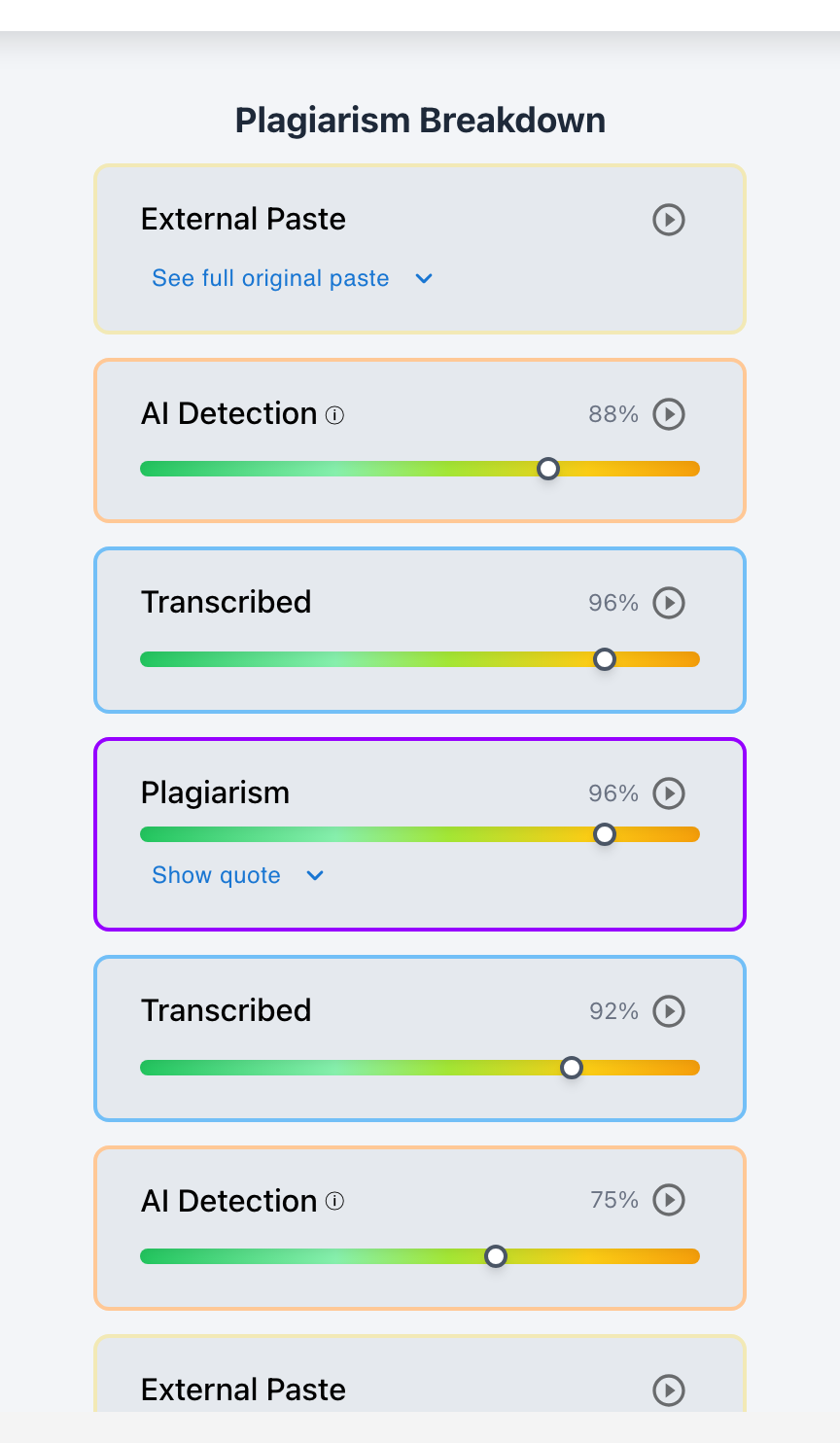
Checkmark Plagiarism protects these integrity thresholds by pairing essay writing playback with AI detection, plagiarism detection, autograding, and integrations with Canvas and Google Classroom.
The 4 Tipping Points into Academic Dishonesty
1. Transfer of Authorship
The moment AI generates sentences, paragraphs, or arguments that the student copies into the submission under their own name.
2. Bypassing the Evaluated Competency
If the assignment evaluates your ability to analyze a poem, having AI generate the analysis short-circuits the learning objective.
3. Deception & Concealment
Using AI when course policy explicitly forbids it, or using automated paraphrasing tools (QuillBot) to hide AI involvement.
4. Fabricating Scholarship
Submitting hallucinated AI citations, non-existent DOIs, or fabricated primary sources as authentic academic research.
The Legal and Academic Definition: Authorship Fraud
Universities and academic honor boards classify unauthorized generative AI use under authorship fraud and contract cheating:
"Submitting academic work that contains text, data, or analysis generated by an external party—human or algorithmic—without proper disclosure and instructor permission constitutes a misrepresentation of authorship and a breach of academic integrity."
How Essay Writing Playback Exposes the Exact Tipping Point
While students often claim they "only used AI for ideas," Checkmark Plagiarism's essay writing playback reveals the physical truth of creation:
- Legitimate Idea Use: Playback shows hours of active typing, backspacing, and rewriting as the student puts brainstormed concepts into their own words.
- Academic Dishonesty: Playback shows an instant wholesale paste of 1,200 polished words at 11:30 PM with zero active drafting time.
Read more in how Checkmark writing process analysis works.
Comparison: Legitimate Assistance vs. Academic Dishonesty
Legitimate Technological Assistance
- Using AI to generate practice quiz questions.
- Asking AI to explain a confusing scientific term.
- Using basic spellcheck to fix typos.
- Writing all sentences independently in the LMS.
Academic Dishonesty (Cheating)
- Prompting AI: "Write a 3-page essay for me."
- Pasting AI text into an assignment without disclosure.
- Using spinning tools to bypass detection.
- Submitting fake AI-generated citations.
A 5-Step Evaluation Protocol for Teachers
Educator Academic Integrity Determination Protocol:
- 1. Confirm whether the observed behavior violates the published course AI policy.
- 2. Review essay writing playback to determine if text was typed or pasted wholesale.
- 3. Audit cited sources in academic databases (JSTOR, Google Scholar) for hallucinations.
- 4. Compare the submission against historical in-class student writing baselines.
- 5. Hold a supportive conference to evaluate real-time oral conceptual mastery.
How Checkmark Plagiarism Upholds Integrity Standards
Checkmark Plagiarism combines **AI detection, essay writing playback, static AI detection, plagiarism detection, autograding, and Canvas/Google Classroom integrations** to make integrity boundaries clear, transparent, and defensible for every assignment.
Frequently Asked Questions
Is using AI to brainstorm ideas considered cheating?
Brainstorming is generally acceptable if the student drafts the actual text independently, follows course policy, and discloses AI brainstorming if required.
When does editing with AI become cheating?
When AI rewrites entire sentences, generates new analytical arguments, or elevates vocabulary beyond the student's authentic capability without disclosure.
Is using ChatGPT to write an outline cheating?
If the assignment explicitly evaluates outlining skills or forbids AI, yes. If permitted for brainstorming and the student writes the essay manually, it is acceptable.
Why is submitting fake citations considered academic dishonesty?
Fabricating academic research, authors, and DOIs compromises scholarly truth and provides physical proof of unauthorized generative AI text generation.
Can writing playback prove whether AI use was dishonest?
Yes. Playback logs distinguish between typing original sentences (legitimate) and pasting external AI text blocks in seconds (dishonest).
What if a student genuinely didn't know AI was forbidden?
Treat the first incident educationally: explain the policy, require a supervised revision, and document the conversation for future reference.
How does comparing previous writing help determine dishonesty?
It reveals whether the submission represents natural growth in the student's recognizable voice or an uncharacteristic leap in syntax and vocabulary.
Can an oral conference resolve borderline AI cases?
Yes. If a student can fluently explain their arguments, define vocabulary, and defend citations orally, it strongly indicates authentic intellectual ownership.
How does Checkmark Plagiarism integrate with Canvas and Google Classroom?
Checkmark Plagiarism embeds dual AI/plagiarism reports and visual writing playback directly inside your LMS grading view.
How should schools define AI dishonesty in their honor codes?
Explicitly state that submitting text, analysis, or citations generated by artificial intelligence without authorization constitutes authorship fraud.
Protecting the Value of Honest Intellectual Labor
Academic integrity is not about fearing technology; it is about preserving the honesty, effort, and growth inherent in genuine human learning. By pairing clear policy boundaries with essay writing playback and student dialogue, educators defend the true value of education.
Checkmark Plagiarism supports this principled standard with AI detection, essay writing playback, static AI detection, plagiarism detection, autograding, and integrations with Canvas and Google Classroom.
See how Checkmark pairs essay writing playback with multi-signal detection to distinguish legitimate assistance from academic dishonesty. View a sample report or request a demonstration.