
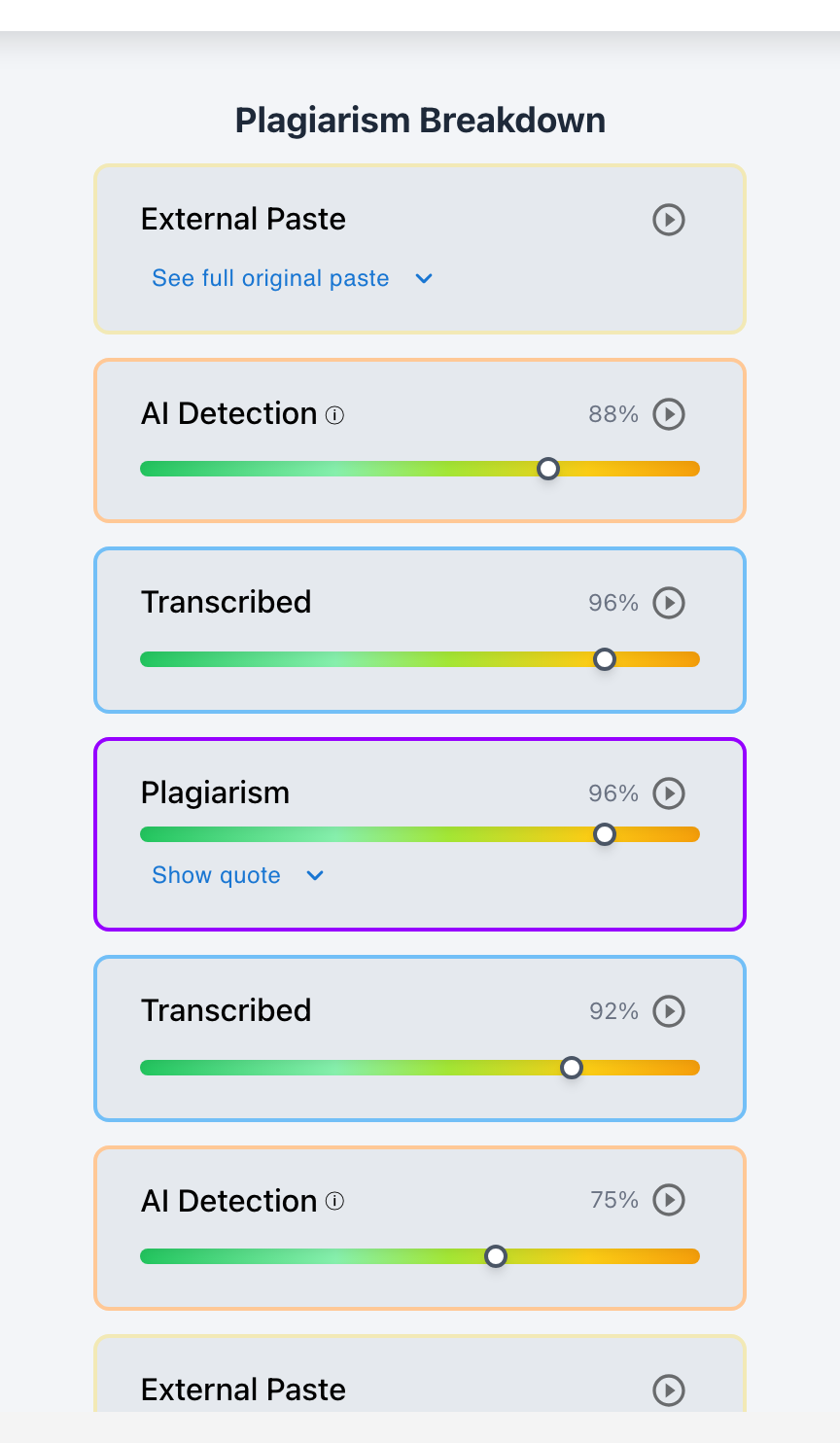
The key difference between uncited writing and plagiarism lies in intent, scope, and process: uncited writing typically involves mechanical formatting errors or forgotten citations in an otherwise student-authored draft, whereas plagiarism involves the deliberate misrepresentation of external text or ideas as one's own original work.
In high school and collegiate classrooms, treating every missing parenthetical citation as malicious academic misconduct damages student trust and ignores the reality of developing research skills. At the same time, excusing blatant copy-pasting as a "simple citation mistake" erodes academic standards. To respond appropriately, educators need clear Uncited / Source Evidence that distinguishes poor citation mechanics from intentional deception.
Below is an educator's guide to distinguishing uncited writing from plagiarism using textual and process evidence.
Checkmark Plagiarism powers source analysis by pairing plagiarism detection with essay writing playback, AI detection, autograding, and integrations with Canvas and Google Classroom.
The 4 Core Distinctions: Uncited Writing vs. Plagiarism
1. Process Evidence & Keystrokes
Uncited Writing: Document shows hours of authentic human typing and revisions, but lacks parentheticals.
Plagiarism: Document shows an instant wholesale clipboard paste with zero typing.
2. Textual Verbatim Overlap
Uncited Writing: Student summarized factual data in their own words without an in-text tag.
Plagiarism: Multiple sentences copied word-for-word without quotation marks.
3. Bibliography & Reference List
Uncited Writing: The source is listed in the Works Cited page, but missing an in-text marker.
Plagiarism: The copied source is completely hidden from the bibliography.
4. Response to Teacher Feedback
Uncited Writing: Student immediately points to the source and adds the citation.
Plagiarism: Student cannot explain where the text came from or define its vocabulary.
What Checkmark Uncited Evidence Cards Reveal
When Checkmark analyzes an essay, it separates matches into two distinct categories:
- Citation Mechanical Errors (Uncited References): Flags factual data or paraphrased summaries where the student cited the author in the bibliography but forgot in-text parentheticals, recommending formative citation coaching.
- Direct Plagiarism (Uncredited Matches): Highlights unquoted verbatim blocks copied from web sources, journals, or peer papers with direct links and paste timestamps.
Read more in how Checkmark writing process analysis works.
Comparison: Uncited Writing vs. Intentional Plagiarism
Uncited Writing (Skill Deficit / Mechanical Error)
- Document shows 3+ hours of active human typing.
- Student rephrased the concept in their own voice.
- Source may be listed in bibliography without in-text tag.
- Student fluently explains the research during check-in.
- Action: Formative feedback & required revision.
Intentional Plagiarism (Misconduct)
- Document shows instant wholesale paste (<3 min drafting).
- Verbatim strings copied without quotation marks.
- Source completely omitted from bibliography.
- Student unable to explain concepts or vocabulary.
- Action: Academic integrity referral & penalty.
A 5-Step Educator Decision Tree
Educator Citation Audit Decision Tree:
- 1. Open the Checkmark report to review matched text and writing playback history.
- 2. If the document shows hours of typing and the source is in the bibliography → treat as Uncited Writing.
- 3. If the document shows an instant paste and unquoted verbatim text → investigate as Plagiarism.
- 4. Hold a brief 2-minute conference to assess student comprehension and intent.
- 5. Apply formative revision for mechanical errors or formal integrity protocols for deception.
How Checkmark Plagiarism Powers Evidence-Based Integrity
Checkmark Plagiarism combines **AI detection, essay writing playback, static AI detection, plagiarism detection, autograding, and Canvas/Google Classroom integrations** to give educators clear, objective criteria to distinguish between citation mistakes and deliberate plagiarism.
Frequently Asked Questions
Is forgetting to put a citation in my essay considered plagiarism?
Technically it is classified as "accidental plagiarism" or uncited writing. Most teachers allow students to correct honest formatting errors on first offenses.
What if I put the source in my bibliography but forgot the in-text citation?
This is a mechanical citation error (uncited writing), not intentional plagiarism, because you openly acknowledged the source in your paper.
How does writing playback prove an uncited source was an honest mistake?
Playback logs show that you spent hours typing and refining the summary in your own words, proving genuine effort rather than copy-pasting.
Can students be punished with a zero for a missing citation?
Fair academic policies differentiate between mechanical citation errors (which receive revision opportunities) and deliberate copy-paste plagiarism.
What is 'patchwriting'?
Patchwriting occurs when a student restructures an author's sentence by swapping a few synonyms without fully synthesizing the idea in their own voice.
How does Checkmark Plagiarism integrate with Canvas LMS?
Checkmark Plagiarism displays visual writing playback timelines, source evidence cards, and dual AI/plagiarism reports directly inside Canvas SpeedGrader.
How can teachers teach the difference effectively?
Use Checkmark's side-by-side evidence cards in class to model proper quotation, paraphrasing, and parenthetical citation techniques.
Does uncited reference analysis protect honest students?
Yes. It ensures that students who make minor citation formatting mistakes are not unfairly subjected to formal academic misconduct hearings.
What should a teacher do if a student plagiarized intentionally?
Present the side-by-side matching card and the playback timestamp log during an objective, supportive academic integrity conference.
Why is distinguishing between the two essential for learning?
Because learning to conduct ethical research is a developmental process. Correcting errors builds confidence, while addressing dishonesty preserves integrity.
Formative Guidance and Clear Academic Integrity
Every classroom should be a place where honest mistakes become learning opportunities and authentic effort is protected. By pairing source evidence cards with essay writing playback, Checkmark Plagiarism gives educators the objective clarity needed to guide student growth with fairness and precision.
Checkmark Plagiarism supports this comprehensive approach with AI detection, essay writing playback, static AI detection, plagiarism detection, autograding, and integrations with Canvas and Google Classroom.
See how Checkmark pairs essay writing playback with multi-signal detection to distinguish uncited writing from plagiarism inside your LMS. View a sample report or request a demonstration.