
While AI writing, plagiarism, and paraphrasing are often discussed interchangeably, they represent fundamentally different writing mechanisms with distinct technological footprints and ethical implications.
In the modern classroom, confusion between these three categories often leads to policy misunderstandings, misapplied penalties, and student anxiety. An essay can be written by AI without containing traditional plagiarism; an essay can contain plagiarism without using AI; and paraphrasing can either be a legitimate academic research skill or a deceptive form of patchwriting.
To evaluate student work fairly and uphold academic standards, educators must clearly understand the definitions, detection mechanisms, and creation timelines of each category.
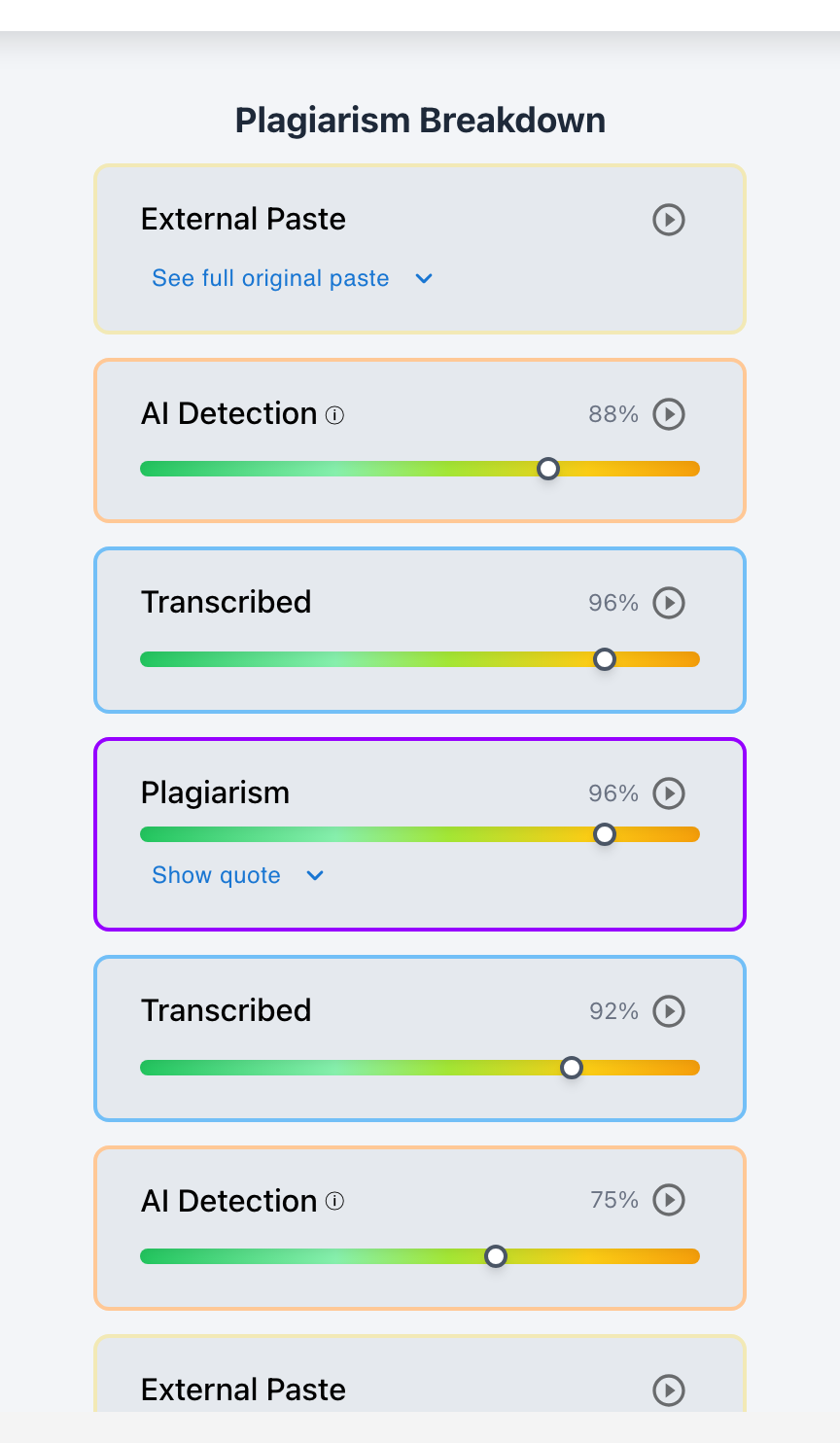
Checkmark Plagiarism clarifies these distinctions by combining plagiarism detection with AI detection, essay writing playback, static AI detection, autograding, and integrations with Canvas and Google Classroom.
Definitions: The 3 Core Categories
1. Generative AI Writing
Text synthesized by large language models (ChatGPT, Claude) using probabilistic next-token predictions rather than copying existing database text.
2. Traditional Plagiarism
Copying words, data, or concepts directly from an existing human source (websites, journals, peer essays) without quotation marks or attribution.
3. Paraphrasing (Valid vs. Spun)
Valid: Synthesizing an author's ideas into one's authentic voice with citation. Spun: Swapping words with tools like QuillBot to evade plagiarism filters.
3-Way Comparison: Mechanics, Detection, and Ethics
Generative AI Writing
- Source: Statistical neural network weights.
- Detection: AI detectors + Essay Writing Playback.
- Plagiarism Match: Usually 0% similarity.
- Ethical Status: Authorship fraud & cognitive bypass if uncredited.
Traditional Plagiarism
- Source: Published web pages, books, or papers.
- Detection: Database string-matching scanners.
- Plagiarism Match: High exact-match percentage.
- Ethical Status: Intellectual property theft & unattributed copying.
Dishonest Paraphrasing
- Source: External text rewritten by automated spinners.
- Detection: Mosaic analysis + Writing Playback.
- Plagiarism Match: Low to moderate similarity.
- Ethical Status: Patchwriting & deceptive disguise of stolen text.
How Essay Writing Playback Distinguishes Each Writing Type
While final submitted documents can look deceptively similar, Checkmark Plagiarism's essay writing playback reveals their fundamentally different creation timelines:
- Authentic Student Paraphrasing: Keystroke logs show active reading, typing original thoughts, revising sentence structure, and manually typing citations over multiple sessions.
- Traditional Copy-Paste Plagiarism: Playback records exact text chunks copied and pasted from external web pages directly into the document.
- Generative AI Writing: Playback shows the entire 1,500-word essay appearing in a single instant paste event with near-zero active drafting time.
- AI-Spun Paraphrasing: Playback captures a wholesale paste of spun text featuring unnatural synonym choices and zero incremental keystrokes.
Read more in how Checkmark writing process analysis works.
Legitimate Paraphrasing vs. Dishonest AI Patchwriting
Legitimate Academic Paraphrasing
- Student reads, understands, and synthesizes the source.
- Expressed in student's authentic, natural voice.
- Includes complete in-text citation and bibliography entry.
- Writing playback shows incremental drafting and thought.
Dishonest AI Patchwriting / Spinning
- Text copied into an AI spinner (QuillBot) to swap words.
- Retains original sentence blueprint with bizarre synonyms.
- Omits citation to hide the original source material.
- Writing playback shows wholesale external paste.
A 5-Step Integrity Checklist for Educators
Educator Classification Checklist:
- 1. Check plagiarism match score for exact web and database matches.
- 2. Review essay writing playback to observe keystroke drafting vs. wholesale paste events.
- 3. Inspect AI detection heatmaps for statistical predictability and low burstiness.
- 4. Audit cited sources in academic databases (JSTOR, Google Scholar) to detect phantom references.
- 5. Hold a brief conference asking the student to explain and synthesize their sources orally.
How Checkmark Plagiarism Clarifies Writing Integrity
Checkmark Plagiarism combines **AI detection, essay writing playback, static AI detection, plagiarism detection, autograding, and Canvas/Google Classroom integrations** to give schools unified visibility across all three categories, eliminating ambiguity and protecting honest student effort.
Frequently Asked Questions
Can an essay be written by AI without being plagiarized?
Yes, in terms of database text matching. ChatGPT generates novel text that produces a 0% plagiarism score, but it remains an ethical integrity violation regarding authorship misrepresentation.
What is the difference between paraphrasing and plagiarizing?
Paraphrasing involves restating an author's ideas in your own words while citing the original source. Plagiarizing involves copying or restating ideas without attribution.
Is using an AI paraphraser considered plagiarism?
Yes. Taking someone else's writing and using an automated spinner to swap words without citing the original work is patchwriting and plagiarism.
Why does writing playback distinguish AI writing from authentic paraphrasing?
Authentic paraphrasing shows typing, pausing, and multi-session editing, while AI writing and spinning appear as instant wholesale paste blocks with minimal typing time.
What is 'mosaic plagiarism'?
Interweaving copied phrases and synonyms from multiple sources without quotation marks or proper attribution to create a patchwork essay.
Can a student accidentally commit AI plagiarism?
Yes. If a student uses an AI tool to "improve grammar" and the tool rewrites entire paragraphs without the student realizing it altered the authorship, it can lead to unintentional misconduct.
How should schools define AI writing in their honor codes?
Explicitly distinguish between authorized assistance (e.g., spellcheck) and unauthorized generative authorship (e.g., having AI generate paragraphs or arguments).
How do fake citations fit into these categories?
Fake citations are unique to generative AI hallucination, providing concrete physical evidence of AI generation rather than traditional plagiarism.
What should a teacher do when uncertain which category applies?
Inspect the essay writing playback timeline, audit the bibliography, and invite the student to discuss their writing process in an exploratory conference.
How does Checkmark Plagiarism assist educators with all three?
Checkmark Plagiarism runs simultaneous plagiarism checks, AI detection scans, and visual writing playback directly inside Canvas and Google Classroom.
Clarity in Definitions Leads to Fairness in Practice
Understanding the clear boundaries between AI generation, traditional plagiarism, and legitimate paraphrasing allows educators to respond to integrity concerns with precision, fairness, and educational empathy. By pairing clear policies with essay writing playback and citation audits, institutions protect authentic learning.
Checkmark Plagiarism supports this principled standard with AI detection, essay writing playback, static AI detection, plagiarism detection, autograding, and integrations with Canvas and Google Classroom.
See how Checkmark pairs essay writing playback with multi-signal detection to distinguish AI writing, plagiarism, and authentic paraphrasing. View a sample report or request a demonstration.