
During doctoral dissertation and master’s thesis defenses (viva voce), graduate committees, departmental academic integrity officers, and thesis advisers should not evaluate scholarly authenticity using static PDF manuscripts or opaque, whole-document AI detector percentages. Because doctoral dissertations span 150 to over 350 pages and represent years of cumulative intellectual labor, superficial detection tools fail catastrophically—triggering severe false positives on dense academic prose while exposing unpublished, patent-eligible research to third-party data harvesting.
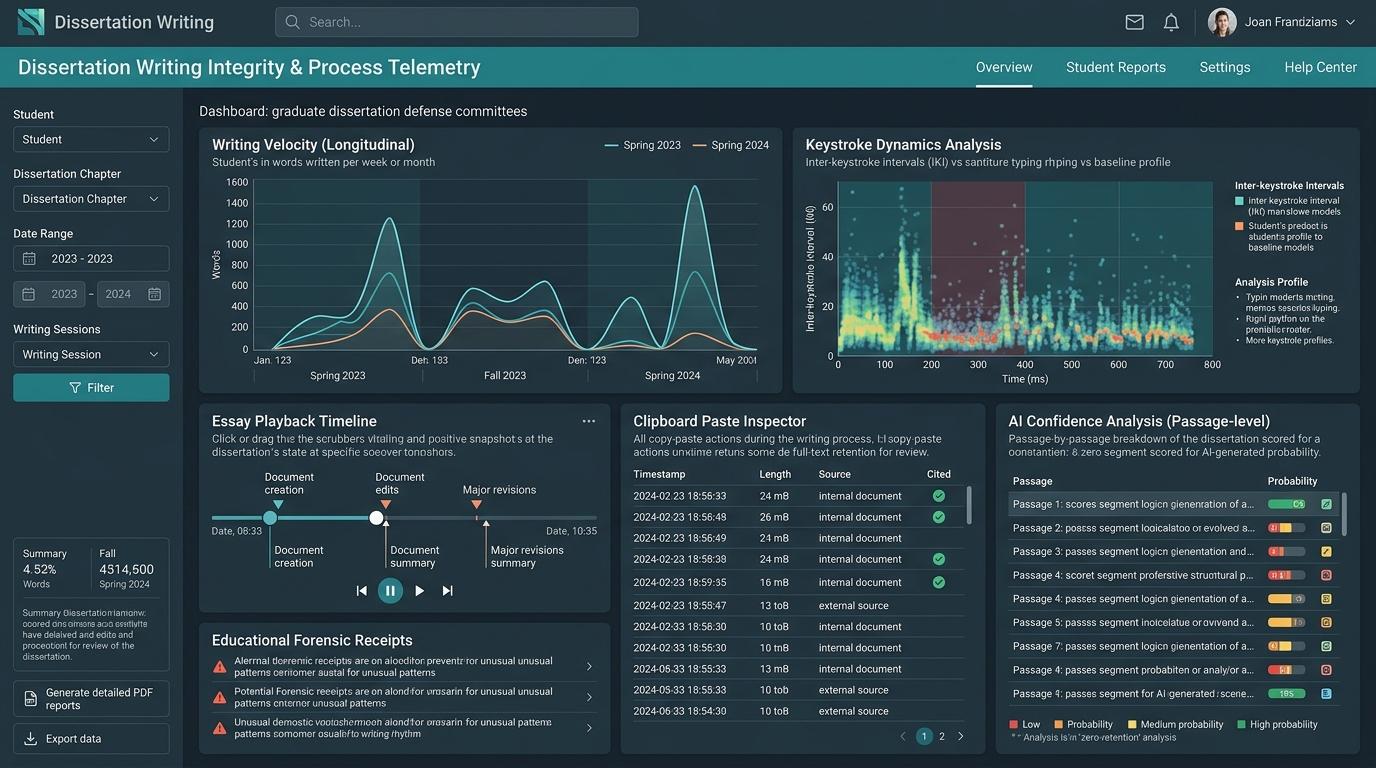
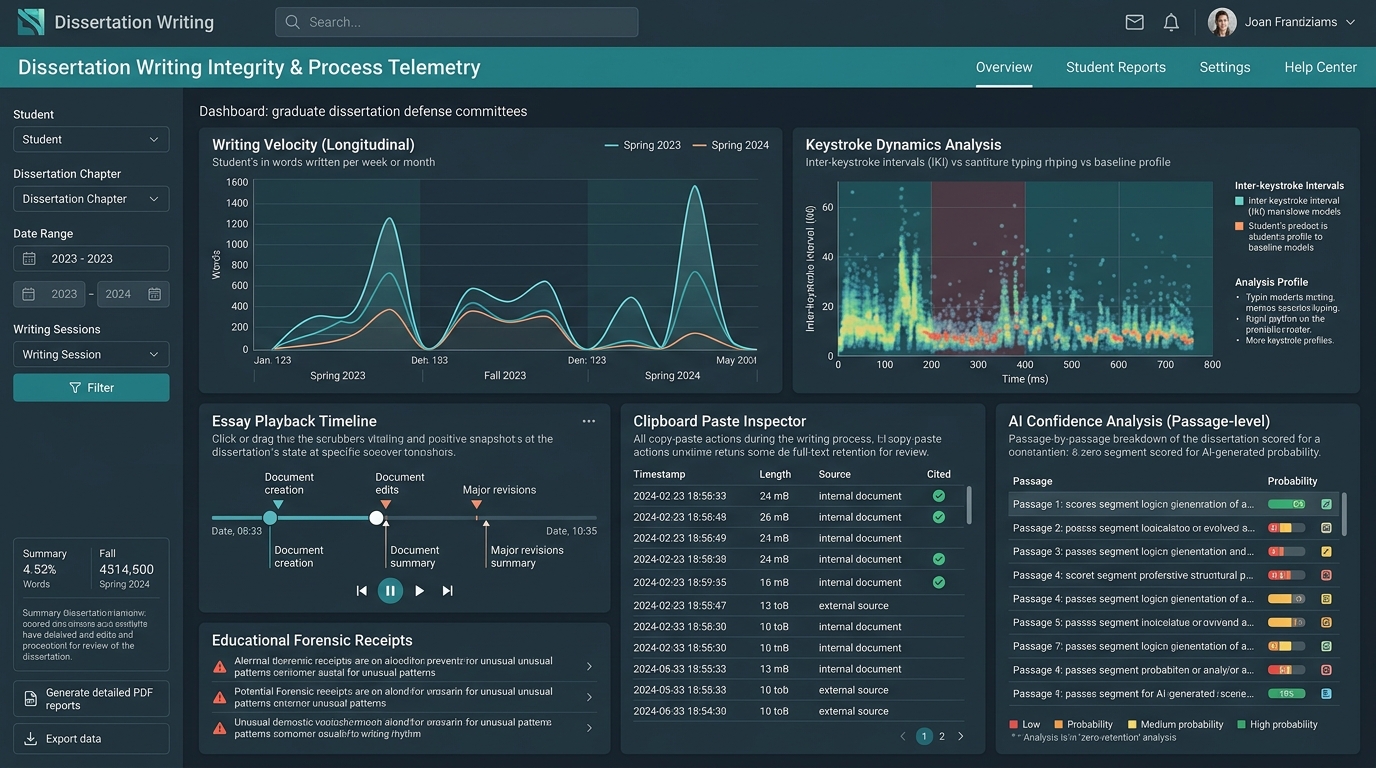
Instead, graduate committees should audit a Longitudinal Writing Process Telemetry Dossier comprised of five core empirical layers: (1) Longitudinal Session Velocity & Temporal Pacing, (2) Inter-Keystroke Interval (IKI) Distribution & Cognitive Friction Metrics, (3) Raw External Clipboard Paste Provenance with Full-Text Preservation, (4) Macro/Micro Structural Revision Trajectories, and (5) Passage-Level AI Confidence Sliders Underpinned by Zero-Data-Retention Ephemeral Architecture. By reviewing these objective writing telemetry signals alongside patent-pending Essay Playback™ (1x–8x scrubbable timeline replay), graduate committees can definitively confirm independent scholarly authorship, protect doctoral candidates from unsubstantiated AI allegations, detect ghostwriting consultancies and late-stage AI panic dumping, and safeguard institutional research integrity without storing student manuscripts.
Checkmark Plagiarism equips Graduate School Deans, Doctoral Dissertation Committees, Master’s Thesis Advisers, and Research Compliance Officers with empirical writing process telemetry and LMS integrations across Canvas LMS, Agilix Buzz, and Google Classroom.
1. The Modern Crisis in Graduate Scholarship & Dissertation Authorship
The doctoral dissertation is the capstone of advanced scholarship. Requiring three to seven years of original empirical experimentation, archival inquiry, or theoretical synthesis, a 150- to 350-page dissertation establishes a scholar’s professional identity, qualifies them for faculty appointments or corporate research leadership, and generates foundational intellectual property (IP).
However, the advent of sophisticated generative large language models (LLMs), AI-driven paraphrasers (“humanizers”), and commercial shadow-writing services has created an unprecedented vulnerability in graduate education:
Doctoral candidates facing funding exhaustion, impending defense deadlines, or severe burnout resort to wholesale AI generation for Chapters 2 (Literature Review) and 5 (Discussion & Future Work).
Commercial “dissertation coaching” firms secretly deploy bespoke LLM pipelines and contract rewriters to generate draft chapters, delivering synthetic text for candidates to retype or copy.
Generative models inventing non-existent academic papers, fabricated Digital Object Identifiers (DOIs), and misattributed empirical findings embedded seamlessly into dense literature reviews.
Iterative paraphrasing software (e.g., QuillBot, Undetectable AI) masking synthetic origins while retaining automated intellectual thought, defeating superficial surface scanners.
The Anatomy of Authentic Scholarly Writing vs. Synthetic Output
Scholarly writing at the graduate level is inherently iterative, cognitively taxing, and non-linear. A researcher does not sit down and produce 40 pages of pristine literature review in a single sitting. Genuine scholarly drafting is characterized by:
- Prolonged cognitive pauses spent consulting physical notes, citation managers (Zotero, Mendeley, EndNote), and primary datasets.
- High revision friction—constant backtracking, restructuring of sentences, deleting redundant clauses, and refining theoretical definitions.
- Distinct temporal clustering—periods of intense synthetic drafting alternating with multi-week pauses dedicated to laboratory assays, field data collection, or statistical modeling in R and Python.
In contrast, unmonitored generative AI produces syntactically fluent, structurally balanced prose instantly—or in continuous, mechanical typing bursts when manually transcribed from a secondary screen. When graduate committees rely exclusively on the final bound PDF, this fundamental distinction in cognitive production is completely invisible.
2. The Graduate Committee Dilemma: Why Traditional Defense Audits Fail
Graduate dissertation committees historically relied on the viva voce (oral defense) and spot-check reading to ensure integrity. In the era of advanced generative AI, these traditional mechanisms fail for two structural reasons:
- A 90-minute oral defense cannot scrutinize 300 pages of dense literature reviews, mathematical derivations, and code.
- Articulate candidates can speak fluently on topics they did not personally compose (“The Charismatic Mask”).
- High-anxiety, neurodivergent, or ESL candidates may appear hesitant despite 100% authentic, grueling human drafting.
- Committees cannot realistically spot-check 400+ citations across 80,000 words in real time.
- Uploading draft dissertations to commercial databases can jeopardize patent novelty (USPTO 35 U.S.C. § 102 & EPC Art. 54).
- Standard probabilistic detectors trigger catastrophic false positives on ESL syntax and formal scholarly registers.
- Proprietary black-box percentages provide zero defensible evidence (“receipts”) for faculty governance panels.
- Can breach federal export controls (ITAR/EAR) and corporate sponsored research agreements (CRADAs).
1. The Oral Defense Blindspot
A 90- to 120-minute oral defense is designed to evaluate a candidate’s mastery of their field and defense of their findings. However:
- The Charismatic Mask: A candidate who outsourced their literature review or used AI to generate their theoretical framework can memorize key themes, rehearse presentation slides, and deliver articulate oral answers without ever having engaged in the actual synthesis of the literature.
- The Neurodivergent / ESL Disadvantage: Conversely, neurodivergent candidates or non-native English speakers may experience severe oral examination anxiety or language retrieval stalls, leading suspicious committees to suspect misconduct where only authentic, grueling human drafting took place.
- The Volume Mismatch: A dissertation committee consisting of 3 to 5 faculty members cannot realistically spot-check 300–600 cited sources, cross-examine every methodology subsection, and verify the sentence-by-sentence authenticity of 80,000 words.
2. The Commercial AI Detector Trap & Research Compliance Hazards
When concerned advisers turn to generic, commercial AI detection software, they introduce severe legal, financial, and ethical risks to the university:
Invalidation of Patent Novelty under USPTO 35 U.S.C. § 102 & EPC Article 54
Under United States patent law (35 U.S.C. § 102, the statutory public disclosure bar) and European patent law (European Patent Convention Article 54), an invention can lose patentability if it is publicly disclosed or made accessible to third parties before a patent application is filed. The United States allows a one-year grace period for the inventor’s own disclosures (35 U.S.C. § 102(b)(1)), but the European Patent Convention has no comparable general grace period (Article 55 excepts only evident abuse and certain international exhibitions, within six months of filing).
- If a graduate student in bioengineering, materials science, or computer science uploads their unpublished dissertation manuscript containing novel chemical vectors or algorithms into a third-party commercial plagiarism/AI checker that stores manuscripts in a cloud database, corporate litigators can argue the research was disclosed to a commercial third party.
- This can invalidate multi-million dollar institutional patents and university technology licensing agreements.
Violation of Corporate Sponsored Research (CRADAs) & Export Control (ITAR/EAR)
Doctoral research is sometimes conducted under Cooperative Research and Development Agreements (CRADAs), which are agreements between federal laboratories and non-federal partners, or under other sponsored-research agreements with defense or corporate partners. Uploading proprietary lab findings to unvetted cloud tools can breach non-disclosure agreements (NDAs). In dual-use fields (aerospace, quantum computing, biosecurity), uploading manuscripts to commercial cloud servers can trigger severe federal violations under ITAR (22 CFR Parts 120–130) and EAR (15 CFR Parts 730–774).
Catastrophic False Positives on Dense Scholarly Registers
Generic AI detectors measure probabilistic word choice (perplexity) and sentence length variation (burstiness) against conversational internet prose. Academic dissertation writing naturally exhibits low perplexity and formal, repetitive terminology:
- Passive voice constructions (“The assay was conducted under standard atmospheric pressure...”)
- Discipline-specific nomenclature and standardized theoretical phrasing
- Dense bibliographic citations
As a result, black-box AI detectors can assign high “AI Generated” scores to human-authored doctoral dissertations, causing immense psychological harm and threatening academic careers with baseless allegations.
3. The Graduate Evidentiary Matrix: Comparative Technology Framework
To evaluate doctoral and master’s submissions defensibly, graduate writing programs, academic deans, and dissertation committees must understand the technical differences between static file reviews, black-box AI checkers, and Longitudinal Writing Process Telemetry.
| Audit Dimension | Static PDF Submission | Standalone AI Detector | Checkmark Telemetry & Essay Playback™ |
|---|---|---|---|
| Evidentiary Basis | Final static text only (zero temporal context) | Probabilistic linguistic surface pattern scan | Empirical keystroke & temporal writing data |
| False-Positive Risk on Formal Academic Prose | N/A (Manual spot check) | High (formal, dense literature reviews can be misread as AI) | Near Zero (Exonerated by authentic replay) |
| Patent & IP Protection (USPTO § 102 / FERPA) | Secure (Kept on campus servers / printed hard) | Catastrophic (Ingested into commercial clouds) | Absolute Zero-Data-Retention guarantee |
| External Paste Tracking | Completely Invisible | Completely Invisible | 100% Timestamped with Raw Text Preservation |
| Resistance to Paraphrase “AI Humanizers” | Vulnerable (Humanized text passes unnoticed) | Completely Defeated (Alters perplexity) | 100% Immune (Cannot fake writing history) |
| Committee Restorative Conferencing Utility | Non-existent (He-said-she-said) | Hostile / Adversarial (“Prove this score wrong”) | Collaborative, Objective “Receipts” |
4. The 5 Core Writing Process Telemetry Layers Graduate Committees Must Review
When auditing a dissertation or thesis draft prior to defense, graduate committees should inspect five empirical telemetry layers generated throughout the candidate’s multi-draft writing cycle.
Longitudinal Velocity
Time-stamped session pacing across weeks, months, and semesters.
Keystroke Dynamics
Inter-Keystroke Interval (IKI) distribution and cognitive friction metrics.
Clipboard Provenance
Immutable capture and retention of unedited external paste payloads.
Revision Trajectories
Macro-structural reorganization and micro-rephrasing evolution.
Passage AI Sliders
Calibrated confidence sliders under zero-data-retention security.
Layer 1: Longitudinal Drafting Velocity & Session Pacing
Scholarly drafting follows realistic physical and cognitive limits. Telemetry dashboards capture the exact time-stamped distribution of text creation across weeks, months, and semesters.
- Authentic Human Scholar Pacing:
- Active compositional velocity typically ranges between 200 and 650 words per hour during complex synthesis.
- Writing sessions are distributed across dozens or hundreds of distinct calendar sessions.
- Extended gaps between drafting sessions align with laboratory experiments, statistical calculations, field interviews, or archival visits.
- Anomalous Synthetic Spikes:
- Sudden appearance of 8,000–15,000 words of dense, flawless literature review or theoretical synthesis within a 3-hour window.
- Zero recorded writing sessions prior to the final submission deadline, followed by a single massive text injection.
Layer 2: Inter-Keystroke Interval (IKI) Distribution & Cognitive Friction
The physical timing between individual keystrokes provides indisputable mathematical proof of human composition versus machine generation or manual transcription.
[Thinking Pause: 4.2s] → [Typing Burst: “However, recent empirical” (IKI: 110ms - 230ms)]→
[Mid-Clause Hesitation: 1.8s] → [Typing: “findings from several studies”]→
[Revision: 14 Backspaces] → [Typing: “demonstrate conflicting outcomes.”]
[Steady Typing: “Furthermore, the molecular weight of the compound...”](IKI: Constant 135ms ± 15ms across 45 minutes; Zero backspaces; Zero conceptual pauses)
[Gap: 2.1s] → [Instant Injection: 3,450 Words / 22,000 Characters in 0.00 Milliseconds]
- Cognitive Burst Architecture: Genuine human authors operate in “cognitive bursts.” An author pauses (1.5 to 8.0 seconds) to formulate a thought, types a phrase in a rapid burst of keystrokes (with variable Inter-Keystroke Intervals between 90ms and 280ms), pauses mid-clause to evaluate phrasing, and frequently engages backspacing or deletion.
- Cognitive Friction Index: High-level graduate prose exhibits significant revision friction:
- Deletion-to-Character Ratio: Authentic dissertations typically exhibit a 12% to 28% character deletion rate (backspaces, highlighted deletions, substitutions).
- Typing Cadence Variance: Standard deviation of IKI is high, reflecting lexical retrieval, syntactic restructuring, and punctuation mechanics.
- Transcription Signature: If a student retypes an AI-generated draft from a secondary monitor, smartphone, or printout, the telemetry exhibits a rigid, metronomic cadence (constant 120–160ms IKI) with near-zero backspacing and no reflective pauses.
Layer 3: Raw Clipboard Paste Provenance & Full-Text Preservation
In graduate research, copying and pasting text is standard practice—doctoral candidates paste raw data tables from R/SPSS, BibTeX references from Zotero, block quotes from open-access journals, and survey questions. The critical investigative requirement is provenance and payload analysis.
- 02:14:22 — Deleted opening conversational prompt line (“Certainly! Here is...”)
- 02:16:45 — Replaced 12 adjective-noun pairs using QuillBot synonym suggestions
- Final State: Final Text in Dissertation Chapter 2 matches retained paste payload with 94.2% structural identity
- Full-Text Clipboard Preservation: Unlike generic word processor version histories that only record the current state of a paragraph, Checkmark’s external paste inspector captures the exact, unedited text placed into the document at the moment of the paste event.
- Post-Paste Rewriting Tracking: Even if a student spends three hours manually editing, rephrasing, or running a paraphrasing tool over a pasted AI generation, the underlying telemetry permanently links the current prose to the original external clipboard injection.
- Benign vs. Unauthorized Pasting: Committees can instantly differentiate between a candidate pasting a 400-word block quote from a recognized historical primary source vs. pasting 4,000 words of synthetic literature review containing telltale LLM preamble markers.
Layer 4: Macro and Micro Structural Revision Trajectories
Doctoral writing is characterized by significant macro-structural reorganization:
- Moving entire sections from Chapter 3 (Methodology) to Chapter 1 (Introduction).
- Re-ordering paragraphs based on adviser feedback.
- Developing early bullet-point outlines into full theoretical arguments over multiple drafts.
Telemetry dossiers track the evolution of document topology. A dissertation that springs into existence fully formed, with zero macro-reorganization, zero section restructuring, and zero deleted conceptual dead-ends, presents an immediate telemetry flag for committee inquiry.
Layer 5: Passage-Level AI Confidence Sliders Under Zero-Retention Architecture
Rather than relying on a single, opaque “68% AI” whole-document score that invites speculation, committees need passage-level granularity anchored by calibrated confidence sliders:
“While early neural language models learned distributed word representations to overcome the curse of dimensionality (Bengio et al., 2003), modern transformer architectures utilize multi-head self-attention mechanisms...”
“To calibrate the spectrometer, we applied a baseline voltage of 3.4V across the cathode array...”
- Educator-Only Flag Statuses: Evidence cards and confidence sliders are private to the committee, ensuring candidates are never subjected to automated accusations.
- Short-Text Honest Guardrails: Subsections under 150 words display
N/Arather than generating inaccurate probabilistic guesses. - Zero-Data-Retention Security: Submissions are processed ephemerally in memory; no student text is ever indexed, stored, or used to train commercial AI models.
5. Step-by-Step Graduate Committee Defense Audit Protocol
Graduate schools should implement a formalized, non-punitive audit protocol that embeds writing telemetry into existing thesis and dissertation milestones.
Draft imported via LMS/LTI. Multi-chapter history aggregated into a unified longitudinal dossier with ephemeral side-by-side plagiarism and passage AI scoring.
Chair reviews paste ratios, timeline milestones, and scrubs flagged chapters at 2x–8x speed to inspect cognitive friction vs. transcription.
Committee anchors questions in objective telemetry data, providing supportive inquiry into research methodologies and drafting progressions.
Phase 1: Pre-Defense Telemetry Dossier Generation (30 Days Prior to Defense)
When the doctoral candidate submits their final dissertation draft to the graduate school:
- The document is imported through Checkmark’s ecosystem integration (Canvas LMS, Buzz LMS, Google Docs, or Microsoft Word LTI integration).
- Checkmark automatically compiles the multi-chapter writing history, aggregating all previous draft milestones, lab write-ups, and revision sessions into a unified Longitudinal Defense Dossier.
- A zero-retention scan runs ephemerally to generate side-by-side web/academic plagiarism matches and passage-level AI confidence indicators.
Phase 2: Automated Anomaly Triage & Essay Playback™ Scrubbing (14 Days Prior)
The Dissertation Committee Chair and Writing Program Director review the dossier summary dashboard:
- Pasting Ratio Review: Examine total external paste percentage. Standard empirical dissertations typically show 15%–30% paste ratios (data tables, code snippets, bibliography, block quotes). If a theoretical or literature chapter shows an 85%+ paste ratio, flag for inspection.
- Session Timeline Check: Verify that drafting milestones correspond with documented adviser meetings and laboratory logbook records.
- Essay Playback™ Scrubbing: If a specific chapter exhibits anomalous velocity or high AI confidence sliders, open Checkmark’s Patent-Pending Essay Playback™ viewer. Scrub through the timeline at 2x, 4x, or 8x speed to watch the candidate’s authentic writing process unfold:
- Observe whether the student drafted organically (typing, pausing, rewriting).
- Observe whether text was pasted in massive blocks and superficially edited.
- Observe whether typing occurred at a rigid, continuous mechanical speed without pauses (indicating manual transcription from a second screen).
Phase 3: Restorative Viva Voce Defense Inquiry Protocol (During the Defense)
If an anomaly is identified, the committee does not make punitive accusations. Instead, the committee uses the telemetry data to formulate constructive, pedagogically grounded inquiry during the closed oral defense session.
“Our AI detector flagged Chapter 2 as 82% AI-generated. Why did you cheat on your literature review?”
“In Chapter 2, pages 45–58, our telemetry review shows that this 4,000-word synthesis of post-Marxist economic theory was inserted in a single 12-minute session via external paste. Could you walk the committee through your note-taking methodology, share the primary literature summaries you compiled prior to this session, and explain the theoretical progression connecting the foundational sources in your review to your own framework in Section 2.4?”
Phase 4: Committee Deliberation & Resolution Pathways
Based on the candidate’s oral defense and telemetry dossier, the committee selects one of three formal resolution pathways:
- Unconditional Defense Approval: Telemetry validates authentic cognitive friction, iterative drafting, and legitimate source quoting across all chapters.
- Restorative Revision Stipulation (Conditional Pass): If specific subsections (e.g., literature review synthesis) reveal uncredited paraphrasing, LLM assistance, or missing source citations without malicious intent, the candidate is given a 30- to 60-day revision window to rewrite the flagged sections under active telemetry tracking.
- Formal Integrity Referral: In clear cases of contract ghostwriting or total unauthorized LLM generation where the candidate cannot explain or defend the underlying scholarship, the dossier is forwarded to the Graduate Academic Integrity Board with complete, objective keystroke “receipts.”
6. Illustrative Dissertation Defense Case Scenarios
The following illustrative scenarios show how writing process telemetry could resolve complex integrity challenges in graduate education. The candidates and figures below are examples, not published records.
| Case Scenario | Initial Complaint / Flag | Telemetry Dossier Proof | Committee Resolution |
|---|---|---|---|
| Scenario A: Late-Stage AI Panic in Education Ph.D. | Chapter 2 (Literature Review) flagged 88% AI by commercial detector | External paste inspector captures raw ChatGPT prompt & 14-min paste payload | 45-day restorative revision window; rewritten organically under tracking |
| Scenario B: ESL STEM Scholar Falsely Accused | Chapter 4 (Discussion) flagged 74% AI due to dense academic syntax | 142 hours of typing, 12,400 backspaces, organic lab equations across 64 sessions | Candidate fully exonerated; committee commends scholarship with distinction |
| Scenario C: Ghostwriting Agency Transcription | Candidate speaks poorly during defense; claims 6 months of solo writing | Mechanical 65 WPM typing, zero pauses, zero edits across 110 pages in 3 days | Formal referral; candidate confesses to hired online dissertation service |
Scenario A: Late-Stage AI Panic in an Education Doctorate (Ed.D.)
- Context: A doctoral candidate in Educational Leadership, balancing full-time school administration with dissertation deadlines, submitted a 210-page dissertation.
- The Flag: Chapter 2 (Literature Review, 35 pages) was flagged by an automated scanner.
- Telemetry Analysis: Checkmark’s timeline revealed that Chapters 1, 3, 4, and 5 had 180+ hours of documented drafting over 18 months. However, Chapter 2 appeared in two massive external paste events over 48 hours. Checkmark’s paste inspector preserved the raw clipboard text, which contained ChatGPT conversational prefixes (“Certainly! Here is an exhaustive analysis of transformational leadership theories...”).
- Committee Action: During the defense, the adviser held a supportive, restorative conference. The candidate confessed to panic due to impending family health crises and deadline exhaustion. Because the empirical data (Chapters 3 and 4) was 100% authentic, the committee granted a 45-day conditional extension. The student rewrote Chapter 2 in Google Docs with active Checkmark telemetry tracking, successfully defending their degree two months later.
Scenario B: Exonerating an International STEM Scholar from False AI Accusations
- Context: A non-native English speaker completing a Ph.D. in Chemical & Biomolecular Engineering submitted a dissertation on catalytic polymer synthesis.
- The Flag: A standalone commercial AI detector flagged Chapter 4 (Discussion) with an 84% “AI Generated” score due to formal, repetitive technical vocabulary and passive voice.
- Telemetry Analysis: The committee chair opened Checkmark Essay Playback™. The telemetry proved that the candidate spent 142 hours across 64 individual drafting sessions composing the chapter. The Inter-Keystroke Interval log showed extensive cognitive friction: 12,400 backspaces, continuous rephrasing of biochemical mechanisms, and live mathematical equation derivations.
- Committee Action: The committee immediately dismissed the generic AI score. The candidate was spared an adversarial honor code hearing, protected from psychological distress, and passed their defense with distinction.
Scenario C: Uncovering a Commercial Ghostwriting Consultancy
- Context: A Master of Arts in History candidate submitted a 110-page thesis on Cold War diplomatic treaties.
- The Flag: During the oral defense, the candidate struggled to explain primary archival sources cited throughout Chapter 3.
- Telemetry Analysis: Checkmark’s keystroke dynamics log revealed that the entire 110-page document was typed over three consecutive days at a mechanical velocity of 65 words per minute without a single cognitive pause longer than 2.0 seconds and with a deletion-to-character ratio of less than 0.8%.
- Committee Action: The committee presented the telemetry graph to the student. Confronted with the objective evidence of transcription, the candidate admitted to purchasing a drafted thesis from an online “dissertation consulting agency” and manually retyping it into the LMS editor from a second monitor. The case was referred to the University Academic Integrity Board with complete, incontrovertible digital documentation.
7. How Checkmark Plagiarism Protects Doctoral Scholars & Institutional Integrity
Checkmark Plagiarism delivers an enterprise-grade academic integrity and writing verification suite engineered specifically for the rigorous demands of higher education institutions, graduate schools, and research universities.
Reconstructs the full history of every chapter keystroke-by-keystroke. Watch drafting, pauses, deletions, restructuring, and paste events in an interactive video-like timeline.
Captures and permanently stores the original text of every external paste event, preserving crucial forensic evidence even if the student rewrites every sentence after pasting.
Eliminates opaque whole-paper percentages. Provides calibrated confidence sliders, sentence-level underlines, and linguistic perplexity/burstiness analytics with honest short-text guardrails.
Scans billions of open-access journals, pre-print servers, and web archives. Side-by-side quote viewers distinguish between properly cited block quotes, missing citations, and patchwriting.
Student submissions are processed in memory and NEVER stored, indexed, or used to train commercial AI models—protecting USPTO patent novelty (§ 102), corporate NDAs, and student IP rights.
Deploy effortlessly across Canvas LMS, Buzz LMS, Moodle, Google Classroom, Google Docs, Microsoft Word, and institutional Single Sign-On (Google SSO, Microsoft SSO).
8. Frequently Asked Questions (FAQ)
1. Why is writing process telemetry more reliable than commercial AI detection scores for dissertations?
Commercial AI detectors evaluate static text using probabilistic linguistic models, searching for patterns common in generic LLM outputs. However, doctoral dissertations naturally share these same features—formal tone, passive voice, high vocabulary consistency, and standardized discipline-specific phrasing—leading to severe false positives. Writing process telemetry does not guess based on surface syntax; it measures the empirical physical reality of how the document was created over time (keystrokes, thinking pauses, revision friction, and paste origins), providing objective evidence that cannot be faked.
2. How does writing telemetry differentiate between legitimate copying of lab data/citations and unauthorized AI pasting?
Checkmark’s External Paste Inspector captures and preserves the exact raw text of every paste event. When a graduate student pastes a bibliographic entry from Zotero, a statistical table from SPSS/R, or an excerpt from a published journal article, the preserved paste payload matches the legitimate academic source. In contrast, unauthorized AI pasting captures conversational prompts, synthetic outlines, or complete un-cited generative essays.
3. Can a candidate fake authentic writing telemetry by retyping AI text from a second monitor?
No. Human cognitive composition tends to follow a “cognitive burst” pattern characterized by thinking pauses (1.5s–8s+), variable inter-keystroke intervals (IKIs), mid-sentence hesitations, and frequent revision backspacing (12%–28% deletion ratio). Manual transcription from a secondary screen produces a distinct, metronomic typing signature: rigid, uniform keystroke intervals with near-zero backspacing and an absence of natural conceptual pauses. Checkmark Essay Playback™ highlights this transcription signature immediately.
4. How does Checkmark protect university patent rights and intellectual property?
Under USPTO 35 U.S.C. § 102 and EPC Article 54, public disclosure or third-party accessibility to an invention prior to patent filing can destroy patent novelty. Legacy plagiarism tools store student manuscripts in centralized commercial databases, exposing research to corporate harvesting and legal challenges. Checkmark operates under a strict Zero-Data-Retention (ZDR) architecture: student manuscripts are processed ephemerally in memory and are never indexed, permanently stored, or used to train commercial AI models.
5. Does reviewing writing telemetry create an adversarial defense environment?
On the contrary, telemetry transforms defense reviews from hostile, speculative confrontations into supportive, evidence-based academic dialogues. When a student is wrongly accused by a generic AI detector, telemetry serves as their ultimate shield and exoneration tool. When genuine drafting gaps or panic-pasting occur, the committee can address the specific issue constructively with objective “receipts,” offering restorative revision pathways rather than automatic punitive expulsions.
6. At what stages of the graduate degree should writing telemetry be reviewed?
Telemetry review should not be saved exclusively for the final oral defense. Best practice is to establish milestone telemetry checkpoints: (1) at the Dissertation Proposal / Prospectus defense, (2) during annual dissertation committee progress reviews, (3) upon submission of individual draft chapters to the adviser, and (4) 30 days prior to the final viva voce defense.
7. How does Checkmark integrate with institutional writing platforms and LMS environments?
Checkmark integrates natively via LTI 1.3 standards with Canvas LMS, Agilix Buzz, Moodle, and Google Classroom, as well as providing direct integrations for Google Docs and Microsoft Word. This ensures complete, uninterrupted keystroke and revision telemetry capture regardless of whether graduate students draft within their institutional LMS or preferred desktop/cloud writing environments.
9. Conclusion: Moving from Suspicion to Verified Scholarly Trust
The modern doctoral dissertation represents years of rigorous inquiry, sacrifice, and intellectual breakthrough. Protecting this milestone requires tools that match the complexity of graduate scholarship.
By replacing opaque, black-box AI scores with Longitudinal Writing Process Telemetry, patent-pending Essay Playback™, and Zero-Data-Retention architecture, graduate schools can uphold the highest standards of academic integrity, protect honest doctoral scholars from false accusations, safeguard critical patent novelty, and foster a culture of transparent, defensible scholarly mentorship.
Stop Guessing. Start Trusting.
Equip your graduate faculty, thesis advisers, and dissertation defense committees with the empirical writing process telemetry needed to verify authentic human scholarship while protecting institutional patent novelty.
Schedule an Institutional Consultation