
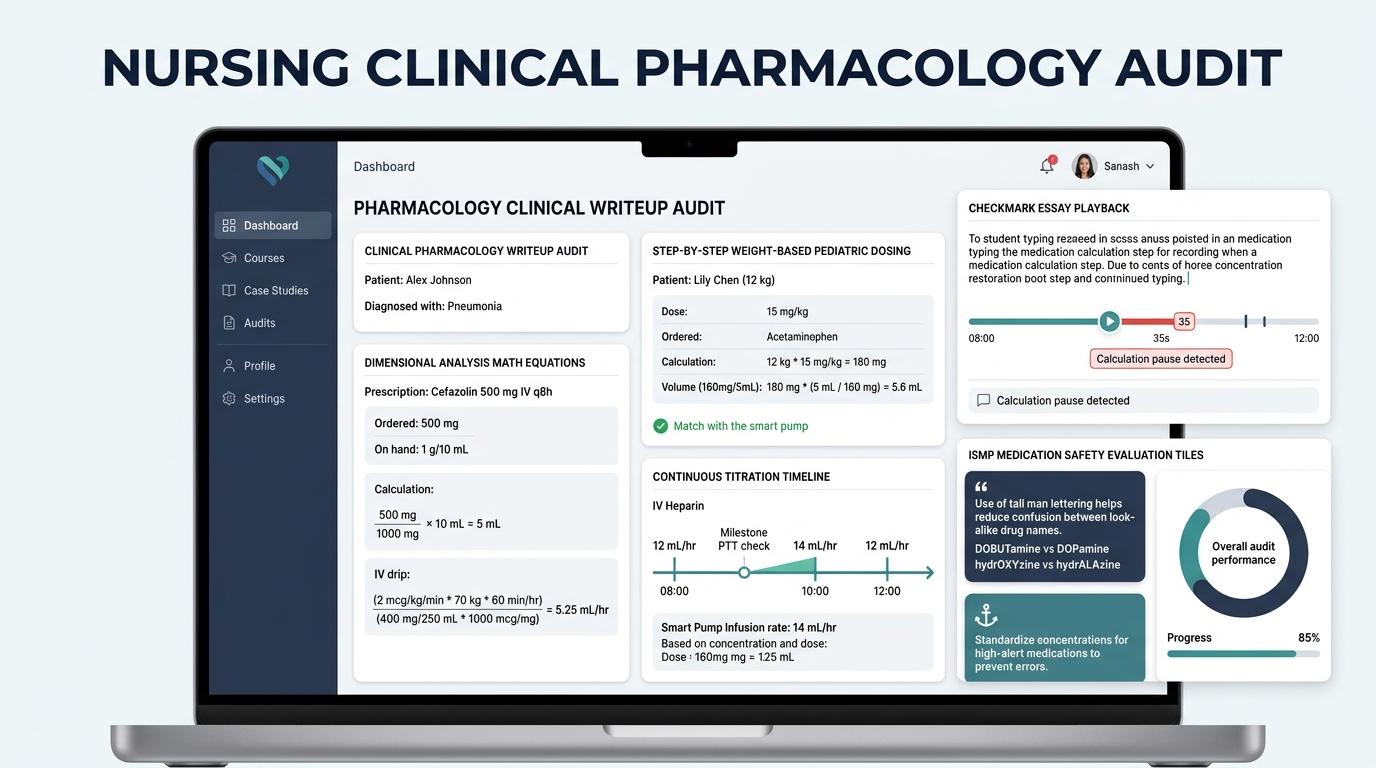
Executive Summary & Patient Safety Imperative
In collegiate nursing education, pharmacology dosage calculation writeups and clinical titration rationales represent the ultimate high-stakes intersection of academic integrity and patient safety. Guided by the NCSBN Next Generation NCLEX (NGN) Clinical Judgment Measurement Model, AACN Essentials, CCNE, and ACEN accreditation standards, nursing students must master complex dimensional analysis, pediatric weight-based dosing (mg/kg/day), continuous vasoactive micro-titrations (mcg/kg/min), and high-alert medication nomograms.
However, the rise of Large Language Models (LLMs) has introduced a catastrophic clinical hazard: AI arithmetic hallucinations. Because generative AI operates on autoregressive token probability rather than deterministic mathematical logic, LLMs frequently output polished, articulate clinical rationales accompanied by fatal calculation errors—such as 10-fold decimal shifts, metric unit confusion (mg vs. mcg), and inverted titration advice. Generic AI text detectors fail by flagging formulaic SBAR handoffs and dimensional math as “AI-generated”—disproportionately penalizing multilingual nursing candidates while missing lethal calculation errors. By deploying a 5-Phase Clinical Telemetry Audit Protocol powered by Checkmark Essay Playback™, educators can verify scratchpad calculation pauses, detect unverified AI transcription, protect honest students, and foster restorative clinical mastery.
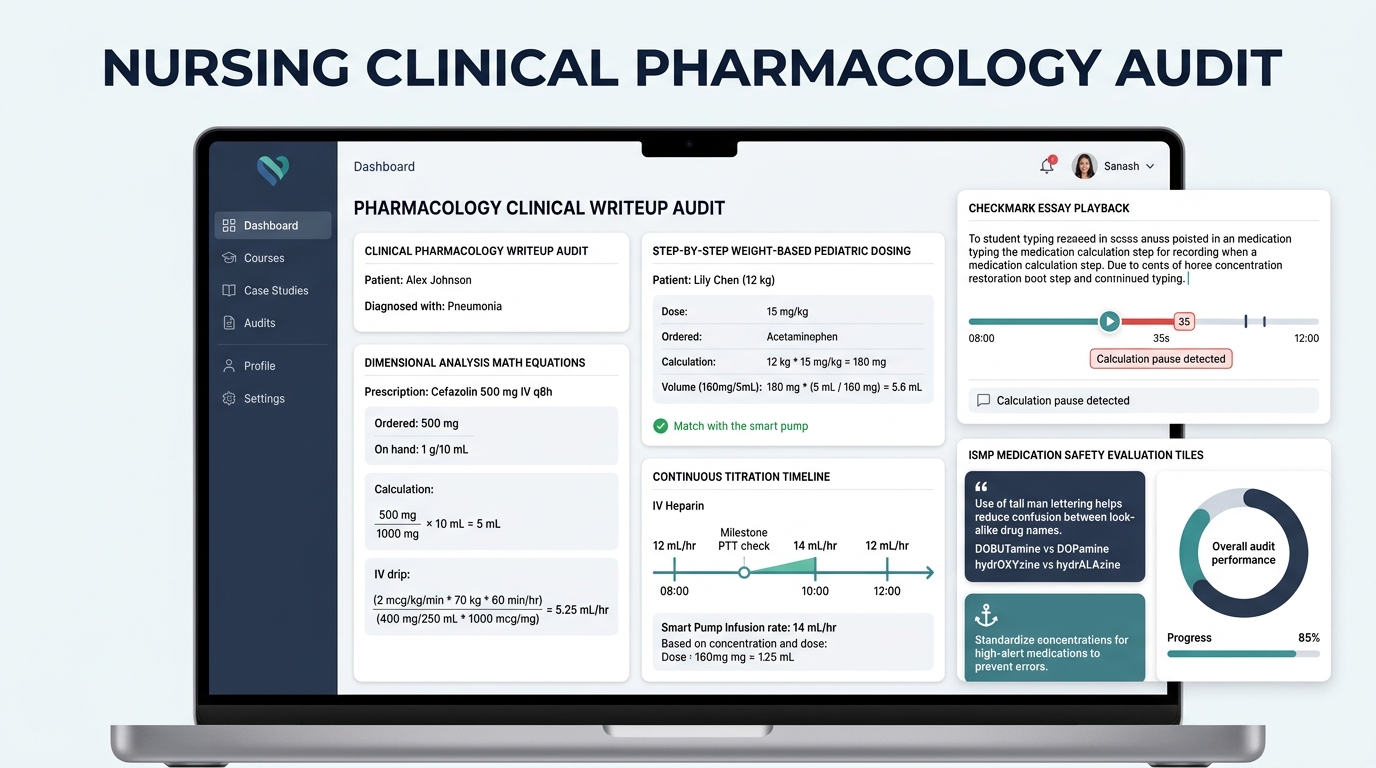
Checkmark Plagiarism delivers the clinical education and academic integrity foundation required for modern nursing curricula by pairing patent-pending Essay Playback™ with passage-level AI confidence cards, side-by-side evidence analysis, quote-anchored rubric autograding, and native gradebook integrations for Canvas LMS, Google Classroom, and Buzz LMS.
1. The High-Stakes Imperative: Clinical Pharmacology, Math Mastery, and Patient Safety
In Bachelor of Science in Nursing (BSN), Accelerated BSN (ABSN), Master of Science in Nursing (MSN), and Doctor of Nursing Practice (DNP) programs, pharmacology dosage calculations are not abstract academic exercises. They are direct proxies for bedside vigilance, clinical judgment, and patient survival.
Every semester, collegiate nursing programs administer rigorous dosage calculation competency examinations—frequently requiring a 90% to 100% benchmark score before candidates are permitted to step into acute care clinical rotations. However, isolated numerical answers on traditional multiple-choice quizzes fail to capture the multi-layered cognitive synthesis required at the bedside. In acute care, a registered nurse does not merely solve a static math equation; they must recognize subtle physiological cues, evaluate laboratory trends, account for organ clearance limitations, align calculations with hospital nomograms, and continuously titrate potent pharmacotherapeutic infusions against dynamic hemodynamic targets.
1. Recognize Cues
- Patient weight in kg / grams
- Renal panel (eGFR, CrCl, SCr)
- MAP, heart rate & vitals
- Current IV line access & compatibilities
2. Analyze Cues
- Pediatric safe dose threshold (mg/kg)
- Organ clearance & accumulation risk
- High-alert drug classification (PINCH)
- Narrow therapeutic index boundaries
3. Prioritize Hypotheses
- Acute hemodynamic urgency vs. routine
- Loading bolus vs. continuous drip
- Inotropic support vs. vasopressor titration
- Fluid volume limits (concentrated bags)
4. Generate Solutions
- Dimensional analysis equation setup
- Unit conversion cross-cancellation
- Pump rate derivation in mL/hr
- Independent double-check calculation
5. Take Action
- Set smart pump rate (mL/hr) & VTBI
- Verify 5 Rights of Med Administration
- Administer per MAR with zero trailing zeros
- Verify line labeling & dedicated lumen
6. Evaluate Outcomes
- Reassess MAP & targeted telemetry
- Audit laboratory feedback (Anti-Xa, aPTT)
- Document dynamic titration increments
- Identify early adverse drug events (ADEs)
Accreditation Mandates and Competency Standards
Collegiate nursing faculty must design, evaluate, and defend pharmacology calculation assessments within strict professional accreditation frameworks:
NCSBN Next Gen NCLEX (NGN)
Evaluates candidates on the 6-layer Clinical Judgment Measurement Model (NCJMM). Requires students to independently formulate calculations and justify pharmacotherapy choices rather than selecting isolated numbers.
CCNE & ACEN Accreditation
CCNE Standards III & IV and ACEN Standards 4 & 5 require nursing programs to systematically document clinical competencies, rigorous evaluation methodologies, and evidence of patient safety mastery before graduation.
AACN Essentials (2021)
Domain 1 (Pharmacological Science), Domain 2 (Person-Centered Dosing & Organ Clearance), and Domain 5 (Quality & Safety error-reduction protocols) anchor professional nursing education.
The Problem with Standalone Numerical Answers
To evaluate whether a student possesses true clinical judgment, modern nursing faculty assign comprehensive Pharmacology Case Writeups, Simulated EHR / MAR Titration Logs, and Complex Dosage Analysis Projects. In these assignments, students are required to write out their full dimensional analysis formulas, explain the pharmacological rationale for drug selection, detail organ clearance adjustments, and outline dynamic titration parameters for unstable simulated patients.
However, the rapid adoption of generative AI has disrupted this assessment paradigm. Nursing faculty now face a critical dilemma: How can educators verify that a student independently calculated a high-alert medication dose and reasoned through the clinical scenario, rather than outsourcing the assignment to a Large Language Model that fabricated both the math and the clinical justification?
2. Deep Dive: Core Clinical Calculations & The AI Arithmetic Hallucination Crisis
To understand why AI-generated pharmacology writeups represent an immediate clinical hazard, nursing faculty must examine both the mathematical precision required in clinical pharmacology and the specific failure modes of Large Language Models.
Σ The Spectrum of High-Stakes Clinical Nursing Calculations
1. Dimensional Analysis
Systematic factor-label setup with continuous unit cross-cancellation and standardized single-line derivation.
2. Pediatric Weight-Based Dosing
Exact weight conversions (lbs → kg), safe dose range validation (mg/kg/day), and divided dose scheduling.
3. Continuous IV Micro-Titrations
Vasoactive micro-rates (mcg/kg/min) translated into smart infusion pump delivery rates (mL/hr) based on MAP feedback.
4. High-Alert Nomograms
IV Unfractionated Heparin anti-Xa protocols and Regular Insulin DKA sliding scales with dynamic rate adjustments.
5. Organ Clearance & CrCl
Cockcroft-Gault Creatinine Clearance equation, eGFR stratification, and renal interval extension (e.g., Vancomycin, Enoxaparin).
6. Reconstitution Dilutions
Solute-to-diluent powder displacement math, resulting final concentrations, and stability expiration windows.
1. Dimensional Analysis (The Gold-Standard Factor-Label Method)
Leading nursing bodies—including the National League for Nursing (NLN) and the Quality and Safety Education for Nurses (QSEN) institute—strongly advocate for Dimensional Analysis (DA) over traditional formula (D / H × V) or ratio-proportion methods.
Dimensional analysis minimizes calculation errors by organizing all given clinical data, unit conversion factors, and desired vehicle quantities into a single, continuous mathematical equation where units sequentially cancel out:
When students write out dimensional analysis steps, faculty can inspect the mechanical setup, verify that conversion factors (e.g., 1000 mcg = 1 mg, 1 kg = 2.2 lbs) are placed in the correct numerator-denominator orientation, and ensure that units cross-cancel cleanly before the final arithmetic multiplication and division occur.
2. Weight-Based Pediatric Dosing
In pediatric pharmacotherapy, physiological margins for error are razor-thin. Pediatric patients have immature hepatic metabolic pathways, developing renal filtration capacities, and dramatically lower body volumes. Dosing is calculated strictly on a weight basis:
Total Daily Dose Equation:
Total Daily Dose (mg/day) = Prescribed Rate (mg/kg/day) × Weight (kg)Individual Dose Equation:
Individual Dose (mg/dose) = Total Daily Dose ÷ Number of Doses per DayClinical Example: Pediatric Ceftriaxone for Meningitis
Pediatric High-Alert
Patient: 18-month-old toddler presenting with acute bacterial meningitis, weighing 24 lbs 4 oz.
Prescription: Ceftriaxone 100 mg/kg/day IV divided every 12 hours (q12h).
Available: Ceftriaxone 1 g vial reconstituted with 9.6 mL sterile water to yield 100 mg/mL.
3. Continuous IV Micro-Titrations (Vasopressors & Inotropes)
In intensive care and emergency nursing, nurses manage continuous infusions of potent vasoactive medications such as Norepinephrine (Levophed), Epinephrine, Dopamine, Dobutamine, Milrinone, and Vasopressin.
These drugs are prescribed in micro-rates (mcg/min or mcg/kg/min) and must be translated into smart infusion pump delivery rates in milliliters per hour (mL/hr):
Clinical Example: An 82 kg patient in refractory septic shock is ordered Norepinephrine at 0.05 mcg/kg/min (Supplied: 4 mg in 250 mL D5W = 16 mcg/mL). The initial pump rate calculates to:
4. High-Alert Medication Nomograms (Heparin & Regular Insulin)
The Institute for Safe Medication Practices (ISMP) classifies intravenous unfractionated heparin and continuous regular insulin among the highest-risk pharmacotherapeutic agents. Both require weight-based nomograms and laboratory-driven titration algorithms.
Weight-Based IV Heparin Titration Nomogram
Patient Weight: 75 kg | Concentration: 25,000 units in 500 mL D5W (50 units/mL)
| Anti-Xa Level | Bolus Dose | Rate Adjustment | Pump Rate Change |
|---|---|---|---|
| < 0.10 units/mL | Re-bolus 80 units/kg (6,000 u) | Increase by 4 units/kg/hr (+300 u/hr) | +6.0 mL/hr |
| 0.10 – 0.34 u/mL | Re-bolus 40 units/kg (3,000 u) | Increase by 2 units/kg/hr (+150 u/hr) | +3.0 mL/hr |
| 0.35 – 0.70 u/mL | No bolus (THERAPEUTIC RANGE) | No change (Maintain current rate) | ±0 mL/hr |
| 0.71 – 0.90 u/mL | No bolus | Decrease by 2 units/kg/hr (-150 u/hr) | -3.0 mL/hr |
| > 0.90 units/mL | Hold infusion for 60 min | Decrease by 3 units/kg/hr (-225 u/hr) | -4.5 mL/hr |
5. Organ Clearance & Pharmacokinetic Adjustments
Clinical pharmacology writeups require students to evaluate renal and hepatic function. For renally eliminated drugs with narrow therapeutic windows (e.g., Vancomycin, Aminoglycosides, Enoxaparin, Digoxin), students must calculate the patient’s Creatinine Clearance (CrCl) using the Cockcroft-Gault equation:
If a patient’s CrCl falls below 30 mL/min, standard therapeutic dosing must be dramatically adjusted (e.g., reducing Enoxaparin from 1 mg/kg subcutaneous every 12 hours to 1 mg/kg every 24 hours). Students must explicitly articulate these pharmacodynamic and pharmacokinetic constraints.
Anatomy of a Lethal AI Pharmacology Hallucination
Large Language Models operate by predicting the next statistically probable token rather than executing deterministic mathematical calculations. When prompted with complex multi-step pharmacology problems, LLMs generate confident, beautifully worded clinical rationales accompanied by fatal calculation errors.
Clinical Prompt:
“A 70 kg patient with acute decompensated heart failure is ordered Dobutamine at 5 mcg/kg/min. Supplied: 500 mg in 250 mL D5W. Calculate the pump rate in mL/hr and provide the clinical rationale.”
AI-Generated Calculation Output (Confident & Articulate):
“Concentration: 500 mg in 250 mL = 2,000 mcg/mL.
Minute requirement: 70 kg × 5 mcg/kg/min = 350 mcg/min.
Hourly requirement: 350 × 60 = 21,000 mcg/hr.
Dividing by concentration gives the pump rate: 21,000 ÷ 2,000 = 105 mL/hr.”
Fatal Error Forensic Audit:
- Correct Math: 21,000 mcg/hr ÷ 2,000 mcg/mL = 10.5 mL/hr.
- The AI Error: Dropped a decimal point during token output, generating 105 mL/hr.
- Clinical Impact: A TEN-FOLD OVERDOSE (50 mcg/kg/min instead of 5 mcg/kg/min).
- Patient Outcome: Severe malignant ventricular dysrhythmias, extreme tachycardia, myocardial infarction, and acute cardiovascular collapse.
10-Fold Decimal Shifts
Dropping leading zeros or shifting decimals, turning 0.2 mg into 2.0 mg (a 1,000% overdose).
Metric Unit Confusion
Inadvertently swapping mg with mcg (e.g. 100 mcg fentanyl calculated as 100 mg).
Bolus vs. Rate Confusion
Calculating an hourly infusion rate as an immediate IV push bolus, causing acute circulatory arrest.
Inverse Titration Logic
Recommending vasopressor decreases while blood pressure is plunging, backed by fluent rationalizations.
3. The Patient Safety & Medication Error Dilemma
Medication errors remain one of the leading causes of preventable patient harm in global healthcare systems. According to landmark studies by the Institute of Medicine (IOM) and the World Health Organization (WHO), medication errors cause hundreds of thousands of adverse drug events annually, with dosage calculation errors representing a major component.
The Five Rights of Medication Administration
- Right Patient: Two independent patient identifiers (Name & DOB / Medical Record Number).
- Right Drug: Triple-check MAR against drug packaging and look-alike/sound-alike alerts.
- Right Dose: Exact mathematical calculation verified via dimensional analysis.
- Right Route: Dedicated line verification, IV push vs. IVPB vs. continuous drip.
- Right Time: Administration within institutional 30-minute safe medication window.
ISMP High-Alert Principles (PINCH)
- Independent Double-Checks: Two nurses independently compute high-alert drugs (Potassium, Insulin, Narcotics, Chemotherapy, Heparin).
- Ban Trailing Zeros: Always write
5 mg, NEVER5.0 mg(prevents misreading as 50 mg). - Mandate Leading Zeros: Always write
0.5 mg, NEVER.5 mg(prevents misreading as 5 mg). - Hemodynamic Target Boundaries: Explicit parameters for titration pause and notification.
Why Generic AI Detectors Fail in Pharmacology & Clinical Nursing
Faced with concerns over AI-generated homework and case studies, many nursing programs have turned to commercial generic AI text detectors (e.g., Turnitin AI, GPTZero, CopyLeaks). However, in clinical pharmacology and nursing education, generic detectors are fundamentally flawed:
Why Generic AI Text Detectors Fail in Clinical Pharmacology
| Generic Detector Shortcoming | Clinical Nursing Reality & Hazards |
|---|---|
| 1. Opaque Whole-Document Percentage | Flags “85% AI” with zero clinical context; cannot identify which formula step was cheated or verify math. |
| 2. False-Positives on Medical Syntax | SBAR templates, MAR entries, and dimensional analysis formulas have low perplexity and naturally trigger false AI scores. |
| 3. Severe Bias Against Multilingual / ESL Students | Non-native English speakers write in precise, textbook-structured sentences that match generic AI detection models. |
| 4. Total Blindness to Math Accuracy | Passes a lethal 10-fold overdose if the surrounding prose is written in an organic, conversational human tone. |
4. The Pharmacology Evidentiary Matrix
To evaluate clinical calculations and titration rationales effectively, nursing faculty need an evidentiary framework that combines mathematical verification, writing process dynamics, and clinical reasoning evaluation.
The Clinical Pharmacology Evidentiary Matrix
| Evaluation Dimension | Generic AI Text Detectors | Traditional Manual Math Checks | Checkmark Telemetry & Essay Playback™ |
|---|---|---|---|
| 1. Math Step Verification | Inapplicable (text only) | Moderate (manual faculty scan) | Complete (dimensional analysis + quote-anchored rubric) |
| 2. Cognitive Calculation Pauses | None (no process capture) | None (static final paper) | Definitive (replays 15–60s scratchpad/calculator pauses) |
| 3. External Paste & Clipboard History | None (binary guess) | None (invisible) | Timestamped & Preserved (captures 0.1s bursts + raw text) |
| 4. SBAR / MAR Clinical Syntax | Extreme False-Positive Risk | High False Alarms (suspicion) | Zero False Flags (passage-level cards ignore templates) |
| 5. Multilingual / ESL Protection | High Risk of Unjust Accusation | Unbiased | Full Protection (verifies drafting dynamics regardless of tone) |
| 6. Defensibility in Hearings | Low (black-box score) | Moderate (faculty opinion) | 100% Objective (timestamped keystroke video & clipboard trail) |
| 7. Restorative Clinical Remediation | None (punitive zero only) | Low (ad-hoc red ink) | High (identifies exact cognitive missteps for targeted drill) |
5. Step-by-Step Nursing Faculty Audit Protocol
To standardize the review of pharmacology calculation writeups, titration case studies, and simulated MAR logs, nursing departments can deploy this 5-Phase Clinical Telemetry Audit Protocol.
Phase 1: Dimensional Analysis Setup Verification
Audit factor-label alignment, numerator-denominator unit cross-cancellation, and intermediate conversion factors.
Phase 2: ISMP Safety & Clinical Sanity Checks
Verify leading zeros (0.5 mg), ban trailing zeros (5.0 mg), validate safe dose ranges, and check CrCl organ adjustments.
Phase 3: Essay Playback™ Cognitive Pause Analysis
Scrub writing session at 1x–8x speed to observe authentic 15–60s scratchpad math pauses vs. unbroken 70+ WPM AI transcription.
Phase 4: External Paste Buffer & Clipboard Inspection
Differentiate legitimate lab prompt pastes from 0.1s block pastes containing pre-generated AI solutions; inspect raw clipboard buffers.
Phase 5: Supportive Restorative Clinical Remediation
Review playback dossier collaboratively with student, emphasize patient safety, and prescribe targeted dimensional analysis drills & lab re-testing.
Phase 3 Deep Dive: Authentic Drafting Cadence vs. AI Secondary-Screen Transcription
When human nursing students solve complex clinical calculations on a computer, their keystrokes exhibit distinct cognitive rhythms:
Keystroke Physics: Authentic Drafting vs. AI Transcription in Essay Playback™
| Forensic Dimension | Authentic Student Drafting (Cognitive Cadence) | Mechanical AI Transcription (Secondary Screen) |
|---|---|---|
| Typing Velocity | Fluctuates naturally between 20 and 55 WPM with burst pauses. | Continuous, unbroken velocity of 65–85 WPM across complex fractions. |
| Scratchpad Pauses | 15–45 second pauses between typing equation factors to compute math. | Zero hesitation pauses; multi-line equations entered in seconds. |
| Revisions & Typos | Spontaneous backspacing, fixing transposed units, re-checking rates. | Flawless first-pass typing without structural arithmetic revisions. |
| Workflow Order | Non-linear problem solving (drafts formula, jumps to rationale, re-checks). | Rigid top-to-bottom linear entry matching an AI output window. |
6. How Checkmark Empowers Nursing Pharmacology & Clinical Faculty
Checkmark Plagiarism is engineered specifically to provide educators with transparent, defensible, and pedagogically supportive evidence—replacing opaque probability scores with actionable writing process telemetry.
1. Essay Playback™ (1x–8x Replay)
Scrub through student drafting sessions like a video. Review a 45-minute pharmacology writeup in under 3 minutes, verifying scratchpad calculation pauses and equation construction.
2. External Paste Inspector
Captures exact timestamps, character counts, and the original raw text placed on the clipboard. Jump directly to the exact millisecond of insertion in Essay Playback.
3. Passage-Level AI Confidence
Replaces single arbitrary percentage scores with sentence-level sliders and evidence cards in the sidebar, allowing faculty to evaluate clinical prose without penalizing formulas.
4. Short-Text Guardrails
Displays N/A for brief math annotations or charting notes under ~150 words rather than guessing on insufficient statistical sample sizes.
5. Teacher-in-the-Loop Autograding
Upload custom clinical pharmacology rubrics. Checkmark generates quote-anchored criterion scores and calculation checks with direct LMS grade passback to Canvas, Buzz, and Google Classroom.
6. Zero-Retention Student Privacy
Student case analyses and clinical writeups are never stored, sold, or used to train commercial AI models. Fully FERPA and COPPA compliant with enterprise 256-bit encryption.
7. Realistic Clinical Case Scenarios
These three realistic case studies demonstrate how nursing faculty use Checkmark to investigate complex submissions, resolve disputes, and uphold clinical competency.
Scenario A: Pediatric Weight-Based Ceftriaxone with AI Decimal Hallucination
10-Fold Lethal ErrorThe Assignment & Submission:
Accelerated BSN case study calculating pediatric antibiotic dosing for an 18-month-old. The student submitted a 400-word writeup with a calculated dose of 5,500 mg/dose (55 mL) instead of 550 mg/dose (5.5 mL).
Checkmark Investigation:
Paste Inspector revealed the entire 400 words were pasted in a 0.2s burst. Clipboard history contained the prompt sent to a commercial LLM, which dropped the decimal during reconstitution.
Scenario B: Critical Care Norepinephrine Titration with Seamless Transcription
Secondary Screen CopyThe Assignment & Submission:
Senior BSN critical care simulation debrief calculating dynamic micro-titration steps for septic shock. The student submitted mathematically flawless multi-tier fractions.
Checkmark Investigation:
Generic detector showed 15% AI. Essay Playback revealed the student typed complex equations at 74 WPM unbroken with zero pauses greater than 2 seconds and zero scratchpad hesitations over 20 minutes.
Scenario C: Heparin Nomogram Writeup (Exonerating an Honest Student)
False Flag DismissedThe Incident:
An ESL nursing candidate submitted a concise SBAR and nomogram writeup. A generic LMS checker flagged it as 88% AI-Generated due to standard hospital templates.
Checkmark Telemetry Audit:
Essay Playback proved a 48-minute drafting session with 35-second scratchpad pauses, an initial math mistake (1,250 u/hr), backspacing, and self-correction to 1,350 u/hr.
8. Frequently Asked Questions (FAQ)
1. Why can’t nursing faculty rely on commercial LLMs to verify student calculations?
Commercial Large Language Models operate on statistical word prediction rather than deterministic arithmetic calculation. When evaluating complex multi-step dimensional analysis, weight-based conversions, or micro-titration formulas, LLMs frequently hallucinate mathematical steps, drop decimal points, or swap metric units while producing articulate, persuasive prose. Faculty must use deterministic answer keys and dimensional analysis verification rather than outsourcing grading to unassisted commercial AI tools.
2. How does Essay Playback™ distinguish between a handheld calculator and AI transcription?
When a student uses a physical calculator or scratch paper while drafting on a computer, Essay Playback™ captures characteristic cognitive calculation pauses: the student types a formula header, pauses for 15 to 45 seconds while punching numbers into their handheld device, and then types the resulting figure—frequently making occasional typos or backspacing to fix arithmetic slips. By contrast, a student transcribing an AI output from a secondary screen types continuously at a steady 60–80 WPM without calculation pauses or formula revisions.
3. Why do generic AI detectors flag authentic SBAR notes and dimensional formulas as AI?
Generic AI detectors measure text perplexity (word choice unpredictability) and burstiness (sentence length variation). Clinical nursing communication—such as SBAR (Situation-Background-Assessment-Recommendation) handoffs, MAR documentation, and dimensional analysis formulas—is intentionally standardized, concise, and structured. This low-perplexity structure naturally triggers false-positive “AI” flags on generic detectors. Checkmark eliminates this flaw by using granular passage-level confidence sliders and process telemetry rather than opaque whole-document probability scores.
4. How should nursing academic integrity committees handle AI calculations resulting in simulated lethal overdoses?
Academic integrity committees should treat such cases through the lens of clinical competency and patient safety. Rather than issuing a standard punitive zero and moving on, the committee should require mandatory clinical remediation. The student should be required to complete supervised dimensional analysis workshops, demonstrate unassisted calculation mastery on a whiteboard, and repeat the clinical simulation scenario under direct observation to ensure that dangerous knowledge deficits are fully corrected before the student cares for human patients.
5. Does Checkmark integrate with Canvas SpeedGrader and Buzz LMS for clinical assignments?
Yes. Checkmark integrates natively via LTI 1.3 with Canvas LMS, Buzz LMS, Moodle, and Google Classroom. Nursing instructors can view the full Essay Playback™ timeline, paste inspector, and passage-level evidence cards directly inside Canvas SpeedGrader or the Buzz grading interface, with one-click direct grade passback to the institutional gradebook.
6. How does Checkmark protect student clinical submissions under FERPA and privacy laws?
Checkmark is built on a strict zero-retention architecture. Student papers, simulated patient logs, and clinical calculation writeups are never stored in public databases, never shared with third parties, and never used to train machine learning models. Checkmark maintains full compliance with FERPA, COPPA, and enterprise cloud security standards with 256-bit encryption in transit and at rest.
7. What syllabus language establishes transparent expectations for calculation telemetry?
Nursing course directors should include explicit policy statements in their syllabi: “In this course, mastering independent pharmacology calculations and clinical titration reasoning is safety-critical. The use of generative AI tools to calculate dosages, generate dimensional analysis formulas, or draft clinical rationales is strictly prohibited. All written calculation assignments are audited using Checkmark Writing Process Telemetry and Essay Playback™ to verify authentic drafting sessions, scratchpad calculation pauses, and clipboard integrity. Any submission displaying external paste bursts or unverified transcription of AI outputs will be referred for clinical competency review and mandatory math remediation.”
9. Conclusion: Moving from Guessing to Verifiable Clinical Competence
In nursing education, the ultimate objective of academic integrity is not to catch students in infractions—it is to guarantee that every graduate who pins on a nursing badge is safe, competent, and trustworthy at the bedside.
When students use generative AI to bypass pharmacology calculations, they risk entering acute care environments with uncorrected mathematical blind spots that can lead to fatal medication errors. Generic AI detectors cannot solve this dilemma; their opaque percentage scores alienate students, penalize standardized medical phrasing, and fail to evaluate mathematical accuracy.
By adopting Checkmark Plagiarism's Clinical Writing Telemetry, nursing programs gain an objective, transparent, and restorative evidentiary standard. With patent-pending Essay Playback™, External Paste Inspection, and teacher-controlled rubric autograding, nursing faculty can verify authentic clinical reasoning, celebrate honest student effort, and uphold the highest standards of patient safety.
Empower Your Nursing Faculty with Process Telemetry
Discover how Checkmark Essay Playback™ and clinical telemetry can safeguard your pharmacology writeups, simulation debriefs, and accreditation outcomes.