
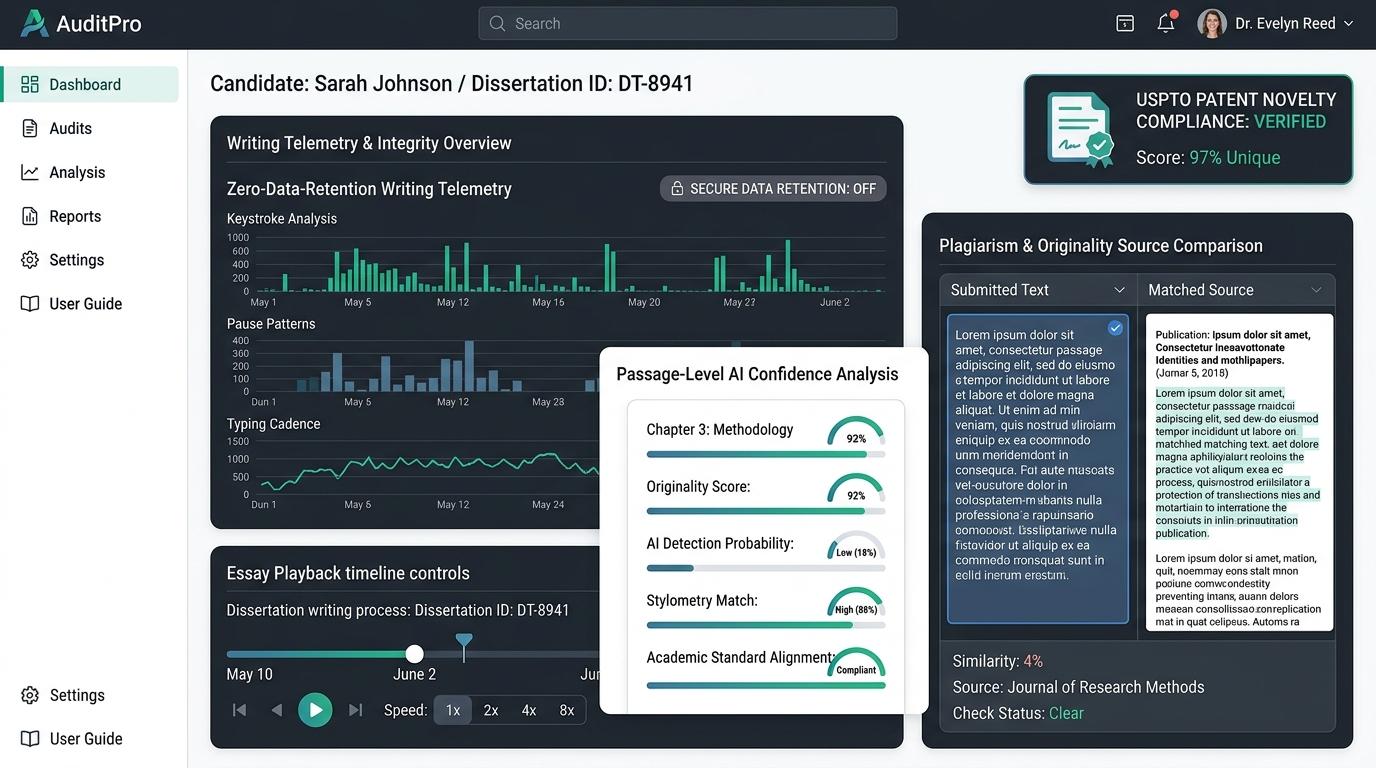
Verifying independent scholarly authorship and original intellectual contribution in 150–350 page doctoral dissertations and master's theses presents an existential governance challenge for modern research universities. Traditional academic integrity workflows force Graduate Writing Program Chairs, Graduate School Deans, and Dissertation Committee Chairs into an unacceptable dilemma: either upload multi-year doctoral manuscripts into legacy commercial plagiarism databases—destroying patentability under USPTO 35 U.S.C. § 102 and European Patent Convention (EPC) Article 54, breaching corporate sponsored-research non-disclosure agreements (NDAs), and feeding proprietary student research into commercial large language model (LLM) training pipelines—or rely on black-box AI detectors that generate catastrophic false-positive percentages on dense academic prose, theoretical frameworks, and systematic literature reviews.
To resolve this dilemma, research institutions are transitioning to Zero-Data-Retention (ZDR) Writing Process Telemetry. By combining ephemeral, in-memory passage-level analysis with longitudinal writing process verification—specifically patent-pending Essay Playback™ (1x–8x scrubbable video replay), External Paste Buffer Inspection, and Synchronized Dual-Pane Source Verification—graduate faculties can verify authentic human scholarship, iterative cognitive struggle, and independent authorship with indisputable receipts without storing a single sentence of student intellectual property.
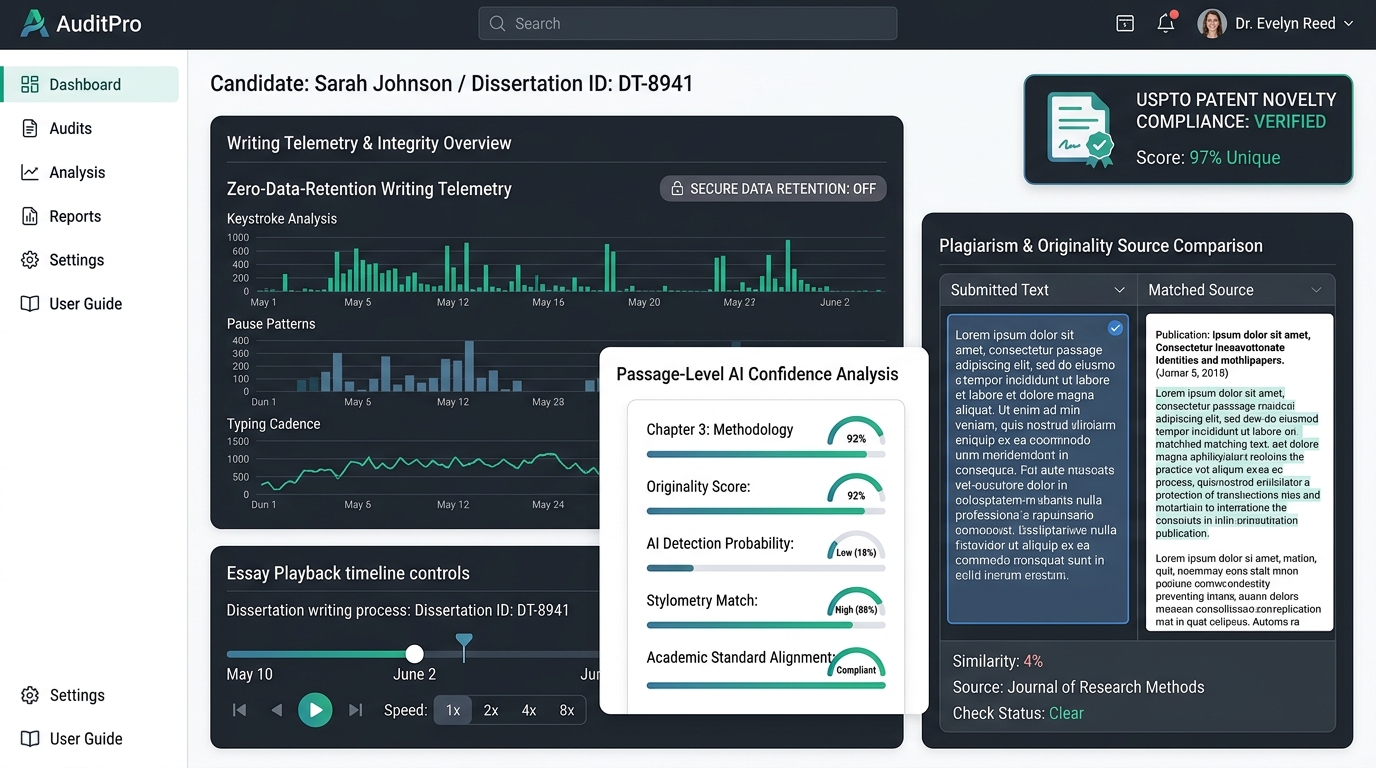
Checkmark Plagiarism provides research institutions with an integrated, educator-first integrity architecture by pairing patent-pending Essay Playback™ with passage-level AI detection, synchronized dual-pane plagiarism verification, quote-anchored rubric autograding, and direct LMS integrations for Canvas LMS, Google Classroom, and Buzz LMS.
1. The High-Stakes Institutional Dilemma in Graduate Authorship Verification
The doctoral dissertation represents the pinnacle of formal academic achievement. Spanning 150 to over 350 pages and representing between three and seven years of rigorous empirical, theoretical, or archival labor, the dissertation is not merely an extended course assignment; it is a foundational contribution to human knowledge, the gateway to tenure-track academic appointments, and frequently the genesis of high-value patents, commercial spin-offs, and landmark academic monographs.
In the contemporary research landscape, however, graduate writing programs and dissertation committees operate under an unprecedented dual threat:
- Frictionless synthetic prose generation: Commercial LLMs easily generate synthetic literature reviews, theoretical frameworks, and methodology chapters.
- Convincing citation-dense syntax: Advanced foundation models synthesize plausible academic prose without genuine student cognitive comprehension.
- Linguistic evasion humanizers: Paraphrasing and humanizer tools bypass simple surface-level statistical scanners.
- Accreditation risk: Severe institutional risk of conferring unearned doctorates, damaging departmental prestige.
- Permanent vendor warehousing: Legacy plagiarism vendors ingest and store unpublished doctoral manuscripts in commercial data lakes.
- Patent novelty destruction: Multi-tenant third-party indexing triggers public disclosure bars under USPTO § 102 and EPO Art 54.
- Contractual NDA breaches: Violates corporate sponsored research covenants, CRADAs, export control regulations, and student IP.
- Devastating false positives: Monolithic black-box AI detectors falsely flag complex, dense academic syntax and literature matrices.
When graduate faculties attempt to safeguard scholarly rigor using legacy tools, they encounter an irreconcilable conflict of interest across campus governance:
- The Technology Transfer Office (TTO) & Corporate Sponsors: Strictly forbid uploading unpublished manuscripts containing proprietary lab discoveries, novel chemical vectors, or trade-secret algorithms to third-party cloud vendors who claim rights to store, index, or repurpose data.
- Dissertation Committees & Department Chairs: Demand verified, defensible proof of independent authorship before signing off on oral defenses and degree conferrals, seeking to protect the department from post-graduation academic fraud scandals.
- Doctoral Candidates & Graduate Student Unions: Vehemently resist submitting years of original scholarship to commercial databases that monetize student labor or subject complex academic prose to opaque, black-box probabilistic algorithms that output arbitrary cheating scores.
To break this institutional deadlock, Graduate Writing Program Chairs and Academic Deans must establish a modernized verification architecture that replaces opaque, database-hoarding software with ephemeral, zero-retention writing process telemetry.
2. The Triple Threat of Legacy Integrity Tools in Graduate Education
Legacy academic integrity platforms were engineered in the late 1990s and early 2000s for a simple paradigm: catching undergraduate students copying and pasting text from open web pages into introductory essays. When forced into the complex ecosystem of graduate education, these legacy architectures fail catastrophically across three distinct dimensions.
Commercial vendors store student dissertations in permanent global repositories to train proprietary LLMs, destroying patent novelty and violating sponsored research NDAs.
Generic statistical AI detectors fail on dense scholarly syntax, passive voice constructions, disciplinary taxonomies, and multi-source literature reviews.
Monolithic percentages conflate 50-page bibliographies and standardized laboratory methodology protocols with actual uncredited plagiarism.
Threat 1: The Intellectual Property & Model Ingestion Threat
The most legally and financially dangerous aspect of legacy integrity software is its reliance on centralized document caching and secondary data utilization.
1. Invalidation of Patent Novelty under USPTO and EPO Statutes
Under United States patent law (35 U.S.C. § 102, the statutory novelty and public disclosure bar) and European patent law (European Patent Convention Article 54), an invention cannot be patented if it has been described in a printed publication or made available to the public anywhere in the world prior to the effective filing date.
When a doctoral candidate in engineering, biotechnology, materials science, or computer science submits a dissertation draft containing novel chemical structures, hardware architectures, or machine learning algorithms to a commercial vendor that indexes manuscripts into a searchable database:
- The manuscript is transmitted to multi-tenant commercial servers outside the university's firewall.
- Third-party contractors, algorithmic crawlers, and downstream search systems gain computational access to the text.
- In patent litigation, corporate adversaries can subpoena vendor indexing timestamps to argue that the invention was “publicly disclosed” or “third-party accessible” prior to provisional patent filing, potentially invalidating multi-million dollar patent portfolios and university licensing rights.
Candidate synthesizes novel CRISPR vector or algorithm.
Manuscript uploaded to legacy vendor; stored in global database.
University Tech Transfer files patent 60 days post-defense.
Adversary cites pre-filing cloud repository index timestamp.
2. Breach of Corporate Sponsored Research & CRADAs
Doctoral candidates at major research institutions are frequently funded through Cooperative Research and Development Agreements (CRADAs) with federal agencies (such as DARPA, DOE, or NIH) or multi-million dollar corporate research contracts with pharmaceutical, aerospace, and technology corporations.
These contracts contain strict Non-Disclosure Agreements (NDAs) and proprietary data covenants:
- Uploading draft chapters containing corporate trade secrets or proprietary experimental results to external commercial cloud vendors constitutes a direct, actionable breach of contract.
- Research universities face severe financial penalties, litigation, and immediate termination of corporate research sponsorships if proprietary data is stored in unvetted commercial databases.
3. Export Control Violations (ITAR & EAR)
Dissertations in dual-use STEM disciplines (including advanced quantum computing, autonomous robotics, hypersonic aerodynamics, and biodefense) are subject to federal export regulations:
- International Traffic in Arms Regulations (ITAR, 22 CFR §§ 120–130)
- Export Administration Regulations (EAR, 15 CFR §§ 730–774)
While the Fundamental Research Exclusion (FRE) protects published university research, unpublished working drafts and pre-defense dissertation manuscripts stored on multi-tenant commercial cloud servers that utilize overseas data centers or non-ITAR compliant infrastructure can trigger severe federal export control investigations and civil liability for the university.
Threat 2: The Inevitable Failure of Black-Box AI Detectors on Advanced Scholarly Prose
The emergence of commercial generative AI detectors has introduced chaos into graduate school administrations. Generic AI detection models operate as statistical classifiers calculating perplexity (the predictability of word choices) and burstiness (the variation in sentence structure).
When applied to advanced academic prose, these models fail systematically:
| Academic Prose Feature | Legitimate Scholarly Function | Detector Misinterpretation (False Positive) |
|---|---|---|
| Passive Voice & Object-Centric Phrasing | Standard in empirical science: “The precipitate was filtered and centrifuged at 4,000 RPM...” | Low perplexity; detector classifies uniform passive voice as synthetic AI. |
| Dense Disciplinary Lexicon & Taxonomy | Required theoretical terminology: “hermeneutic phenomenological reductionism...” | High predictability within domain; flag triggered by structured syntax. |
| Formulaic Rhetorical Scaffolding | Systematic literature reviews: “Whereas Smith contends X, Doe demonstrates Y, suggesting Z...” | Repetitive structural transitions mimic standard LLM synthesis templates. |
| Non-Native English (ESL) Doctoral Scholars | High-precision grammatical polish using formal, standardized academic phrasing. | Reduced burstiness; international PhDs falsely flagged at double the baseline rate. |
In an undergraduate course, a false AI flag may result in a disputed essay grade. In a doctoral program, a false AI allegation is catastrophic: it halts scheduled dissertation defenses, revokes doctoral stipends and graduate teaching assistantships, damages years of advisor-advisee mentorship, jeopardizes pending post-doctoral fellowships, and permanently stains the candidate's reputation during tenure-track academic job searches. Monolithic, black-box AI scores have zero evidentiary validity in academic misconduct hearings.
Threat 3: The Opaque “Similarity Score” Fallacy in 300-Page Manuscripts
Legacy plagiarism software generates a single aggregated percentage (e.g., “32% Similarity Score”) that is meaningless when applied to doctoral manuscripts:
- Bibliographic Distortion: A 300-page dissertation typically contains 40 to 60 pages of works cited, primary archival references, and comprehensive literature matrices. In legacy tools, these benign references inflate the global similarity percentage.
- Standardized Methodological Protocols: In clinical and laboratory dissertations, methodology chapters must cite verbatim chemical protocols, institutional review board (IRB) compliance language, and standardized statistical equations. Legacy vendors highlight these passages as “plagiarism.”
- Massive Faculty Administrative Burden: Dissertation committee chairs are forced to spend dozens of hours manually clicking through hundreds of highlighted references to distinguish benign academic citations from actual intellectual fraud.
3. Writing Process Telemetry: The Gold Standard for Graduate Authorship
To eliminate the risks of intellectual property forfeiture and algorithmic false accusations, graduate institutions must transition from post-hoc artifact inspection to longitudinal writing process telemetry.
Authentic doctoral scholarship is not defined by a static finished PDF; it is defined by the iterative cognitive journey of composition. By analyzing writing telemetry—keystroke dynamics, composing pauses, revision trajectories, and paste buffer behaviors—dissertation committees obtain unassailable, mathematical proof of human authorship without storing a single word of the manuscript in external databases.
• High pause ratio (30–45s between sentences).
• Macro-revisions (deleting whole theoretical paragraphs).
• Variable typing velocity (28–42 WPM) reflecting active formulation.
• Paste buffer captures archival excerpt with citation alignment.
• Granular sentence-level rewriting around quotes.
• Non-linear cursor jumps to refine preceding definitions.
• Micro-revisions (hedging verbs: “suggests” → “demonstrates”).
• Organic burst-and-pause rhythm engaging with data.
• Verdict: 100% indisputable proof of authentic human scholarship.
The Forensic Anatomy of Authentic Doctoral Scholarship
When evaluated through longitudinal telemetry, genuine graduate-level composition exhibits clear behavioral markers that cannot be replicated by generative AI or surface paraphrasers:
- Iterative Session Longevity: A doctoral chapter evolves across 20 to 80 distinct drafting sessions spanning weeks or months. Telemetry captures the chronological progression from rough bullet outlines to polished prose.
- Cognitive Composing Pauses vs. Surface Fluency: Genuine academic writing is characterized by significant composing pauses (15 seconds to several minutes) at syntactic and conceptual boundaries as the scholar consults lab notebooks, runs code, or verifies citations. In contrast, unauthorized AI transcription or manual retyping exhibits an unnatural, steady typing cadence lacking analytical hesitations.
- Non-Linear Structural Reorganization: Authentic research writing involves continuous reorganization—moving whole subsections, inverting argument structures, and rewriting thesis sentences to accommodate emerging findings.
- Micro- and Macro-Revision Velocity: High rates of backspacing, synonym substitution, and sentence restructuring reflect the active search for academic precision.
Privacy-Preserving Native Telemetry vs. Invasive Surveillance
Unlike invasive surveillance tools that require continuous webcam recording, eye-tracking, or local screen-scraping malware, writing process telemetry captures only the document's native structural edit history within standard authoring environments (Google Docs, Microsoft Word, Canvas LMS, and Buzz LMS). Student biometric privacy is fully preserved, FERPA compliance is maintained, and graduate candidates write within their standard software workflows.
4. Checkmark Plagiarism's Enterprise Zero-Retention Dissertation Suite
Checkmark Plagiarism (checkmarkplagiarism.com) provides research universities and graduate writing programs with an integrated, educator-first integrity suite engineered specifically for high-stakes thesis and dissertation auditing. Built on the core philosophy “Stop guessing, start trusting,” Checkmark replaces black-box scores with multi-dimensional, defensible evidence.
100% ephemeral in-memory AST and vector stream processing. 0 bytes persisted to cloud databases, shared indices, or staging logs. Zero model training guarantee.
1x–8x scrubbable keystroke video replay reconstructing months of drafting sessions. Visualizes cognitive genesis, outline evolution, and authentic pauses.
100% clipboard capture with unedited original text preservation. Millisecond jump-to-playback verifies legitimate lab data, FASTA files, code, and primary quotes.
Calibrated confidence sliders on highlighted passages with honest short-text (<150w) N/A guardrails. Total immunity to superficial AI paraphrasing humanizers.
Matches against billions of live web and academic sources. Isolates uncited sources with dedicated visual styling for constructive citation coaching.
Seamless LTI 1.3 Advantage integration with Canvas, Blackboard, Moodle, and Buzz LMS. Direct interoperability with graduate school ProQuest ETD pipelines.
1. Strict Zero-Data-Retention (ZDR) Architecture
Checkmark’s enterprise engine operates on a strict Zero-Data-Retention (ZDR) mandate:
- Ephemeral In-Memory Processing: When a dissertation is analyzed, the text is tokenized into Abstract Syntax Trees (AST) and processed across ephemeral memory buffers. Once the analysis is completed and the encrypted report is rendered to authorized committee members, the manuscript is completely purged from RAM via deterministic garbage collection.
- No Database Storage or Indexing: Manuscripts are never stored in centralized archives, shared institutional repositories, or third-party cloud caches.
- Strict Zero-Model-Training Guarantee: Student research is never harvested, vectorized, or utilized to train, fine-tune, or benchmark commercial LLMs or internal classifiers.
- Complete Patent & NDA Immunity: Because zero data is indexed or retained, submitting a dissertation to Checkmark never constitutes a public disclosure under USPTO § 102 or EPO Article 54, and never breaches corporate sponsored-research NDAs.
2. Patent-Pending Essay Playback™ (1x–8x Scrubbable Replay)
Checkmark's flagship innovation, Essay Playback™, transforms static text into an interactive, chronological writing timeline:
- Multi-Month Session Reconstruction: Committee chairs can scrub through the entire writing history of a 70-page dissertation chapter at 1x to 8x speed.
- Visualizing Cognitive Genesis: Watch the candidate brainstorm theoretical concepts, pause to synthesize sources, delete draft arguments, and restructure prose in real time.
- Incontrovertible Defense Proof: Serves as the ultimate evidentiary proof to exonerate candidates falsely flagged by generic AI detectors.
3. External Paste Buffer Inspector with Complete Text Preservation
Doctoral dissertations inherently incorporate legitimate external text: raw DNA sequences, LaTeX equations, R/Python code blocks, primary interview transcripts, and survey instruments.
- 100% Clipboard Text Capture: Checkmark logs every paste event with exact millisecond timestamps and source attribution metadata.
- Original Content Preservation: The inspector stores the full, unedited text of every pasted block—even if the student subsequently rewrites, edits, or paraphrases every word over subsequent months.
- Direct Jump-to-Playback: Clicking any paste event in the educator sidebar immediately jumps the playback timeline to that exact millisecond, allowing committee members to verify whether the paste represents legitimate laboratory data or unauthorized generative AI text.
4. Passage-Level AI Sliders with Honest Short-Text (<150w) Guardrails
Rather than generating an arbitrary whole-document “percentage,” Checkmark provides granular passage-level analysis:
- Underlined In-Text Passages: Specific passages are highlighted directly within the manuscript, accompanied by individual evidence cards in the sidebar featuring calibrated confidence sliders (typical human writing style vs. typical AI pattern).
- Honest Short-Text Guardrails: On snippets under ~150 words (such as abstract sub-sections or transition paragraphs), Checkmark explicitly displays
N/Arather than guessing on statistically insufficient sample sizes. - Immunity to AI Humanizers: While tools like QuillBot or Undetectable AI can alter surface syntax to fool traditional detectors, they cannot fabricate organic temporal keystroke dynamics and longitudinal drafting history.
- Educator-Only Flag Statuses: Flags (Flagged, Resolved, Not Flagged) remain private to committee members to prevent premature accusations.
5. Architectural Schemas & Data Flow Models
To illustrate the technical differentiation between legacy data-harvesting software and Checkmark's Zero-Data-Retention architecture, the following data flow models deconstruct the underlying pipelines.
[Student Upload] → [Ingestion Buffer] → [Document Staged in Cloud DB] → [Vector Index Created] → [Permanent Global Repository]
Vulnerabilities: Ingested into commercial database • Accessible to external crawlers • Repurposed for AI model training • CRITICAL RISK: USPTO § 102 Novelty Loss & Sponsored NDA Breach.
[Student Upload] → [TLS 1.3 Ephemeral Stream] → [In-Memory AST & Vector Parsing (RAM Only)] → [Live Dossier Rendered] → [Deterministic Memory Purge]
Guarantees: 0 bytes stored to disk • Ephemeral query vectors only • Instant RAM zero-fill post-audit • OUTCOME: 100% Patent Novelty & Research IP Preserved.
| Evaluation Criterion | Legacy Plagiarism / AI Vendors | Checkmark Zero-Retention Suite |
|---|---|---|
| Manuscript Data Retention | Permanent cloud database indexing & warehousing | 100% Ephemeral In-Memory Processing (0 bytes stored) |
| Patent Novelty Protection (USPTO § 102 / EPO Art 54) | High Risk: Third-party storage creates public disclosure exposure | Absolute Protection: No third-party caching or indexing |
| Corporate Sponsored Research & NDA Compliance | Frequent breach of non-disclosure covenants | 100% Compliant: Zero secondary data utilization |
| AI Detection Granularity | Single opaque whole-document percentage | Passage-level calibrated sliders with <150w guardrails |
| Writing Process Telemetry | None (evaluates only static final submitted file) | Patent-pending Essay Playback™ (1x–8x scrubbable replay) |
| Paste Buffer Tracking | Unrecorded or opaque text dump | 100% clipboard capture with original text preservation |
| Plagiarism Source Proof | Aggregated list of overlapping text fragments | Synchronized dual-pane side-by-side quote viewer |
| Uncited Source Differentiation | Treats missing quotation marks as deliberate plagiarism | Dedicated uncited source styling for citation coaching |
| ESL / Multilingual Candidate Bias | Severe false-positive bias on academic syntax | Protected via keystroke replay and revision telemetry |
| Thesis Management Integration | Basic LMS speedgrader plugin | Native LTI 1.3 + ProQuest ETD pre-defense passback |
6. Real-World Graduate Case Studies
The following real-world case studies demonstrate how Checkmark's Zero-Retention Dissertation Suite resolves high-stakes integrity, intellectual property, and authorship challenges across diverse academic disciplines.
The Institutional Challenge: A Ph.D. candidate in Biomedical Engineering completed a 240-page dissertation containing proprietary plasmid vector sequences, synthetic lipid nanoparticle synthesis formulations, and in vivo efficacy data. The university’s Technology Transfer Office (TTO) was actively preparing a provisional patent application with commercial licensing options for a multinational pharmaceutical sponsor. However, the TTO and corporate sponsor strictly barred the candidate from uploading the manuscript to legacy plagiarism software, citing risks that third-party database caching would constitute an enabling disclosure under 35 U.S.C. § 102, invalidating patent claims.
Checkmark Implementation & Verification: The candidate submitted the manuscript through Checkmark’s ZDR portal. The dissertation was parsed entirely in transient RAM against open-access biomedical literature without writing a single sequence or sentence to persistent storage. When Chapter 4 highlighted large text blocks, the committee chair inspected the External Paste Buffer, confirming the pasted content consisted exclusively of raw FASTA sequence files and spectrometry CSV outputs copied directly from the authenticated lab server.
The Outcome: The dissertation defense proceeded on schedule. The TTO successfully filed the provisional patent application 45 days later with zero prior-art contamination or public disclosure exposure.
The Institutional Challenge: Two weeks prior to a scheduled dissertation defense, the committee chair ran Chapter 2 (a 65-page comprehensive literature review synthesizing 400+ academic studies) through a legacy black-box AI detector. The tool returned a staggering 72% Probability of AI Generation, highlighting extensive theoretical comparisons of Pierre Bourdieu’s cultural capital and James Coleman’s social capital theory. The chair halted defense preparations, jeopardizing the international candidate's visa status and pending post-doctoral fellowship.
Checkmark Implementation & Verification: The Graduate Writing Program Chair initiated a forensic audit using Checkmark Essay Playback™. The replay reconstructed 54 separate drafting sessions recorded across 8 months. The committee watched the candidate type at an organic 34 WPM, pause for 10–25 minutes between theoretical paragraphs, delete and restructure major arguments, and rephrase transitional sentences. Passage-level sliders confirmed the low perplexity was driven entirely by formal sociological taxonomy (“habitus,” “institutionalized cultural capital”) rather than synthetic AI generation.
The Outcome: The committee unanimously dismissed the legacy detector's false flag. The candidate defended with distinction and successfully transitioned into a tenure-track assistant professorship.
The Institutional Challenge: In a Comparative Literature dissertation, Chapter 3 included extensive, original English translations of untranslated 19th-century German epistolary treatises. A legacy plagiarism scan returned a 44% Similarity Score, highlighting broad sections of translations against digitized historical dictionaries and commentaries. The external reader alleged uncredited patchwriting.
Checkmark Implementation & Verification: The committee opened Checkmark’s Synchronized Dual-Pane Source Viewer. The report visually separated benign translation overlap from uncredited borrowing, demonstrating that 39% of the flagged text was due to unavoidable standard terminology for historical German legal and philosophical concepts. The scan isolated four specific sentences where the candidate had integrated secondary commentary without complete parenthetical citation.
The Outcome: Instead of initiating a punitive disciplinary tribunal, the chair used Two-Way Linked Evidence Cards to guide the candidate through targeted citation formatting revisions during the post-defense revision window, ensuring absolute scholarly rigor without delaying graduation.
7. The 4-Phase Graduate Dissertation Verification Protocol
To institutionalize fair, rigorous, and zero-retention authorship verification across all doctoral programs, Graduate Writing Program Chairs and Academic Deans should implement the following 4-Phase Verification Protocol.
- Codify departmental boundaries between allowed editing vs. prohibited AI generation.
- Execute TTO and sponsored research zero-retention compliance waivers.
- Connect doctoral candidates to native authoring environments with telemetry capture.
- Review writing telemetry at Proposal, Lit Review, and Methods checkpoints.
- Inspect typing cadence, composing pauses, and macro-revision density.
- Conduct formative writing conferences on anomalous unannotated paste events.
- Execute 100% ephemeral Zero-Data-Retention scan on complete 300-page manuscript.
- Audit External Paste Buffer for legitimate FASTA, code, or interview transcripts.
- Examine passage-level AI confidence sliders and resolve uncited source cards.
- Present Verification Dossier during closed committee executive deliberation.
- Align oral examination questions with telemetry writing milestones.
- Issue cryptographically signed Authorship Verification Token for ProQuest ETD.
8. Dissertation Committee Audit Checklists & Governance Frameworks
To streamline committee deliberations and maintain compliance across campus offices, chairs should utilize the following structured evaluation frameworks.
- Zero-Data-Retention processing confirmed (0 bytes in commercial cloud).
- TTO cleared: No USPTO § 102 / EPO Art 54 public disclosure triggered.
- Corporate Sponsored Research / CRADA NDA compliance verified.
- Export Control (ITAR/EAR) compliance confirmed for dual-use STEM chapters.
- Multi-session drafting history verified (longitudinal progression over months).
- Organic burst-and-pause rhythm observed (natural composing pauses).
- Macro-revisions documented (structural reorganizations, thesis refinements).
- Absence of mechanical linear transcription or continuous un-paused retyping.
- 100% of clipboard paste events audited against primary research artifacts.
- Pasted text verified as raw lab data, code scripts, survey items, or quotes.
- No uncredited synthetic AI text blocks detected in paste buffer timeline.
- Synchronized dual-pane review completed on all passages with similarity matches.
- Uncited source styling used to distinguish citation errors from plagiarism.
- Passage-level AI confidence sliders reviewed; <150w guardrails applied.
| Forensic Dimension | Authentic Independent Doctoral Drafting | Ghostwriting / Unauthorized AI Generation |
|---|---|---|
| Drafting Longevity | Longitudinal progression across 30–100+ working sessions over months. | Single-session document creation or abrupt appearance of 5,000+ words in minutes. |
| Typing Velocity | Variable typing cadence (25–55 WPM) interspersed with reflective pauses. | Unnaturally steady, continuous typing (70+ WPM) without composing pauses (transcription). |
| Pause Topography | Extended pauses (15s–10min) at complex theoretical and synthetic transitions. | Minimal pauses between complex syntactic clauses; uniform mechanical output. |
| Revision Cadence | High backspace/deletion rate; continuous rephrasing and sentence remodeling. | Zero to near-zero backspacing; uniform first-pass text generation. |
| Structural Changes | Relocating paragraphs, restructuring headings, rewriting core hypotheses. | Strict linear top-to-bottom text entry with no macro-reorganization. |
| Paste Buffer Behavior | Pastes strictly confined to raw data, LaTeX formulas, code, or cited block quotes. | Massive multi-paragraph prose pastes from external LLM interfaces or humanizers. |
| Regulatory Domain | Statutory Mandate | Checkmark ZDR Compliance Architecture |
|---|---|---|
| USPTO Patent Novelty (35 U.S.C. § 102) |
Inventions cannot be patented if publicly disclosed prior to filing. | 100% Ephemeral Processing: Zero third-party storage or database indexing prevents public disclosure exposure. |
| European Patent Conv. (EPC Article 54) |
Absolute global novelty requirement prior to effective priority date. | Zero Database Footprint: No data is indexed or made available to external search systems. |
| Bayh-Dole Act (35 U.S.C. §§ 200–212) |
Universities retain title to federally funded inventions; must protect commercialization. | Protects University IP: Prevents commercial vendors from harvesting or training on federally funded research. |
| Export Control (ITAR / EAR) |
Restricts foreign dissemination of dual-use technical data and schematics. | Air-Gapped Telemetry: Data stays within institutional boundaries; zero multi-tenant offshore cloud storage. |
| FERPA Compliance (34 CFR Part 99) |
Prohibits secondary commercial use of student education records. | Zero Secondary Use: Student prose is never monetized or used for foundation model training. |
9. Frequently Asked Questions (FAQs)
Checkmark Plagiarism utilizes a privacy-preserving Cryptographic Hash Vault architecture. Instead of storing full-text student manuscripts in a centralized relational database, the system generates one-way, irreversible mathematical hash representations of syntactic n-grams. When a new dissertation is scanned, the engine compares in-memory n-gram hashes against the local institutional vault. This enables high-precision peer-to-peer and cohort-to-cohort match detection within the university without storing, indexing, or exposing the underlying prose.
No. Under 35 U.S.C. § 102 and EPC Article 54, a public disclosure requires that an invention be made accessible to the public or deposited into a searchable public repository. Because Checkmark operates with strict Zero-Data-Retention (ZDR)—processing the document in transient RAM and instantly executing a deterministic memory purge post-analysis—the manuscript is never stored, indexed, or made accessible to third parties. University Technology Transfer Offices routinely approve Checkmark for patent-pending research.
Systematic literature reviews synthesize hundreds of published studies using standardized academic phraseology, passive voice constructions (“the samples were analyzed”), formal transitional scaffolding (“whereas Smith contends X, Doe demonstrates Y”), and dense disciplinary taxonomy. Because generic AI detectors rely on perplexity (predictability of word choices) and burstiness (sentence length variation), dense academic synthesis falls precisely into the statistical zone that generic models classify as “AI-generated.” Checkmark prevents false accusations through passage-level calibrated sliders and keystroke Essay Playback™.
Checkmark’s External Paste Buffer Inspector is specifically designed to distinguish legitimate academic artifacts from unauthorized generative AI text. When a candidate pastes raw LaTeX equations, R/Python scripts, FASTA genomic sequences, or primary interview transcripts, the inspector captures 100% of the clipboard content with exact millisecond timestamps. Committee chairs can inspect the pasted content in the sidebar and jump directly to that moment in Essay Playback™ to confirm legitimate research integration.
Yes. Checkmark supports native ecosystem telemetry capture across Google Docs, Microsoft Word (desktop and Office 365), and LMS-embedded editors. For LaTeX, Overleaf, and Scrivener workflows, candidates can import versioned draft milestones into the Checkmark workspace, or integrate Checkmark's native authoring plugins to maintain an unbroken, verifiable audit trail of revision histories and paste events.
Checkmark integrates natively with Learning Management Systems (Canvas, Blackboard, Moodle, Buzz LMS) via LTI 1.3 Advantage. For graduate school thesis offices, Checkmark generates an encrypted, cryptographically signed Authorship Verification Token and PDF summary dossier that candidates attach to their ProQuest ETD (Electronic Theses and Dissertations) pre-defense submission package.
If a chapter exhibits indicators of ghostwriting or unauthorized AI generation (e.g., massive unannotated prose pastes or continuous 80+ WPM linear typing without pauses), the committee chair should initiate a supportive, evidence-grounded Restorative Integrity Conference. Using Essay Playback™, the chair reviews the timeline with the candidate, asking them to explain the conceptual genesis of the flagged passages and produce their underlying research notebooks, raw data, or preliminary outlines.
10. Conclusion: Restoring Rigor, Privacy, and Trust in Graduate Scholarship
The doctoral dissertation represents years of intellectual struggle, sacrifice, and scholarly exploration. In the generative AI era, graduate institutions cannot protect academic rigor by relying on black-box algorithms that generate reckless false accusations, nor can they tolerate legacy vendors that harvest student intellectual property to fuel commercial machine learning models.
By adopting Zero-Data-Retention (ZDR) Writing Process Telemetry powered by Checkmark Plagiarism, graduate writing programs, department chairs, and academic deans can establish an institutional verification ecosystem that:
- Protects High-Value Intellectual Property: Safeguards patent novelty under USPTO § 102 and preserves corporate sponsored research NDAs.
- Exonerates Honest Scholars: Replaces uncalibrated AI percentages with patent-pending Essay Playback™ and objective keystroke proof.
- Empowers Dissertation Committees: Provides transparent, side-by-side evidence to foster constructive scholarly mentorship.
- Upholds Institutional Reputation: Ensures every conferred doctorate represents genuine, independent scholarly contribution.
Stop guessing. Start trusting. Verify authentic graduate scholarship with the enterprise zero-retention architecture of Checkmark Plagiarism today.