
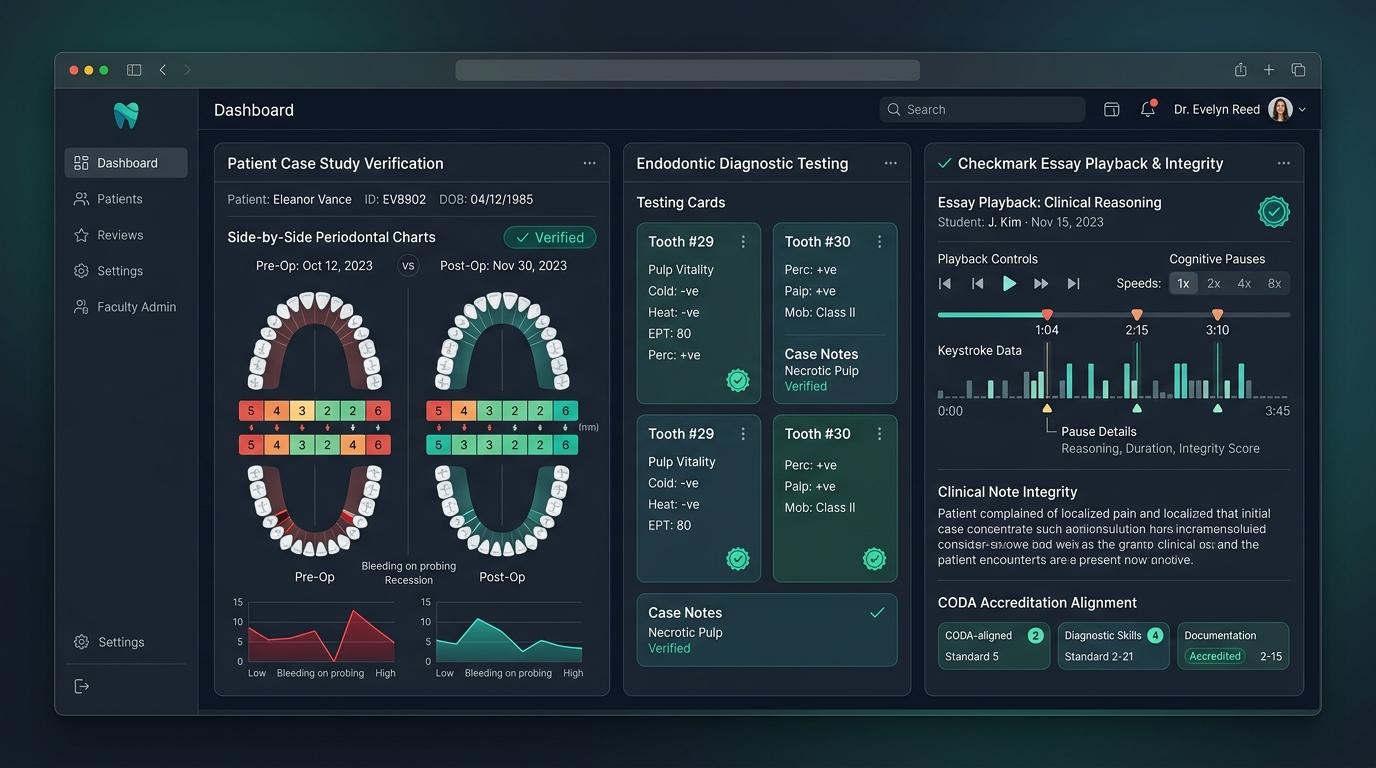
In predoctoral dental education (DDS/DMD), dental hygiene programs, and advanced specialty residencies, clinical competency case writeups and chairside patient encounter notes represent the ultimate bridge between biomedical theory and autonomous patient care. Under Commission on Dental Accreditation (CODA) Standards 2-24 and 5-2, dental programs must objectively verify that candidates demonstrate independent diagnostic reasoning, accurate periodontal risk stratification, valid pulpal/periapical testing interpretation, and medically sound, phased treatment sequencing before graduation. However, the proliferation of Large Language Models (LLMs) has introduced a grave educational and patient safety dilemma: AI clinical hallucinations. LLMs generate fluent, textbook-perfect case summaries that often mask dangerous clinical impossibilities—such as biologically incompatible periodontal pocket depths, paradoxical endodontic diagnoses (e.g., diagnosing reversible pulpitis on a necrotic tooth with periapical radiolucency), inverted restorative sequences, and overlooked surgical contraindications. Simultaneously, legacy AI text detectors fail dental faculty completely: they trigger rampant false positives on standardized dental shorthand (e.g., FMX, BOP, CAL, MOD, SRP, RCT, WNL) while remaining blind to completely synthetic diagnostic logic. To uphold clinical excellence without resorting to adversarial guesswork, leading dental institutions are adopting a 5-Phase Dental Clinical Telemetry Audit Protocol. By combining EHR/radiographic concordance checks with Checkmark’s patent-pending Essay Playback™ (1x–8x keystroke replay), External Paste Inspection, and teacher-in-the-loop rubric autograding, dental educators can audit the authentic cognitive pauses between chart review and note drafting, detect outsourced AI generation, protect honest clinicians, and safeguard future patients.
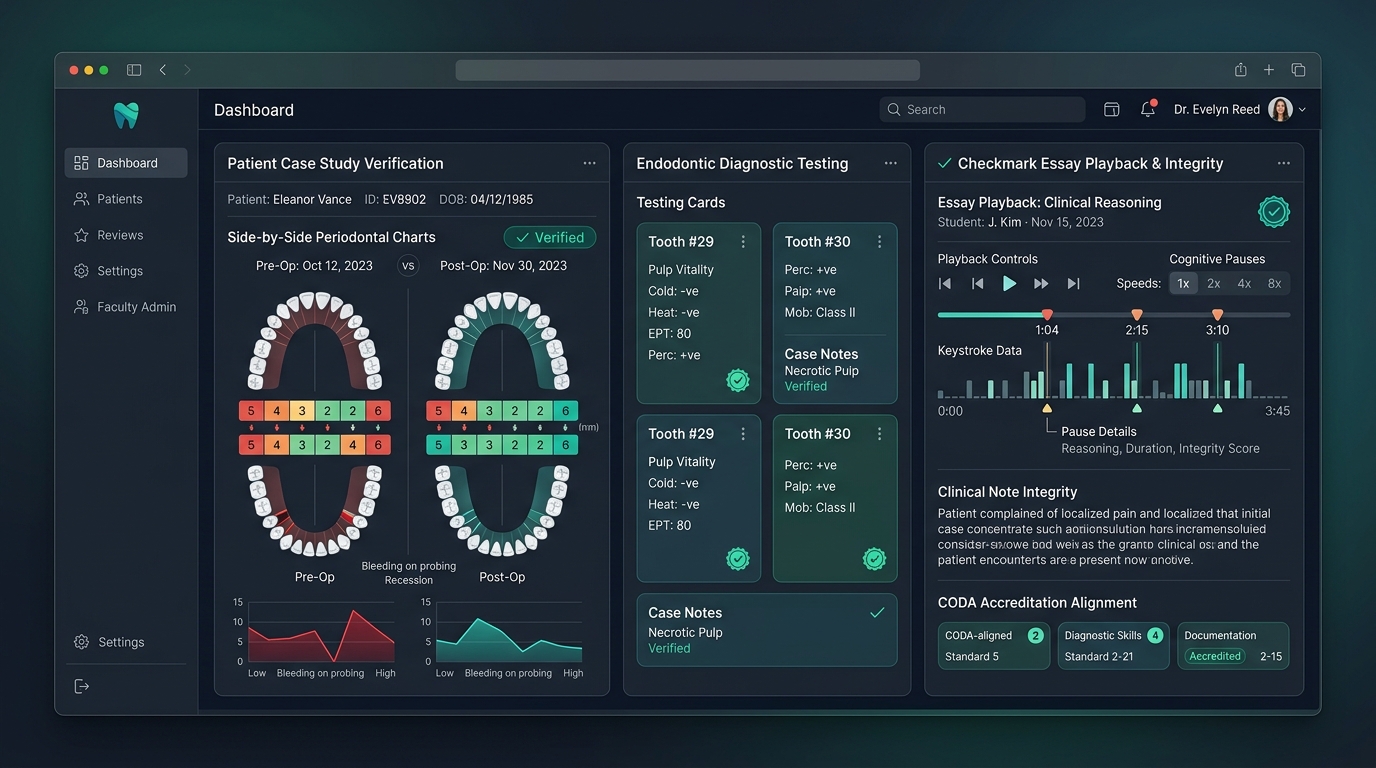
Checkmark Plagiarism provides the foundational technology for health sciences integrity by uniting patent-pending Essay Playback™ with passage-level AI confidence scoring, source-linked plagiarism detection, quote-anchored clinical rubric autograding, and enterprise LMS integrations for Canvas LMS, Blackboard, and D2L Brightspace.
1. The High-Stakes Imperative: Dental Clinical Competency & Accreditation Standards
Modern dental education has fundamentally shifted from traditional numerical procedural minimums to comprehensive, competency-based clinical education. Under this contemporary paradigm, a graduating dentist is not merely an operator who has completed a quota of Class II amalgam restorations or complete dentures; they must be a primary care oral health physician capable of independent diagnostic synthesis, ethical risk assessment, interprofessional communication, and patient-centered treatment planning.
In dental school clinics, faculty oversee this transition through three high-stakes assessment modalities:
Longitudinal documentation tracking the complete oral rehabilitation of multi-disciplinary patients across Periodontics, Endodontics, Restorative Dentistry, Prosthodontics, and Oral Surgery.
Unassisted clinical encounters where students independently interview, examine, chart, diagnose, and develop treatment plans for complex patients under direct faculty observation.
Rigorous, multi-page written defenses analyzing diagnostic casts, full-mouth radiographic series (FMX), cone-beam computed tomography (CBCT) volumes, periodontal charts, and alternative treatment options.
- Full-Mouth Probing & CAL Charting
- FMX & 3D CBCT Volumetric Imaging
- Cold (Endo-Ice), EPT, & Bite Testing
- Systemic Medication & Vitals Triangulation
- AAP 2017 Periodontitis Stage & Grade
- AAE Pulpal & Periapical Categorization
- Hard Tissue Caries Risk (CAMBRA)
- Occlusal Plane & Biomechanical Restorability
- ASA Physical Status Classification
- Anticoagulant & Bleeding Risk (INR/DOAC)
- MRONJ Bone Necrosis Risk Assessment
- Local Anesthetic Cardiac Dosing Maximums
- Phase I: Emergency & Disease Control (SRP)
- Phase II: Periodontal / Pre-Prosthetic Surgery
- Phase III: Fixed / Removable Rehabilitation
- Phase IV: 3-4 Month Periodontal Maintenance
- Informed Consent & Risk Disclosure
- Aseptic Isolation & Tooth Structure Preservation
- Standardized SOAP EHR Charting
- Drug Dosages & Anesthetic Quantities
- 4-6 Week Post-SRP Probing Depth Re-Chart
- Restorative Marginal Integrity Audit
- Pulpal Symptom Resolution Verification
- Longitudinal Recall Surveillance Protocol
Accreditation Mandates: CODA Standards 2-24 and 5-2
Collegiate dental education programs in the United States and internationally are governed by stringent accreditation benchmarks established by the Commission on Dental Accreditation (CODA) and the American Dental Education Association (ADEA):
Mandate: “Graduates must be competent in assessing the treatment needs of patients for all stages of life, developing a comprehensive treatment plan, and obtaining informed consent.”
Curricular Impact: Faculty must maintain verifiable, defensible documentation proving that every graduating dentist can independently assess diagnostic data, formulate evidence-based treatment rationales, and modify therapy based on systemic health variables without unapproved external or AI assistance.
Mandate: “The dental school must have a formal, written system of quality assurance for the patient care program that includes... an active audit system of patient records to evaluate the quality of care and the accuracy, completeness, and timeliness of documentation.”
Legal & Ethical Impact: Patient encounter notes are legal medical records. Fabricated, inaccurate, or unverified student documentation in the electronic health record (EHR)—such as axiUm, Dentrix Enterprise, or Epic Wisdom—exposes academic medical centers to severe malpractice liability, accreditation sanctions, and Medicaid/insurance billing fraud audits.
The Rise of the Synthetic Case Writeup
The widespread availability of generative Large Language Models (e.g., ChatGPT, Claude, Gemini) has introduced an unprecedented vulnerability into dental academic assessments. Dental students facing intense clinical graduation requirements, high patient cancellation rates, and demanding academic schedules are increasingly tempted to feed raw diagnostic fragments or patient charts into generative AI tools to output fully synthesized SOAP notes, Periodontal Risk Narratives, and Comprehensive Treatment Planning Case Presentations.
While the resulting text appears polished, scholarly, and articulate, it frequently severs the vital connection between what the student actually observed in the patient’s oral cavity and what was written in the academic submission. When clinical faculty cannot verify whether a treatment rationale reflects authentic student reasoning or synthetic AI prose, patient care safety and institutional accreditation are compromised.
2. Anatomy of Dental Clinical Documentation & The AI Hallucination Threat
To effectively evaluate student submissions, dental faculty must understand the precise clinical architecture of dental case documentation and recognize the specific cognitive flaws and hallucinations that characterize LLM-generated dental writeups.
- Subjective: CC, HPI, Med Hx, Pain Scale
- Objective: Hard/Soft Tissue, Caries, Vitals
- Assessment: CDT & ICD-10 Diagnostic Codes
- Plan: Anesthetic mg/carps, isolation, CDT codes
- Probing Depth (PD): 6 points/tooth in mm
- Gingival Margin (GM): Recession vs Hyperplasia
- Attachment Loss: CAL = PD + GM (exact math)
- Bleeding on Probing: BOP % & Furcations
- Cold (Endo-Ice): Transient vs Lingering (>15s)
- EPT Threshold: 0-80 Vitality Baseline
- Periapical: Percussion, Palpation, Bite Stick
- Radiographic: Intact PDL vs Widened vs PARL
- Phase I: Disease Control, Caries Stabilization, SRP
- Phase II: Perio Re-Eval (4-6 wk), Ferrule Surgery
- Phase III: Fixed / RPD Surveyor Restorations
- Phase IV: Customized Maintenance Recalls
Anticoagulation: Warfarin INR target (2.0–3.0) vs DOAC non-interruption protocols.
Bone Antiresorptives: Oral bisphosphonate vs high-dose IV oncology MRONJ risk staging.
Cardiac Limits: 0.04mg epinephrine limit for ASA III/IV vs 0.2mg for healthy adults.
Nerve Proximity: >2.0mm safety margin to Inferior Alveolar Canal & mental foramen.
1. Chairside Encounter Notes & The Dental SOAP Framework
In institutional dental clinics, daily clinical encounters are recorded using the standardized SOAP (Subjective, Objective, Assessment, Plan) format:
- Subjective (S): Chief complaint (
"My lower right molar aches when I drink cold water and lingers for 30 seconds"), History of Present Illness (onset, duration, frequency, aggravating/relieving factors), review of medical history updates, and systemic medications. - Objective (O): Clinical examination findings, extraoral/intraoral soft tissue exam, hard tissue charting (restorations, caries, fractures), periodontal metrics, diagnostic radiographic findings (bone loss patterns, periapical radiolucencies, periodontal ligament widening), and pulp vitality readings.
- Assessment (A): Definitive American Dental Association (ADA) and specialty diagnostic codes (e.g., AAP/EFP 2017 Stage III Grade B Generalized Periodontitis; AAE Symptomatic Irreversible Pulpitis with Symptomatic Apical Periodontitis for tooth #30; ICD-10 K02.62 dental caries on pit and fissure).
- Plan (P): Detailed, step-by-step documentation of treatment rendered during the appointment (anesthetic agent, vasoconstrictor concentration, total cartridges and milligrams administered, isolation method, CDT procedural codes), patient tolerance, post-operative instructions, and next appointment objectives.
2. Periodontal Charting Narratives & Biomechanical Realities
A foundational competency in predoctoral dental education is diagnosing and staging periodontal disease according to the 2017 AAP/EFP World Workshop Classification of Periodontal and Peri-Implant Diseases and Conditions.
Students must integrate six discrete numerical data points per tooth:
- Probing Depth (PD): Distance from the gingival margin to the base of the periodontal pocket (measured in millimeters).
- Gingival Margin Level (GM): Distance from the cementoenamel junction (CEJ) to the gingival margin. A positive value indicates gingival recession (CEJ exposed); a negative value indicates gingival hyperplasia/coronal migration.
- Clinical Attachment Loss (CAL): The true biological measure of periodontal tissue destruction:
CAL (mm) = Probing Depth (PD) + Gingival Margin Level (GM)
- Bleeding on Probing (BOP): Percentage of charted sites exhibiting bleeding within 30 seconds of probing (a primary marker of active inflammatory disease).
- Furcation Involvement: Horizontal bone loss between multi-rooted teeth (Class I, II, or III per Hamp/Glickman classifications).
- Tooth Mobility: Pathologic horizontal/vertical movement (Miller Class I: ≤ 1mm; Class II: > 1mm; Class III: vertical depression).
The LLM Periodontal Failure Mode: Impossible Anatomical Combinations
Large Language Models process clinical terminology statistically rather than spatially. When students use AI to draft periodontal case narratives, the LLM frequently generates anatomically impossible or physiologically contradictory clinical metrics:
- The “Zero Recession, 8mm Pocket, Zero CAL” Hallucination: An LLM might state, “The patient presented with localized 8mm probing depths on the direct facial of tooth #24 with healthy gingival margins at the CEJ, resulting in 0mm of clinical attachment loss.” Biologically, if the gingival margin is at the CEJ (0mm), an 8mm probing depth automatically equates to 8mm of Clinical Attachment Loss (CAL = 8 + 0 = 8mm).
- The “Heavy Smoker with 95% BOP” Contradiction: Generative AI often pairs a patient history of heavy cigarette smoking (> 1 pack/day) with an aggressive, generalized 95% Bleeding on Probing rate, completely overlooking the well-established vasoconstrictive suppression of clinical bleeding caused by nicotine in authentic periodontal presentations.
| Clinical Parameter | Authentic Clinical Observation | LLM Synthetic Hallucination |
|---|---|---|
| Clinical Attachment Loss (CAL) | CAL = PD + GM (Mathematically verified against CEJ position). |
Claims severe pocketing (6–8mm) with zero attachment loss; ignores GM arithmetic. |
| Smoking & Bleeding Correlation | Nicotine vasoconstriction suppresses gingival bleeding (low BOP, severe bone loss). | Reports generalized 90%+ BOP in heavy smokers (standard textbook bleeding trap). |
| Furcation vs. Root Trunk Anatomy | Correlates root trunk length with bone loss level on periapical radiographs. | Diagnoses Class III furcation on teeth with high, intact crestal bone levels. |
| Supracrestal Tissue Attachment | Respects 2.04mm biologic width in subgingival crown margin placement. | Recommends subgingival margins 4mm below bone crest without crown lengthening. |
3. Endodontic Diagnostic Testing & Vitality Formulations
In endodontic case studies, students must correlate clinical diagnostic tests with radiographic findings to assign two distinct diagnoses: a Pulpal Diagnosis and an Apical Diagnosis per American Association of Endodontists (AAE) consensus standards:
| AAE Diagnostic Category | Clinical Diagnostic Findings & Sensibility Profile |
|---|---|
| Pulpal Diagnostic Categories | |
| Normal Pulp | Mild, transient response to cold (Endo-Ice); subsides in 1–2 seconds; no spontaneous pain; EPT responds within normal baseline limits. |
| Reversible Pulpitis | Exaggerated, sharp response to cold/sweet; subsides immediately within 1–3 seconds after stimulus removal; no spontaneous pain; EPT positive. |
| Symptomatic Irreversible Pulpitis | Sharp or dull throbbing pain to cold/heat; lingering discomfort for > 15–30 seconds after stimulus removal; spontaneous radiating pain. |
| Asymptomatic Irreversible Pulpitis | Deep caries extending to pulp chamber; no clinical symptoms; positive response to thermal testing; vital pulp exposed upon excavation. |
| Pulp Necrosis | Completely unresponsive to cold testing (Endo-Ice) and EPT (80/80); tooth is non-vital (requires periapical testing to stage apex). |
| Apical Diagnostic Categories | |
| Normal Apical Tissues | Non-sensitive to mechanical percussion and palpation; intact lamina dura and uniform PDL space radiographically. |
| Symptomatic Apical Periodontitis | Marked tenderness/pain to mechanical percussion and biting force; may or may not exhibit widened PDL space on periapical radiographs. |
| Asymptomatic Apical Periodontitis | No pain to percussion or palpation; distinct circumscribed periapical radiolucency (PARL) visible at apex on periapical/CBCT radiograph. |
| Chronic Apical Abscess | Characterized by an active draining sinus tract (fistula); non-tender or mild discomfort; periapical radiolucency present radiographically. |
| Acute Apical Abscess | Rapid onset, severe spontaneous throbbing pain, extreme pain to touch, active purulent swelling, systemic malaise, lymphadenopathy. |
The LLM Endodontic Failure Mode: Diagnostic Paradoxes
Generative AI models frequently generate fatal diagnostic contradictions:
- The “Vital Necrosis” Paradox: An LLM-generated narrative might describe a tooth as exhibiting “severe lingering response to cold testing for 45 seconds” while concurrently diagnosing the tooth with “Pulp Necrosis.” By definition, a necrotic pulp contains non-viable sensory nerve fibers and cannot generate an exaggerated vital thermal response.
- The “Reversible Apical Radiolucency” Error: An LLM might diagnose “Reversible Pulpitis with Asymptomatic Apical Periodontitis (large 4mm periapical radiolucency at the distal apex).” In biological reality, periapical bone destruction resulting from endodontic pathosis requires necrotic bacterial egress through the apical foramen; it cannot coexist with a purely reversible, vital pulpal condition.
4. Prosthodontic & Restorative Treatment Sequencing
In complex clinical competency cases, the hallmark of clinical maturity is Treatment Sequencing. Students must organize patient care into four distinct, logical phases:
Medical consults, antibiotic prophylaxis, hypertension triage, smoking cessation counseling. Emergency pain/infection relief (pulpectomy, incise & drain, urgent extractions). Caries control restorations (glass ionomer / resin interim therapeutic restorations). Full-mouth scaling and root planing (SRP), oral hygiene instruction (OHI), chlorhexidine therapy. Extraction of non-restorable / hopeless teeth; definitive endodontic therapy for restorable teeth.
4–6 week post-SRP periodontal re-evaluation (probing depth re-measurement, BOP audit). Periodontal pocket reduction / osseous resective surgery / connective tissue grafting. Crown lengthening surgery to establish 2.0mm biological ferrule. Pre-prosthetic surgery (tuberosity reduction, tori removal, alveolar ridge preservation). Minor tooth movement / orthodontic alignment prior to fixed prosthodontics.
Core build-ups with post-and-core where ferrule is verified. Single-unit definitive crowns (Zirconia, Lithium Disilicate, PFM). Fixed Partial Dentures (bridges) / Implant surgical placement and custom abutment restoration. Removable Partial Dentures (RPD framework try-in, altered cast impression, delivery) / Complete Dentures. Occlusal equilibration and protective nightguard fabrication.
Customized 3-month or 4-month periodontal maintenance intervals. Periodic oral examination, bite-wing radiographs, caries risk reassessment (CAMBRA). Prosthodontic hardware integrity inspection, occlusal check, oral hygiene reinforcement.
The LLM Sequencing Failure Mode: Inverted Chronology
Because LLMs synthesize text based on topic keywords rather than biological healing dependencies, AI-generated case plans constantly commit critical sequencing errors:
- Recommending definitive crown preparation on abutment teeth before performing Phase I periodontal scaling or endodontic therapy.
- Designing a removable partial denture (RPD) prior to extracting hopeless, non-restorable abutments or completing surveyor crown restorations.
- Skipping the mandatory 4-to-6 week post-SRP periodontal re-evaluation and immediately scheduling surgical crown lengthening or bone grafting.
5. Surgical Risk Assessments & Medical Complexities
Dental students must synthesize complex medical histories to prevent fatal chairside emergencies. A student case writeup must specifically address:
- Anticoagulant & Antiplatelet Therapy: Differentiating between traditional Vitamin K antagonists (Warfarin, requiring a therapeutic INR check within 24–72 hours of surgery, target 2.0–3.0) and Direct Oral Anticoagulants (DOACs: Apixaban, Rivaroxaban, Dabigatran), where routine discontinuation is contraindicated due to rebound thromboembolism risk.
- Antiresorptive & Antiangiogenic Agents (MRONJ Risk): Staging patient risk for Medication-Related Osteonecrosis of the Jaw (MRONJ) based on route of administration (oral bisphosphonate for osteoporosis vs. high-dose IV zoledronic acid/denosumab for oncologic bone metastases) and duration of exposure (> 4 years increasing risk).
- Cardiovascular & Hypertensive Limits: Calculating maximum allowable local anesthetic cartridges based on epinephrine cardiac dosing (0.04mg maximum for ASA III/IV cardiovascular patients vs. 0.2mg for healthy ASA I adults).
- Anatomical Nerve & Sinus Proximity: Measuring safety margins (> 2.0mm) from the Inferior Alveolar Canal (IAC), mental foramen, and maxillary sinus floor on CBCT/panoramic imaging prior to implant placement or mandibular third molar extraction.
3. The Patient Care & CODA Accreditation Dilemma: Why Generic AI Detectors Fail Dental Faculty
When dental clinical faculty suspect that a student’s competency case study or chart writeup was generated by an LLM, they often turn to commercial, generic AI detection tools. However, in health sciences and dental education, generic AI checkers fail catastrophically, creating serious risks for academic fairness and accreditation compliance.
Generic detectors measure low perplexity on formulaic dental shorthand (FMX, BOP, CAL, MOD, SRP, WNL, 2% Lido 1:100k epi).
Polished 1,500-word LLM case defenses exhibit high burstiness and scholarly vocabulary, scoring 100% “Human Written.”
1. The False Positive Crisis on Standard Dental Shorthand
Generic AI text detectors rely on statistical algorithms measuring perplexity (word choice predictability) and burstiness (variation in sentence length and structure). In dental charting, however, professional standards mandate that students write with extreme conciseness, predictable clinical formulas, and codified medical abbreviations.
When a student writes an authentic chairside note:
Pt presents for scheduled Phase I SRP LL quad. Med Hx reviewed, no changes, BP 124/82, HR 72, ASA II (well-controlled T2DM, HbA1c 6.8%). Confirmed informed consent. Administered 1 carp (1.8 mL) 2% Lidocaine w/ 1:100,000 epi via left IANB and 1 carp 4% Articaine w/ 1:100k epi via buccal infiltration. Profound anesthesia achieved. Completed ultrasonic debridement (Cavitron Slimline) and hand scaling (Graceys 11/12, 13/14) on teeth #18-21. Subgingival irrigation w/ 0.12% CHX. Hemostasis achieved. Post-op instructions given. Pt tolerated procedure WNL. Re-eval in 4-6 wks.
Generic AI detectors evaluate this text and calculate near-zero perplexity because standard medical nomenclature, drug dosages, and clinical shorthand follow rigid statistical patterns. Consequently, the detector assigns a 95% to 100% “AI Generated” score, falsely accusing an honest student of academic misconduct. This systemic flaw disproportionately harms International Dentist Program (IDP) candidates, non-native English speakers, and neurodivergent clinicians who strictly adhere to template conventions.
2. The False Negative Blind Spot on Hallucinated Treatment Rationales
Conversely, when a student prompts a modern LLM (such as GPT-4o or Claude 3.5 Sonnet) with:
“Write a 1,500-word comprehensive clinical defense for a 52-year-old patient with generalized severe periodontitis and multiple broken teeth,”
the model outputs fluid, highly descriptive, varied prose. The sentence lengths vary naturally, transitions are sophisticated, and vocabulary is rich. Generic AI detectors score this passage as 100% “Human Written.”
Yet, beneath the polished prose lies clinical disaster: the AI recommends crown restorations on teeth with active 9mm infrabony pockets, misses a dangerous bisphosphonate history, and suggests placing implants into infected extraction sockets without bone grafting. The generic tool gives the essay a clean pass, leaving faculty completely unaware of the student’s profound lack of clinical competence.
3. FERPA, HIPAA, and Data Security Compliance
Submitting student case studies—which contain anonymized yet detailed patient medical histories, clinical photographs, tooth numbers, and localized clinical scenarios—into commercial, unvetted AI detection websites creates severe data privacy vulnerabilities:
- Public LLM Scraping: Many commercial detectors retain uploaded submissions to train future models, violating student copyright, institutional ownership, and FERPA data sovereignty.
- HIPAA Exposure: Even if obvious personal identifiers (names, dates of birth, MRNs) are removed, uploading specialized health histories to non-HIPAA-compliant cloud platforms violates healthcare data governance standards.
Dental schools require a secure, zero-retention, FERPA-compliant evidentiary platform that evaluates writing authenticity directly within the institution’s learning management ecosystem.
4. The Dental Clinical Evidentiary Matrix
To illustrate the stark differences between traditional grading, legacy AI text checkers, and modern writing process telemetry, dental faculty can consult the following comparative evidentiary framework:
| Evidentiary Dimension | Traditional Chairside Faculty Grading | Generic AI Text Detectors | Checkmark Clinical Telemetry & Playback™ |
|---|---|---|---|
| Granularity of Analysis | Subjective, holistic review; spot-checks physical charts. | Single whole-document score (e.g. “78% AI”). | Passage-level granular confidence sliders. |
| Periodontal & Diagnostic Math Verification | Manually checks calculations if time permits chairside. | Completely blind to math; flags formulaic equations. | Verifies typing and calculation pauses. |
| Diagnostic Synthesis Pauses (EHR to Note Reasoning) | Cannot observe how student drafted note after clinic. | Zero process data; analyzes static output text only. | Captures 15–60s pauses during chart synthesis. |
| External Paste & Clipboard Tracking | Cannot prove if note was pasted from ChatGPT or notes. | Blind to paste events; cannot preserve clipboard content. | Timestamped capture of full original text. |
| Second-Screen Transcription Detection | Undetectable unless faculty stands directly behind student. | Cannot distinguish typing speed from active composition. | Identifies mechanical, unpaused retyping streams. |
| Standard Dental Shorthand Sensitivity (FMX, BOP, CAL) | Understands clinical acronyms and standard SOAP syntax. | Triggers rampant FALSE POSITIVES on abbreviations. | Calibrated sliders; ignores shorthand traps. |
| CODA Standard 2-24 & 5-2 Defensibility | Vulnerable to appeals due to lack of objective evidence. | Legally indefensible; black-box scores rejected by boards. | Irrefutable, keystroke-by-keystroke receipts. |
| Student Data Privacy & HIPAA / FERPA Compliance | Internal EHR; low tech, high administrative burden. | High risk; often retains data for commercial AI training. | Zero-retention cloud; 100% FERPA/HIPAA safe. |
5. The 5-Phase Dental Faculty Audit Protocol for Competency Case Studies
To standardize the evaluation of clinical writeups, case portfolios, and independent competency examinations, dental school academic integrity committees and clinical quality assurance teams can execute the following structured 5-Phase Clinical Telemetry Audit Protocol:
Cross-examine written submission against axiUm / Dentrix EHR charts and digital FMX/CBCT. Audit 6-point probing depths, CAL calculations, bone crest levels, and pulpal vitality logs.
Verify Phase I (Disease Control) → Phase II (Surgical) → Phase III (Rehab) → Phase IV (Recall). Audit biological ferrule (1.5–2.0mm), crown-to-root ratios, and restorative margins.
Scrub through student drafting timeline at 1x to 8x speed in Checkmark Essay Playback™. Inspect cognitive synthesis pauses (15–60s) where student correlates chart data with diagnosis.
Inspect timestamped external paste events in Checkmark’s clipboard inspector. Differentiate between approved EHR template macros and full-cloth AI generation pastes.
Conduct supportive, chairside video-scrub review with the student. Replay drafting moments, ask student to defend treatment logic, and guide clinical remediation.
Phase 1: EHR & Radiographic Concordance Audit
Before opening the text analysis, the clinical faculty evaluator opens the patient’s official electronic health record (e.g., axiUm, Dentrix Enterprise) and digital imaging software (e.g., MiPACS, Romexis, Dexis):
- Periodontal Chart Verification: Cross-check the student’s written CAL values against the charted probing depths and gingival margins. Verify that the documented bone loss on bitewing/periapical radiographs matches the diagnosed AAP Stage (e.g., Stage I: coronal third < 15%; Stage II: coronal third 15–33%; Stage III: extending to middle third of root and beyond).
- Endodontic Testing Concordance: Compare the student’s written pulp testing summary with the raw chairside data sheet. Ensure that cold responses, EPT scores, and percussion findings align perfectly with the definitive pulpal and apical diagnoses.
- Hard Tissue Odontogram Cross-Check: Confirm that all identified carious lesions, defective margins, and missing teeth correspond to the actual patient odontogram.
Phase 2: Biological & Biomechanical Sequencing Logic Verification
The evaluator evaluates the internal chronological and biological validity of the proposed treatment plan:
- Disease Control Precedence: Has the student prioritized emergency pain relief, active caries stabilization, and initial periodontal debridement before proposing definitive prosthodontics?
- Structural Viability Assessment: For every tooth slated for a post-and-core and crown, has the student documented at least 1.5mm to 2.0mm of sound vertical tooth structure coronal to the preparation margin (the mandatory ferrule effect)?
- Prognosis Assignment: Are individual tooth prognoses (Good, Fair, Poor, Questionable, Hopeless) aligned with multi-rooted furcation levels, residual bone support, and restorative restorability?
Phase 3: Telemetry & Keystroke Synthesis Pause Analysis (Essay Playback™)
Using Checkmark’s patent-pending Essay Playback™, the faculty member reviews the dynamic writing process of the case report:
- The Clinical Synthesis Rhythm: In genuine student composition, writing is non-linear. The student types a paragraph describing the patient’s medical history, pauses for 30–60 seconds (switching windows to review the axiUm lab values or digital bitewings), types the periodontal diagnosis, pauses to calculate CAL, deletes a tentative prognosis, and revises the treatment sequence.
- The Mechanical AI Retyping Anomaly: In contrast, when a student retypes an AI-generated essay from a secondary screen (such as a smartphone resting beside the keyboard), Essay Playback™ reveals a continuous, unbroken, mechanical typing stream (60–95 WPM) with zero diagnostic pauses, zero chart-checking intervals, and virtually no structural sentence reorganizations.
[Type CC/HPI] → (45s Pause: axiUm Review) → [Draft Perio Dx] → (30s Pause: Calc CAL) → [Draft Stage III] → (Backspace Grade A → B) → (60s Pause: FMX Check) → [Plan Endo]
- • Non-linear composition with natural cognitive hesitation
- • 15–60s dwell times corresponding to radiographic analysis
- • Active revision of diagnostic grades and drug dosages
[Type 85 WPM continuous unbroken text payload without chart lookup pauses....................]
- • Unnatural constant-velocity character dispatch
- • Zero chart consultation intervals or calculation hesitations
- • Monotonic linear drafting without structural rewrites
Phase 4: External Paste & Secondary-Device Transcription Triage
The evaluator inspects Checkmark’s External Paste Inspector:
- Whitelisted Clinical Macros: Dental students frequently use approved institutional chart templates (e.g., standard post-extraction instruction paragraphs or surgical prep checklists). Checkmark flags these pastes with exact timestamping and original text preservation, allowing faculty to quickly confirm they are authorized institutional boilerplate.
- Full-Block AI Pastes: If the student pasted 800 words of complex, multi-paragraph differential diagnosis in a single 0.2-second event, Checkmark preserves the complete pasted content—even if the student later spent 20 minutes tweaking individual adjectives or moving sentences to disguise the paste.
Phase 5: Supportive Restorative Clinical Judgment Conferences
If irreconcilable discrepancies or unverified AI text are identified, the faculty member initiates a supportive, non-adversarial clinical conference:
- Opening with Evidence: The faculty member opens Checkmark Essay Playback™ alongside the patient’s EHR chart, inviting the student to review their writing timeline together.
- Inquiry into Clinical Rationale: “Let’s look at your diagnosis for tooth #19. Your writeup diagnoses reversible pulpitis, but the chart notes a 5mm periapical radiolucency and non-responsiveness to cold. Walk me through your diagnostic reasoning when you wrote this section.”
- Restorative Remediation: If the student outsourced the reasoning to an LLM, the conference shifts away from punitive confrontation toward clinical remediation. The student is guided through re-evaluating the actual patient radiographs, re-charting the diagnostic findings, and independently authoring an authentic clinical treatment defense.
6. How Checkmark Empowers Dental School Faculty & Clinical QA Teams
Checkmark Plagiarism is engineered specifically to meet the rigorous pedagogical, evidentiary, and accreditation requirements of health sciences and professional dental education.
Passage-Level AI Confidence Sliders
Unlike blunt whole-paper detectors that return a meaningless percentage, Checkmark analyzes text with passage-level granularity. Each flagged passage is paired with an individual evidence card in the sidebar featuring calibrated confidence sliders comparing typical human clinical drafting style against typical LLM output.
- Short Clinical Note Guardrails: Entries under ~150 words display an honest
N/Arather than guessing on insufficient text, eliminating shorthand false positives. - Educator-Only Privacy: Flags remain private to clinical faculty, preventing automated student stress.
Patent-Pending Essay Playback™ (1x–8x)
Reconstructs the complete drafting session keystroke-by-keystroke. Dental clinical instructors can scrub through the entire writing process like a high-definition video.
- Exonerating Honest Clinicians: Keystroke timeline with genuine composing pauses serves as irrefutable proof of authentic human authorship.
- Exposing Subcontracted Reasoning: Provides clear, objective evidentiary documentation for academic integrity committees when reasoning is outsourced.
External Paste Inspector with Full Payload
Records every paste event with millisecond precision, capturing the full clipboard content even if the student subsequently edits, paraphrases, or reformats the text.
- Jump-to-Playback Verification: One-click navigation to watch the exact moment of insertion.
- Template Macro Differentiation: Instantly distinguishes between approved institutional EHR templates and unauthorized AI paragraphs.
Teacher-in-the-Loop AI Rubric Autograding
Streamlines the grading of comprehensive dental case presentations by providing first-draft rubric evaluations anchored to student prose.
- Custom CODA Rubrics: Evaluates Data Accuracy, Diagnostic Synthesis, Periodontal Risk, and Sequencing.
- Direct LMS Passback: Teacher-approved scores sync seamlessly with Canvas LMS, Blackboard, Brightspace D2L, or Buzz LMS.
7. Frequently Asked Questions (FAQ)
How do dental clinical faculty differentiate between approved EHR template macros and prohibited AI text generation?
Approved EHR templates (such as standardized post-operative instructions, informed consent paragraphs, or anesthesia checklists) are standard in clinical practice. In Checkmark, these entries appear as identifiable external paste events. Because Checkmark preserves the full pasted text, faculty can immediately verify that the content matches the institution’s official axiUm/Dentrix boilerplate. In contrast, unauthorized AI generation typically appears as extensive, customized multi-paragraph diagnostic reasoning, differential diagnoses, and treatment plans pasted or mechanically transcribed into the document without corresponding clinical synthesis pauses.
Why do standard dental abbreviations (e.g., FMX, BOP, CAL, MOD, SRP, RCT) trigger false positives on generic AI checkers?
Generic AI checkers measure perplexity (statistical word unpredictability). In clinical dentistry, standardized abbreviations and formulaic SOAP phrasing represent the most predictable, codified syntax possible. Generic models evaluate these standard medical patterns as “low perplexity,” assigning high AI probability scores. Checkmark eliminates this issue through passage-level linguistic analysis, short-text guardrails, and keystroke process validation, evaluating how the student composed the text rather than penalizing professional shorthand.
How does Checkmark maintain HIPAA compliance when dental students write about real clinical patients?
Checkmark operates under a strict zero-retention, enterprise-secure cloud architecture. Student submissions are never cached, indexed, or utilized to train commercial machine learning models. Furthermore, Checkmark integrates directly within the university’s secure Single Sign-On (SSO) and LMS infrastructure (Canvas, Blackboard, Moodle), ensuring that student case writeups and de-identified patient data remain fully protected under FERPA, HIPAA, and institutional data governance policies.
How can clinical instructors evaluate International Dentist Program (IDP) candidates fairly without AI bias?
International Dentist Program candidates and non-native English speakers often write with formal, grammatically precise, or template-aligned structures that generic AI detectors disproportionately misclassify as synthetic. Checkmark protects IDP candidates by shifting the evaluation focus from surface syntax to authentic writing telemetry. When faculty can see the candidate’s authentic Essay Playback™ timeline—complete with thoughtful clinical pauses, vocabulary revisions, and data cross-referencing—the student’s clinical reasoning is verified beyond dispute.
Can Checkmark be used during formal CODA accreditation reviews to document clinical competency assurance?
Yes. Under CODA Standards 2-24 and 5-2, dental institutions must demonstrate robust quality assurance mechanisms and verifiable proof of student clinical competence. Checkmark’s comprehensive evidentiary dossiers—combining passage-level analysis, quote-anchored rubric justifications, and keystroke playback archives—provide accreditation committees with transparent, auditable proof that student clinical competencies and patient encounter records reflect authentic, independent clinical decision-making.
What should a faculty member do if a student’s case study exhibits perfect writing but biologically impossible clinical data?
When a submission presents articulate prose alongside clinical impossibilities (such as diagnosing pulp necrosis on a vital tooth or reporting impossible CAL values), faculty should initiate Phase 5 of the audit protocol: a Supportive Restorative Clinical Judgment Conference. By replaying the student’s Essay Playback™ timeline alongside the actual patient radiographs and periodontal charts, the instructor can address the diagnostic breakdown formatively, helping the student recognize where automated tools fail and guiding them to master genuine clinical synthesis.
How does keystroke playback help detect students retyping AI-generated text from a smartphone or second monitor?
When a student types an authentic clinical case study, their keystroke velocity fluctuates naturally: typing speeds slow down during complex diagnostic formulation, burst during familiar descriptive sections, and pause for 15–60 seconds while examining radiographs or calculating math. When a student retypes text from a second screen, Essay Playback™ reveals an unnatural, constant-cadence typing stream (steady 70–90 WPM) with zero diagnostic hesitation pauses, no data lookups, and minimal semantic editing, providing clear objective evidence of external transcription.
8. Conclusion: Transforming Clinical Integrity from Adversarial Guessing to Objective Trust
In dental education, patient safety is inextricably linked to academic integrity. When a dental graduate enters private practice or hospital residency, their ability to independently evaluate diagnostic data, calculate biological attachment loss, interpret pulp vitality tests, and sequence multi-phase treatment plans directly determines the standard of care their patients receive.
Relying on opaque, whole-paper AI detection scores creates an adversarial learning environment that penalizes honest clinicians while missing catastrophic clinical errors. By implementing Checkmark’s multi-dimensional integrity platform—leveraging passage-level confidence analysis, patent-pending Essay Playback™, external paste inspection, and teacher-controlled rubric autograding—dental schools can:
Stop guessing, start trusting. Empower your dental faculty with the clinical telemetry needed to foster authentic reasoning and clinical excellence.
See how Checkmark captures diagnostic pauses, tracks external paste events, and visualizes clinical writing telemetry in Canvas SpeedGrader. View a sample report or request a clinical education demonstration for your dental institution.