
The college admissions landscape is undergoing an unprecedented trust crisis. The explosion of generative AI models, commercial “essay polishers,” and paid ghostwriting consultancies has collided with high-stakes admissions screening algorithms, resulting in false-positive AI flags that can disproportionately harm international and non-native English applicants, and may also affect first-generation and neurodivergent applicants. When an admissions committee or scholarship board questions the authenticity of a Common App personal statement or institutional supplement, static text and probabilistic AI detector percentages cannot provide defensible proof.
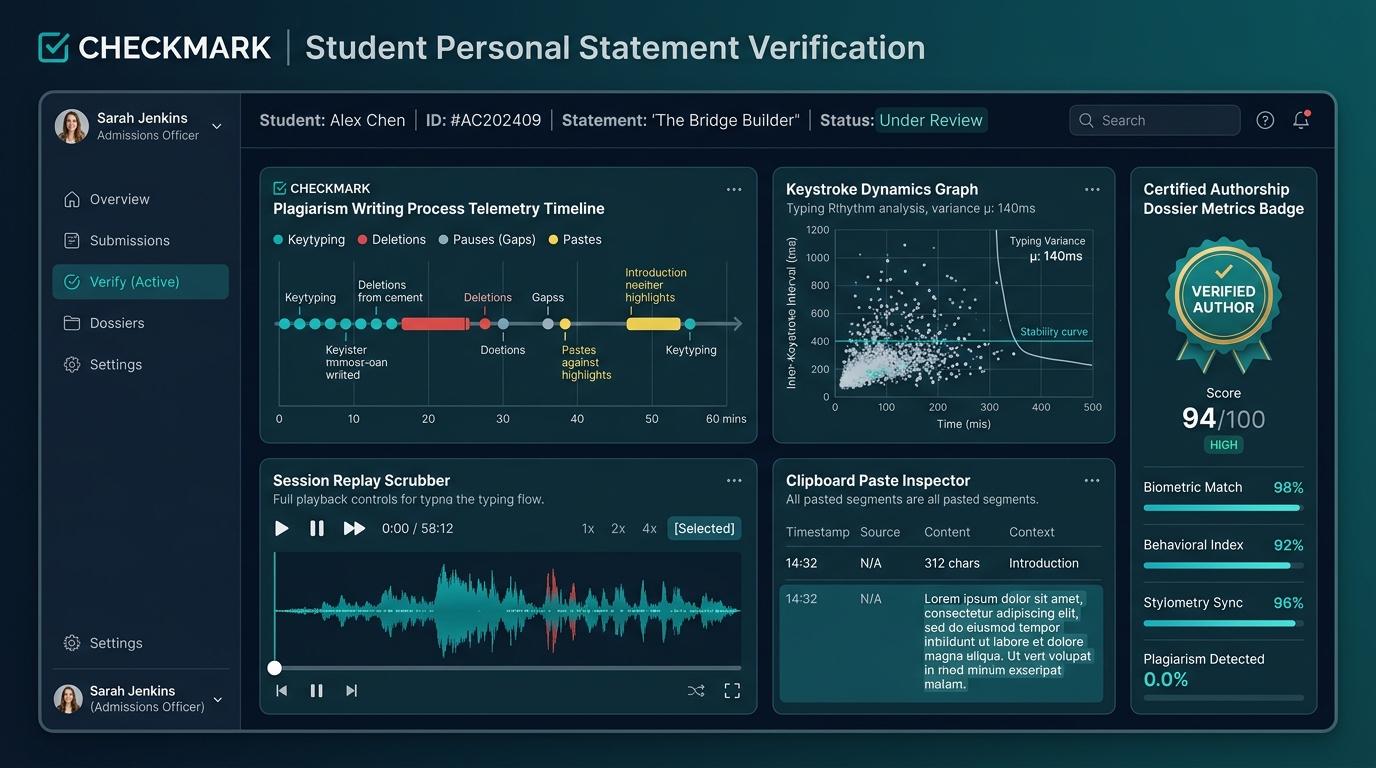
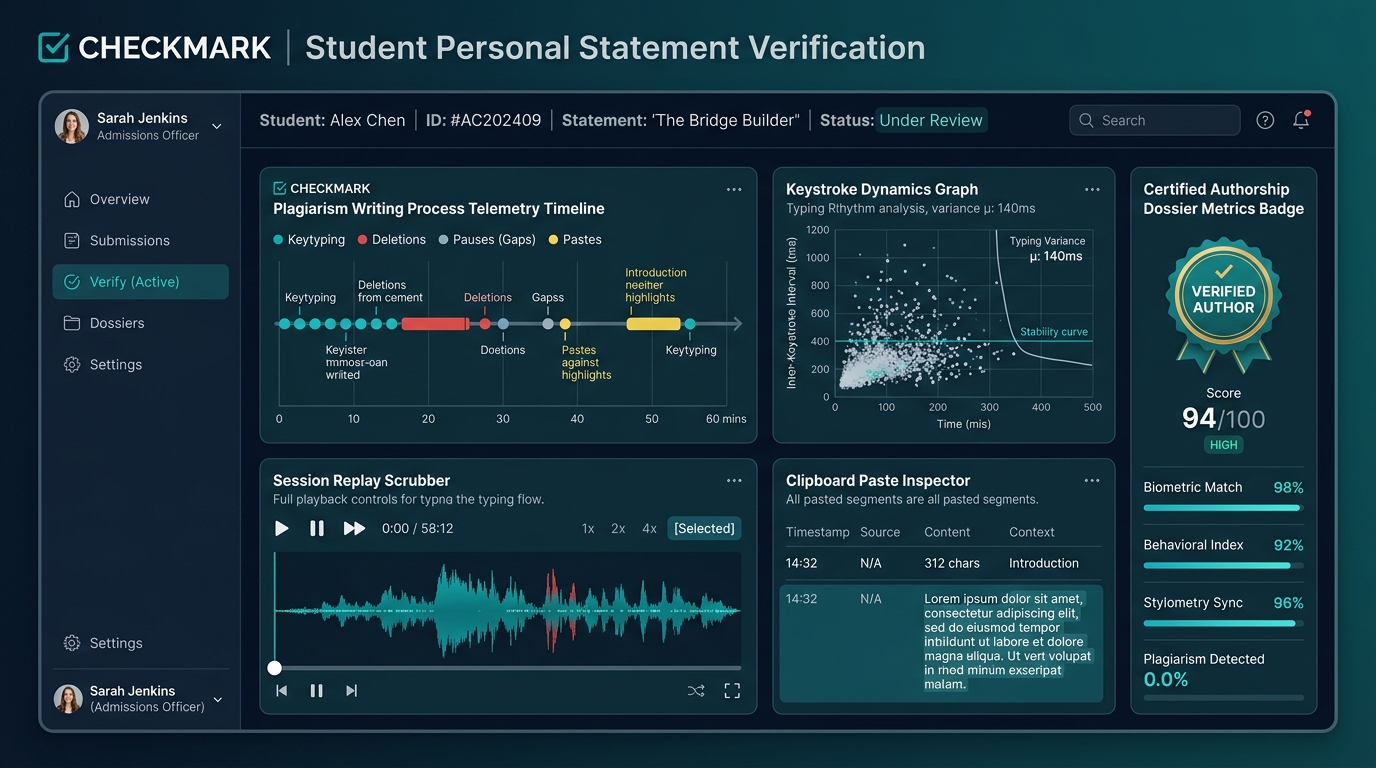
Writing Process Telemetry provides the definitive evidentiary standard. By examining longitudinal multi-session drafting histories, cognitive pause architecture, Inter-Keystroke Interval (IKI) dynamics, and raw clipboard paste buffers through Checkmark Plagiarism’s patent-pending Essay Playback™ (1x–8x scrubbable video replay), college counselors, independent educational consultants (IECs), and admissions deans can definitively verify authentic student voice, protect honest applicants from wrongful accusations, and uphold institutional integrity with transparent, non-punitive evidence.
Checkmark Plagiarism equips college counselors, high school guidance teams, and higher education admissions committees with verifiable writing telemetry across Canvas LMS, Agilix Buzz, and Google Classroom.
1. The High-Stakes Admissions Landscape: The Collapse of Textual Trust
Every application cycle, millions of high school seniors navigate one of the most psychologically intense milestones of their academic lives: authoring the college admissions essay. Whether crafting the 650-word Common Application Personal Statement, responding to Coalition for College prompts, answering institutional supplements (“Why Us?” essays, community reflections, or intellectual vitality prompts), or competing for life-changing national scholarships (such as the Gates, Coca-Cola, or Robertson Scholarships), students are asked to distill their lived experiences, core values, and intellectual potential into short, persuasive narratives.
In an era of hyper-selective admissions—where acceptance rates at leading national universities frequently dip below 5% and standardized testing policies remain in flux—the personal statement serves as the primary qualitative window into an applicant’s character, authentic voice, and capacity for critical self-reflection.
- LLMs generating polished, synthetic narratives in seconds
- AI paraphrasers (QuillBot, Undetectable AI) skewing perplexity
- Homogenization of student voice into sterile reflection formulas
- Boutique consultancies charging premium fees for ghostwritten dossiers
- Aggressive parental rewrites stripping adolescent syntax
- Unregulated online essay mills producing bespoke statements
- Automated whole-document AI detection triage scores
- Documented false-positive bias against non-native English writers
- Zero due process: applicant files discarded with zero recourse
The Spectrum of Application Assistance
In college admissions, the boundary between ethical guidance and academic fraud is frequently misunderstood. High school counselors and independent consultants routinely assist students with brainstorming and high-level structural feedback. However, the emergence of generative AI and aggressive commercial editing has blurred these boundaries:
| Assistance Level | Description & Modality | Ethical Classification | Evidentiary Footprint in Writing Telemetry |
|---|---|---|---|
| Level 1: Authentic Independent Authorship | Student conceives ideas, writes rough drafts, struggles with phrasing, and refines prose across multiple sessions over weeks. | Fully Ethical & Standard | Rich, continuous typing streams; organic pause distributions; high local deletion rates (15%–25%); gradual word-count expansion. |
| Level 2: Authorized Mentor Coaching | Counselors, English teachers, or IECs suggest thematic directions, point out logical gaps, and ask clarifying questions. | Fully Ethical & Encouraged | Student manually implements revisions; telemetry displays deliberate pauses at suggested edit points followed by authentic rewriting. |
| Level 3: Heavy Third-Party Over-Editing | Well-meaning parents, tutors, or editors directly rewrite clauses, inject elevated vocabulary, and restructure paragraphs. | Compromised Voice | Sudden bursts of adult syntactic patterns; sporadic external paste events of multi-clause chunks without corresponding ideation pauses. |
| Level 4: Prompted Generative AI Drafting | Student prompts an LLM with bullet points and copies generated paragraphs directly into the essay document. | Unauthorized Misconduct | Bulk paste events (0.1–0.4s) of finished paragraphs; total absence of keyboard-level drafting, vocabulary searches, or trial phrasing. |
| Level 5: Commercial Ghostwriting | A paid consultant or essay mill authors the essay off-platform, providing the student with a completed file. | Severe Academic Fraud | Instantaneous single-block paste of the entire 650-word statement or rapid, mechanical retyping from a secondary screen. |
When admissions readers evaluate static final submissions (such as a PDF or text paste into the Common App portal), a Level 1 authentic student essay polished through intense effort can look statistically identical to a Level 4 or Level 5 AI-assisted or ghostwritten submission.
2. The False-Positive & Evidentiary Crisis in Admissions
The immediate reaction of many educational institutions and testing agencies has been to deploy automated, black-box AI detection software. These detectors analyze static text for statistical markers—primarily perplexity (a measure of word predictability) and burstiness (the variation in sentence length and structure).
However, relying on standalone AI percentages to evaluate college admissions essays has created an institutional and ethical crisis.
A Stanford study (Liang et al., 2023) found an average false-positive rate above 60% on essays by non-native English writers. Neurodivergent students with systematic syntax may be misclassified as well.
A statistical score is not evidence. It provides no timestamped “receipts,” cannot identify when or how assistance occurred, and cannot distinguish Grammarly from wholesale generation.
Hard to reconcile with the emphasis on transparency in NACAC’s best-practices Guide to Ethical Practice. Opens institutions to appeals and parent challenges because proprietary black boxes cannot be audited or explained.
The Inherent Vulnerabilities of Static Text Classifiers
1. Severe Disparities Against International and ESL/ELL Applicants
A study by Stanford University researchers (Liang et al., 2023) found that seven widely used AI text detectors misclassified human-written TOEFL essays by non-native English speakers as AI-generated, with an average false-positive rate of 61.3%. English Language Learners (ELL) and multilingual international students often utilize a more constrained lexical range and standardized syntactic transitions. Large language models are trained to optimize fluency using similar high-probability word sequences. Consequently, an earnest personal statement written by an international student describing their cultural transition is vastly more likely to be falsely flagged as AI than an essay written by a native English speaker.
2. Possible False Flags on Neurodivergent and High-Structure Writers
Some students on the autism spectrum (ASD), some students with ADHD, and many highly analytical writers employ consistent, structured sentence architectures and precise vocabulary. If their natural prose exhibits lower sentence-length variance (lower burstiness), static AI detectors may misinterpret their authentic voice as machine output. The Stanford study above tested non-native English writers, not neurodivergent writers, but the same statistical mechanism makes this a real concern. Punishing neurodivergent students for their authentic communication style would raise serious equity and accessibility problems.
3. Inability to Withstand Legal and Institutional Due Process
The National Association for College Admission Counseling (NACAC) Guide to Ethical Practice in College Admission is the field’s best-practices document for principled conduct, and its recent revisions call for greater transparency about the information colleges may consider. If a university denies admission, rescinds an acceptance, or revokes a merit scholarship based solely on an unverified 85% AI score, the institution possesses zero defensible evidence. A probability score cannot prove when, where, or how misconduct occurred. When parents or legal counsel demand proof, admissions deans who rely on static detectors find themselves defenseless.
4. Vulnerability to AI Paraphrasers and “Humanizers”
While static detectors falsely flag honest students, they are easily bypassed by bad actors. Commercial AI “humanizers” (such as Undetectable AI or HideMyAI) deliberately inject subtle grammatical inconsistencies and irregular vocabulary into LLM-generated text to skew perplexity scores downward. As a result, static detectors create the worst possible outcome: they exonerate sophisticated cheaters while penalizing earnest, hardworking students.
3. The Four Pillars of Authentic Personal Statement Telemetry
To establish indisputable proof of authorship, college counselors, independent educational consultants, and university admissions officers must move beyond static text analysis and evaluate Writing Process Telemetry.
Writing telemetry records the granular, temporal biomechanics of the writing process as it unfolds. Just as a pilot’s flight data recorder captures altitude, speed, and control inputs throughout a flight, writing telemetry captures keystrokes, cognitive pauses, revision bursts, and clipboard interactions across every drafting session.
Timestamped logging proving composition distributed over weeks across 3–7 distinct drafting milestones.
- Active typing vs. passive browser idle time
- Multi-week session dispersion timestamps
- Natural word-count expansion & compression curve
Hierarchical hesitation logging revealing authentic human reflection, lexical search, and syntactic restructuring.
- Micro-pauses (100–500ms) vs. lexical pauses (500–2,000ms)
- Conceptual reflection pauses (2,000–15,000ms+)
- Revision bursts and non-linear paragraph editing
Biomechanical millisecond intervals between keystrokes proving organic human cadence vs. mechanical transcription.
- Log-normal IKI velocity curves (120ms–850ms)
- Backspace & deletion ratio analysis (12%–25%)
- Immunity to second-screen and phone transcription
Immutable capture of every external clipboard insertion with millisecond timestamps and original text preservation.
- 100% preservation of raw pasted strings
- Micro-pastes (quotes) vs. macro-pastes (dumping)
- Instant jump-to-playback video navigation
Pillar 1: Longitudinal Multi-Session Drafting Histories
Authentic personal statements are not written in a single 45-minute sitting. The process of personal narrative development requires iterative reflection, structural experimentation, and multiple revision passes over days, weeks, or months.
Writing telemetry captures:
- Total Active Drafting Time: Distinguishing between passive time (document left open in a browser tab) and active typing/editing duration.
- Session Dispersion: Timestamped logging showing sessions distributed across multiple calendar dates, proving iterative development.
- Dynamic Word-Count Trajectory: Tracking the natural expansion (overwriting during initial drafting) and compression (trimming to meet the 650-word Common App ceiling) characteristic of genuine essay composition.
Pillar 2: Cognitive Pause Architecture & Revision Bursts
Research on cognitive models of the writing process (Flower & Hayes, 1981; Alamargot & Chanquoy, 2001) treats composing as an effortful cognitive activity, which is why human drafting is marked by pauses and revision. Pauses can be grouped by length; the bands below are illustrative working categories used in this article, not thresholds reported in those works:
- Micro-Pauses (100ms – 500ms): Natural motor transitions between keypresses within familiar words.
- Lexical Pauses (500ms – 2,000ms): Word-retrieval hesitations occurring before complex adjectives, metaphors, or specific vocabulary.
- Syntactic & Conceptual Pauses (2,000ms – 15,000ms+): Extended hesitations occurring at clause and paragraph boundaries where the writer plans narrative structure, evaluates emotional resonance, or reflects on a memory.
In authentic student drafting, cognitive pauses are inextricably linked to revision bursts—sequences where a student stops typing, deletes a phrase, retypes an alternative, pauses again, and refines the cadence. Conversely, when an applicant transcribes an AI-generated essay from a secondary screen, conceptual pauses disappear, replaced by uniform, mechanical keypresses.
Pillar 3: Inter-Keystroke Interval (IKI) Dynamics & Typing Biometrics
Inter-Keystroke Interval (IKI) measures the exact time in milliseconds elapsed between consecutive keystrokes. Human typing biometrics exhibit natural rhythm variations governed by hand anatomy, letter pairings (digraphs), and cognitive processing load.
- Velocity: Highly Variable (120ms to 850ms IKI)
- Distribution: Bimodal / Right-skewed with long hesitation tails
- Key Activity: High Backspace Ratio (12%–22% revision rate)
- Cadence: Bursts of speed followed by reflective pauses
- Velocity: Constant, Unnatural Rhythm (140ms to 210ms IKI)
- Distribution: Narrow Gaussian / Unimodal flat curve
- Key Activity: Near-Zero Backspace Ratio (<1.5% deletions)
- Cadence: Relentless linear entry from phone/second screen
When students attempt to defeat paste-detection algorithms by manually retyping text generated by an LLM or provided by a ghostwriter, their IKI profile reveals the deception:
- Zero Ideation Pauses: The student does not pause to choose vocabulary; they are simply reading and typing.
- Negligible Deletion Rate: Because the text is already pre-composed and grammatically perfect, the backspace key is almost never touched.
- Robotic Cadence: Keystroke velocities remain flat across complex clauses, compound sentences, and narrative climaxes.
Pillar 4: Raw Clipboard / External Paste Provenance Tracking
The most definitive evidence of contract cheating or unassisted AI generation is found in clipboard telemetry.
Checkmark Plagiarism’s telemetry engine captures an immutable audit trail of every paste event:
- Timestamped Insertion Speed: Capturing the exact duration of the paste (e.g., 650 words inserted in 0.24 seconds).
- Raw Clipboard Text Preservation: The system records the complete, unaltered text that entered the document via the clipboard—even if the student subsequently edits, rewrites, or deletes every individual word.
- Contextual Categorization: Distinguishing between legitimate micro-pastes (e.g., pasting a 15-word quote from an old journal entry, a scientific term, or a previously saved outline bullet) versus monolithic macro-pastes (e.g., inserting a complete 500-word essay body from an external application).
4. The Admissions Evidentiary Matrix
To understand how writing process telemetry transforms admissions evaluation, consider how different assessment methods compare across key evidentiary, ethical, and operational criteria:
| Evaluation Dimension | Static PDF / Text Box | Standalone AI Detector Score | Checkmark Writing Telemetry & Playback™ |
|---|---|---|---|
| Primary Data Source | Final frozen text characters. | Statistical token predictability (perplexity/burstiness). | Full temporal keystroke stream, IKI dynamics, pause logs, & paste buffers. |
| Evidentiary Strength | Zero proof of authorship. | Unreliable (Probabilistic guess). | Definitive (“Receipts”). Immutable forensic audit trail. |
| False-Positive Risk | N/A (Subjective guessing). | Severe (61.3% average false-positive rate on non-native English essays in one Stanford study). | Virtually Zero. Authentic biomechanics cannot be faked. |
| AI “Humanizer” Immunity | Zero immunity. | Zero (Easily tricked by syntax scramblers). | 100% Immune. Paraphrasers cannot fake historical typing logs. |
| Paste Provenance Tracking | None. Pastes look identical to typed text. | None. Ignores clipboard origins. | Complete. Captures raw text, timestamp, and word count. |
| Visual Session Replay | None. | None. Static percentage badge only. | Patent-Pending Essay Playback™ (1x–8x scrubbable video). |
| Counselor Defense Utility | Cannot defend against allegations. | Causes panic; leaves counselor without facts. | Generates Certified Authorship Dossier to exonerate student. |
5. Step-by-Step Counselor & Admissions Audit Protocol
To institutionalize fair, non-punitive, and scientifically defensible verification, high school college counseling departments, IECs, and university admissions offices should implement the following four-phase protocol:
Establish monitored drafting workspaces early; conduct formative check-ins at 25%, 50%, and 75% milestones; track organic brainstorming notes and revision arcs.
Inspect Essay Playback™ timeline for continuous drafting and natural pause curves; audit clipboard log for legitimate micro-pastes; generate Certified Authorship Dossier.
Frame inquiries around authentic voice preservation; review Essay Playback™ collaboratively with the student to explore over-edited sections; restore genuine student prose.
When an admissions reader encounters an automated filter flag, counselor transmits Certified Authorship Dossier directly to Admissions Dean to confirm authentic candidacy.
SHA256:8942019-mv-auth-dossier
View-Only Link Embedded
6. Checkmark Plagiarism: The Comprehensive Platform for Admissions Integrity
Checkmark Plagiarism is engineered specifically to eliminate black-box guesswork and provide educators with transparent, multi-dimensional evidence.
Patent-Pending Essay Playback™
Reconstructs the entire composition history of a personal statement as a scrubbable, high-definition video timeline (1x to 8x speed). Counselors and admissions deans can watch the student type, hesitate, backspace, and reorganize thoughts in real time.
External Paste Buffer Inspector
Logs raw clipboard text, exact timestamps, and insertion DOM nodes down to the millisecond. Preserves original clipboard content even if subsequent rewriting alters every word, with a “Jump to Playback” sync button.
Passage-Level AI Confidence Sliders
Replaces opaque whole-paper percentages with sentence-by-sentence perplexity and burstiness cards. Features strict short-text guardrails (<150 words automatically displays N/A) to prevent false flags on brief supplement responses.
Zero Model Training & FERPA Privacy
Guarantees zero data retention for AI model training. Highly personal student narratives (disclosures of hardship, identity, or health) are never fed into public LLMs, ensuring 100% compliance with FERPA and COPPA standards.
7. Illustrative Case Studies & Admissions Scenarios
The following scenarios illustrate how writing process telemetry resolves complex authenticity challenges in high-stakes admissions environments. The applicants and figures below are examples, not published records:
Context & Flag: A Korean applicant submitted a personal statement on community volunteering. The university’s automated admissions triage scanner flagged the essay as “91% AI Generated” due to formal syntax and consistent sentence structures.
Telemetry Resolution: The counselor pulled the Checkmark Essay Playback™, which revealed 8 distinct drafting sessions over 3 weeks (11.4 active hours), 1,840 local deletions, and natural 4,000ms vocabulary search pauses before complex idioms. The Admissions Dean dismissed the automated flag and confirmed the student’s acceptance.
Context & Flag: A high school senior’s Common App essay suddenly shifted in tone between Draft 2 and Draft 3. The counselor noticed elevated corporate vocabulary and adult syntactic patterns.
Telemetry Resolution: The Paste Inspector revealed three separate paste events (totaling 280 words) occurring within 4 minutes on a Sunday evening from an external Word document. During a non-adversarial playback conference, the student admitted a parent hired a commercial editor. The counselor guided the student to revert to Draft 2, recovering the authentic adolescent voice before submission.
Context & Flag: An applicant submitted a supplemental essay for a competitive $50,000 STEM scholarship. A standard static AI detector reported “0% AI” because the student used Undetectable AI to randomize perplexity.
Telemetry Resolution: Checkmark Telemetry revealed the entire 500-word essay was entered in a single 0.3-second paste event with zero prior drafting time, zero keyboard keystrokes, and zero cognitive pauses. When asked for preliminary drafting artifacts, the applicant could not produce notes; the scholarship was awarded to an authentic alternate.
8. Comprehensive FAQ for Counselors, Deans, and IECs
1. How does writing process telemetry differ from Google Docs Version History?
While standard Google Docs Version History periodically saves batched “snapshots” (often grouping hundreds of edits together into 10- or 15-minute intervals), it cannot capture real-time typing dynamics. Google Docs snapshots do not record Inter-Keystroke Intervals (IKI), cognitive pause durations, millisecond-level paste durations, or raw clipboard content prior to editing. Checkmark’s patent-pending Essay Playback™ captures the continuous, granular keystroke stream, allowing educators to scrub through every individual keypress, deletion, and pause with millisecond precision.
2. How should college counselors handle parents who insist on heavily editing their child’s essay?
Counselors should use Checkmark’s telemetry and Essay Playback™ as an objective educational coaching tool. Show parents how aggressive line-by-line rewrites create glaring anomalies in writing telemetry (such as abrupt paste bursts and inconsistent IKI dynamics) that trigger admissions scrutiny. Furthermore, explain that admissions deans are trained to detect over-packaged, adult prose. Demonstrating that the student’s authentic, unvarnished voice in early playback drafts is more compelling and emotionally resonant than sanitized prose helps parents step back ethically.
3. What happens if a student legitimately drafts their personal statement in an offline notes app or notebook before typing it into the official document?
When students compose offline and type their draft into the official workspace, their telemetry displays an authentic transcription profile (steady typing, but with occasional typos, manual line breaks, and formatting pauses) rather than an instantaneous 0.2-second paste. To verify complete authenticity, the counselor simply asks the student to present their preliminary offline artifacts—handwritten notebook pages, voice memos, or dated digital notes files. Checkmark allows counselors to attach these supporting artifacts directly to the Certified Authorship Dossier.
4. Does tracking writing telemetry violate student data privacy laws like FERPA or COPPA?
No. Checkmark Plagiarism is engineered from the ground up to comply with FERPA, COPPA, and international data protection standards. Unlike commercial AI detection tools that store student essays in public repositories or use student writing to train large language models, Checkmark operates on a strict Zero Model Training Architecture. All telemetry data is encrypted at rest and in transit, belongs exclusively to the educational institution or student, and is never monetized or shared with third parties.
5. How do writing telemetry tools protect neurodivergent students who compose non-linearly?
Neurodivergent students (such as those with ADHD or dyslexia) often write in unconventional ways—brainstorming concluding thoughts first, jumping erratically between paragraphs, or deleting large blocks of text during sudden bursts of hyperfocus. Generic AI detectors may misread these students’ final syntax as rigid or idiosyncratic. Checkmark’s Essay Playback™ protects neurodivergent applicants by visually demonstrating the immense human effort, organic trial-and-error, and non-linear cognitive restructuring that produced the final essay.
6. Can a student fake authentic typing telemetry by using an automated keystroke bot or macro?
No. Software macros and automated typing scripts output keypresses with uniform, mathematical spacing (e.g., exactly 120ms between every keystroke). Human typing biomechanics are inherently variable, exhibiting subtle micro-variations across digraphs, finger reaches, and cognitive pauses. Checkmark’s telemetry engine analyzes the statistical distribution of Inter-Keystroke Intervals; artificial, macro-generated typing displays an unnaturally flat variance that is immediately flagged as synthetic entry.
7. If an admissions office receives a Certified Authorship Dossier, how quickly can a reader review it?
Checkmark’s Certified Authorship Dossiers are designed for rapid, high-level evaluation. An admissions reader or committee chair can review the summary telemetry metrics (session count, total active drafting hours, deletion ratio, and paste audit) in less than 30 seconds. If deeper verification is required, the reader can open the embedded Essay Playback™ link and scrub through the entire composition history at 8x speed in under two minutes, providing instant, unassailable confidence without slowing down the admissions cycle.
9. Conclusion: Moving from Suspicion to Verifiable Trust
The college personal statement remains one of the most powerful opportunities for young people to articulate their identity, resilience, and vision for the future. Allowing automated, probabilistic AI detectors to undermine this milestone with false accusations is an institutional failure that damages students and degrades trust in the admissions process.
By embracing Writing Process Telemetry, Keystroke Forensics, and Essay Playback™, secondary schools, independent consultants, and higher education admissions deans can replace opaque percentages and adversarial confrontation with transparent, objective evidence.
When educators have access to the full, verifiable drafting story, they no longer have to guess what happened behind the screen. They can stand firmly behind their students, celebrate authentic personal voice, and ensure that college admissions remains a fair, equitable, and inspiring journey for every applicant.
Protect Student Voice with Verifiable Admissions Telemetry
Equip your college counseling department, IEC practice, or admissions committee with patent-pending Essay Playback™, granular paste tracking, and Certified Authorship Dossiers.