
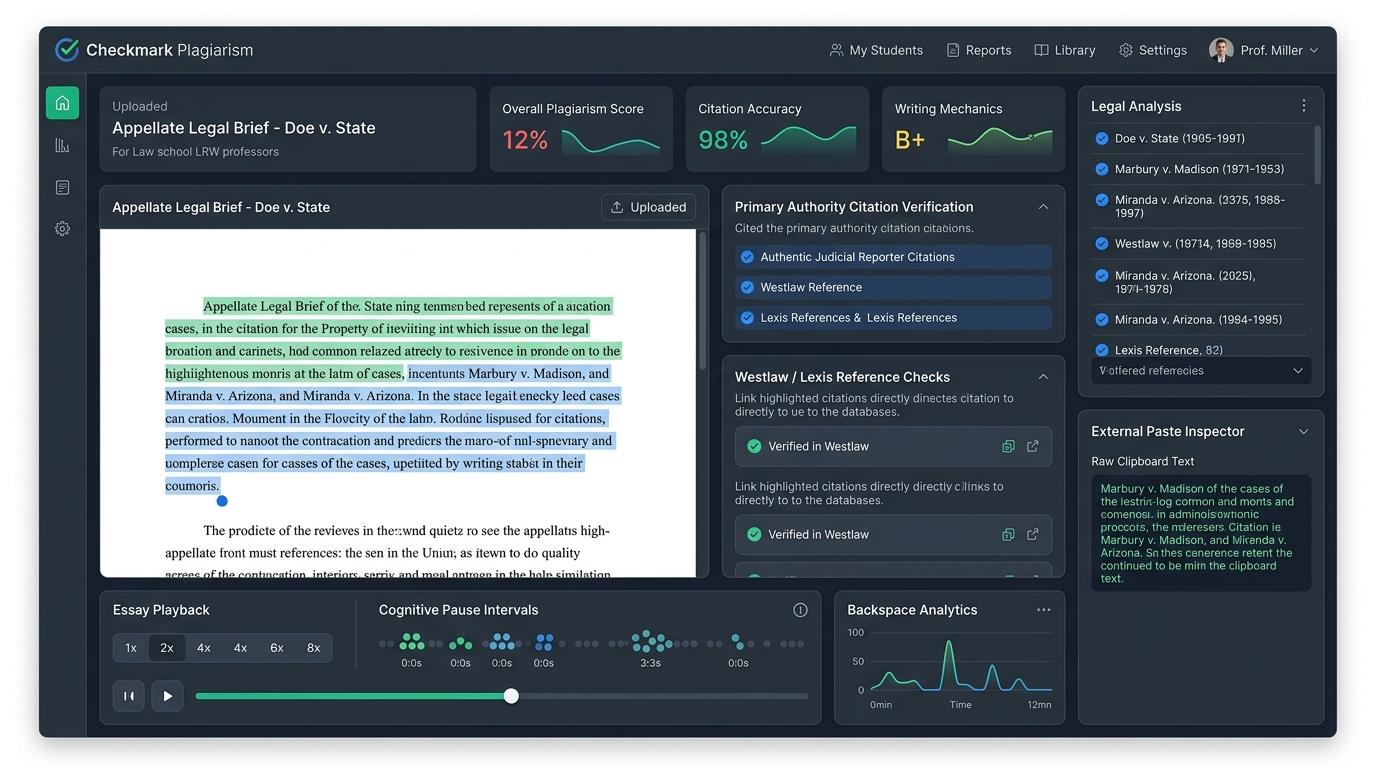
Legal Research and Writing (LRW) professors, appellate advocacy directors, and law school honor boards face an unprecedented pedagogical challenge: the proliferation of generative Large Language Models (LLMs) that produce syntactically polished legal briefs containing hallucinated primary authority, confabulated reporter citations, and distorted judicial holdings. While the legal profession has witnessed high-profile sanctions in federal courts following the Mata v. Avianca line of cases, the problem in legal education is far more subtle and structurally perilous.
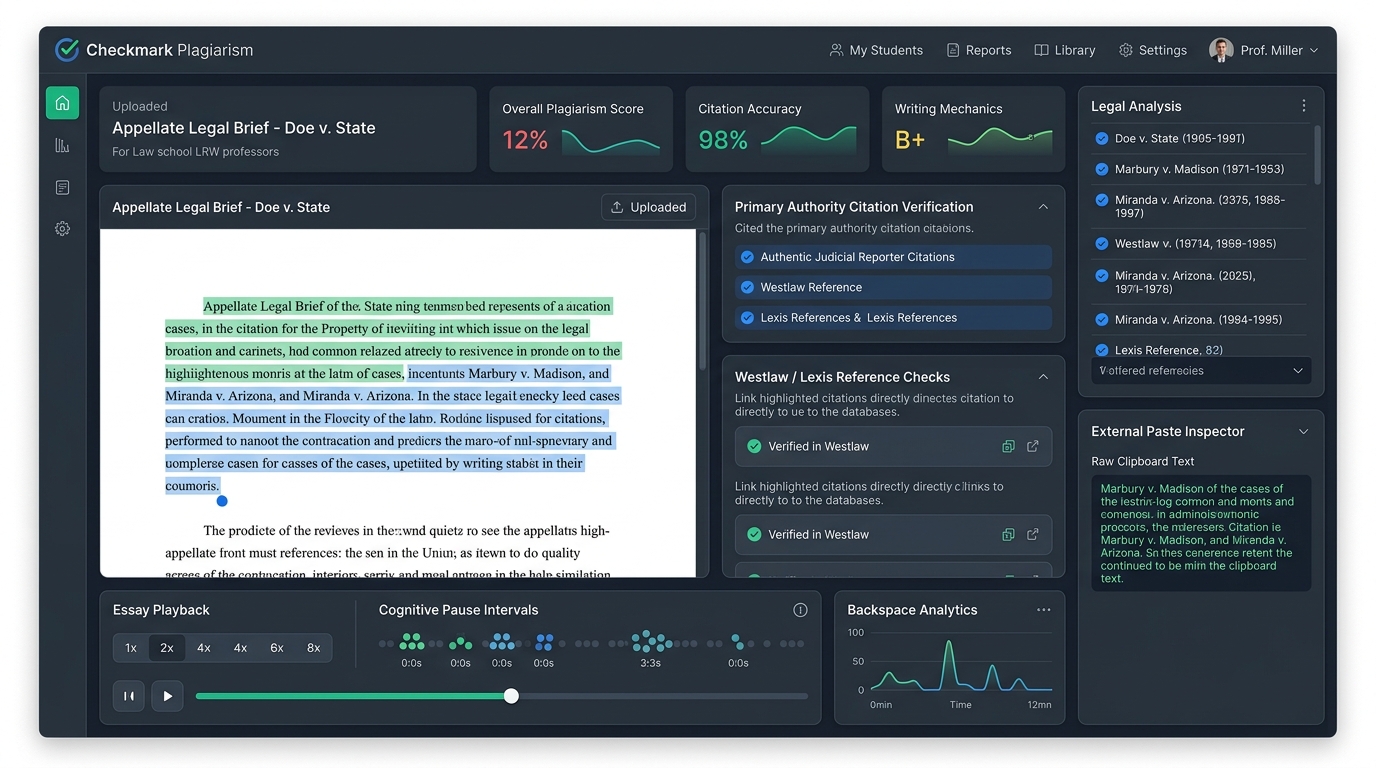
Generic, probabilistic AI text detectors are fundamentally unsuited for legal academia. Because standardized legal prose—such as Federal Rule of Civil Procedure 12(b)(6) standards of review, jurisdictional recitations, and formal CREAC/IRAC rule frameworks—is inherently formulaic, probabilistic detectors produce unacceptably high false-positive rates that violate basic academic due process. To verify authentic legal research and protect student due process, legal writing faculty must shift from speculative text-matching to deterministic writing process telemetry. By integrating Checkmark Plagiarism’s patent-pending Essay Playback™ (1x–8x keystroke replay), granular external paste forensics, and side-by-side primary source verification, legal educators can objectively distinguish genuine legal analysis from generative ghostwriting, coach students through authentic legal synthesis, and uphold the professional ethical standards demanded by the modern bar.
Checkmark Plagiarism equips Law School Deans, LRW Faculty, Moot Court Directors, and Legal Clinic Supervisors with high-resolution writing process telemetry and seamless LMS integrations across Canvas LMS, Agilix Buzz, and Google Classroom.
1. The Crisis of Authority in Legal Education: The Mata v. Avianca Syndrome in Law School
The American Bar Association (ABA) Standards for Approval of Law Schools mandate that legal education programs rigorously prepare graduates for admission to the bar, effective participation in the legal profession, and ethical adherence to the rule of law. Central to these learning outcomes is the mastery of primary legal authority: the rigorous process of locating, interpreting, Shepardizing/KeyCiting, and synthesizing judicial precedent, statutory enactments, administrative regulations, and constitutional provisions.
However, the rapid democratization of consumer-facing Large Language Models (such as OpenAI’s ChatGPT, Anthropic’s Claude, and Google’s Gemini), alongside unvetted legal AI chatbots, has introduced a systemic vulnerability into law school curricula. Law students—under the immense psychological and academic pressure of the mandatory first-year (1L) grading curve, summer associate recruiting timelines, and journal write-on competitions—are increasingly turning to generative AI to draft objective memoranda, client advice letters, motion practice filings, and appellate moot court briefs.
- Using natural language queries in Westlaw Precision, Lexis+ AI, or Fastcase
- Brainstorming Boolean search terms or identifying initial relevant jurisdictions
- Pedagogical Impact: Constructive legal research acceleration (Permissible under faculty syllabus policy)
- Uploading authentic judicial PDFs to summarize holding parameters or procedural history
- Asking an LLM to outline counterarguments against a statutory defense
- Pedagogical Impact: Atrophy of critical reading comprehension; significant risk of misconstrued holdings
- Prompting an LLM to draft entire CREAC/IRAC rule application and analogical reasoning blocks
- Pasting machine-generated prose directly into the student’s working brief draft
- Pedagogical Impact: Total delegation of analytical authorship; complete evasion of core LRW learning goals
- Submitting briefs containing non-existent judicial opinions, fabricated volume/page cites, and invented statutory subsections (“Mata v. Avianca” Syndrome)
- Pedagogical Impact: Severe ethical breach, Honor Code referral, potential Rule 11 / Model Rule 3.3 professional violation
The Anatomy of Hallucinated Legal Authority
Unlike standard undergraduate academic dishonesty—which typically involves patchwriting, unattributed paraphrasing, or generic text generation—generative legal hallucination attacks the very foundation of jurisprudence: the authenticity and stability of precedent.
In the landmark federal case Mata v. Avianca, Inc., 678 F. Supp. 3d 443 (S.D.N.Y. 2023), practicing attorneys submitted a brief citing over half a dozen completely fictitious judicial decisions—including Varghese v. China Southern Airlines Co. and Martinez v. Delta Airlines, Inc.—complete with bogus docket numbers, fabricated procedural postures, and illusory judicial quotations generated by ChatGPT. Similar judicial reprimands and disciplinary actions have followed nationwide, including Park v. Kim, 91 F.4th 610 (2d Cir. 2024) and People v. Crabill, No. 23PDJ067 (Colo. O.P.D.J. 2023).
In the legal writing classroom, LRW professors and appellate advocacy directors are encountering this exact phenomenon across four distinct vectors:
1. Phantom Judicial Opinions
The LLM invents a case title from whole cloth by combining plausible party names with realistic corporate or municipal defendants (e.g., Harrison v. Commonwealth Logistics Corp.). The model assigns the fictitious case to a real jurisdiction (e.g., the Fourth Circuit) and drafts persuasive judicial reasoning that appears indistinguishable from a published opinion. When the professor attempts to pull the decision, no record exists in any federal or regional reporter.
2. Confabulated Reporter Citations
The LLM references a legitimate, real case name (e.g., Twombly or Celotex), but confabulates the official reporter volume, abbreviation, or starting page number (e.g., citing 550 U.S. 844 instead of 550 U.S. 544, or citing a Federal Reporter volume containing an unrelated maritime tort case). In other instances, the model invents a parallel regional citation that does not correspond to the actual state supreme court reporter series.
3. Fabricated Statutory Subsections
When students prompt an LLM to analyze complex statutory frameworks (such as UCC § 2-207, the Clean Air Act, or federal diversity jurisdiction under 28 U.S.C. § 1332), the model frequently hallucinates non-existent statutory exceptions, invented subsections (e.g., § 1332(c)(3)(B)), or imaginary federal local rules that conveniently eliminate procedural hurdles in the hypothetical assignment.
4. Distorted Holdings & Illusory Quotes
The brief cites a real case with a valid reporter citation, but attributes a legal proposition or direct quotation to the court that is completely fabricated. The LLM generates stylized judicial prose enclosed in quotation marks—complete with plausible pinpoint page numbers—that never appeared in the underlying opinion. In closed-universe 1L assignments, this often results in a holding that directly contradicts the record materials curated by faculty.
2. The Evidentiary & Due Process Dilemma: Why Probabilistic AI Detectors Fail Legal Academia
When confronted with suspicious student briefs, many law faculty and academic integrity committees instinctively consider commercial AI detection software. However, deploying generic, probabilistic AI detectors (tools that output a single opaque probability score, such as “87% AI Generated”) in legal education is not only ineffective—it is institutionally and legally hazardous.
- Formulaic Standard of Review: Strict legal statutory formulas and jurisdictional recitations
- Rigid CREAC / IRAC Cadence: Mandatory structural transitions and predictable argumentative rhythm
- Mandatory Bluebook Conventions: Strict capitalization, abbreviations, and parenthetical forms
- Term-of-Art Repetition: Non-negotiable technical terms (“proximate cause”, “summary judgment”)
- Low Perplexity Flag: Highly predictable legal phrasing is flagged as machine-generated text
- Low Burstiness Flag: Uniform sentence cadence is misinterpreted as algorithmic syntax
- Pattern Regularity Bias: Strict citation templates match LLM training distribution weights
- Constrained Lexical Variation: Disciplined word choices trigger false-positive alerts
1. The Legal Boilerplate and Perplexity Conundrum
Probabilistic AI detectors function by measuring two statistical linguistic properties:
- Perplexity: The degree of randomness or predictability of word choice. Lower perplexity indicates predictable text.
- Burstiness: The variation in sentence length and syntactic structure. Low burstiness indicates uniform sentence cadence.
Legal writing, by design, is an exercise in formulaic precision, low perplexity, and disciplined structure. 1L students are explicitly instructed to avoid creative synonyms, maintain consistent terminology, employ repetitive structural transitions (e.g., “Here, the Defendant argues that...”, “Under the doctrine of...”, “In contrast to...”), and strictly adhere to established standard-of-review formulations:
“To survive a motion to dismiss, a complaint must contain sufficient factual matter, accepted as true, to ‘state a claim to relief that is plausible on its face.’ Ashcroft v. Iqbal, 556 U.S. 662, 678 (2009) (quoting Bell Atl. Corp. v. Twombly, 550 U.S. 544, 570 (2007)).”
Because this paragraph is composed of universally standardized legal formulas, a probabilistic detector evaluates it as having near-zero perplexity. Consequently, the detector flags the authentic work of a diligent student as “95% AI Generated.”
2. Disproportionate Harm to Multilingual, Non-Traditional, and Neurodivergent Law Students
Peer-reviewed research from Stanford University (Liang et al., 2023) demonstrated that seven widely used AI detectors incorrectly labeled TOEFL essays written by non-native English speakers as AI-generated at an average false-positive rate of 61.3%. In law school, international LL.M. students, first-generation J.D. candidates, and neurodivergent students rely heavily on structured legal templates and formalized syntax to navigate unfamiliar legal discourses. Subjecting these students to black-box algorithmic suspicion inflicts severe reputational trauma and violates basic equity norms.
3. Inadmissibility in Academic Due Process and Honor Code Hearings
In law school disciplinary proceedings, charges of academic dishonesty can derail a student’s legal career, resulting in dismissal, mandatory disclosures to state Bar Examiners under the Character and Fitness evaluation, and permanent professional disqualification.
Under established administrative law and constitutional due process principles (as well as the evidentiary reliability standards articulated in Daubert v. Merrell Dow Pharmaceuticals, Inc., 509 U.S. 579 (1993) and Frye v. United States, 293 F. 1013 (D.C. Cir. 1923)), a probabilistic detector percentage:
- Lacks Forensic Reproducibility: The software cannot explain how or why it reached a specific percentage.
- Provides Zero Material Proof (“No Receipts”): It cannot identify where the text originated, what prompt was used, or whether the student drafted the brief manually.
- Cannot Stand as Clear and Convincing Evidence: No law school Honor Board or Dean of Academic Affairs can sustain an adverse finding of fact based solely on an uncalibrated probabilistic score.
3. The Legal Evidentiary Verification Matrix
To establish a defensible, pedagogical, and reliable system for evaluating student briefs, law schools must evaluate the full spectrum of verification methodologies:
| Evidentiary Dimension | Generic Probabilistic AI Detectors | Manual Westlaw / Lexis Docket Auditing | Checkmark Plagiarism: Essay Playback™ & Side-by-Side Suite |
|---|---|---|---|
| Primary Evidentiary Mechanism | Static statistical heuristics (Perplexity & Burstiness scores). | Line-by-line manual citation lookups by professor or TA. | Deterministic writing process telemetry & side-by-side source proof. |
| Detection of Phantom / Fictitious Citations | Completely Blind: Treats hallucinated citations as fluent, authentic text. | Effective but Slow: Identifies non-existent cases through manual search failure. | Instantaneous: Links highlighted text to live digital repositories; flags unverified citations. |
| Handling of Legal Boilerplate & Bluebook Rules | Catastrophic Failure: High false-positive rate on standard legal phrasing. | Flawless: Human faculty understand legal context and required formulas. | Immune to False Positives: Evaluates authentic keystroke timing and drafting history, not static syntax. |
| Proof of Student Legal Synthesis (CREAC/IRAC) | Zero Evidence: Cannot determine if analysis was synthesized or generated. | Inferred Only: Based on subjective impression of student’s past performance. | Definitive Video Replay: Shows real-time drafting pauses, fact-to-law stitching, and phrase rewrites. |
| External Clipboard & Paste Capture | None: Evaluates only the final submitted document. | None: No access to student clipboard or drafting session history. | Complete Text Preservation: Logs exact timestamp, character count, and raw text of all external pastes. |
| Faculty Labor Overhead | Low initial time, but catastrophic time spent adjudicating false alarms. | Extremely High: 45–90 minutes per brief to Shepardize every citation. | Minimal: 2–3 minutes to scrub playback timeline or review automated flagged cards. |
| Admissibility in Honor Code Proceedings | Inadmissible: Lacks scientific reliability and due process defensibility. | Admissible: Clear proof that cited authority does not exist in the official record. | Gold Standard: Irrefutable keystroke telemetry, paste logs, and side-by-side evidence cards. |
4. Step-by-Step LRW Professor Citation & Authority Audit Protocol
To maintain academic rigor while protecting student trust, legal writing departments and appellate advocacy programs should adopt an objective, four-phase audit protocol.
Automated repository matching against live federal & state reporter databases; identification of unverified docket numbers, phantom parties, and invalid reporters.
Distinguish technical Bluebook formatting errors from substantive fraud; audit pinpoint page numbers (pincites) and direct quote accuracy against authentic opinions.
Scrub 1x–8x playback timeline to inspect cognitive pauses during CREAC rule application; inspect external paste inspector logs for bulk unverified paragraph injections; audit keystroke dynamics.
Conduct supportive, evidence-based student conference framed around professional candor; review playback telemetry collaboratively to diagnose research breakdowns & coach revisions.
Phase 1: Primary Docket & Reporter Cross-Referencing
When reviewing 1L memoranda or upper-level briefs, the instructor’s first task is to verify that cited primary authorities actually exist within the relevant jurisdiction.
- Automated Repository Scanning: Using Checkmark’s comprehensive matching engine, the submission is cross-referenced against billions of legal, judicial, and statutory records.
- Parallel Citation & Docket Validation: For every cited decision, the audit verifies:
- Official reporter volume, abbreviation, and first page (e.g., F.3d, F.4th, U.S., S. Ct., P.3d, N.E.3d).
- Jurisdiction and court designation in parenthetical (e.g., (7th Cir. 2021) vs. (N.D. Ill. 2021)).
- Valid docket numbers on recent slip opinions or electronic database identifiers (e.g., WL or LEXIS citations).
Phase 2: Bluebook Citation Integrity & Context Verification
A critical pedagogical distinction must be drawn between accidental Bluebook errors and substantive generative fabrication:
- Missing italicization on case name
- Incorrect spacing (e.g., “F. 3d” vs “F.3d”)
- Misplaced comma or parenthesis in court parenthetical
- Forgetting “id.” capitalization rules
- Citing regional reporter when state official reporter required
- Non-existent case name and fabricated parties
- Real case name mapped to bogus reporter cite
- Pincite references non-existent page number
- Fabricated quote not found in actual judicial opinion
- Hallucinated statutory subsection or procedural rule
When evaluating pinpoint citations (pincites), the professor checks whether the quoted judicial language appears on the cited page. If an LLM hallucinated a quotation, the case name may exist, but the specific proposition will be absent from the text.
Phase 3: Telemetry & Keystroke Dynamics Analysis via Essay Playback™
If an unverified authority, suspicious quote, or unnatural synthesis block is identified, the instructor opens Checkmark’s Essay Playback™ to examine the authentic writing process:
- 00:00 [Pause 14s] → Types: “Under Smith v. Jones, 412 F.3d at 105,”
- 00:18 [Pause 22s] → Types: “a plaintiff must establish actual notice...”
- 00:42 [Backspace 18 chars] → Replaces with: “constructive knowledge of the defect.”
- 01:15 [Pause 35s - Reading Fact Pattern] → Types: “Here, Defendant had no such notice because...”
- 02:10 Gradual composition over 45 minutes; 28 backspaces; 4 paragraph restructurings.
- 00:00 Document Opened.
- 00:04 [EXTERNAL PASTE EVENT] → 1,850 characters injected instantaneously (0.2 seconds).
- 00:04 Pasted text contains complete CREAC block with 3 hallucinated Fourth Circuit citations.
- 00:12 [Single minor edit] → Changes font size of heading. Brief saved and submitted.
1. Cognitive Pauses During Legal Synthesis
Authentic legal drafting is inherently non-linear and cognitively demanding. When a law student writes a CREAC (Conclusion, Rule, Explanation, Application, Counterargument) section:
- Rule Explanation Phase: The student pauses frequently to consult source texts, types tentative rule syntheses, backspaces to refine legal terminology, and reorganizes precedent summaries.
- Application / Fact-to-Law Stitching: The typing telemetry exhibits long Inter-Keystroke Intervals (IKIs) (often 10–60 seconds of contemplation) between sentences as the student struggles to analogize or distinguish the hypothetical facts from the case law.
- High Local Revision Rate: Authentic legal writers constantly revise subordinate clauses, swap adjectives for precise terms of art, and adjust modal verbs (e.g., changing “the court must” to “the court may”).
2. External Paste Inspector Forensics
Checkmark’s external paste inspector captures the complete raw text of any external clipboard injection. If a student prompted an LLM to “write an argument that the officer lacked probable cause under Terry v. Ohio” and pasted the resulting text, the inspector records:
- The exact millisecond of the paste event.
- The full original pasted text (preserving the hallucinated citations even if the student subsequently attempts to reword or delete individual sentences).
- A direct “Jump to Playback” button allowing the professor to witness the exact document state before and after the paste.
3. Detecting Dual-Screen Mechanical Transcription
When students attempt to evade paste detection by placing an LLM on a second monitor, tablet, or smartphone and retyping the machine-generated text manually, they leave a distinct biomechanical signature:
- Monotonous Typing Cadence: Steady, unvarying Inter-Keystroke Intervals (typically 120–180ms per keystroke) without the organic pauses associated with legal analysis.
- Zero Ideation Pauses: Absence of long mid-paragraph pauses where legal synthesis occurs.
- Near-Zero Structural Revisions: The student types complex, multi-clause legal arguments from start to finish without ever deleting a sentence, reorganizing a paragraph, or changing a legal characterization.
Phase 4: Restorative Inquiry & Rule 11 Pedagogical Conferencing
Academic integrity in legal education must be pedagogical, not purely punitive. Law students are in training for a licensed profession governed by strict ethical canons—including ABA Model Rule 3.3 (Candor Toward the Tribunal) and Federal Rule of Civil Procedure 11(b)(2) (certifying that legal contentions are warranted by existing law or a non-frivolous argument for extending the law).
When telemetry reveals unauthorized AI generation or fabricated citations, the LRW professor should conduct a Restorative Inquiry Conference:
Open Checkmark Plagiarism report alongside Essay Playback™ timeline. Display side-by-side verification showing that cited authority does not exist in Westlaw/Lexis.
“I noticed that the brief cites ‘Harrison v. Logistics Corp.’ from the Fourth Circuit, but our reporter audit shows no record of this decision. Let's look at your drafting timeline together.”
Scrub through the Playback timeline with the student at 2x speed. Invite the student to walk through their research trail: “Can you show me where you pulled this holding from your Westlaw research history or case notes?”
Anchor the discussion in Rule 11 obligations, judicial sanctions, and Bar Character & Fitness. Emphasize that in legal practice, submitting hallucinated citations can lead to malpractice liability, contempt sanctions, and loss of law license.
Require the student to submit verified Westlaw/Lexis research trails and case PDFs. Re-draft the argument section using authentic primary authority under tracked Playback monitoring.
5. How Checkmark Plagiarism Empowers Legal Writing Programs
Checkmark Plagiarism is engineered specifically to address the complex evidentiary, pedagogical, and security requirements of higher education and professional law schools.
- Calibrated confidence grading
- No punitive whole-brief percentages
- Private educator status flags
- Full keystroke-by-keystroke replay
- Cognitive pause tracking
- Second-screen transcription detection
- Exact timestamp & character count
- 100% raw text retention
- Direct “Jump to Playback” link
- CREAC / IRAC autograding draft
- Teacher final grading authority
- Seamless LMS grade passback
1. Passage-Level Granularity & Calibrated Confidence Sliders
Rather than assigning an arbitrary, punitive whole-brief percentage (e.g., “78% AI”), Checkmark underlines specific suspicious passages directly within the document. Each passage is paired with an individual evidence card in the sidebar displaying a calibrated confidence slider comparing typical human legal drafting cadence against machine-generated synthesis patterns. Instructors can mark individual cards as Flagged, Resolved, or Not Flagged—with all statuses remaining private to faculty to prevent unwarranted student panic.
2. Patent-Pending Essay Playback™ (Keystroke-by-Keystroke Reconstruction)
Essay Playback™ reconstructs the entire drafting process from the initial blank page to the final submission. Professors can scrub through the session timeline like a video at 1x, 2x, 4x, or 8x speed, observing every keystroke, pause, deletion, rephrasing, and structural modification in real time. This provides definitive, objective proof of independent authorship, effectively exonerating honest students whose structured legal prose might trigger false alarms on generic tools.
3. External Paste Inspector with Complete Text Preservation
When text is pasted from an external application (such as an unvetted chatbot, notes file, or external browser window), Checkmark captures and permanently stores the entire raw pasted text string, along with precise timestamps and character counts. Even if a student subsequently rewrites, reorders, or deletes every individual word in the pasted paragraph, the original injected text remains fully inspectable for forensic review.
4. Side-by-Side Comprehensive Web, Legal, & Peer Matching
Checkmark matches submissions against billions of public web pages, law reviews, open-access legal treatises, and digital court documents. The interface features two-way linked evidence cards: clicking any highlighted passage in the student’s brief instantly scrolls to the corresponding source excerpt in the Plagiarism Breakdown sidebar, displaying side-by-side quote comparisons with direct clickable links to the original authority.
5. Cohort & Closed-Universe Peer Match Detection
In 1L legal writing courses where all students in a section analyze the same closed universe of three to five judicial opinions, traditional plagiarism checkers overwhelm professors with thousands of false similarity matches across common citations. Checkmark’s intelligent filtering recognizes standard assignment citations while isolating unauthorized cross-section peer sharing and collaborative drafting across cohort sections.
6. AI Autograder & Quote-Anchored Rubric Justifications
Legal writing professors spend dozens of hours grading multi-page briefs against complex criteria (such as Question Presented clarity, Rule Synthesis, Analogical Reasoning, and Bluebook Precision). Checkmark’s AI Autograder generates draft rubric scores with written justifications strictly anchored to direct quotes from the student’s brief.
- Teacher-in-the-Loop Authority: All AI evaluations remain provisional drafts until reviewed, modified, and approved by the professor.
- Direct Gradebook Synchronization: Finalized scores and narrative feedback sync directly back to Canvas LMS, Buzz LMS, or Google Classroom gradebooks with a single click.
7. Zero Model Training & Law School Privacy Compliance
Law student submissions often contain sensitive client facts from legal clinic cases, proprietary moot court problem materials, or student work product. Checkmark Plagiarism guarantees a zero-retention, zero-model-training architecture: student briefs are never used to train commercial AI models or public datasets, ensuring strict compliance with FERPA, institutional data governance policies, and law school confidentiality obligations.
6. Realistic Law School Case Scenarios
Scenario A: The Confabulated Federal Precedent in Appellate Advocacy
Fabrication DetectedContext: In a 2L Appellate Advocacy moot court brief on Fourth Amendment geofence warrants, a student submitted an articulate brief citing United States v. Kessler, 614 F.3d 892 (6th Cir. 2021), complete with an exact quotation: “Geofence warrants that fail to establish individualized nexus to the specific coordinates violate the Fourth Amendment's particularity requirement.”
Investigation: The professor attempted to pull the decision on Westlaw, finding that 614 F.3d 892 falls within Khoury v. Philips Medical Systems, 614 F.3d 888 (8th Cir. 2010), a decision about the exclusion of expert testimony in a medical-equipment injury suit, unrelated to geofence warrants. In Checkmark, the professor opened the External Paste Inspector and discovered that the entire 3-paragraph section had been pasted in a single 0.3-second event from an external source.
Resolution: In the pedagogical conference, the student admitted to using an LLM to generate case summaries after falling behind on the deadline. Using Essay Playback™, the professor demonstrated the failure of candor and guided the student through researching genuine precedents on digital location data (Carpenter v. United States and United States v. Chatrie), requiring a full re-draft with verified citations.
Scenario B: Exonerating a 1L Flagged by a Generic AI Detector
Student ExoneratedContext: A 1L student submitted an objective memorandum on a contract consideration problem. The university’s generic LMS plagiarism/AI tool flagged the memorandum as 92% AI Generated, prompting an immediate integrity inquiry by the teaching assistant.
Investigation: The LRW professor reviewed the submission in Checkmark Plagiarism. While the static prose had low perplexity due to strict adherence to the professor’s provided CREAC template, Essay Playback™ revealed 16 hours of authentic drafting across four distinct sessions. The telemetry showed 840 backspaces, organic 20-to-45-second cognitive pauses during rule application, and iterative restructuring of the analysis.
Resolution: The professor immediately cleared the student of any wrongdoing, using the Playback video replay as unassailable proof of independent authorship. The student was protected from a traumatic and erroneous Honor Code referral.
Scenario C: The Paraphrased Law Review Patchwrite in Law Clinic
Coached RevisionContext: A 3L student in the Environmental Law Clinic submitted a draft amicus brief. The text did not trigger standard web search flags, but the analytical framework appeared unusually sophisticated for a draft.
Investigation: Checkmark’s Side-by-Side Matching identified a 65% structural and conceptual match against an uncited Harvard Law Review article from 2024. The External Paste Inspector showed that the student had pasted four paragraphs from the law review and run them through an AI paraphrasing tool before pasting them into the brief editor.
Resolution: The clinic supervisor used Checkmark’s two-way linked cards to demonstrate how patchwriting secondary sources violates both academic integrity and professional research standards. The student was coached on proper secondary source attribution and required to re-synthesize the argument from original statutory materials.
7. Frequently Asked Questions (FAQs)
1. How can legal writing faculty distinguish between authorized legal AI tools (e.g., Westlaw Precision, Lexis+ AI) and unauthorized generative ghostwriting?
Faculty syllabi should establish clear functional boundaries. Authorized legal research AI (such as Lexis+ AI or Westlaw Precision) is designed for search term discovery, citation retrieval, and identifying relevant jurisdictions, with all outputs linked to verified primary authority. Unauthorized generative ghostwriting involves prompting an LLM to compose the prose, synthesis, and argumentation of the brief itself. Checkmark’s Essay Playback™ makes this distinction immediately obvious: authorized research results in real-time manual drafting with research pauses, whereas ghostwriting results in external bulk text pastes or robotic transcription.
2. Can students bypass Essay Playback™ by manually retyping AI-generated text from a second monitor or phone?
No. Retyping text from a secondary device produces a distinct biomechanical signature in keystroke telemetry: monotonous typing cadence (constant 120–180ms intervals), near-zero cognitive pauses between complex legal clauses, and an absence of structural paragraph deletions or word-choice hesitations. Authentic legal synthesis is inherently non-linear and exhibits high local revision rates.
3. What is the immediate first step an LRW professor should take upon finding an unfamiliar citation?
Do not rely on a generic AI detector. Perform an immediate lookup in Westlaw, Lexis, or Google Scholar using the exact reporter volume and page number. If the citation returns no matching case or points to an unrelated subject matter, check Checkmark’s External Paste Inspector and Essay Playback™ timeline to verify the exact drafting history of the passage before contacting the student.
4. How does Checkmark handle closed-universe memo assignments where 60 students analyze the exact same four cases?
Checkmark’s algorithmic engine is designed to recognize common assignment parameters. In closed-universe assignments, standard case citations, statutory quotations, and prescribed jurisdictional headings are recognized as authorized commonalities, preventing false similarity noise while accurately isolating uncredited peer-to-peer text sharing across sections.
5. Why are whole-document AI detection percentages inadmissible in law school Honor Code proceedings?
A whole-document percentage is an opaque probabilistic prediction based on statistical language models; it does not provide forensic receipts, cannot identify where the text originated, and exhibits high error rates on standardized legal prose. Law school disciplinary proceedings require clear and convincing evidence, which is provided by deterministic telemetry—such as exact paste timestamps, raw clipboard logs, and scrubbable keystroke video replays.
6. How does Checkmark’s Rubric Autograder evaluate legal writing structures like CREAC or IRAC?
Checkmark’s Rubric Autograder evaluates student text against custom legal writing rubrics, analyzing structural criteria such as rule synthesis clarity, factual analogizing, counterargument development, and citation form. It generates quote-anchored justifications tied directly to specific lines of student prose, while leaving all final grading authority and point modifications entirely in the hands of the professor.
7. Does Checkmark store student briefs in public AI repositories or use them to train commercial models?
No. Checkmark maintains a strict zero-retention, zero-model-training data governance architecture. Student submissions are processed in secure, encrypted cloud environments and are never used to train public or proprietary AI models, ensuring complete compliance with FERPA and law school confidentiality obligations.
8. How can law clinic supervisors use writing telemetry to verify intern work product before court filing?
Clinic supervisors can use Checkmark’s Essay Playback™ to audit intern-drafted pleadings, motions, and client memos prior to filing. This provides the supervising attorney with verifiable proof that all factual assertions and primary authority citations were researched and drafted authentically, safeguarding the clinic and its supervising attorneys from Rule 11 sanctions.
8. Conclusion: Restoring Trust and Professional Excellence in Legal Writing
The emergence of generative AI does not signify the demise of rigorous legal research and writing; rather, it underscores the vital importance of transparent, defensible, and pedagogical assessment. Speculative whole-brief AI detection percentages create a culture of paranoia and unfairly penalize honest law students who master structured legal prose.
By adopting Checkmark Plagiarism’s integrated platform—combining patent-pending Essay Playback™, granular paste forensics, side-by-side primary source verification, and quote-anchored rubric feedback—legal writing professors, moot court directors, and academic deans can replace uncertainty with objective evidence. In doing so, law schools ensure that the next generation of lawyers enters the profession equipped with genuine analytical mastery, unwavering candor toward the tribunal, and an enduring commitment to the rule of law.