
The college admissions landscape has entered a volatile era where automated AI screening tools, high-priced commercial ghostwriters, and opaque similarity checkers collide with the most high-stakes writing of a student's secondary school career: the college application essay. When university admissions offices flag a Common App personal statement, supplemental essay, or competitive scholarship application for suspected ghostwriting or artificial intelligence generation, they routinely contact high school guidance counselors and upper school deans to verify student authenticity.
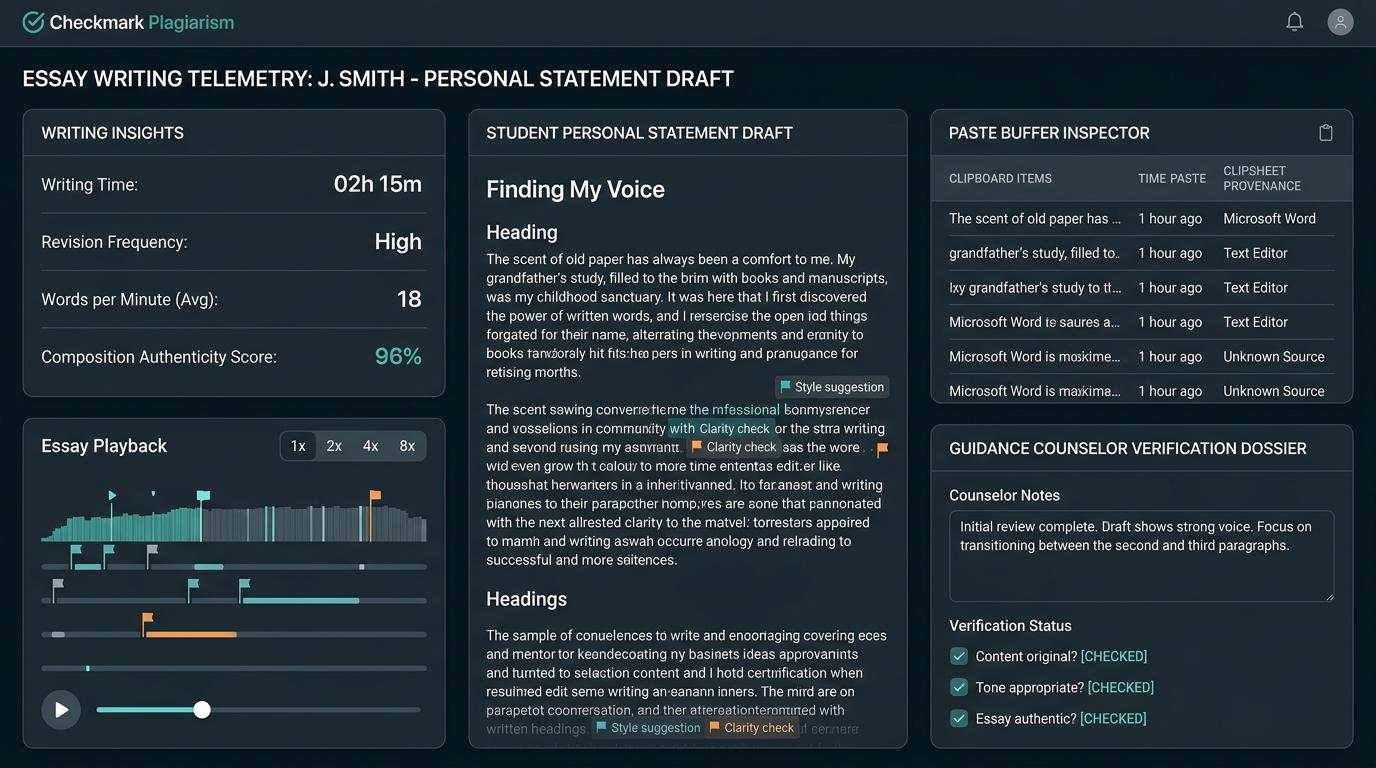
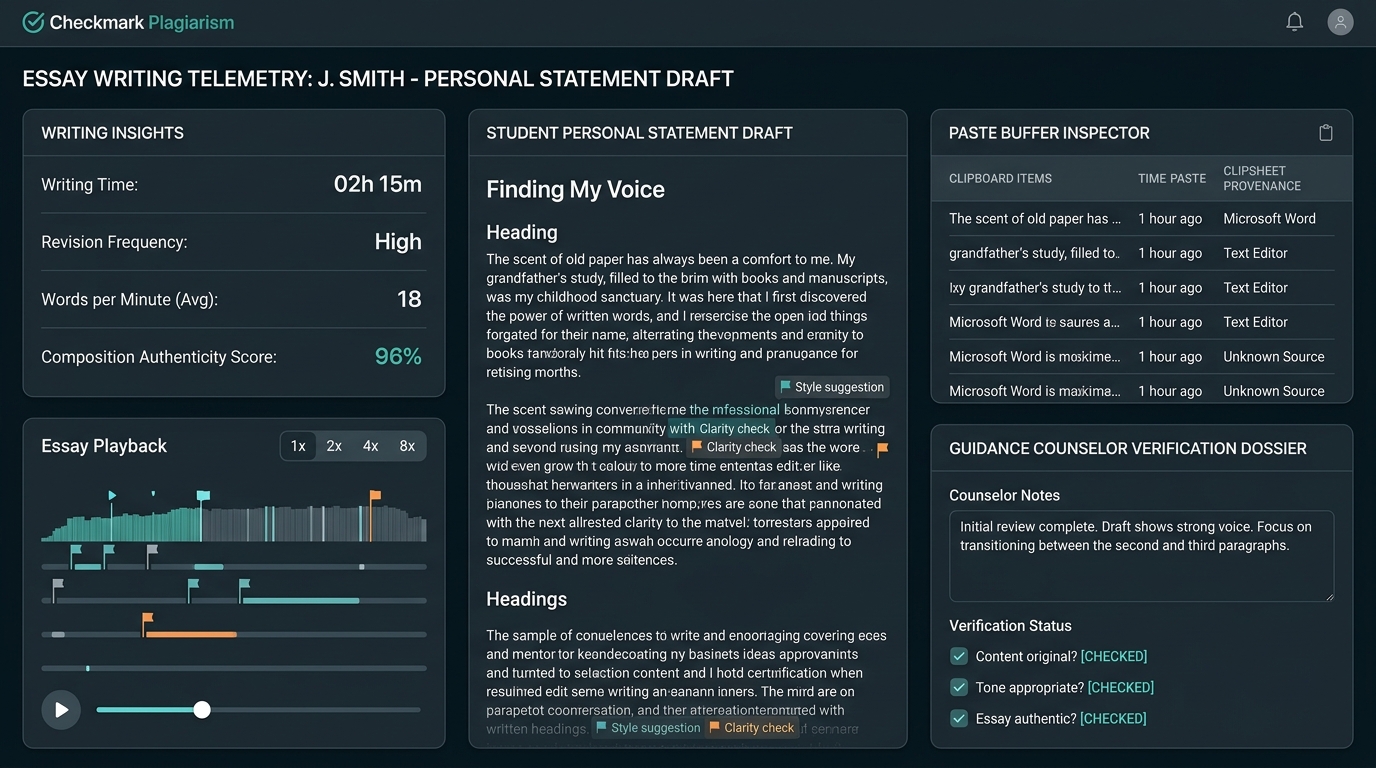
Relying on gut feelings or unscientific whole-paper AI detection percentages leaves counselors powerless to defend honest students or remediate contract cheating. Checkmark Plagiarism resolves this crisis by providing Writing Process Telemetry and the Non-Invasive Authorship Dossier. By capturing patent-pending Essay Playback™ (1x–8x scrubbable video replay), an External Paste Buffer Inspector, granular passage-level linguistic distributions, and verifiable drafting sessions across Google Docs, Microsoft Word, and LMS platforms, counselors can provide university admissions committees with immutable, transparent evidence (“receipts”) that preserves student futures while upholding rigorous institutional ethics.
Checkmark Plagiarism equips high school guidance counselors, college advisors, and academic integrity officers with forensic writing telemetry and enterprise LMS integrations across Canvas LMS, Agilix Buzz, and Google Classroom.
1. The High-Stakes College Admissions Integrity Crisis
Every autumn, millions of high school seniors across the globe submit deeply personal narratives to university admissions offices. Through the Common Application, Coalition Application, University of California Personal Insight Questions (PIQs), Ivy League and Tier-1 institutional supplements, and prestigious merit scholarship competitions, students are asked to condense their identity, intellectual curiosity, resilience, and personal values into essays ranging from 250 to 650 words.
In an ultra-competitive admissions environment—where acceptance rates at top-tier universities hover in the single digits—the personal statement has become the primary qualitative differentiator separating academically identical candidates.
However, this intense pressure has catalyzed a severe integrity crisis characterized by three intersecting forces:
Multi-thousand-dollar “packaging” consultancies and freelance essay mills rewriting student statements line-by-line, coupled with aggressive parental over-editing that erases natural adolescent voice.
Students prompting large language models (GPT-4o, Claude 3.5 Sonnet) for whole-cloth narrative generation, subsequently passing text through paraphrasers (QuillBot, Undetectable AI) to evade static classifiers.
University admissions triage scripts running black-box AI detectors on massive application pools, generating devastating false-positive flags on honest first-generation, low-income, and ESL/ELL applicants.
The Spectrum of College Application Essay Assistance
Admissions integrity is not binary. It exists along a complex continuum ranging from completely legitimate pedagogical support to outright fraud:
| Level | Assistance Category | Typical Modality | Ethical Status | Evidentiary Footprint in Telemetry |
|---|---|---|---|---|
| Level 1 | Authentic Self-Drafting | Student drafts from scratch, revises over multiple sessions, refines voice independently. | Fully Ethical & Standard | Continuous typing dynamics, frequent backspaces, natural pauses, multi-session evolution. |
| Level 2 | Authorized Mentorship | Counselor or English teacher brainstorms themes, asks probing questions, suggests structural tweaks. | Fully Ethical & Encouraged | Student incorporates feedback manually; drafting timeline shows deliberate restructuring. |
| Level 3 | Heavy-Handed Over-Editing | Parents or tutors directly rewrite sentences, inject adult vocabulary, and restructure paragraphs. | Ethical Gray Area / Disfavored | Sudden bursts of adult syntax; sporadic external paste events of multi-sentence revisions. |
| Level 4 | Prompt-Engineered AI Generation | Student inputs personal anecdotes into an LLM and copies the resulting synthesized essay. | Unauthorized / Misconduct | Bulk paste events (0.1–0.4s) or robotic transcription typing with zero conceptual pauses. |
| Level 5 | Commercial Contract Ghostwriting | Paid consultant or essay mill authors the essay entirely off-platform. | Severe Fraud / Disqualification | Instantaneous insertion of completed essay body; total absence of drafting history. |
When admissions offices suspect an essay falls into Level 4 or Level 5, the consequences for the student are catastrophic: immediate disqualification, cancellation of application files across affiliated institutions, revocation of merit scholarships, and permanent disciplinary notation.
2. The Counselor’s Dilemma & The Inadequacy of Static Classifiers
When an admissions officer or regional dean suspects fraud, the high school guidance counselor, college advisor, or upper school dean receives an urgent inquiry:
“Dear Counselor, during our holistic review of Student X’s application, their personal statement was flagged by our automated integrity filter for 86% synthetic generation / ghostwriting indicators. Prior to our committee making a final determination regarding application eligibility, we request your official written attestation regarding whether this document represents the student’s authentic, unassisted work.”
This places the high school counselor in an agonizing, high-stakes dilemma:
- Counselor vouches purely on personal character
- Lacks objective, tamper-evident primary proof
- If student cheated, high school credibility is destroyed
- Admissions trust with university is permanently damaged
- Counselor blindly accepts the automated software score
- Innocent student is disqualified from dream university
- First-gen, low-income, and ESL applicants marginalized
- Student suffers severe, unearned reputational trauma
Replace speculative opinions with timestamped keystroke forensics, multi-session drafting timelines, and verified clipboard paste logs that university deans accept unconditionally.
Why Static Classifiers Fail in College Admissions Adjudication
Static AI detectors and legacy similarity checkers are fundamentally incapable of adjudicating high-stakes admissions essays due to severe algorithmic and ethical defects:
1. Severe Disparities and False Positives Among First-Gen and ESL/ELL Applicants
Empirical research from Stanford University (Liang et al., 2023) found that seven widely used AI detectors misclassified more than half of the TOEFL essays written by non-native English speakers as AI-generated, an average false-positive rate of about 61%. First-generation students, English Language Learners (ELL), and students from underrepresented backgrounds often write with simpler syntactic transitions and lower lexical perplexity—the exact statistical markers that trigger false AI flags. Penalizing a student for writing a clear, earnest narrative about overcoming adversity is a devastating equity failure.
2. The Nuance of Personal Voice vs. “Perplexity”
College personal statements encourage intense reflection, metaphor, and emotional vulnerability. When a student spends hours polishing a pivotal opening hook, the resulting prose may exhibit high rhythm and precision. Static classifiers routinely misinterpret clean, impactful writing as large language model output because both prioritize grammatical coherence.
3. Lack of Due Process and Legal Vulnerability
The National Association for College Admission Counseling (NACAC) Guide to Ethical Practice in College Admission recommends that members promote ethical practices in the use of artificial intelligence that align with transparency, integrity, fairness, and respect for student dignity. Relying on an opaque, probabilistic number (“84% AI”) without primary source proof falls short of those values and of basic procedural fairness. A percentage is not evidence; it is a statistical guess that cannot withstand legal, administrative, or parental scrutiny.
3. Checkmark Plagiarism: The Application Telemetry & Defense Suite
To protect honest applicants, maintain institutional credibility, and uncover genuine ghostwriting, college counseling departments require forensic, multi-dimensional evidence.
Checkmark Plagiarism provides a dedicated suite of writing process telemetry tools engineered specifically for educators, counselors, and academic integrity officers:
Reconstructs complete multi-session drafting histories keystroke-by-keystroke, capturing cognitive pauses, vocabulary experimentation, and sentence restructuring.
Preserves 100% of clipboard text pasted into the application essay with millisecond timestamps and jump-to-playback sync.
- Full raw clipboard text storage
- Brainstorm note verification
- Instant timeline sync
Tamper-evident, exportable verification report for university admissions deans with zero biometric intrusion.
- Active composition time
- Drafting velocity profiling
- Zero surveillance or webcams
Calibrated confidence sliders evaluating specific passages rather than whole-paper speculative numbers.
- Perplexity & burstiness cards
- Side-by-side source matching
- <150w guardrail (Displays N/A)
1. Patent-Pending Essay Playback™ (1x to 8x Scrubbable Timeline)
The most powerful defense of an authentic personal statement is the visual history of its creation. Essay Playback™ reconstructs the student's entire writing session like a high-definition video timeline:
- Scrubbable Time Travel: Counselors can scrub from Minute 0 to the final draft at variable speeds (1x, 2x, 4x, 8x), watching words appear, get deleted, and transform organically.
- Vulnerability & Formulation Pauses: Captures the natural, human pauses where a student stops typing for several minutes to reflect on personal hardship, family dynamics, or complex identity narratives before carefully drafting a reflective paragraph.
- Micro-Revisions & Backspacing: Authenticates thousands of natural keyboard events, including synonym replacements, comma adjustments, sentence inversions, and discarded opening paragraphs.
2. External Paste Buffer Inspector
Ghostwriting and AI fraud almost always manifest as external paste events. However, honest students also paste text legitimately (e.g., pulling a memorable quote from their phone's notes app, copying a journal reflection written over the summer, or inserting feedback provided by their counselor).
Checkmark's External Paste Buffer Inspector captures and preserves 100% of clipboard text:
| Paste ID | Timestamp | Length | Words | Stored Raw Content Preview | Action |
|---|---|---|---|---|---|
| #01 | Sept 12 - 16:14 | 74 chars | 12 words | “El que no arriesga, no cruza el río (Abuela’s favorite saying)” | Verified Note → |
| #02 | Oct 02 - 19:45 | 182 chars | 28 words | “Feedback from Ms. Higgins: Focus more on your leadership role in Robotics...” | Counselor Note → |
- If a student pastes a 150-word paragraph, Checkmark stores the exact original clipboard payload.
- Even if the student subsequently edits, rewords, or deletes the pasted text, the historical snapshot remains permanently viewable.
- A single click on the “Jump to Playback” button transports the counselor directly to the exact millisecond in the timeline when the paste occurred, revealing whether the student immediately reworked the text or left a finished, alien block untouched.
3. Non-Invasive Authorship Dossier
Universities cannot demand that high school students subject themselves to invasive biometric proctoring or keystroke spyware on personal devices. Checkmark’s Non-Invasive Authorship Dossier operates natively within standard educational drafting environments (Google Docs, Canvas LMS, Buzz LMS, Microsoft Word/OneDrive) without capturing screen video, webcam footage, or personal device telemetry.
The resulting exportable Dossier provides admissions committees with:
- Total Active Composition Time: e.g., 14 hours, 32 minutes across 9 distinct sessions over 28 days.
- Drafting Velocity Profile: average net Words Per Minute matched against normal human cognitive limits of 15–45 WPM.
- Macro and Micro Revision Metrics: total backspaces, deletions, paragraph restructurings.
- Paste Provenance Summary: count, volume, and origin analysis of all external insertions.
- Passage-Level Calibrated AI & Plagiarism Analysis: with complete source transparency.
4. Telemetry vs. Static Detectors vs. Invasive Proctoring
When evaluating academic integrity solutions for high school college counseling offices, schools must balance forensic defensibility against student privacy and equity:
| Evaluation Dimension | Legacy Static AI Detectors | Invasive Proctoring Tools | Checkmark Writing Telemetry |
|---|---|---|---|
| Primary Output | Single probabilistic percentage (“78% AI Detected”) | Webcam video recordings, room scans, eye-tracking logs | Multi-evidence Dossier, Essay Playback™, paste logs, passage cards |
| Defensibility in Admissions Appeals | Zero (Cannot explain feature weights; easily challenged) | Low (Captures physical room, not cognitive writing evolution) | Unassailable (Provides primary temporal evidence of composition) |
| Student Privacy & Dignity | High risk of student work used for secondary LLM training | Extremely Invasive (Captures home environment and biometrics) | Non-Invasive (Zero video, zero biometrics, FERPA zero-training SLA) |
| ESL / ELL Equity | High False Positives (Biased against simpler syntax) | Ineffective at detecting linguistic nuance | Equity-First (Evaluates effort, pauses, and revisions, not vocabulary) |
| Ghostwriting Detection | Blind (Cannot detect human ghostwriters) | Blind to off-screen contract writers drafting on other devices | Definitive (Detects 0.3s clipboard drops and unnatural cadence) |
| Counselor Usability | Opaque score forces counselor into guesswork | Hours of intrusive video footage to review | Interactive 1x–8x scrub with instant paste jump points |
5. Illustrative Admissions Case Studies
The following illustrative scenarios (the students, institutions, and figures are examples, not reports of specific real cases) show how high school counselors and college admissions committees utilize Checkmark Writing Telemetry to resolve high-stakes ghostwriting and AI allegations:
AI Filter False Positive Exonerated
Ivy League filter flagged Common App essay with 81% AI score. Telemetry proved 14.5 hours of drafting across 9 sessions and 1,840 backspaces. Full admission granted.
$120,000 Award Reversal
STEM research supplemental disqualified for 44% uncited similarity. Paste Buffer Inspector proved text matched student's verified science fair project journal.
Ghostwriting Mill Restorative Fix
Senior pasted 420-word paragraph at 2:14 AM in 0.3s from paid consultant. Counselor used Playback in supportive conference; student authored authentic draft.
Case Study 1: Defending a First-Generation Senior Falsely Flagged by an Admissions AI Filter
- The Student: Mateo R., a high-achieving first-generation senior applying early decision to an elite private university.
- The Allegation: The university admissions processing team ran all submitted personal statements through an automated AI detection triage script. Mateo’s essay—an earnest reflection on translating legal and medical documents for his immigrant grandparents—returned an 81% AI Probability Score. The university admissions director emailed Mateo’s high school guidance counselor stating that unless authentic authorship could be established within five business days, Mateo’s early decision application would be rendered void for integrity violations.
- The Telemetry Investigation:
- The guidance counselor opened Mateo’s drafting workspace within Checkmark Plagiarism (integrated with the school's Google Workspace).
- The counselor launched Essay Playback™, revealing a total active drafting history of 14 hours and 32 minutes across 9 separate composition sessions over a four-week period.
- The playback captured extensive cognitive formulation pauses—averaging 4 to 7 minutes each—where Mateo sat at key thematic junctures before drafting sentences describing the emotional weight of medical translation.
- The telemetry recorded 1,840 backspace events, showing Mateo actively experimenting with vocabulary, reorganizing sentence structures, and discarding an entire 200-word introductory anecdote in Session 3.
- The External Paste Buffer Inspector showed exactly two paste events: one for a 12-word Spanish idiom from a family recipe document and one containing the counselor's formatting notes.
- The Resolution: The counselor generated an official Checkmark Non-Invasive Authorship Dossier and attached a formal attestation letter. Upon reviewing the timestamped playback logs and revision metrics, the university's Dean of Admissions immediately rescinded the flag, issued a written apology for the automated false alarm, and admitted Mateo with a full-tuition financial aid package.
Case Study 2: Reversing a $120,000 Merit Scholarship Disqualification
- The Student: Priya K., a senior applying for a prestigious national STEM leadership scholarship requiring a 500-word supplemental essay on independent scientific research.
- The Allegation: The scholarship review foundation’s legacy scanner flagged Priya's essay with a 44% Uncited Source Match, cross-referencing published conference abstracts on polymer chemistry. The review panel disqualified Priya from the final interview round, citing suspected contract ghostwriting by an academic researcher.
- The Telemetry Investigation:
- The upper school college advisor initiated an emergency appeal and requested access to the flagged text sections.
- In Checkmark’s two-way linked Plagiarism Breakdown, the flagged 180-word block corresponded to experimental methodology and data points.
- The advisor checked Checkmark’s Paste Buffer Inspector, which stored the exact clipboard insertion event from October 12 at 4:15 PM.
- The advisor cross-referenced the pasted text with Priya's verified Google Drive science fair project journal (which had also been tracked in Checkmark since junior year). The data and methodology phrases were Priya’s own primary research notes recorded eight months prior during her regional science fair project.
- The Resolution: The college advisor submitted the Authorship Dossier demonstrating that Priya had pasted her own original, unreleased laboratory notes rather than contracting a researcher. The scholarship foundation’s appeals board reviewed the telemetry, overturned the disqualification, and invited Priya to the final interview, where she was ultimately awarded the $120,000 four-year scholarship.
Case Study 3: Exposing & Remediating a Commercial Ghostwriting Mill Insertion
- The Student: Julian T., a senior feeling intense familial pressure to secure admission to a Top-20 university. Julian’s parents hired a private “boutique” college consultant for $8,500.
- The Discovery: During a routine pre-submission advisory review in late October, Julian’s school counselor noticed that Julian’s personal statement suddenly featured an exceptionally polished, baroque writing style that diverged drastically from his in-class English essays and initial brainstorms.
- The Telemetry Investigation:
- The counselor reviewed Julian’s essay timeline in Checkmark Plagiarism.
- While the first 150 words showed normal drafting velocity (24 net WPM over 45 minutes), the document exhibited an External Paste Event of 420 words at 2:14 AM on a Sunday morning, inserted in exactly 0.3 seconds.
- Following the massive paste, Julian spent only 90 seconds in the document—fixing three capitalized letters—before closing the tab.
- The Paste Buffer Inspector revealed that the entire philosophical reflection and concluding narrative had been copied from an external clipboard source with zero preliminary drafting, notes, or iterative typing.
- The Restorative Intervention:
- Rather than issuing a punitive referral or submitting a compromised application, the counselor invited Julian to a supportive, private conference.
- The counselor shared the screen, opened Essay Playback™, and gently said: “Julian, I see your genuine voice in the first paragraph, but at 2:14 AM, this entire narrative was dropped in from the outside. College admissions committees use advanced screening and will immediately recognize that this isn't your voice. Let's talk about what happened.”
- Julian broke down and admitted that the private consultant had rewritten his essay and instructed him to paste it in.
- The counselor guided Julian to delete the ghostwritten insertion. Over the next two weeks, Julian worked in the school's drafting workspace to author an authentic, heartfelt essay about his actual passions.
- Julian submitted a 100% authentic application that he owned with pride, avoiding severe disciplinary disqualification.
6. The 4-Phase Counselor Admissions Verification Protocol
When an admissions office questions an applicant's essay, or when a counselor conducts pre-submission due diligence, following a standardized, objective protocol is essential:
- Establish a 5-day administrative hold with the admissions office
- Request specific flagged passage coordinates and vendor tool names
- Reassure student and family while maintaining procedural neutrality
- Audit active composition hours and multi-session distribution
- Scrub Essay Playback™ (1x–8x) for cognitive pauses and revisions
- Inspect External Paste Buffer for 100% clipboard provenance
- Conduct non-accusatory, screen-shared review of writing replay
- Ask student to articulate thematic evolution of key passages
- Verify cognitive ownership and identify unauthorized edits
- Export tamper-evident Checkmark Non-Invasive Authorship Dossier
- Sign Official Counselor Attestation & Telemetry Certification Letter
- Transmit directly to Dean of Admissions & secure written clearance
Phase 1: Intake & Triage of the Admissions Inquiry
- Establish an Administrative Hold: Immediately contact the regional admissions representative to request a formal hold on the application file (typically 5 to 7 business days) to allow the high school counseling office to complete its evidentiary review.
- Obtain Primary Documentation: Ask the admissions office for the specific flagged passages, the name and version of the detection software used, and the precise nature of the concern (AI generation, peer match, or commercial ghostwriting).
- Maintain Calm with the Student and Family: Inform the student and their guardians that the inquiry is an automated screening triage and that the school possesses complete drafting telemetry to verify their authentic work.
Phase 2: Telemetry Audit & Paste Deconstruction
- Step 1 — Session Volume & Duration: Check that the essay was drafted across multiple sessions. A genuine Common App personal statement typically reflects 6 to 18 hours of total engagement across 4 to 12 distinct dates.
- Step 2 — Typing Cadence & Inter-Key Intervals (IKI): Examine the student's typing velocity profile. Normal human composition averages 15 to 45 WPM with variable bursts, whereas automated transcription or robot typing exhibits uniform velocity without pauses.
- Step 3 — Revision & Backspace Density: Verify that the essay exhibits a healthy revision index. Authentic essays typically feature 500 to 2,500+ keystroke deletions/backspaces as the writer refines tone and syntax.
- Step 4 — Paste Buffer Inspection: Review every clipboard insertion in Checkmark's paste inspector. Verify whether pasted chunks represent the student's own notes or uncredited third-party text.
Phase 3: Supportive Student-Counselor Conference
- Non-Accusatory Tone: Begin the meeting with supportive framing: “Our goal today is to look at your drafting timeline together so I can build an unassailable defense file for the university.”
- Screen-Share Playback: Open Checkmark Essay Playback™ and scrub through key turning points in the essay.
- Cognitive Ownership Check: Ask open-ended questions about the writing:
- “Tell me about why you changed the opening hook in your third draft.”
- “What prompted you to use the metaphor in paragraph 4?”
- “Where were you when you wrote this section on your family history?”
- Remediation if Unauthorized Assistance Occurred: If the student admits to using an AI generator or commercial ghostwriter, provide immediate, calm guidance to withdraw or replace the compromised essay before official admissions deadlines pass.
Phase 4: Formal Dossier Submission & Admissions Liaison
- Export Verification File: Export the official, tamper-evident Checkmark Non-Invasive Authorship Dossier containing verified session logs, playback links, and paste provenance summaries.
- Attach Counselor Attestation: Attach a signed letter from the High School College Counseling Office certifying that the student's writing process was monitored, audited, and verified.
- Direct Transmission: Transmit the packet directly to the Dean of Admissions or Chair of the Admissions Integrity Board via encrypted administrative channels.
7. Model High School Advisory Policies & Application Drafting Guidelines
To prevent admissions integrity crises before they occur, high school counseling departments, college guidance offices, and independent schools should adopt explicit advisory syllabus policies:
“All seniors must compose all college application essays (Common App, supplements, scholarships) within the school-managed Google Workspace / LMS environment equipped with Checkmark telemetry. This ensures an unbroken, tamper-evident record of authentic drafting to protect against false AI accusations and verify scholarship eligibility.”
PERMISSIBLE: Brainstorming topics with counselors, discussing ideas with parents, receiving high-level feedback on clarity and structure, correcting minor punctuation.
IMPERMISSIBLE: Having any third party (parent, tutor, consultant, AI) draft, rewrite, or inject unsolicited prose into the document. Pasting text generated by an LLM is strictly prohibited.
“If a student drafts notes or reflections in an external offline journal or notes app, they must preserve the original dated note. When pasting notes into the application document, the student must be prepared to demonstrate the origin of the pasted material upon request.”
Guidance for Working with Independent Educational Consultants (IECs)
Many families hire Independent Educational Consultants (IECs) to assist with college planning. High schools should provide clear written guidelines to parents and IECs:
- Adherence to IECA / HECA Ethical Codes: Private consultants who belong to the Independent Educational Consultants Association (IECA) pledge to follow its Principles of Good Practice, which state that members shall not write application essays or any portion of an essay for students. The Higher Education Consultants Association (HECA) likewise states that a professional educational consultant should not write essays for students.
- Drafting in the School Workspace: All drafting must remain in the student’s verified school account so that telemetric provenance is never severed.
- Comment-Only Feedback: Parents and consultants should be instructed to provide feedback exclusively via document comments rather than direct text edits.
8. Official Admissions Appeal Letter Templates for Counselors
When defending a student against an automated AI flag or ghostwriting inquiry, counselors can adapt the following formal attestation letter templates:
Template A: Counselor Official Attestation & Telemetry Exoneration Letter
[HIGH SCHOOL LETTERHEAD]
OFFICE OF COLLEGE COUNSELING & GUIDANCE

[Date]

Office of Undergraduate Admissions
Attn: Admissions Integrity Committee / Regional Admissions Dean
[University Name]
[University Address]
[City, State, Zip Code]

RE: Verification of Authentic Authorship – [Student Full Name] (Application ID: [XXXXXX])
    Common Application Personal Statement & Supplemental Essays

Dear Dean [Last Name] and Members of the Admissions Committee,

I am writing in my official capacity as Director of College Counseling at [High School Name] to provide comprehensive, verified evidentiary documentation regarding the authentic authorship of the application essays submitted by [Student Full Name].

We were notified on [Date] that [Student's Name]’s personal statement was flagged by your office's automated screening system for suspected artificial intelligence generation / external assistance.

As an institution committed to the highest standards of academic integrity, [High School Name] requires all seniors to compose their college application essays within our managed digital writing workspace, monitored via Checkmark Plagiarism's Writing Process Telemetry suite.

Following a thorough forensic audit of [Student's Name]'s drafting history and an in-person advisory conference, our office has verified the complete, unassisted authenticity of this work based on the following primary telemetry findings:

1. Temporal Drafting History: [Student's Name] composed this essay across [X] distinct composition sessions between [Start Date] and [End Date], totaling [XX hours and XX minutes] of active writing time.
2. Keystroke Dynamics & Revision Profiling: The document contains [XXXX] individual keyboard events, including [XXX] backspaces and deletions, demonstrating continuous iterative drafting, vocabulary experimentation, and voice refinement.
3. Formulation & Cognitive Pauses: The telemetry records natural cognitive pauses (ranging from 2 to 8 minutes) at pivotal reflective junctures, consistent with authentic adolescent reflection.
4. Clipboard & Paste Buffer Audit: Checkmark's External Paste Buffer Inspector confirms that [100% / XX%] of the text was composed natively via direct keystrokes. [If applicable: The single paste event of XX words on (Date) was verified as the student's own journal brainstorm].

Attached to this letter, please find the complete, tamper-evident Checkmark Non-Invasive Authorship Dossier, including scrubbable Essay Playback™ session logs.

Given this definitive primary evidence, we respectfully request that your office clear all integrity flags from [Student's Name]’s application file and proceed with holistic review without prejudice.

Should you require any further documentation or wish to review the live playback replay, please contact me directly at [Phone Number] or [Email Address].

Sincerely,

[Counselor Signature]

[Counselor Full Name], M.Ed.
Director of College Counseling
[High School Name]
[School Phone Number] | [Counselor Email]
Template B: Supplemental Essay Paste Provenance Certification
[HIGH SCHOOL LETTERHEAD]
OFFICE OF COLLEGE COUNSELING

[Date]

[Scholarship Foundation / University Honors Program]
Attn: Scholarship Selection & Ethics Committee
[Address]

RE: Paste Provenance & Research Authorship Certification – [Student Name]

Dear Scholarship Selection Committee,

On behalf of [High School Name], I am submitting this official Paste Provenance Certification regarding the 500-word STEM supplemental research essay submitted by [Student Name] for the [Name of Scholarship/Honors Program].

Our office conducted a telemetry audit using Checkmark Plagiarism to investigate the [XX%] similarity index flagged on [Student Name]'s submission.

Our audit confirmed that the flagged passage of [XXX] words, which was pasted into the document on [Date] at [Time], represents [Student Name]'s own primary research notes from their [Year/Project Name], originally recorded in their verified school laboratory journal on [Original Date]. Checkmark's External Paste Buffer Inspector verified the exact character-level match to the student's historical notes.

We have verified that this submission represents 100% original, independent student research and prose. The complete Checkmark Authorship Dossier is attached for your review.

We request that [Student Name] be fully reinstated into the candidate review pool.

Respectfully submitted,

[Counselor Name]
College Counselor, [High School Name]
9. Frequently Asked Questions (FAQs)
1. How does Checkmark prove an essay was not ghostwritten if an external consultant wrote it and the student retyped it manually?
Retyping (transcription) produces a completely different keystroke cadence than genuine drafting. When an author composes an original essay, their typing velocity fluctuates constantly—they pause for seconds or minutes to search for vocabulary, restructure sentences, and frequently use backspaces to fix phrasing. In contrast, a student copying text from a phone, second monitor, or paper note exhibits steady, mechanical typing at a constant speed with virtually zero conceptual pauses and minimal backspacing. Checkmark’s Transcription Detection algorithms and Essay Playback™ instantly reveal these unnatural typing patterns.
2. Can a student just write their personal statement in Apple Notes or Microsoft Word and paste it into Google Docs?
Yes, students frequently draft notes across multiple devices. However, when an entire essay is pasted in a single 0.2-second event, it creates an unverified “black box” in the drafting history. By deploying Checkmark’s native extensions and integrations across Google Docs, Microsoft Word, Canvas, and Buzz LMS, schools enable students to maintain an unbroken, verified drafting trail regardless of which platform they use, ensuring that paste events are always supported by underlying historical drafts.
3. Does Checkmark violate student privacy laws like FERPA or COPPA when recording writing telemetry?
No. Checkmark is strictly FERPA and COPPA compliant. Unlike invasive proctoring software, Checkmark captures zero webcam video, zero audio recordings, zero screen captures, and zero personal device browsing data. It records only document-level text editing events within the student's authorized school drafting workspace. Crucially, Checkmark maintains a strict Zero Model Training Guarantee—student college essays are never ingested, sold, or used to train commercial AI models.
4. How can counselors convince admissions officers to trust Checkmark telemetry over their own internal AI screening tools?
University admissions officers are acutely aware that static AI detectors are prone to false positives and legal challenges. When a high school counselor provides a Checkmark Non-Invasive Authorship Dossier, they are not offering an alternative opinion; they are providing primary, tamper-evident temporal proof (keystroke timelines, session counts, pause distributions, and paste buffers). Admissions deans universally prefer objective, primary evidence over probabilistic software guesses.
5. What should a counselor do if a student confesses to having used ChatGPT for their personal statement?
If the inquiry occurs prior to official university review, the counselor should handle the situation as a supportive, pedagogical teaching moment. The counselor should guide the student to completely discard the AI-generated text, brainstorm authentic personal themes, and author a fresh, genuine draft within the Checkmark workspace. If the inquiry comes directly from a university admissions office post-submission, the counselor must facilitate an honest, transparent conference with the student and family to determine appropriate remediation or application withdrawal in accordance with the school's integrity policy and NACAC ethical guidelines.
6. Why does Checkmark display N/A for text samples under 150 words?
Static AI detectors frequently output misleading 90%+ AI scores on short text snippets (such as short 100-word college supplemental answers or extracurricular descriptions) because the sample size is statistically insufficient to evaluate linguistic burstiness and perplexity. Checkmark enforces strict, honest guardrails: any text sample under ~150 words displays N/A rather than guessing, preventing unwarranted accusations on short application responses.
7. How does Checkmark integrate with high school college counseling platforms like Naviance, Scoir, or MaiaLearning?
While college application transmission platforms (such as Naviance, Scoir, and MaiaLearning) manage document submission to the Common App and universities, Checkmark operates directly within the composition environments where students write (Google Docs, Canvas LMS, Buzz LMS, and Microsoft Word). Counselors can export the Checkmark Authorship Dossier as a certified PDF and attach it directly to the student’s counselor recommendation packet or send it via secure email during an admissions inquiry.
Conclusion: Stop Guessing, Start Trusting
The college admissions essay is a sacred milestone in a student's educational journey—a vulnerable expression of their unique voice, aspirations, and lived experiences. In an era dominated by generative AI confusion, predatory ghostwriting mills, and erratic automated detection filters, high school guidance counselors cannot afford to leave student futures to chance or unprovable opinions.
By adopting Checkmark Plagiarism’s Writing Process Telemetry, Essay Playback™, and Non-Invasive Authorship Dossiers, college counseling departments build a transparent, defensible wall of integrity around their students. Counselors gain the forensic tools needed to expose bad actors, mentor developing writers, and authoritatively defend honest seniors—ensuring that every college acceptance is earned with authentic pride.
Protect Your Senior Class with Verifiable Writing Telemetry
Equip your counseling department with tamper-evident writing process replay, paste buffer inspection, and non-invasive authorship dossiers across Google Docs, Canvas, and Word.