
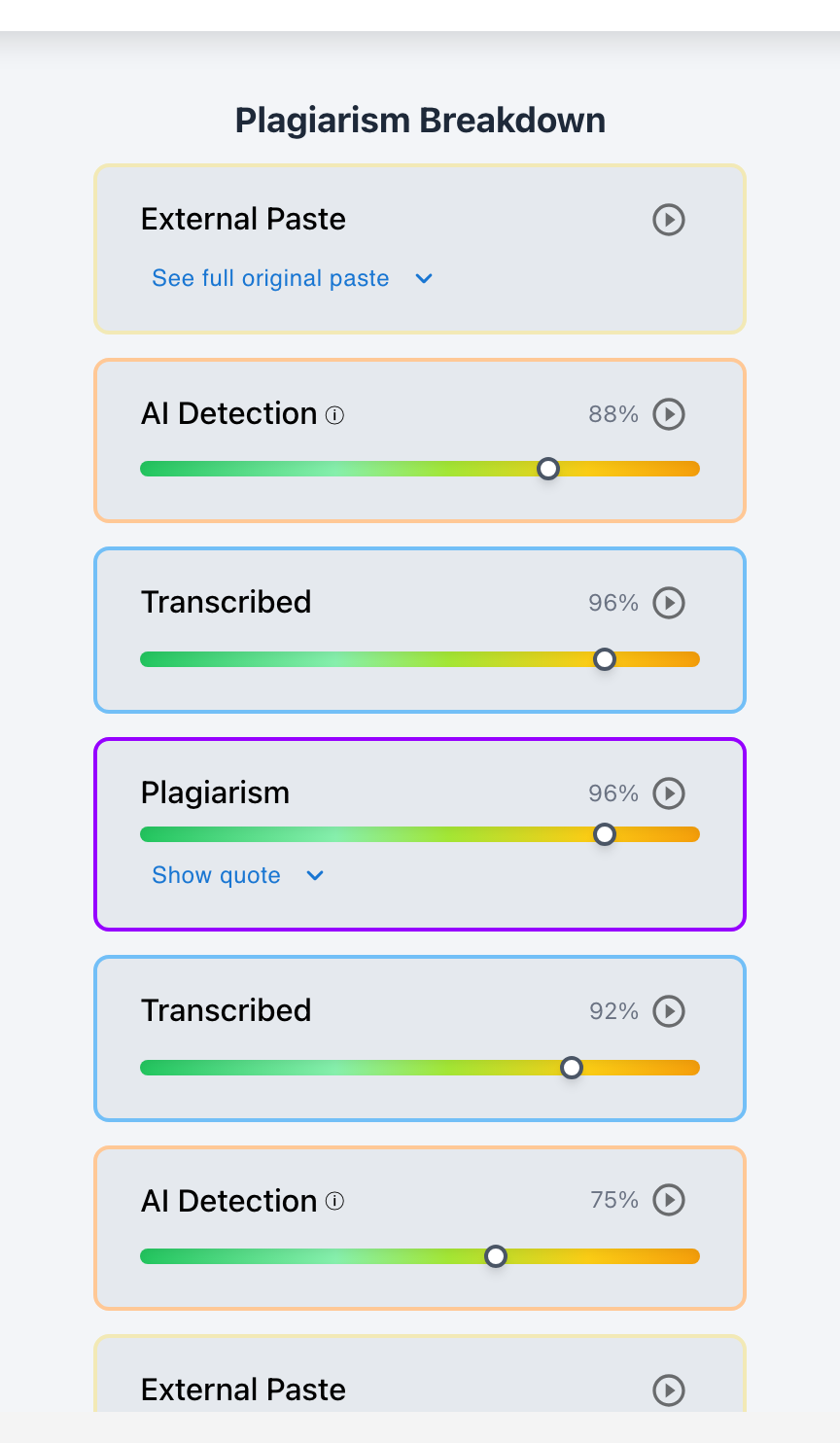
Large language models excel at standardized, generic writing prompts—but struggle immensely when assignments demand local physical context, multi-stage human reflection, live dialogue, and documented drafting timelines.
Because ChatGPT is trained on broad public internet text, it can write a competent 5-paragraph essay on the causes of World War I in three seconds. However, it cannot interview a local town historian, analyze a specific argument made by a classmate during Tuesday's seminar, reflect on personal artistic growth, or fake the keystroke-by-keystroke timeline captured by essay writing playback.
Understanding which assignment formats are hardest for AI to complete enables educators to design rigorous, inspiring assessments that celebrate authentic student thinking.
Checkmark Plagiarism empowers these assignment formats by pairing essay writing playback with AI detection, plagiarism detection, autograding, and integrations with Canvas and Google Classroom.
The 6 Assignment Types That Are Hardest for ChatGPT
1. Local Fieldwork & Primary Data Collection
Assignments requiring students to conduct original community interviews, perform physical lab tests, or analyze local artifacts that exist nowhere online.
2. In-Class Seminar & Debate Syntheses
Prompts asking students to connect readings to specific arguments made by peers in Thursday's live classroom debate.
3. Metacognitive Writing Logs
Requiring students to submit reflective process memos explaining why they restructured their thesis, deleted a paragraph, or selected specific sources.
4. Multi-Modal Artifact Portfolios
Combining written analysis with recorded audio interviews, hand-drawn diagrams, physical models, or annotated PDF scans.
5. Scaffolded Writing with Playback
Multi-week milestone essays tracked via writing playback, verifying incremental keystrokes and eliminating overnight copy-paste shortcuts.
6. Live Oral Defenses & Q&A
Brief 2-minute conferences where students explain their thesis, define technical terms, and justify their research orally.
Comparative Matrix: High vs. Low AI Vulnerability Formats
High AI Vulnerability (Avoid)
- Standard 5-paragraph literary analysis.
- Generic biography or historical event summaries.
- Take-home multiple choice and short factual definitions.
- Single-deadline unmonitored final essay submissions.
Low AI Vulnerability (Adopt)
- Synthesizing in-class lecture notes with local observations.
- Iterative drafting tracked with essay writing playback.
- Primary data analysis from student-conducted experiments.
- Written essays paired with brief live oral defenses.
Why Essay Writing Playback Secures Every Assignment Type
Regardless of the prompt style, Checkmark Plagiarism's essay writing playback provides an unassailable record of authentic authorship:
- Tracking the Journey: Captures hours of active typing, backspacing, and multi-session development over several days.
- Catching External Text: Instantly flags if a student pastes a full essay into the document rather than composing it keystroke-by-keystroke.
- Corroborating Oral Defense: Teachers can review the playback timeline together with the student during check-in conferences.
Read more in how Checkmark writing process analysis works.
A 6-Step Implementation Guide for Teachers
Educator Assignment Redesign Protocol:
- 1. Audit current prompts and identify assignments relying on generic internet topics.
- 2. Inject local classroom anchors: require citations of specific lecture slides or student debates.
- 3. Require students to collect or analyze one piece of real-world primary data.
- 4. Break major papers into 3 distinct milestone submissions (outline, rough draft, final).
- 5. Enable essay writing playback tracking inside Canvas or Google Classroom.
- 6. Conclude the assignment with a brief 2-minute oral check or peer Q&A session.
How Checkmark Plagiarism Automates Process Assessment
Checkmark Plagiarism combines **AI detection, essay writing playback, static AI detection, plagiarism detection, autograding, and Canvas/Google Classroom integrations** to make process-heavy, AI-resistant assignments easy to manage and grade at scale.
Frequently Asked Questions
Why does ChatGPT struggle with local community assignments?
ChatGPT has no access to real-time local events, campus happenings, or unindexed town records, making localized research impossible for AI to fabricate convincingly.
What is an in-class debate synthesis assignment?
An essay where students must summarize opposing arguments made by specific classmates during a live seminar and analyze those points using course readings.
Can ChatGPT write a convincing personal reflection?
ChatGPT simulates emotional language, but its reflections are generic and clichéd. It cannot recall specific classroom struggles, lab mistakes, or personal insights.
How does writing playback prove an assignment was completed without AI?
Playback captures the full typing history—keystrokes, pauses, deletions, and multi-session drafting—proving authentic human composition.
Are oral defenses practical for large classes?
Yes. Quick 2-minute speed check-ins during regular class time or peer-to-peer defense rubrics provide strong verification without consuming hours of grading.
How can science teachers design AI-resistant lab reports?
Require students to include raw lab data photographs, hand-drawn apparatus diagrams, and explanations of specific experimental anomalies that occurred in the room.
Can students use AI to complete multi-modal portfolios?
While AI can generate text, creating integrated portfolios with original audio, physical prototypes, and hand-annotated sources requires extensive human effort.
What if a student writes an essay in another software program?
Instruct students to complete drafts directly within your LMS or provide external document version history and timestamp logs.
Do AI-resistant assignments improve student learning?
Yes. Anchoring work in local context, primary research, and metacognitive reflection encourages deeper critical thinking and authentic engagement.
How does Checkmark Plagiarism support educators?
Checkmark Plagiarism delivers automated writing playback replays, citation verification, dual AI/plagiarism scans, and seamless LMS integration.
Authentic Learning Happens Through Human Process
When assignments demand personal insight, localized context, and documented drafting timelines, generative AI becomes obsolete as a cheating tool. By prioritizing authentic human process, educators foster meaningful scholarship and lifelong critical thinking.
Checkmark Plagiarism supports this comprehensive approach with AI detection, essay writing playback, static AI detection, plagiarism detection, autograding, and integrations with Canvas and Google Classroom.
See how Checkmark pairs essay writing playback with multi-signal detection to support engaging, AI-resistant assignment design. View a sample report or request a demonstration.