
The rapid mainstreaming of generative artificial intelligence has exposed fatal institutional, legal, and pedagogical flaws in traditional course syllabi. Across secondary school districts and higher education institutions, boilerplate “zero-tolerance” prohibition clauses (e.g., “The use of AI is strictly prohibited and will result in an automatic zero and disciplinary referral”) have collapsed under the weight of procedural due process vulnerabilities (Goss v. Lopez, Board of Curators v. Horowitz), systemic false positives on developmental and multilingual writers, and widespread parental and legal backlash. Furthermore, syllabus clauses relying on commercial black-box AI detection scores create severe FERPA and civil rights liabilities by substituting uncalibrated probabilistic percentages for verifiable evidentiary proof.
To safeguard faculty authority, uphold constitutional due process, and foster genuine student writing development, Secondary English Language Arts (ELA) Department Chairs, Writing Program Administrators (WPAs), and Academic Integrity Officers must overhaul their syllabi. Institutions must pivot from adversarial, post-submission policing to Restorative AI Integrity Checkpoints grounded in Checkmark Plagiarism’s foundational philosophy: “Stop guessing, start trusting.”
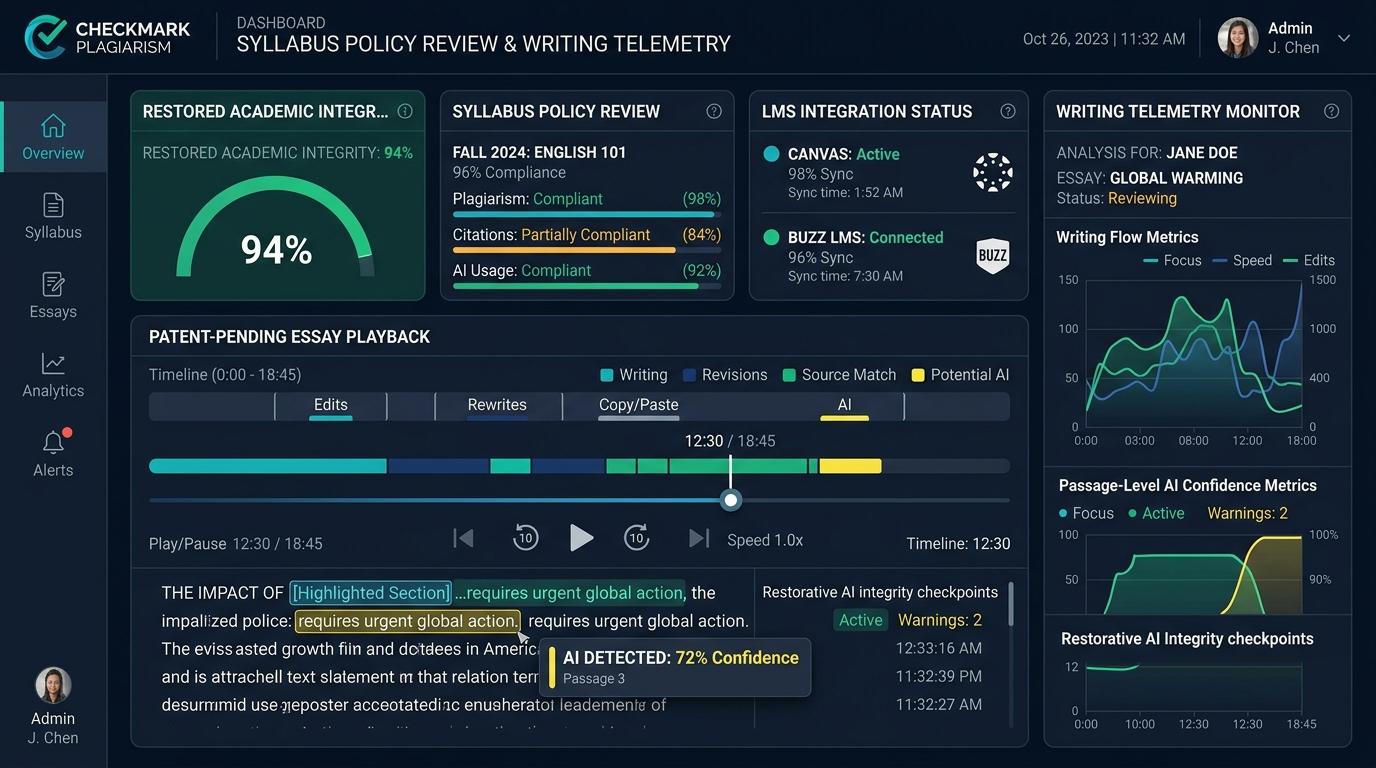
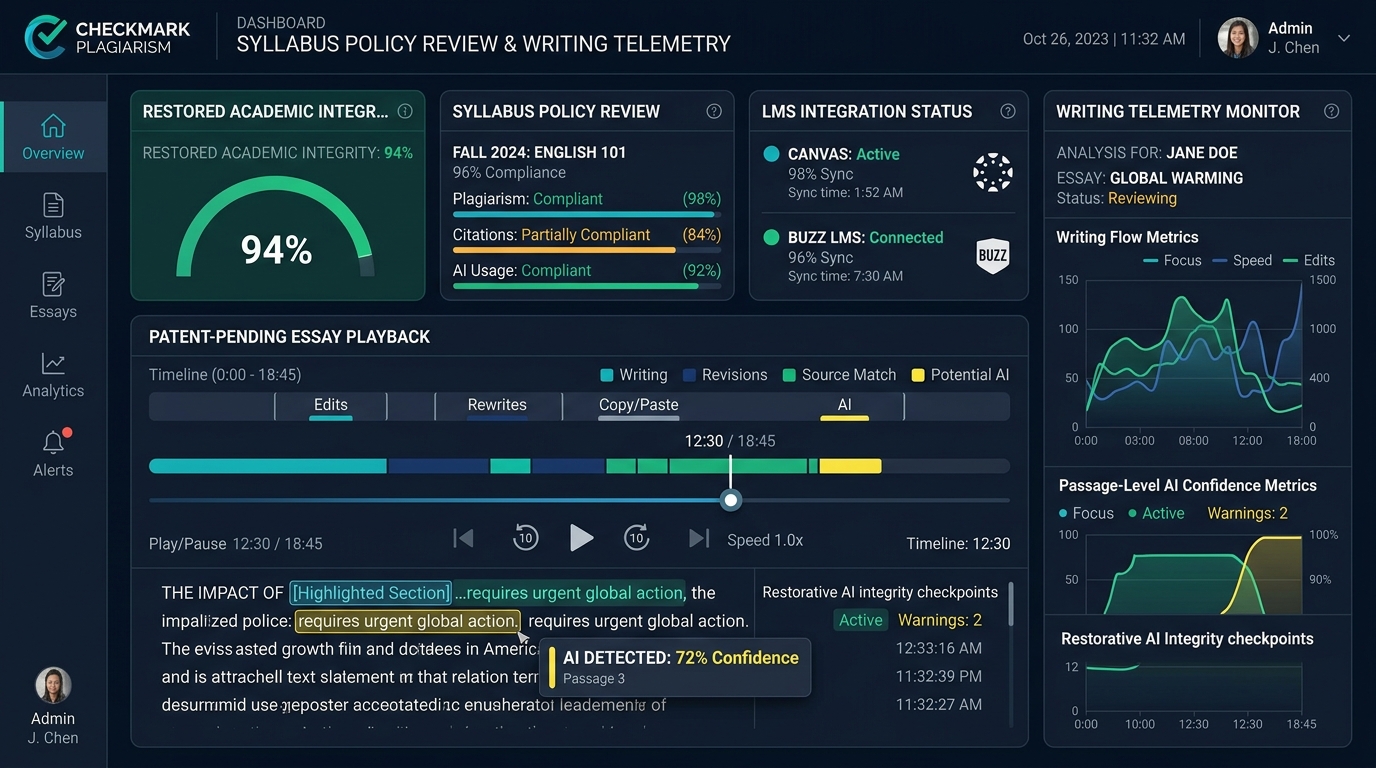
By formalizing a 4-stage process-based checkpoint architecture supported by objective writing telemetry—anchored by patent-pending Essay Playback™ (1x–8x scrubbable keystroke replay, cognitive pause topography, and 100% external paste buffer preservation), passage-level AI confidence scoring, and teacher-in-the-loop rubric autograding synced with Canvas LMS, Buzz LMS, and Google Classroom—departments can establish transparent, contractually sound syllabus language that protects all stakeholders while restoring mutual trust to the writing classroom.
Checkmark Plagiarism provides instructional leaders, ELA department chairs, university writing program administrators, and classroom faculty with forensic writing telemetry, passage-level detection guardrails, and enterprise LMS integrations to establish contractually airtight syllabus policies.
1. The Breakdown of Traditional “Zero-Tolerance” Syllabus Clauses
For decades, academic integrity policies in secondary and postsecondary course syllabi relied on a shared understanding of plagiarism: the verbatim or near-verbatim misappropriation of published text from print sources or commercial paper mills. However, the arrival of large language models (LLMs) fundamentally altered the mechanics of textual composition, rendering standard syllabus boilerplate obsolete.
When departments attempt to address generative AI through legacy paradigms—adding punitive, one-line blanket bans—they unintentionally create an untenable instructional environment characterized by legal exposure, administrative paralysis, and pedagogical harm.
The Ambiguity Trap
- What constitutes “assistance” vs. “generation”?
- Are spellcheck, Grammarly, or translation tools prohibited?
- Fails constitutional “fair notice” requirements.
The Detector Trap
- Relies on black-box score lacking evidentiary backing.
- Severe false-positive rates on ELL & neurodivergent prose.
- Violates FERPA inspection and data privacy rules.
The Procedural Collapse
- Imposes automatic penalty without substantive notice or hearing.
- Violates Goss v. Lopez and Title VI protections.
- Destroys student-teacher trust and creates grievance gridlock.
1.1 The “Ambiguity Trap” and Constitutional Due Process Failures
The foremost legal vulnerability in contemporary syllabi is the Ambiguity Trap. Generic syllabus clauses routinely prohibit “unauthorized AI assistance,” “unapproved technological tools,” or “unethical automation” without defining where permissible assistive drafting ends and prohibited unauthorized generation begins.
In public educational institutions, course syllabi function not merely as informal roadmaps, but as quasi-contractual notices that establish the rules under which student work is evaluated. When disciplinary sanctions—such as course failure, loss of scholarships, suspension from athletics, or permanent transcript notations—are tethered to vague standards, institutions risk violating procedural and substantive due process protections established by federal case law:
Goss v. Lopez (419 U.S. 565, 1975)
The Supreme Court affirmed that students possess constitutionally protected property and liberty interests in their education. Adverse disciplinary actions require prior, specific notice of prohibited conduct, disclosure of the primary evidence, and an informal hearing that grants the student a meaningful opportunity to present their defense. A syllabus that fails to clearly delineate permitted digital tools fails the constitutional threshold of “fair notice.”
Board of Curators v. Horowitz (435 U.S. 78, 1978)
While the Supreme Court granted academic institutions wide latitude in making genuine academic judgments, it drew a sharp boundary between purely academic grading and disciplinary misconduct. When a faculty member assigns a punitive zero (0%) based on an unproven allegation of fraud rather than an evaluation of demonstrated subject mastery, courts treat the action as disciplinary, requiring robust procedural safeguards.
The Spectrum of Digital Writing Tools: Resolving the Ambiguity Void
Assistive Utility
- Spellcheck & Autocorrect
- Basic Grammar Checking
- Bilingual Translation
- Thesaurus & Dictionary Lookups
Always Permitted across all courses.
Hybrid Cognition
- AI Ideation & Brainstorming
- Outline Generation & Structuring
- Sentence-Level Paraphrasing
- Style & Tone Adjustments
Permitted with milestone disclosure logs.
Autonomous Generation
- Full Prompt-to-Essay Generation
- AI Humanizer / Paraphraser Cycling
- Automated Synthesis without Source Check
- Falsified Citation Fabrication
Prohibited without explicit course permission.
Without granular syllabus definitions, a student who uses an AI-powered translation tool to clarify an idiom, or a student who uses an automated grammar extension to correct comma splices, faces the identical existential sanction as a student who pasted an entire prompt into ChatGPT. This ambiguity paralyzes faculty judgment and invites successful legal challenges.
1.2 The “Detector Trap” and Institutional Liability
The second fatal flaw in legacy syllabi is the Detector Trap: incorporating automated, commercial black-box AI detection scores as binding evidentiary thresholds for academic penalties (e.g., “Submissions flagged above 20% AI will automatically fail”).
Embedding third-party AI probability percentages into course policy exposes school districts and universities to significant institutional liability:
The Four Pillars of Detector Score Liability
Statistical Unreliability & Black-Box Nature
Standalone detectors evaluate aggregate linguistic predictability (perplexity) and sentence variation (burstiness). They generate probabilistic guesses, not forensic receipts. A whole-document percentage cannot identify which specific sentences were authored by a machine versus composed by the student.
Civil Rights & Disparate Impact (Title VI & ADA/504)
Empirical research confirms that generic AI detectors exhibit disproportionate false-positive rates on non-native English speakers, English Language Learners (ELL), and neurodivergent writers who employ structured, low-perplexity syntactic patterns. Penalizing students based on biased statistical algorithms creates actionable civil rights claims.
FERPA Violations & Data Sovereignty (34 CFR § 99.10)
Under FERPA, parents and eligible students have the statutory right to inspect all primary records supporting an adverse academic determination. Proprietary algorithms that refuse to disclose underlying feature weights violate this mandate. Uploading student essays to commercial vendors that train public LLMs violates federal privacy regulations.
Mathematical Distortion of Grades
Assessment scholars (Guskey, Reeves) demonstrate that assigning a punitive zero (0%) on a 100-point scale mathematically destroys a student’s grade, distorting academic mastery with an uncalibrated behavioral punishment. Academic integrity interventions must preserve standards-based evaluation.
1.3 Comparative Matrix: Punitive vs. Restorative Syllabus Frameworks
The fundamental difference between outdated punitive syllabus language and modern restorative syllabus policy lies in the shift from outcome-based suspicion to process-based transparency:
| Policy Dimension | Legacy Punitive AI Syllabus Policy | Modern Restorative Checkpoint Syllabus Policy |
|---|---|---|
| Core Operational Premise | Assumes guilt upon automated flagging; views students as potential adversaries. | Assumes good faith; views academic integrity as a developmental competency (“Stop guessing, start trusting”). |
| Evidentiary Standard | Opaque third-party whole-document probability percentage (e.g., “75% AI”). | Multi-factor writing telemetry: patent-pending Essay Playback™, cognitive pause topography, and paste snapshots. |
| Policy Clarity | Ambiguous blanket prohibition (“unauthorized AI is forbidden”). | Granular tool taxonomy classifying permitted ideation vs. prohibited generation across 4 distinct milestones. |
| Due Process Compliance | Fails Goss v. Lopez; imposes immediate zeroes without evidentiary disclosure. | Fully compliant with Goss v. Lopez; mandates collaborative evidence co-viewing conferences prior to grading. |
| Equity & Inclusion | Penalizes formulaic ELL and neurodivergent writing styles through algorithmic bias. | Protects non-traditional writers by validating authentic temporal keystroke drafting and editing history. |
| LMS Workflow Integration | Disconnected; manual gradebook overrides and contentious email threads. | Native integration with Canvas SpeedGrader, Buzz LMS, and Google Classroom. |
| Data Privacy & FERPA | High risk; student essays uploaded to unvetted platforms that harvest data for LLMs. | Enterprise zero-retention guarantee; FERPA, COPPA, and SOPIPA compliant with local encryption. |
2. The Restorative Paradigm: Transitioning from Gatekeeping to Process Telemetry
The solution to the syllabus crisis is not to double down on draconian surveillance, but to fundamentally redesign the architectural framework of writing assessment. Writing is an iterative, cognitive journey of sense-making, drafting, struggle, and revision—not an instantaneous product generated at the click of a button.
Post-Submission Policing
No process visibility • High false positives • Adversarial conflict
Checkmark Restorative Process Checkpoints
Continuous proof of labor • 100% due process protection • Trust restored
2.1 The Philosophy of “Stop Guessing, Start Trusting”
When faculty members are forced to act as forensic detectives analyzing static text files, teacher morale plummets and student-teacher trust dissolves. Faculty find themselves asking unanswerable questions: Did a student write this unusually sophisticated sentence, or did an LLM generate it? Did the student use an AI rewriter, or did they spend three hours polishing their prose with a dictionary?
Checkmark Plagiarism eliminates this guesswork by introducing writing telemetry. Instead of guessing what occurred during the drafting process based on post-hoc statistical analysis, educators inspect the actual temporal history of how the document was constructed.
When authentic writing history is captured in real time, honest students are permanently protected from false accusations, while students who struggle or attempt shortcuts are provided with clear, supportive intervention pathways before an integrity breach occurs.
2.2 Writing as a Verifiable Cognitive Process
Authentic human drafting leaves an unmistakable cognitive footprint across time:
Burstiness of Thought
Human writers type in short conceptual bursts, followed by pauses for cognitive reflection, idea organization, and lexical selection.
Dynamic Revision Loops
Genuine writers routinely backspace, restructure clauses, delete entire paragraphs, and rearrange arguments midway through composition.
Natural Keystroke Variability
Human typing speeds vary based on syntactic complexity, cognitive load, and deliberate editing pauses.
Conversely, unauthorized AI generation pasted into a document—or mechanically retyped while reading from a second monitor or mobile device—exhibits unnatural temporal anomalies:
Instantaneous Mass Insertion
800 words appear in the document in a single millisecond (clipboard paste event) with no preceding drafting telemetry.
Mechanical Uniformity
120 words per minute typed with zero composing pauses, zero structural deletions, and robotic rhythm (transcription dynamic).
Surface Smoothing
Linear, top-to-bottom typing with no conceptual reorganization, structural repositioning, or exploratory backspacing.

3. Checkmark Plagiarism’s 4-Stage Restorative Integrity Architecture
To make restorative integrity operational across an entire department or university program, Checkmark Plagiarism provides an end-to-end technical architecture structured around Four Mandatory Milestone Checkpoints.
Every course syllabus should explicitly reference these four checkpoints, establishing clear expectations for how student writing will be developed, tracked, and evaluated.
Topic, Thesis & Source Matrix (Formative Ideation)
Objective: Establish authentic intellectual ownership before drafting commences.
- Technical Workflow: Students log primary sources, working thesis statements, and initial outlines in the approved LMS environment (Canvas, Buzz, Google Classroom).
- AI Policy Scope: If permitted by track, students log exploratory AI brainstorming prompts and initial concept maps directly into their source matrix.
First-Draft Telemetry Baseline (Essay Playback™)
Objective: Capture authentic drafting telemetry during the primary composition phase.
- Technical Workflow: Students draft in the native Checkmark-integrated editor (Google Docs, Canvas embedded editor, or Microsoft Word via Checkmark extension).
- Telemetry Captured: Keystroke cadence, composing pause topography, and 100% clipboard paste capture preserving full original pasted text even if later rewritten.
Peer & Teacher Revision Sprints (In-Process Evolution)
Objective: Track structural refinement, paragraph expansion, and argumentative deepening.
- Technical Workflow: Essay Playback™ records macro-level editing sprints, tracking sentence transformations, lexical substitutions, and organizational flow.
- Restorative Intervention: Faculty review timeline flags (e.g., mass text insertion) before final submission, enabling informal coaching rather than punitive discipline.
Multi-Factor Integrity Dossier & Teacher-in-the-Loop Grading
Objective: Generate a comprehensive, legally defensible evidentiary report for grading.
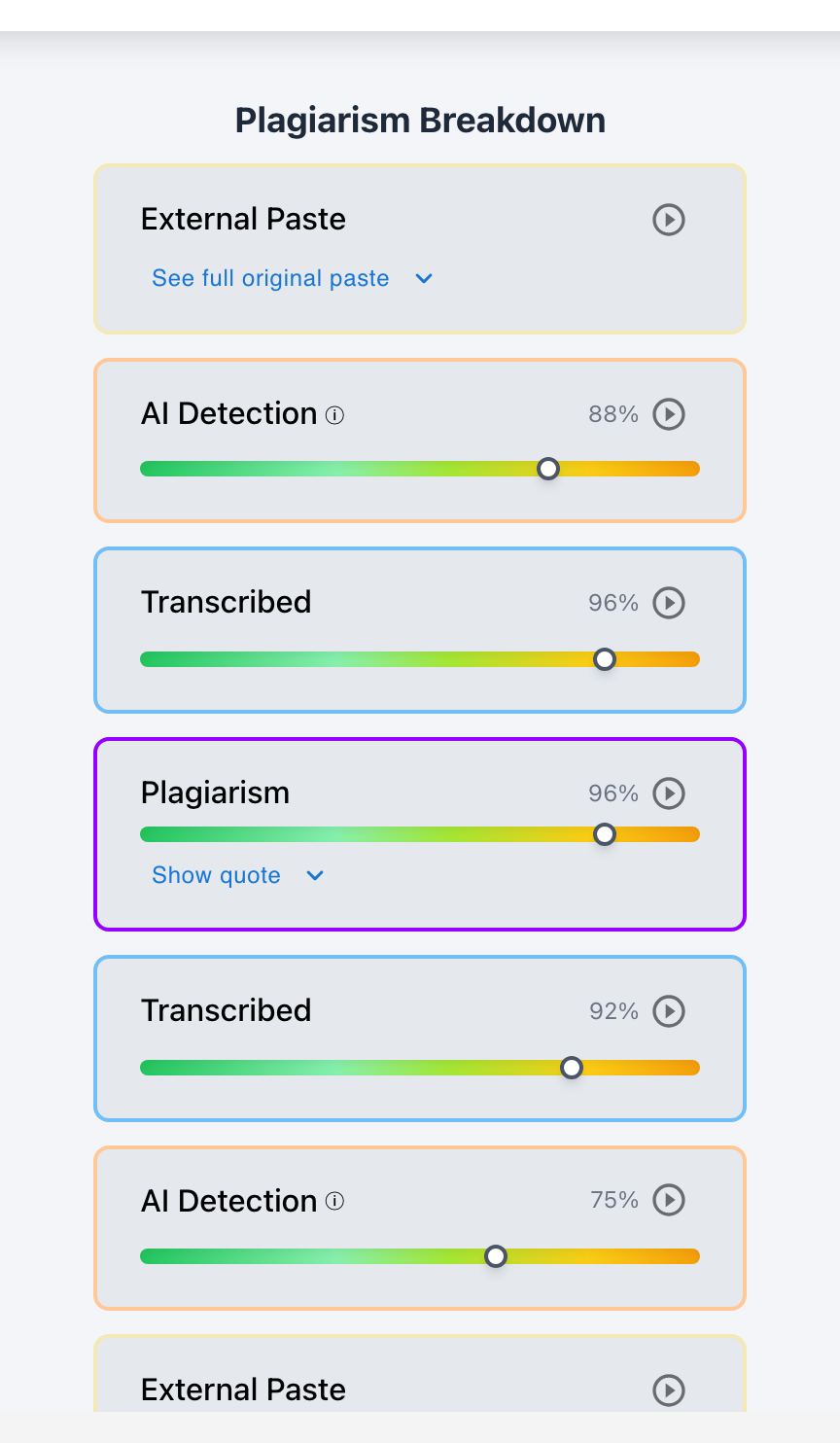
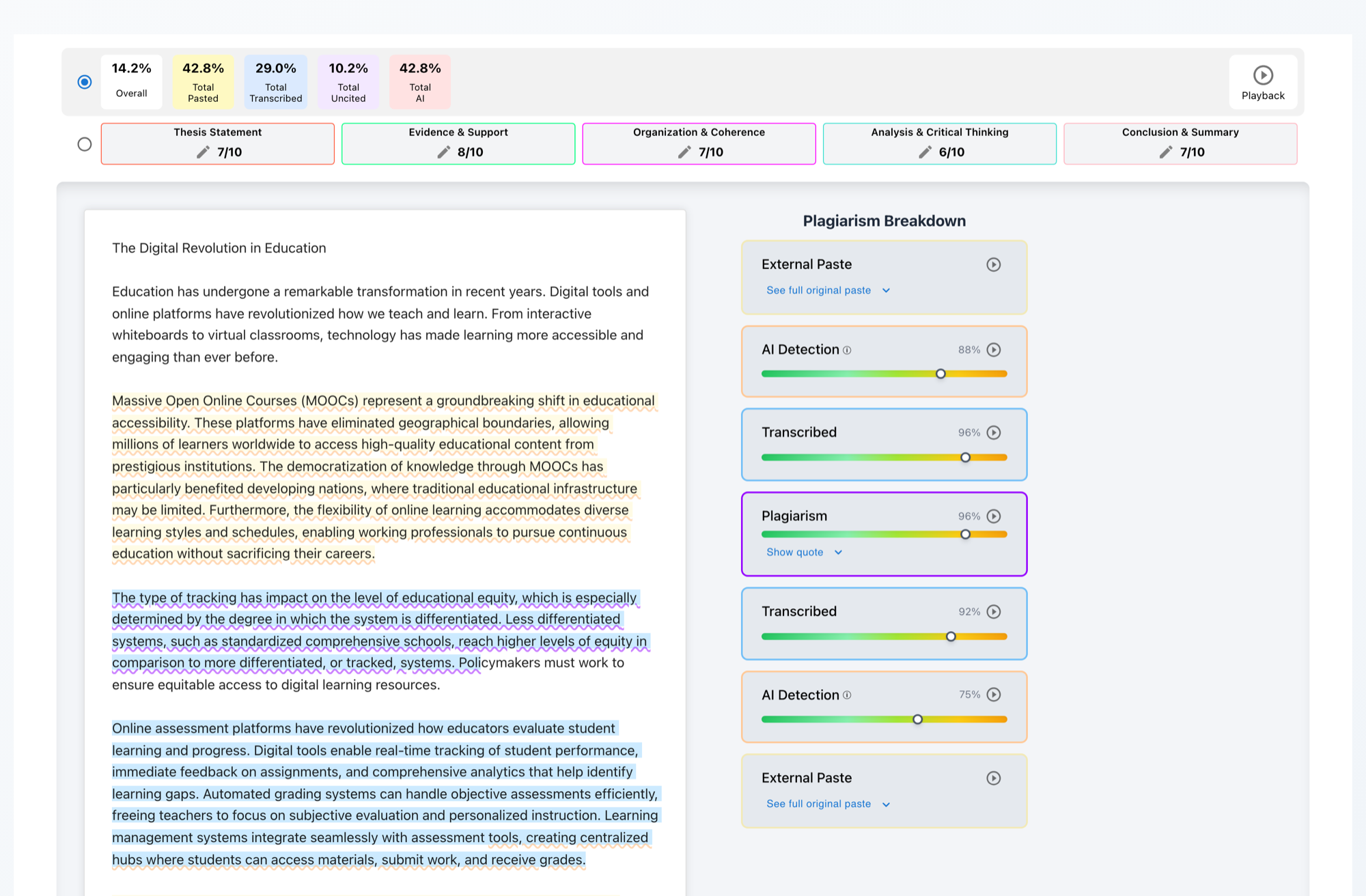
- Passage-Level AI Analysis: Calibrated confidence sliders with <150-word honest guardrails (displays N/A on short texts to prevent false positives). Flags are private to educators.
- Dual-Pane Plagiarism Verification: Scans billions of live web pages and peer archives with side-by-side quote comparisons and dedicated uncited source coaching styles.
- Teacher-in-the-Loop Autograding: Generates quote-anchored rubric justifications that remain drafts until approved by the teacher, then pushes final scores to the LMS gradebook.
- Zero-Retention Security: Verifies that no student text is cached or used for AI model training.
3.2 Patent-Pending Essay Playback™: The Evidentiary Engine
At the core of Checkmark Plagiarism’s checkpoint architecture is Essay Playback™, a patent-pending telemetry engine that transforms how educators evaluate writing authenticity:
4. Ready-to-Adopt Modular Syllabus Policy Clauses
To assist English Department Chairs, Writing Program Administrators, and Faculty in modernizing their course policies, Checkmark Plagiarism provides Three Modular Syllabus Policy Models paired with Universal Mandatory Addenda.
Departments should select the policy model (Permissive, Scaffolded, or Strict) that matches their pedagogical goals, and pair it with the Universal Addenda to ensure full legal, due process, and FERPA protection.
Selecting Your Departmental Syllabus Policy Model
Permissive / Exploratory
Best For: Advanced rhetoric, digital humanities, creative writing, and AI-integrated courses.
Philosophy: AI is an active collaborator; student must disclose and reflect on cognitive synergy.
Scaffolded / Balanced
Best For: Core composition (English 101/102), secondary ELA (Grades 9–12), AP Seminar/Lang.
Philosophy: AI permitted during ideation and polishing; core drafting and synthesis remain human.
Strict / Closed Process
Best For: Foundational grammar, timed diagnostic essays, and developmental writing courses.
Philosophy: Zero generative AI allowed; standard spellcheck and basic grammar checkers permitted.
4.1 Modular Policy Clause Options
### Academic Integrity & Generative AI Policy: Exploratory Framework
In this course, we recognize generative artificial intelligence (e.g., ChatGPT, Claude, Gemini) as powerful cognitive tools that are transforming professional and academic communication. You are permitted and encouraged to utilize generative AI technologies as assistive partners in your research, brainstorming, concept mapping, and drafting processes, subject to the following professional standards:
- Mandatory Disclosure & AI Process Documentation: If you utilize generative AI tools at any stage of an assignment, you must include an “AI Process Appendix” detailing: (a) the specific tool and model version used, (b) the primary prompts entered, (c) how you evaluated and verified the AI output for factual accuracy and bias, and (d) how you refined the generated material into your own authentic voice.
- Intellectual Responsibility & Authorship: You remain 100% intellectually and ethically responsible for every word, claim, calculation, and citation submitted. AI hallucinations, fabricated citations, or unverified claims will be evaluated as academic deficiencies under the grading rubric.
- Restorative Telemetry Verification: All drafting must occur within the approved course writing environment (Checkmark-integrated Google Docs / Canvas / Buzz LMS). Your writing process telemetry—including ideation logs, Essay Playback™ drafting sessions, and revision sprints—serves as your primary defense and portfolio of authentic intellectual labor.
### Academic Integrity & Generative AI Policy: Scaffolded Process Framework
Writing is a vital mode of critical thinking, personal expression, and intellectual discovery. To ensure you develop authentic foundational rhetoric and reasoning skills while learning to navigate modern digital tools responsibly, this course employs a Scaffolded AI Integrity Framework aligned with our 4-Stage Checkpoint System:
- Permitted AI Uses (Stage 1 & Stage 3):
- Brainstorming & Concept Exploration (Checkpoint 1): You may use AI to explore topic ideas, generate counterarguments, or discover primary research angles, provided all prompts are logged in your Topic & Source Matrix.
- Grammar, Mechanics & Clarity (Checkpoint 3): You may use standard assistive tools (spellcheck, basic grammar assistants, bilingual translation) to polish your independently drafted prose.
- Prohibited AI Uses (Stage 2 & Final Submission):
- You may NOT use generative AI to write, outline, draft, or synthesize your thesis statement, core body paragraphs, textual analysis, or conclusion.
- You may NOT pass your draft through AI “paraphrasers,” “humanizers,” or text spinners to evade detection.
- Milestone Telemetry & Essay Playback™ Verification:
- All major essays must be composed in our designated Checkmark-integrated writing platform. The system records your authentic writing process telemetry (keystrokes, drafting pauses, and revision history).
- In the event of a question regarding authorship, we will co-view your Essay Playback™ timeline together in a supportive, restorative conference. If authentic process telemetry is present, your work is fully validated.
### Academic Integrity & Generative AI Policy: Closed Process Framework
The core objective of this course is the cultivation of your independent voice, analytical reasoning, and compositional fluency. To ensure that every student masters the foundational architecture of rhetoric without automated shortcuts, the use of generative artificial intelligence tools (including text generators, automated paraphrasers, and AI outline creators) is strictly prohibited on all coursework.
- Permitted Assistive Utilities: Standard word processor spellcheckers, built-in dictionary tools, and basic grammar checkers are fully permitted.
- Prohibited Technologies: Any tool that generates original text, restructures entire paragraphs, or synthesizes source material via generative AI (including ChatGPT, Claude, Gemini, QuillBot, and Undetectable AI) is not permitted.
- Telemetric Proof of Authorship:
- To guarantee a level playing field and eliminate subjective guesswork, all drafting must be completed in the course-approved writing environment.
- The platform’s patent-pending Essay Playback™ will record your real-time typing dynamics, composing pauses, and revision sprints.
- We do not use automated, punitive black-box AI percentage scores to penalize students. Your authentic, continuous keystroke drafting history is your complete and defensible proof of independent authorship.
4.2 Universal Mandatory Addenda (Include with Any Model)
Every syllabus—regardless of whether Model A, B, or C is selected—must include the following four structural addenda to guarantee legal due process, FERPA compliance, and procedural transparency.
Section 1: Approved Technical Writing Environments
To enable transparent process verification and protect your work against unfounded integrity disputes, all formal writing assignments must be composed directly within the institutionally supported writing environment:
- Canvas LMS / Buzz LMS Embedded SpeedGrader Editors with active Checkmark integration; OR
- Google Docs / Microsoft Word utilizing the authorized institutional Checkmark Writing Process Extension.
Important Notice on External Drafting: Drafting essays in offline, unmonitored local text editors (e.g., Apple Notes, Microsoft Notepad) and pasting large blocks of finished text into the final submission interface prevents the system from capturing your authentic keystroke telemetry. If you compose notes externally, you must preserve your timestamped research notes and be prepared to demonstrate your drafting process during milestone check-ins.
Section 2: The 4-Stage Restorative Milestone Checkpoint Protocol
Writing assessment in this course is structured around four developmental milestones. Meeting each milestone is a required component of assignment completion:
- Checkpoint 1: Topic, Thesis & Source Matrix: Submission of research plan, primary quotations, and concept outline.
- Checkpoint 2: First-Draft Telemetry Baseline: Live drafting in the approved editor to establish authentic temporal baseline via Essay Playback™.
- Checkpoint 3: Revision Sprints & Peer Review: Documented structural revisions and responses to formative feedback.
- Checkpoint 4: Final Multi-Factor Dossier & Evaluation: Generation of comprehensive dossier (passage-level AI analysis, dual-pane plagiarism source proof, teacher-in-the-loop rubric grading).
Section 3: Evidentiary Standards and Disputed Submissions Protocol
In accordance with institutional policy and constitutional due process (Goss v. Lopez), this course strictly prohibits assigning academic or disciplinary penalties based solely on automated, third-party AI probability percentages.
If a submission exhibits significant telemetric anomalies (such as instantaneous mass pastes of uncredited text or mechanical transcribing cadence) or passage-level pattern flags, the following Restorative Co-Viewing Protocol will be initiated:
- Notice & Safe Harbor: The instructor will mark the assignment as “Incomplete / Under Review” in the LMS gradebook. No punitive zero or disciplinary referral will be entered.
- Restorative Co-Viewing Conference: The student and instructor will meet for an informal 15-minute conference to co-view the Essay Playback™ timeline, examine the paste buffer history, and discuss the student’s research and writing choices.
- Resolution Pathways:
- Exoneration: If the keystroke timeline demonstrates authentic drafting, the submission is immediately approved for full grading without prejudice.
- Restorative Revision Contract: If unauthorized AI generation or uncredited copy-pasting is identified, the student is granted a 72-hour revision window to redraft the assignment under a structured revision sprint contract for full mastery credit, accompanied by a targeted citation or writing coaching module.
Section 4: FERPA, Data Sovereignty, and AI Privacy Rights
Your intellectual property, personal data, and written work are protected under the Family Educational Rights and Privacy Act (FERPA, 34 CFR Part 99) and state student privacy statutes.
This course utilizes Checkmark Plagiarism, an enterprise-grade academic integrity platform that operates under a strict Zero-Data Retention Guarantee:
- Your essays, drafts, and keystroke logs are encrypted in transit and at rest.
- Your work is NEVER shared with commercial third parties, cached in public databases, or used to train commercial generative AI or large language models.
- All AI-assisted rubric evaluations remain private instructor drafts until reviewed, modified, and finalized by the course instructor.
5. Departmental Implementation Blueprints & Workflows
Adopting restorative syllabus language requires a coordinated departmental strategy. ELA Department Chairs, Writing Program Administrators (WPAs), and Academic Integrity Officers can use the following blueprints to ensure seamless rollouts across high school departments, writing programs, and multi-section college courses.
- Audit existing syllabi across all sections to remove legacy black-box detector clauses.
- Select standardized departmental policy model (Model A, B, or C) for each course tier.
- Conduct faculty norming workshops on interpreting Essay Playback™ timelines and pause dynamics.
- Integrate Checkmark LTI 1.3 tools into Canvas SpeedGrader, Buzz LMS, and Google Classroom.
- Verify single sign-on (SSO) and configure direct gradebook rubric passback.
- Publish student-facing onboarding guide: “How Writing Telemetry Protects Your Work.”
- Track Checkpoints 1–3 as low-stakes formative benchmarks in the LMS gradebook.
- Utilize Checkmark’s teacher-in-the-loop autograder to generate quote-anchored rubric feedback.
- Execute Restorative Co-Viewing Conferences for any submissions with telemetry anomalies.
- Academic Integrity Committee reviews telemetry dossiers for any contested grades.
- Evaluate departmental data: measure false-positive reductions and student retention gains.
- Iterate syllabus language based on faculty and student conference feedback.
5.1 Departmental Misconduct Triage Flowchart
When an integrity issue arises, faculty and department leaders must follow a standardized, non-punitive triage workflow:
- Natural composing pauses & cadence
- Rich revision loops / backspacing
- Passage-level sliders clear
- Instant 500+ word paste event
- Mechanical transcribing typing velocity
- Uncredited live web matches
Student explains process • Telemetry validates labor • Full credit awarded without stigma
Unauthorized AI acknowledged • 72-hr rewrite sprint in Checkmark • Citation coaching

6. Restorative Co-Viewing Protocols: Scripts and Investigative Workflows
The restorative conference is the pedagogical cornerstone of Checkmark’s syllabus policy. Unlike an adversarial interrogation, a restorative co-viewing session is an educational conversation grounded in shared, objective evidence.
The Supportive Initial Check-In (Exploring an External Paste Flag)
“Hi Alex, thank you for meeting with me today. I really enjoyed the core argument of your draft on renewable energy subsidies. As you know from our syllabus, we use Checkmark’s Essay Playback™ to help track writing milestones and protect everyone’s original work. When I opened your drafting timeline, I noticed that around minute 14, a 450-word section was pasted into body paragraph two all at once. Let’s pull up the timeline together on my screen. Can you walk me through where those notes were gathered and how you assembled that section?”
“Oh, yeah! I was doing my research at the library on my tablet over the weekend and typed out my initial source summaries into Google Keep. Then when I sat down to draft the main essay on my laptop, I copied those notes over into the document.”
“That makes complete sense! Let’s click the ‘View Original Pasted Text’ button in Checkmark to look at the raw clipboard snapshot. We can see your raw bullet points from Google Keep right here, and then in the playback from minute 16 to 28, we can watch you expanding those bullets into full analytical sentences. That confirms your authentic process. For our next paper, remember our syllabus guideline: try to do that initial drafting directly in the Checkmark editor so you don’t even have to worry about a paste flag. I’ll clear this flag and approve your draft for final peer review.”
Resolving a Disputed False Positive (Exonerating an Honest ELL Student)
“Professor, I heard other students talking about AI flags, and I’m terrified. English is my second language, and I always write using very formal sentence templates that I learned in prep school. Did I get flagged?”
“Take a deep breath, Maria. Our course syllabus explicitly states that we do not use whole-paper black-box percentages to judge your work. Let’s open your Checkmark Multi-Factor Integrity Dossier right now. Look at your Essay Playback™ timeline: over the course of three hours and twenty minutes, we see 2,400 discrete keystrokes, 320 backspace deletions, and several long pauses where you stopped to revise your vocabulary and reorder clauses.
Furthermore, Checkmark’s passage-level confidence sliders show that your vocabulary aligns with standard formal academic syntax, not automated LLM generation. Your drafting telemetry provides 100% forensic proof that this is your authentic writing. You are completely exonerated, and your grade is based purely on our rubric criteria.”
“Thank you so much. In my other class, the professor just gave me a zero on an essay because of a detector percentage and wouldn’t even let me explain.”
“That’s exactly why our department updated our syllabus to require writing telemetry. Your effort and growth are what matter here.”
Navigating Confirmed Authorship Fraud with a Restorative Revision Contract
“Jordan, let’s look at the playback timeline together. We can see that the entire draft was pasted in at 2:15 AM in two large blocks, with only 4 minutes of total active editing time. In Checkmark’s Paste Buffer Inspector, we can also see the telltale introductory phrasing generated by an LLM prompt. Can you tell me what happened leading up to the deadline?”
“I’m sorry, Professor. I had two exams on Thursday and my shift ran late at work. It was 2 AM, I panicked, and I pasted the prompt into ChatGPT. I’ve never done that before, and I felt terrible the second I submitted it.”
“I appreciate your honesty in telling me the truth right now. Acknowledging a mistake is the first step in restorative integrity. Under our course syllabus, we do not issue an automatic F or send you to the disciplinary board for a first-time panic lapse. Instead, we activate our Restorative Revision Contract.
Here is what we are going to do: You have 72 hours to complete a structured rewrite of this essay. You will complete Checkpoint 1 (Source Matrix) by tomorrow afternoon, and you will draft the full paper directly within the Checkmark editor so we can see your authentic Essay Playback™ timeline. If you complete the revision sprint and meet our rubric criteria, you will receive full earned academic credit, minus a standard late turnaround deduction. Does that feel like a fair path forward?”
“Yes, absolutely. Thank you for giving me a chance to actually do the work.”
7. Real-World Institutional Case Studies
The implementation of restorative syllabus language supported by Checkmark Plagiarism has been rigorously tested across diverse institutional environments. Below are three representative case studies demonstrating measurable outcomes.
Major State University (40-Section Sequence)
Challenge: 120+ contested AI misconduct appeals, faculty burnout, grievance board gridlock under vague prohibition policies.
Intervention: Universal adoption of Syllabus Model B paired with Canvas SpeedGrader Checkmark sync and faculty norming workshops.
Suburban High School (1,800 Students)
Challenge: Parent revolts over unverified 68% AI detector score disqualifying an honors student; disparate impact on multilingual writers.
Intervention: Department-wide 4-checkpoint syllabus standard + Buzz LMS & Google Docs telemetry capture.
Community College Distance Sequence
Challenge: High attrition (34% non-completion) in asynchronous online composition due to unverified AI cheating flags.
Intervention: Asynchronous screen-share co-viewing protocol + enterprise zero-retention guarantee.
8. Frequently Asked Questions (FAQs) for Chairs, WPAs, and Faculty
1. Why is a blanket prohibition clause legally vulnerable in public education institutions?
A blanket prohibition clause (e.g., “All AI is strictly forbidden”) fails to define the boundaries of modern writing tools. Because common word processors, search engines, and accessibility tools (spellcheck, autocomplete, translation tools) now embed generative algorithms, a vague prohibition violates the constitutional standard of fair notice under Goss v. Lopez. Students cannot reasonably know which digital tools constitute violations, making subsequent disciplinary sanctions legally vulnerable to procedural due process challenges.
2. How does Checkmark’s Essay Playback™ differ from standard Google Docs revision history?
Standard Google Docs revision history captures periodic, uncompressed document snapshots at irregular intervals (often 15 to 30 minutes apart). It does not capture discrete keystroke dynamics, micro-pauses, or typing cadence. Furthermore, if a student pastes text from an external source, Google Docs only records the resulting text—it does not preserve the original clipboard snapshot. Checkmark’s patent-pending Essay Playback™ records continuous, millisecond-accurate keystroke telemetry, visualizes cognitive pause distribution across time, and captures 100% of external paste buffer data, preserving the exact original pasted text even if every word is later edited or deleted.
3. What should faculty do if a student drafts an essay offline in an unmonitored text editor?
Our Universal Syllabus Addendum (Section 1) explicitly addresses offline drafting. If a student pastes a completed essay from an external editor, the instructor marks the submission as “Incomplete / Under Review” and schedules a brief restorative conference. The student is asked to present their timestamped research notes, outline, or browser history, and complete a 10-minute live writing/revision sprint in Checkmark. This confirms their intellectual grasp of the topic while reinforcing the expectation to draft in the supported environment for future assignments.
4. How does syllabus language handle AI-powered grammar assistants (Grammarly, QuillBot) without causing false accusations?
Our syllabus models establish a clear distinction between Assistive Utility Tools (spelling, basic grammar correction, bilingual vocabulary lookup) and Generative/Transformative Tools (paragraph restructuring, tone rewrites, automated text generation). Furthermore, Checkmark’s multi-factor analysis does not flag standard grammar corrections as machine authorship because the underlying Essay Playback™ telemetry validates that the student authored the core sentences.
5. Can a student refuse to use writing telemetry on FERPA or privacy grounds?
No. Writing telemetry recorded within an approved educational platform (Canvas, Buzz, Google Docs) is a direct educational record governed by FERPA. Checkmark Plagiarism operates under a strict Enterprise Zero-Retention Guarantee: student submissions are encrypted, never sold, and never used to train public or commercial AI models. Because the platform protects student data sovereignty and does not harvest student prose, institutional adoption complies fully with FERPA (34 CFR Part 99), COPPA, and state student privacy regulations.
6. How do restorative checkpoints save faculty grading time while preventing dishonesty?
Traditional AI policing requires instructors to spend hours manually investigating suspicious text, running secondary detector scans, writing misconduct reports, and attending contentious grievance hearings. Checkmark’s 4-stage checkpoint architecture automates verification: (1) Essay Playback™ validates drafting authenticity in 30 seconds of timeline scrubbing, (2) the teacher-in-the-loop autograder generates quote-anchored rubric feedback aligned with assignment criteria, and (3) final grades and feedback push directly to Canvas SpeedGrader, Buzz LMS, or Google Classroom with a single click.
7. What specific wording prevents students from claiming they “didn’t know” an AI tool was unauthorized?
Our Recommended Syllabus Clause (Model B) clearly itemizes permitted vs. prohibited uses by assignment milestone. Permitted activities (brainstorming in Checkpoint 1, proofreading in Checkpoint 3) are explicitly defined, while prohibited activities (generating body paragraphs, using text humanizers/paraphrasers in Checkpoint 2) are unequivocally barred. This eliminates plausible deniability and satisfies the legal requirement of specific prior notice.
8. How does direct LMS grade passback ensure due process compliance during gradebook audits?
Checkmark’s seamless LTI 1.3 integration with Canvas, Buzz, and Google Classroom ensures that all rubric justifications, quote-anchored feedback, and telemetric audit logs are permanently stored directly within the student’s institutional LMS gradebook record. If a grade or integrity finding is audited by a department chair, dean, or parent, the complete multi-factor dossier—including the Essay Playback™ recording—is immediately accessible, eliminating reliance on private instructor notes or inaccessible third-party portals.
9. Conclusion: Restoring Trust in the Writing Classroom
The generative AI era does not require educators to abandon writing assessment, nor does it require institutions to transform classrooms into hostile surveillance environments. The failure of traditional “zero-tolerance” syllabus clauses has revealed an undeniable truth: policing outcomes through black-box algorithms destroys student-teacher relationships and invites legal vulnerability.
By adopting legally sound, pedagogically transparent Restorative AI Integrity Checkpoints powered by Checkmark Plagiarism, secondary departments and university writing programs can construct an assessment environment where:
- Faculty are protected from ambiguous policies and contentious grading disputes.
- Students are granted full constitutional due process and clear behavioral boundaries.
- Honest, diverse, and multilingual writers are permanently shielded from false accusations.
- Struggling students are guided through restorative, mastery-based revision pathways.
Stop Guessing, Start Trusting
Equip your department with contractually defensible syllabus language, patent-pending writing process telemetry, and seamless LMS grading integrations. Protect your faculty, empower your students, and preserve the integrity of authentic writing.