
The proliferation of generative AI has thrust secondary school English departments and high school leadership into an acute institutional, legal, and human relations crisis. High school English Language Arts (ELA) teachers, department chairs, academic integrity committees, and building principals routinely find themselves caught in high-stakes disputes: automated AI detectors flag student essays with opaque, uncalibrated probability scores (e.g., “78% AI-Generated”), students passionately maintain their innocence, and defensive parents threaten legal or administrative escalation.
When schools react through traditional zero-tolerance paradigms—imposing automatic zeroes (0%), disciplinary write-ups, and adversarial confrontations—they shatter student-teacher trust, punish formulaic developmental writers, and expose districts to procedural due process violations under Goss v. Lopez and FERPA inspection mandates. High school writing programs must transition from punitive suspicion to Restorative Academic Integrity Conferencing. Grounded in Checkmark Plagiarism’s core philosophy—“Stop guessing, start trusting”—this framework replaces black-box detector scores with objective writing process telemetry.
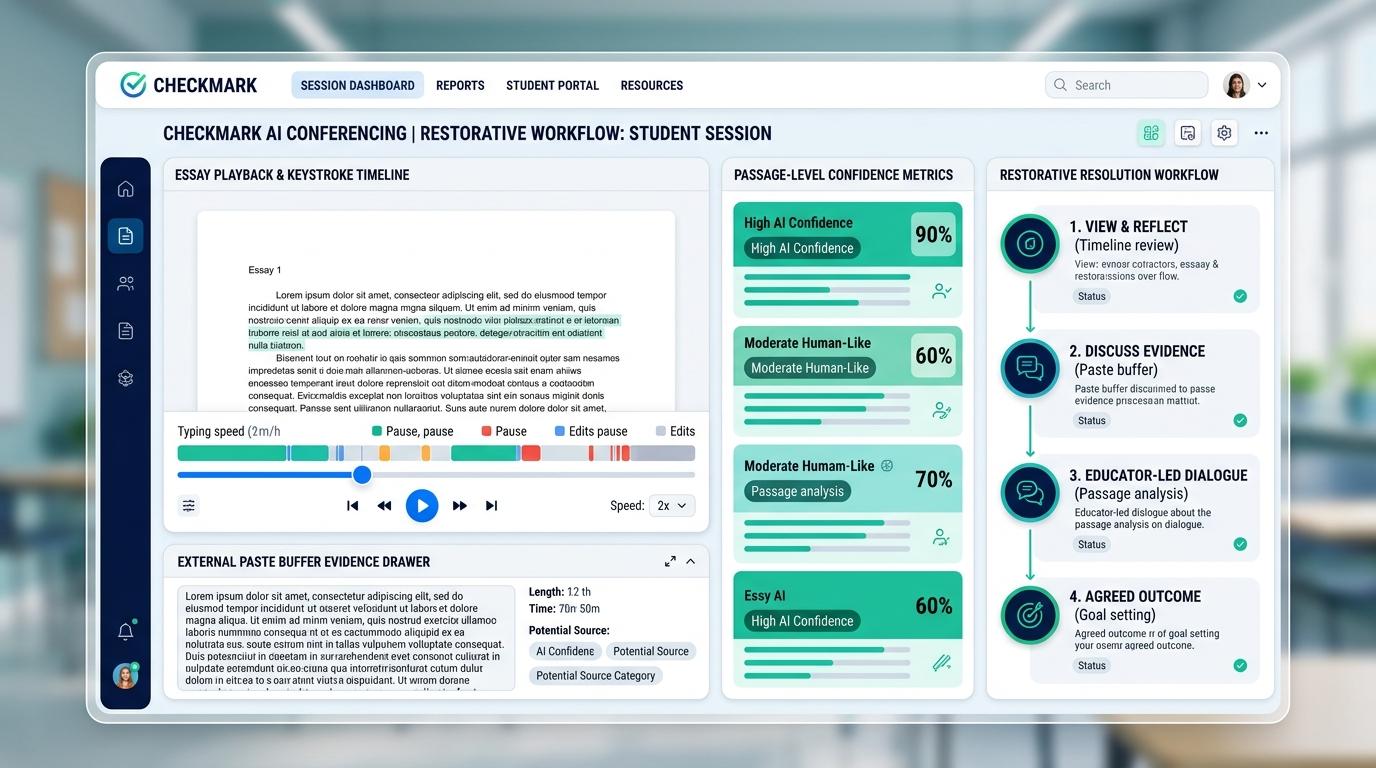
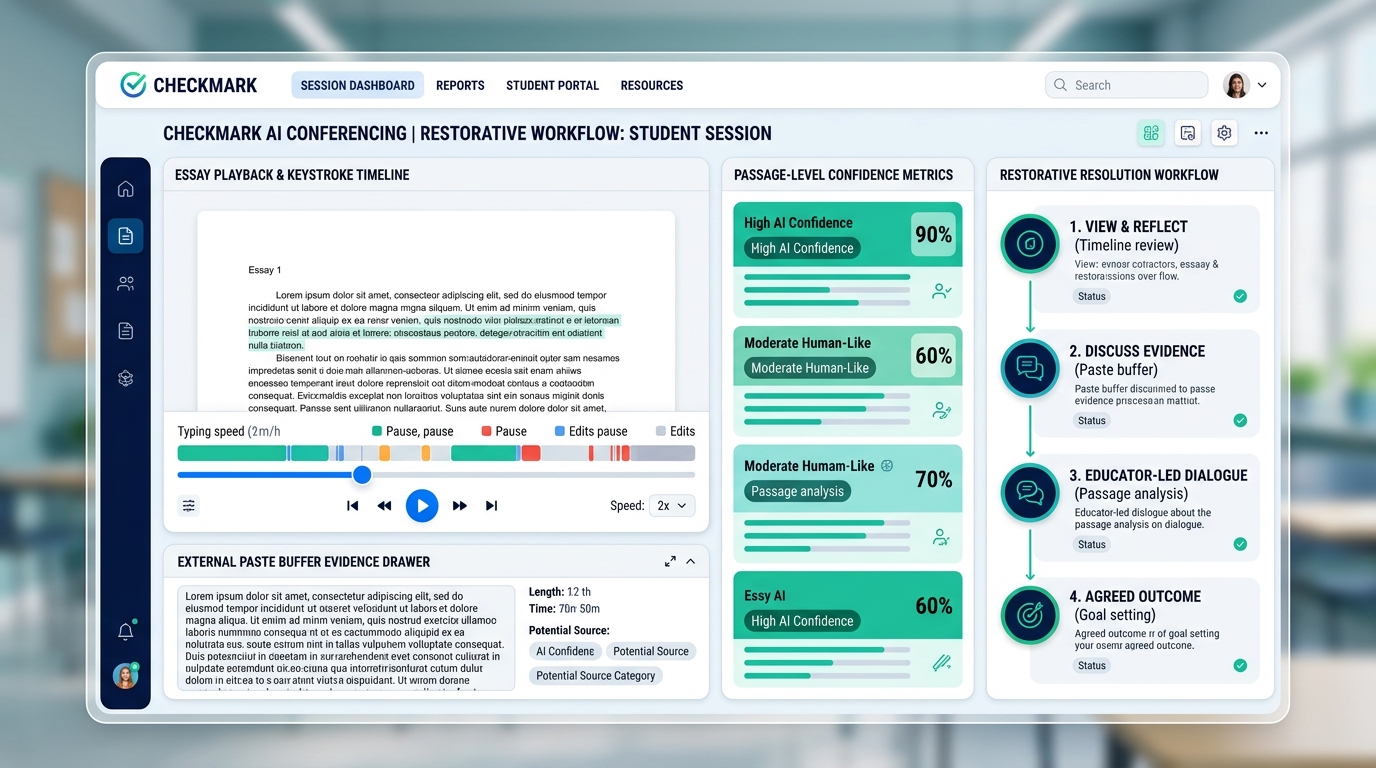
Powered by patent-pending Essay Playback™ (1x–8x scrubbable keystroke video replay, pause topography, and 100% paste buffer preservation), passage-level AI confidence sliders with <150w guardrails, dual-pane plagiarism source verification, and teacher-in-the-loop rubric autograding synced with Canvas LMS, Buzz LMS, and Google Classroom, educators can conduct structured, 15-minute Socratic conferences that de-escalate conflict, diagnose root learning obstacles, exonerate honest students, and guide struggling writers along structured pathways to authentic academic mastery.
Checkmark Plagiarism equips high school writing departments, ELA chairs, academic integrity committees, and principals with writing process forensics and enterprise LMS integrations across Canvas SpeedGrader, Buzz LMS, and Google Classroom.
1. The High-Stakes Crisis: Why Traditional AI Accusations Are Breaking Secondary Schools
Secondary English departments and high school administrators today operate on the front lines of an acute pedagogical dilemma. In nearly every comprehensive high school, magnet academy, and suburban district, teachers and instructional leaders are confronted by a recurring, exhausting scenario:
Generated by standalone black-box neural classifier
Teacher flags misconduct and logs disciplinary report
Student insists on innocence; feels villainized
Parents demand technical proof, GPA protection
Attorney retention, board appeals, inspection demands
Principal forced to overturn zero or crush faculty morale
When a teacher submits an 11th-grade argumentative paper to a first-generation, standalone AI detector, the software returns a whole-document percentage score: 78% AI. Under legacy academic integrity policies designed decades ago for commercial paper mills, the teacher feels compelled to assign an immediate zero, issue an academic misconduct referral, and notify parents.
The fallout is immediate and destructive:
- The Student’s Despair: The student passionately insists they wrote the paper independently—perhaps utilizing permitted grammar tools, translating a phrase from their primary language, or drafting after hours of struggling with an outline. They feel branded as a cheat without being afforded the opportunity to explain their process.
- The Parent’s Outrage: Parents, alarmed by the threat to their child’s Grade Point Average (GPA), college admissions prospects, and honor society status, respond defensively. They demand technical proof of the allegation, question the teacher’s competence, and escalate the dispute directly to the principal, superintendent, or school board.
- The Administrator’s Gridlock: Building principals and department chairs are left trapped between supporting faculty judgment and facing indefensible administrative positions. Because the commercial detector provides only an uncalibrated probability percentage rather than tangible forensic receipts, the school cannot meet basic evidentiary standards.
The Three Systemic Failures of the Punitive Zero-Tolerance Paradigm
Mathematical & Pedagogical Destruction
A single zero (0%) on a 100-point scale inflicts catastrophic mathematical damage, carrying 6x the mathematical weight of any standard letter grade band (an “F” spans 0–59%, whereas A, B, C, and D span only 10% each). A single zero drops a student’s semester grade by 15–20 percentage points, rendering academic recovery virtually impossible. Grades cease to measure standards mastery and become punitive behavioral penalties.
Evidentiary Vulnerability & False-Positive Injustice
Black-box AI detectors measure surface statistics (perplexity and burstiness) that penalize formulaic developmental writing, standard five-paragraph essay structures, and English Language Learner (ELL) syntax. Statistical classifiers cannot sustain legal burdens of proof in public secondary education, leaving districts defenseless in administrative appeals.
Relational Alienation & Adaptive Cheating
Punitive zero-tolerance policies do not deter dishonesty; they incentivize students to hide struggles, employ multi-tiered AI humanizers, or retype generated text character-by-character from secondary devices. The teacher-student relationship shifts from collaborative mentorship to adversarial policing.
To resolve this crisis, high school writing programs must abandon the adversarial zero-tolerance model and establish Restorative AI Conferencing Protocols. Academic integrity is not a binary switch to be enforced through automated punishment; it is a developmental competency that must be cultivated through transparent, evidence-backed dialogue.
2. Legal, Constitutional, and Due Process Mandates in Secondary Writing Assessment
Before designing a department-wide conferencing protocol, instructional leaders and academic integrity committees must examine the legal and statutory frameworks governing student discipline and academic records in secondary education.
Goss v. Lopez (419 U.S. 565)
- Public school students hold constitutionally protected property and liberty interests in academic standing.
- Disciplinary penalties require timely notice, disclosure of primary evidence, and an informal hearing before sanctions.
- Monolithic AI detector percentages fail all three prongs of procedural due process.
FERPA (34 CFR § 99.10)
- Parents and eligible students possess statutory rights to inspect all primary records and evidentiary logs.
- Vendor algorithms cannot be shielded as “proprietary trade secrets” when used for adverse student evaluations.
- Uploading student essays to vendors that train future LLMs violates federal privacy protections.
Standards-Based Grading
- State assessment codes require grades to reflect demonstrated academic mastery of standards.
- Leading scholars (Guskey, Reeves) prove behavioral penalties must not distort proficiency scores.
- Suspected AI usage is an authorship and attribution failure requiring revision, not a permanent zero.
The Constitutional Mandate: Goss v. Lopez and Procedural Due Process
In Goss v. Lopez (419 U.S. 565), the United States Supreme Court established that public school students possess legitimate property and liberty entitlements to public education protected by the Due Process Clause of the Fourteenth Amendment. When an academic dishonesty accusation results in disciplinary consequences—such as formal reprimands, suspension from extracurricular activities, loss of honor society eligibility, or academic transcript notations—the school must satisfy three basic procedural requirements:
- Timely, Specific Notice: The student must be informed of the specific nature of the alleged infraction prior to the imposition of any sanction.
- Disclosure of Primary Evidence: The school must present the substantive basis for the allegation, allowing the student to examine the exact evidence in question.
- Meaningful Opportunity to Respond: The student must be granted an opportunity to present their version of events in a fair, non-coercive setting.
Relying solely on a third-party commercial AI detector score fails all three prongs of procedural due process. A probabilistic percentage (e.g., “This text is 81% likely to be machine-generated”) does not identify specific copied passages, does not reveal the underlying data model, and cannot be independently audited by the student or parent.
The Federal Statutory Mandate: FERPA (34 CFR Part 99 § 99.10)
Under the Family Educational Rights and Privacy Act (FERPA), parents and students over the age of 18 have the legal right to inspect all education records directly related to the student maintained by an educational agency.
When a school district takes an adverse academic or disciplinary action based on automated edtech software, the district is legally obligated to provide parents with the foundational data supporting that decision. If a school relies on a vendor that maintains a “black-box” model where the internal feature scoring cannot be reviewed, the district faces severe compliance exposure. Furthermore, uploading student essays to unvetted third-party platforms that retain student prose to train future AI models violates FERPA’s strict third-party data disclosure protections.
The Pedagogical Reform Mandate: Separating Mastery from Behavior
Leading assessment scholars, including Dr. Thomas Guskey (On Your Mark: Challenging the Conventions of Grading and Reporting) and Dr. Douglas Reeves (Elements of Grading), have proven that combining academic measurement with behavioral punishment invalidates gradebook data:
| Assessment Dimension | Traditional Punitive System (0%) | Restorative Telemetry Workflow (INC / Revision) |
|---|---|---|
| Gradebook Status | Assigns immediate 0% (Grade = F). | Marks assignment as “Incomplete / Under Review” (INC). |
| Semester GPA Impact | Student average drops 15–20 percentage points; recovery impossible. | Preserves baseline standard validity; temporary hold pending revision. |
| Accountability Pathway | Passive behavioral punishment; student disengages or cheats smarter. | Structured 7-day Revision Contract to demonstrate authentic mastery. |
| Pedagogical Focus | Punitive compliance and disciplinary record keeping. | Diagnostic learning, metacognitive reflection, and writing growth. |
A restorative integrity workflow decouples the investigation of writing authenticity from gradebook destruction, treating unauthorized AI usage as an instructional failure of authorship and attribution rather than a permanent academic death sentence.
3. The Three Core Pillars of Restorative AI Integrity Conferencing
To operationalize restorative academic integrity across a secondary writing department, instructional leaders must ground their departmental protocols in three fundamental pillars.
Evidence-Grounded Neutrality
- “Stop guessing, start trusting”: Replace black-box detector percentages with scrubbable writing telemetry.
- Co-view typing cadence, pause topography, and clipboard logs on a shared screen.
- Dialogue centers on observable physical facts rather than moral accusations.
Diagnostic Socratic Inquiry
- Identify the underlying root cause: deadline panic, cognitive overload, research confusion, or tool drift.
- Separate intentional dishonesty from developmental writing struggles and multilingual syntax.
- Engage student in non-threatening metacognitive self-reflection.
Growth-Oriented Repair
- Replace permanent zeroes with structured Revision Mastery Contracts.
- Supervised drafting sprints in writing labs with Essay Playback™ active.
- Targeted citation and synthesis coaching; full standards-based credit recovery.
Pillar 1: Evidence-Grounded Neutrality (“Stop Guessing, Start Trusting”)
The bedrock principle of Checkmark Plagiarism’s philosophy is “Stop guessing, start trusting.” In an adversarial conference, the teacher acts as a prosecutor, presenting an AI detector score and demanding a confession. The student naturally becomes defensive, and the conversation devolves into a subjective “he-said-she-said” confrontation.
In contrast, restorative conferencing begins with Evidence-Grounded Neutrality. The teacher does not accuse; instead, the teacher and student sit side by side (or share a screen) to co-view the objective telemetry of the writing session:
- Real-Time Keystroke Playback: The educator opens the document’s timestamped reconstruction, observing drafting cadence, revision bursts, pauses, and backspacing.
- Paste Buffer Telemetry: Any external text introduced into the document is reviewed via preserved clipboard logs, revealing whether the paste was an original brainstormed outline, a teacher-provided prompt, or an unverified external output.
- Passage-Level Granularity: Rather than evaluating an arbitrary 0–100% whole-document score, the conference focuses specifically on underlined sentences with calibrated confidence sliders that explain typical human variance versus typical AI predictability.
When dialogue centers on observable telemetry rather than personal accusations, defensiveness dissolves. The student is presented with factual data about their document’s assembly, shifting the dynamic from confrontation to joint inquiry.
Pillar 2: Diagnostic Socratic Inquiry
Unauthorized AI generation rarely occurs in a vacuum of malice. In high school writing contexts, unauthorized tool usage is almost always a symptom of an underlying academic or emotional breakdown:
| Root Cause Category | Typical High School Scenario | Observed Telemetric Signature | Prescribed Restorative Remedy |
|---|---|---|---|
| 1. Deadline Panic & Cognitive Overload | Student faced 3 exams on Friday, panicked at 11:30 PM, and prompted ChatGPT for complete body sections. | Sudden external paste of 600w at 11:42 PM after zero prior typing activity on the LMS editor. | Time-management plan; supervised writing sprint on counterarguments. |
| 2. Research & Synthesis Breakdown | Student found complex scholarly articles, could not comprehend them, and used AI to summarize and paste. | High similarity match or AI paraphrased block with zero organic composing pauses or backspaces. | Writing Center coaching on synthesis, source mapping, and APA/MLA citation. |
| 3. Assistive Tool Permissibility Drift | Student drafted rough bullet points, then ran text through Grammarly GO or QuillBot to “sound smarter.” | Entire student draft replaced in 2 large clipboard overwrites with sudden burstiness shifts. | Voice & style coaching; explicit guidelines on assistive vs generative tools. |
| 4. Multilingual (ELL) Formulaic Style | Multilingual writer used standard structural sentence frames memorized in language acquisition modules. | Organic typing speed with high dictionary pause count; false-positive flag due to low perplexity. | Immediate exoneration; dismissal of all flags; praise for authentic composition. |
During a restorative conference, the teacher employs targeted Socratic questioning to identify which of these four scenarios took place. By diagnosing the root breakdown, the educator can prescribe an appropriate instructional remedy rather than a generic disciplinary sanction.
Pillar 3: Growth-Oriented Repair & Mastery Pathways
A restorative model demands that students who commit academic integrity breaches be held accountable—not through punitive isolation, but through active educational repair.
When an authentic breach is identified, the student is not assigned an irrecoverable zero. Instead:
- The original submission is marked as Incomplete / Revision Required in the LMS gradebook.
- The student signs a Restorative Revision Mastery Contract, agreeing to draft a revised essay under supervised conditions (e.g., in-class writing workshop, after-school writing center lab, or monitored digital drafting sprints).
- The student completes targeted remediation on ethical research, source attribution, or rhetorical outlining.
- Upon successful completion of the revised draft, the student receives the earned standards-based grade, reflecting their actual mastery of ELA standards.
Adversarial Zero-Tolerance vs. Restorative Conferencing Model
Zero-Tolerance Adjudication
- Evidence: Whole-document AI detector percentage score (e.g., 78% AI).
- Educator Role: Disciplinary prosecutor, investigator, and judge.
- Student Posture: Defensive denial, panic, and emotional alienation.
- Gradebook Action: Immediate permanent zero (0%); devastating semester average.
- Parent Dynamic: Adversarial legal threats, school board grievances.
- Long-Term Outcome: Students learn advanced detection evasion (AI humanizers).
- Administrative Cost: 10–20 hours of contentious appeals per dispute.
Restorative Conferencing Protocol
- Evidence: Patent-pending Essay Playback™ + timestamped paste buffer telemetry.
- Educator Role: Diagnostic writing coach and process facilitator.
- Student Posture: Reflective, collaborative, and engaged in learning.
- Gradebook Action: Temporary “Incomplete” hold pending revision mastery.
- Parent Dynamic: Supportive partnership focused on student skill building.
- Long-Term Outcome: Builds metacognitive writing stamina, citation ethics, and trust.
- Administrative Cost: 15-minute structured triage resolving issues immediately.
4. Checkmark Plagiarism’s Restorative Conferencing Suite
To execute restorative conferencing effectively, high school writing departments need purpose-built technology designed specifically for educational due process. Checkmark Plagiarism provides a comprehensive, multi-dimensional integrity platform built around transparency, diagnostic insight, and educator control.
1x–8x scrubbable video replay of keystroke cadence, pause topography, and recursive backspacing.
100% clipboard text preserved permanently at millisecond of insertion with Jump-to-Playback sync.
Passage-level confidence sliders, <150w honest guardrails, and dual-pane side-by-side source matching.
Criterion-by-criterion point breakdowns anchored to quotes in student text. Direct grade and formative feedback passback into Canvas SpeedGrader, Buzz LMS, and Google Classroom.
1. Patent-Pending Essay Playback™ (1x–8x Scrubbable Video Replay)
The centerpiece of Checkmark Plagiarism’s restorative suite is Essay Playback™. Unlike traditional word processing revision histories that only show coarse periodic snapshots, Essay Playback™ reconstructs the entire writing process keystroke-by-keystroke.
- Variable Playback Speed: Teachers and students can scrub through hours of composition at 1x, 2x, 4x, or 8x speed, watching the essay emerge organically.
- Cognitive Pause Topography: Visual indicators highlight where the student paused to formulate arguments, consult sources, re-read previous sentences, or restructure paragraphs.
- Revision Dynamics & Backspacing: Authentically drafted essays feature a rich texture of micro-revisions, typological corrections, and sentence reorganizations. Mechanical transcribing (e.g., copying off a mobile phone or second monitor) reveals an unnatural, robotic typing cadence with near-zero backspacing and uniform velocity.
- Shared Screen De-Escalation: Placing the scrubbable playback on a shared monitor during a conference eliminates tension. The student sees their own process reflected back to them, making honest dialogue natural and non-threatening.

2. External Paste Buffer Inspector with Complete Text Preservation
One of the greatest sources of friction in high school writing conferences is the ambiguity of pasted text. Traditional tools indicate that text was pasted, but cannot prove what was pasted or where it originated.
Checkmark’s External Paste Buffer Inspector preserves 100% of clipboard text introduced from outside the active editor:
- Permanent Clipboard Archive: Even if a student pastes a block of text and subsequently edits or rewrites every word, Checkmark preserves the full original raw pasted string in a timestamped evidence card.
- “Jump-to-Playback” Integration: Clicking on any paste evidence card instantly rewinds the Essay Playback™ timeline to the precise millisecond the paste occurred.
- Source Differentiation: Teachers can instantly distinguish between legitimate pastes (e.g., a student pasting their own pre-written thesis statement or a cited primary source excerpt) and illicit pastes (e.g., an entire 500-word block generated by an external LLM).
3. Multidimensional Integrity Evidence Dossier
Rather than relying on a single, misleading whole-paper percentage score, Checkmark generates a Multidimensional Integrity Dossier:
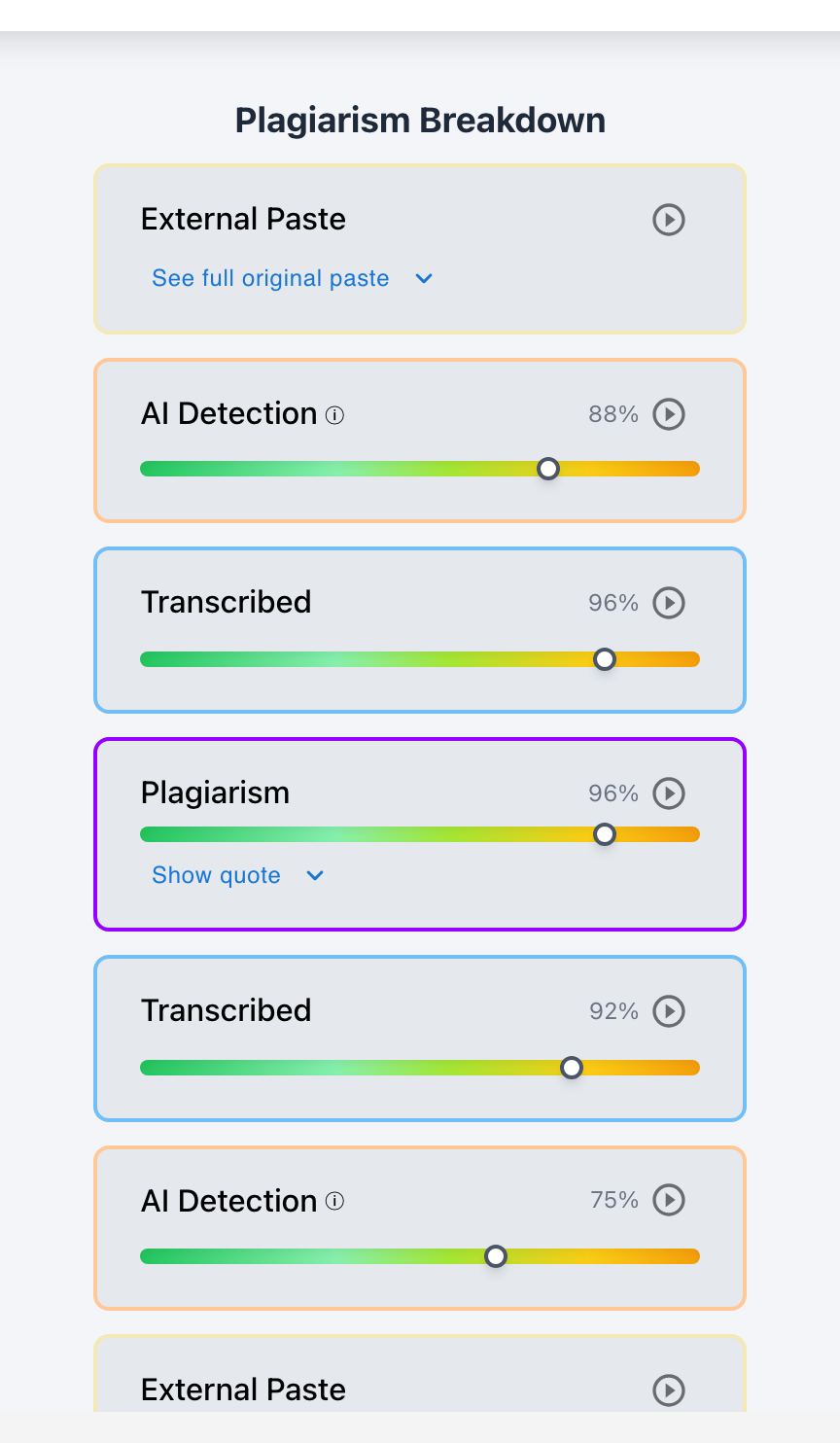
- Passage-Level AI Confidence Sliders: Specific sentences and paragraphs are underlined in the text with individual confidence cards in the sidebar. Each card features a calibrated slider demonstrating whether the phrasing exhibits typical human variance versus typical AI predictability (low perplexity, uniform burstiness).
- Honest Guardrails (<150 Words): Checkmark implements strict algorithmic guardrails. Any text snippet below ~150 words displays an
N/Aflag, acknowledging that short passages do not contain sufficient statistical tokens to make defensible AI determinations. - Dual-Pane Plagiarism Matching: Direct side-by-side quote comparisons match student prose against billions of live web pages, academic repositories, and peer submissions. Uncited source material is visually differentiated from improperly formatted citations, enabling targeted citation triage.
- Educator-Only Flag Statuses: Flag statuses (Flagged, Resolved, Not Flagged) remain strictly private to teachers until reviewed, preventing premature student panic.
4. Teacher-in-the-Loop AI Rubric Autograding & LMS Integration
Checkmark bridges academic integrity with standards-based instruction through its Teacher-in-the-Loop AI Rubric Autograder:
- Quote-Anchored Formative Feedback: The autograder evaluates student drafts against custom or district rubrics, generating criterion-by-criterion point breakdowns anchored directly to specific quotes in the student’s prose.
- Teacher Final Authority: All AI evaluations remain formative drafts until the instructor reviews, edits, and approves the scores.
- LTI 1.3 Seamless LMS Synchronization: Finalized rubric scores and formative feedback push directly into Canvas SpeedGrader, Buzz LMS, and Google Classroom gradebooks with a single click, closing the loop between diagnostic conferencing and grade reporting.
5. Zero-Training FERPA & COPPA Architecture
Student data privacy is an absolute institutional priority. Checkmark Plagiarism operates under a strict Zero-Training Architecture:
- No AI Model Training: Student submissions, writing telemetry, and clipboard logs are never utilized to train general AI models or shared with commercial entities.
- Full Enterprise Security: Compliant with FERPA, COPPA, and state student data privacy laws, utilizing end-to-end encryption in transit (TLS 1.3) and at rest (AES-256).
5. The 4-Phase Restorative Conferencing Protocol
To ensure consistency, equity, and procedural rigor across all grade levels, high school writing departments should implement this structured 4-Phase Protocol for every disputed AI submission.
Phase 1: Pre-Conference Telemetry Audit (5 Minutes)
Educator independently audits Checkmark Dossier, scrubs Essay Playback™ at 4x speed, inspects paste buffer logs, and codes assignment as “Incomplete / Under Review” in Canvas/Buzz gradebook.
Phase 2: Socratic Co-Viewing Conference (10–15 Minutes)
Teacher and student sit side-by-side in a private setting sharing a screen with Essay Playback™ active. Student leads narration of drafting journey while teacher probes key anomaly points.
Phase 3: Root-Cause Diagnosis & Attribution Analysis (5 Minutes)
Dialogue distinguishes between deadline panic, research confusion, tool drift, and ELL formulaic style. Student takes ownership of process in a supportive, growth-oriented environment.
Phase 4: Restorative Action Plan & Revision Contract (5 Minutes)
Teacher and student execute standardized Restorative Resolution Form, schedule a 7-day supervised revision milestone, and notify parents with objective telemetry summary and mastery terms.
Phase 1: Pre-Conference Telemetry Audit (Educator Pre-Check)
Before contacting the student or parent, the educator conducts a rapid 5-minute pre-conference audit using the Checkmark dashboard.
- • Step 1: Open Checkmark Integrity Dossier and examine passage-level confidence sliders.
- • Step 2: Launch Essay Playback™ and scrub timeline at 4x speed to assess typing cadence.
- • Step 3: Review Paste Buffer Inspector. Are there external pastes? What is the word count and content?
- • Step 4: Check pause topography. Are there organic pauses between clauses, or steady mechanical typing?
- • Step 5: Check plagiarism viewer for uncited source overlap or patchwriting.
- • Step 6: Enter “INC” (Incomplete) in Canvas/Buzz gradebook (DO NOT enter a 0%).
- • Step 7: Schedule a private, 15-minute conference during office hours, writing lab, or planning period.
Phase 2: Socratic Co-Viewing Conference (The Shared Screen)
The conference must take place in a private, supportive setting. The physical environment matters: the teacher and student should sit side-by-side facing a single monitor, rather than across an adversarial desk.
- Neutral Framing: The teacher opens the meeting without mentioning cheating, plagiarism, or AI percentages.
- Screen Sharing: The teacher opens Checkmark’s Essay Playback™ at the start of the student’s writing timeline.
- Student-Led Narration: The teacher invites the student to describe their writing journey:
- “I’d love to watch the replay of your drafting process with you so you can walk me through how you developed your thesis and structured your body paragraphs.”
- “Tell me about the sources you found most compelling while writing this section.”
- Scrubbing to Anomaly Points: When the playback reaches a major pause, a large external paste, or an underlined passage, the teacher pauses the replay and asks open-ended diagnostic questions:
- “Here at the 14-minute mark, there is a paste of 280 words. Can you remind me what notes or document you copied that from?”
- “In this third paragraph, the vocabulary shifts significantly from your previous draft. Walk me through how you crafted this argument.”
Phase 3: Root-Cause Diagnosis & Attribution Analysis
Because the student is looking directly at their own writing telemetry, they do not feel backed into a corner. When an external LLM generation was utilized, students almost universally explain their reasoning within minutes when met with non-judgmental inquiry:
- Scenario A (Admitted LLM Generation Due to Panic): The student explains that they had two soccer matches and three exams, panicked late at night, and used an AI tool to write the counterargument.
Restorative Response: Validate the emotional stress while firmly upholding academic standards: “Thank you for your honesty. I understand how overwhelming that week was. However, using AI to generate your analysis means you haven’t yet demonstrated mastery of counterargument synthesis. Let’s build a plan for you to master that skill.”
- Scenario B (Tool Drift / Over-Reliance on Grammar Polishers): The student wrote their own ideas in rough bullet points, then ran them through an AI rewriting tool to “sound more academic.”
Restorative Response: Treat this as an attribution and voice lesson: “Your original ideas were strong. When an AI tool rewrites your sentences, it strips away your authentic voice and reasoning. Let’s work on developing your formal academic vocabulary organically.”
- Scenario C (Exoneration of Authentic Process): The student demonstrates that their external paste was their own detailed handwritten outline typed into Google Keep, or explains their authentic reasoning with high fluency. The teacher observes organic composing pauses and micro-revisions throughout the replay.
Restorative Response: Clear all flags immediately: “Thank you for walking me through this. Your revision history clearly reflects your authentic thinking. I will mark this submission as fully verified.”
Phase 4: Restorative Action Plan & Revision Mastery Contract
When an authentic integrity breach or unauthorized assistance is identified, the conference concludes with the execution of a Restorative Revision Mastery Contract.
The contract establishes clear, achievable milestones:
- Targeted Skill Remediation: The student completes a 15-minute module on proper paraphrasing, source attribution, or rhetorical outlining.
- Supervised Drafting Sprint: The student drafts the revised sections directly within the LMS editor or monitored writing lab with Essay Playback™ active.
- Timeline & Credit Recovery: The student submits the completed revision within 5 to 7 school days. The revision is evaluated against the course rubric, allowing the student to earn full or appropriately adjusted academic credit.
- Transparent Family Communication: The teacher sends a copy of the agreed resolution form to parents, framing the outcome around student responsibility, support, and academic growth.
6. Turnkey Restorative Conference Intake & Resolution Form
Writing departments can immediately adopt this standardized, turnkey intake and resolution form for all disputed AI submissions.
Secondary ELA Academic Integrity Restorative Resolution Form
“I understand the expectations of authentic authorship and agree to complete the restorative revision plan outlined above.”
7. Master Dialogue Scripts for Teachers, Parents, and Students
To support teachers during challenging conversations, departments should provide standardized dialogue frameworks that maintain restorative framing.
Teacher to Student
“Hi Marcus, thanks for meeting with me today. Before I finalize your rubric feedback, let’s look at the drafting replay together so you can walk me through how you structured your arguments and selected your sources.”
“Here at the 18-minute mark, the playback shows a paste of 350 words in paragraph 3. Can you open your notes or show me where you pre-drafted this section?”
Teacher to Parent
“Dear Mr. and Mrs. Davis, Sarah and I co-viewed her drafting telemetry today. Rather than assigning a punitive zero, our department follows a restorative integrity policy. Sarah has entered a Revision Mastery Plan to demonstrate full mastery of our research standards for full credit.”
“I would be delighted to invite you to a 10-minute screen share where we can look at the Essay Playback™ timeline together alongside Sarah to see how transparent and supportive this process is.”
Student Reflection Prompts
8. Real-World High School Case Studies
To understand how restorative conferencing transforms school culture and reduces administrative friction, examine these three real-world implementation case studies.
| Case Study | Core Allegation Challenge | Restorative Resolution with Checkmark |
|---|---|---|
| 1. Suburban High School AP Lang Dispute | 11th-grade paper flagged at 78% AI; parents retained attorney; threatened board grievance. | 15-min playback separated organic intro from midnight LLM paste; revision signed; dispute resolved in 24h. |
| 2. Mid-Sized District ELA Rollout (8 Schools) | 134 formal parent appeals per year over standalone AI detector zeroes; severe faculty burnout. | Mandated telemetry protocols district-wide; formal parent appeals dropped by 91.8% (from 134 to 11). |
| 3. Multilingual (ELL) Student Exoneration | 10th-grade ELL student flagged at 65% AI due to repetitive syntactic transitions. | Essay Playback™ proved 1h 42m of organic keystrokes & dictionary pauses; zero pastes; fully exonerated. |
Case Study 1: Suburban High School 11th-Grade ELA Research Paper Dispute
The Incident: An 11th-grade student in AP English Language submitted a 2,000-word synthesis paper on algorithmic bias. A legacy commercial detector returned a 78% AI Probability score. The teacher initially prepared an academic dishonesty write-up resulting in a 0% and loss of National Honor Society standing. The parents immediately retained an education attorney and demanded an emergency hearing with the principal.
The Restorative Intervention: The ELA Department Chair intervened, placing the disciplinary write-up on hold and convening a 15-minute restorative conference using Checkmark Plagiarism.
The Outcome: Because the evidence was transparent and undeniable, the parents withdrew their legal challenge. The student signed a Restorative Revision Contract, spent two 45-minute sessions in the school writing center re-synthesizing Section 4 from primary sources, and submitted an authenticated final draft that earned an 88% (B+). The entire dispute was resolved in under 24 hours without administrative escalation.
Case Study 2: District-Wide ELA Implementation (90%+ Reduction in Parent Appeals)
The Challenge: In the 2024–2025 academic year, the district recorded 134 formal parent grievances and academic integrity appeals arising from teachers assigning zeroes based on standalone AI detection software. Assistant principals spent an average of 6.5 hours per appeal adjudicating disputes with zero verifiable evidence, resulting in severe teacher burnout and damaged community trust.
The Strategy: The District Curriculum Director and Secondary ELA Department Chairs banned standalone probability percentages and mandated Checkmark’s Restorative Conferencing Protocol district-wide:
- No zero could be entered in the LMS gradebook for suspected AI usage; all flagged papers were coded as “Incomplete / Restorative Review.”
- Every inquiry required a co-viewing session using Essay Playback™ and Paste Buffer logs.
- Every substantiated breach followed the turnkey 7-day Revision Mastery Contract.
Case Study 3: Exonerating a Falsely Flagged Multilingual (ELL) Student
The Incident: A 10th-grade multilingual student who transitioned from Spanish-dominant instruction submitted a persuasive essay on environmental conservation. A commercial AI detector flagged the submission at 65% AI, primarily highlighting the student’s repetitive transition words (“Furthermore,” “In addition,” “Therefore”) and predictable sentence structures.
The Investigation: The ELA teacher scheduled a restorative conference with the school’s ELL specialist present.
The Outcome: The teacher immediately dismissed the flag and apologized to the student for the automated system’s false alarm. Checkmark’s writing telemetry protected a vulnerable multilingual writer from a catastrophic false accusation, preserving academic self-efficacy and institutional trust.
9. Frequently Asked Questions (FAQs)
1. How can secondary ELA teachers manage 15-minute restorative conferences with course loads of 120–150 students?
Teachers do not conduct conferences for every student—only for the small percentage (typically 3–6% of submissions) exhibiting significant telemetric anomalies or large unverified paste events. By utilizing Checkmark’s rapid Pre-Conference Audit (Phase 1), teachers can filter out false positives in under 3 minutes. Furthermore, conferences can be scheduled during standard classroom writing workshop days, independent reading periods, or 10-minute office hour blocks, eliminating after-hours administrative overload.
2. What should a department chair do if a student steadfastly denies AI usage despite incontrovertible telemetry evidence?
When telemetry clearly shows an external paste of unverified text without accompanying drafting history, and the student cannot explain the vocabulary or syntax during Socratic questioning, the educator remains calm and neutral. The teacher does not demand a confession. Instead, the teacher focuses on demonstrated mastery: “Regardless of how this text entered the document, our department policy requires that you demonstrate independent mastery of this writing standard. Because this section does not reflect your verified drafting, you have the opportunity to demonstrate your mastery during our supervised writing lab.” The focus remains entirely on academic performance rather than moral condemnation.
3. How does the protocol handle students who claim they drafted their essay offline in a different word processor?
Checkmark provides native integrations and extension tooling across Google Docs, Canvas LMS, Buzz LMS, and Microsoft Word. If a student claims they drafted offline in another application, the teacher asks the student to provide the version history of that external document. If no version history exists (e.g., the text appeared all at once), the student is informed that unverified offline text cannot be authenticated for summative credit, and is invited to complete their revision sprint within the authenticated school LMS environment.
4. Doesn’t allowing revisions and credit recovery encourage students to “try cheating” knowing they won’t get a zero?
Extensive educational research shows the opposite. In punitive systems with automatic zeroes, desperate students double down on sophisticated evasion tactics (such as AI humanizers and ghostwriting). Under a restorative model, the requirement to complete a supervised drafting sprint and citation coaching is significantly more demanding than doing the work honestly the first time. Students quickly learn that shortcuts do not bypass the learning process; they simply result in more rigorous supervised practice.
5. How does Checkmark Plagiarism protect student privacy under federal and state student data laws?
Checkmark Plagiarism operates under a strict Zero-Training Architecture. Student submissions, writing telemetry, and clipboard logs are never indexed into public datasets, sold to third parties, or used to train commercial generative AI models. All data is encrypted in transit (TLS 1.3) and at rest (AES-256), fully complying with FERPA (34 CFR Part 99), COPPA, and state student digital privacy agreements (SDPCs).
6. Can the Restorative Intake & Resolution workflow integrate directly with our district’s LMS?
Yes. Checkmark is fully integrated via LTI 1.3 Advantage with Canvas LMS, Buzz LMS, and Google Classroom. Teachers can launch Essay Playback™ and review the Multidimensional Integrity Dossier directly within Canvas SpeedGrader or the Buzz grading interface. Rubric evaluations and formative revision notes synchronize back to the LMS gradebook in real time with a single click.
7. What is the appropriate escalation protocol when a student commits repeat academic integrity violations across multiple semesters?
While the first incident is treated through classroom-level restorative revision, repeat offenses involve a multi-tiered support team. For a second or third offense, the Department Chair, Guidance Counselor, and Assistant Principal of Academics convene a formal family conference. The student is placed on an Academic Authorship Growth Plan, receiving structured weekly executive functioning coaching, mandatory writing center check-ins, and all summative drafting conducted in supervised digital environments. Disciplinary records remain focused on interventions and educational support rather than exclusionary punishments.
10. Conclusion: Leading the Institutional Shift Toward Trust and Authorship
The emergence of generative AI does not signify the demise of high school writing instruction. Rather, it exposes the obsolescence of punitive, zero-tolerance disciplinary systems that rely on probabilistic guesswork. When schools respond to technological disruption with adversarial accusations and automatic zeroes, they compromise academic standards, damage student well-being, and alienate their communities.
By adopting Restorative Conferencing Protocols powered by Checkmark Plagiarism, high school writing departments can lead a profound institutional transformation. Armed with the transparent, indisputable evidence of Essay Playback™, comprehensive paste buffer preservation, and passage-level AI confidence metrics, educators can replace suspicion with mentorship.
High school writing programs can proudly embody the core promise of modern academic integrity: “Stop guessing, start trusting.” In doing so, they ensure that every secondary student is supported, every honest writer is protected, and every graduate leaves equipped with authentic, independent voice and critical thinking.
Secondary Departmental Restorative Integrity Launch Checklist
Remove all “automatic zero” language and replace with Restorative Revision Mastery pathways in the student handbook.
Equip all ELA faculty with Checkmark Plagiarism LTI 1.3 integrations across Canvas LMS, Buzz LMS, and Google Classroom.
Conduct a 60-minute workshop on Socratic Co-Viewing techniques and Phase 1–4 Restorative Conferencing Protocols.
Distribute the standardized Restorative Conference Intake & Resolution Form to all writing teachers and academic deans.
Publish a proactive letter to families explaining the district’s commitment to writing telemetry, due process, and mastery-based learning.
Audit departmental restorative resolution metrics to track revision completion rates, false-positive dismissals, and parent satisfaction.