
In the Advanced Placement (AP) Capstone program, the Individual Research Report (IRR / Performance Task 1) and Individual Written Argument (IWA / Performance Task 2) require students to demonstrate sophisticated source triangulation—synthesizing divergent academic lenses, evaluating source credibility, and placing peer-reviewed studies into active scholarly conversation under the College Board's QUEST pedagogical framework.
However, the rapid proliferation of Generative AI has created a severe evidentiary crisis: large language models (LLMs) effortlessly manufacture hallucinated citations, ghost authors, confabulated Digital Object Identifiers (DOIs), and superficial "flattened" synthesis where ideological tension between lenses is artificially smoothed away. Generic black-box AI detectors fail AP educators—triggering devastating false positives on dense, authentic academic literature reviews while missing prompt-injected fake citations disguised by paraphrasing tools.
Checkmark Plagiarism resolves this dilemma through a multi-dimensional evidentiary suite: combining Side-by-Side Live Source Proof, CrossRef/EBSCO verification, granular passage-level AI confidence sliders, and patent-pending Essay Playback™ (1x–8x keystroke replay with 100% paste buffer retention). This guide provides AP Seminar teachers, AP Capstone coordinators, and humanities chairs with an actionable audit protocol to verify authentic scholarship, expose synthetic research artifacts, and conduct restorative student conferences backed by undeniable process telemetry.
Checkmark Plagiarism empowers AP Capstone teachers and secondary research coordinators by combining side-by-side live source verification with passage-level AI confidence analysis, Essay Playback™ writing telemetry, and quote-anchored rubric autograding integrated with Canvas LMS and Agilix Buzz LMS.

1. The High-Stakes AP Capstone Integrity Dilemma
The AP Capstone Diploma Program—anchored by AP Seminar in Year 1 and AP Research in Year 2—stands as one of the most rigorous inquiry-based curricula in secondary education. Rather than assessing rote memorization through conventional multiple-choice exams, AP Seminar combines an end-of-course exam with two extensive, multi-month performance tasks submitted directly to the AP Digital Portfolio:
-
Performance Task 1 (PT1): Team Project and Presentation
- The Individual Research Report (IRR): A 1,200-word independent academic investigation wherein each student analyzes the team's overarching research question through a dedicated academic lens (e.g., economic, ethical, environmental, political, historical, scientific, or cultural).
- Scored by AP Readers on the official College Board 30-point analytic rubric, the IRR requires students to situate the problem in context (Row 1), understand and analyze the reasoning in their sources' arguments (Row 2), evaluate source credibility and select relevant evidence (Row 3), understand and analyze a range of perspectives (Row 4), and apply conventions of attribution, citation, grammar, and style (Rows 5 & 6).
-
Performance Task 2 (PT2): Individual Research-Based Essay and Presentation
- The Individual Written Argument (IWA): A 2,000-word defensible argument synthesizing cross-curricular stimulus material with independent academic literature to propose an evidence-grounded solution or resolution.
- • Multi-source academic literature review
- • Dedicated academic lens isolation (ethical, economic, etc.)
- • Evaluates perspective tension & methodological limits
- • 30-Point AP Seminar IRR Analytic Rubric
- • Cross-curricular stimulus material integration
- • Defensible thesis & complex line of reasoning
- • Evaluates counter-arguments & stakeholder trade-offs
- • 48-Point AP Seminar IWA Analytic Rubric
- • 3+ divergent peer-reviewed sources placed in dialogue
- • Nuanced ideological & methodological tension
- • Methodological critique & sample size limits
- • Organic writing telemetry with active reading pauses
- • Hallucinated studies, ghost authors, invented titles
- • Confabulated DOIs (404 errors, recycled prefixes)
- • "Flattened" superficial consensus (smoothing)
- • Rapid batch paste or uniform mechanical retyping
The Pedagogical Heart: The QUEST Framework
At the core of AP Seminar is the QUEST framework:
- Q — Question and Explore: Formulating focused, research-worthy inquiries that address complex societal dilemmas.
- U — Understand and Analyze: Interrogating authors' premises, methodological evidence, and underlying assumptions.
- E — Evaluate Multiple Perspectives: Distinguishing between an author's point of view (subjective opinion/stance) and a scholarly perspective (a comprehensive academic lens backed by evidence and disciplinary logic).
- S — Synthesize Ideas: Placing multiple disparate sources into direct, dialectical conversation—triangulating findings to establish new understanding.
- T — Team, Transform, and Transmit: Communicating findings collaboratively and defending conclusions through disciplined academic writing.
What is True Academic Source Triangulation?
In collegiate-level research and AP Capstone, triangulation is not simply stringing three quotes together in a row (a common novice mistake known as patchwriting or source listing).
Definition of Genuine Triangulation: The deliberate juxtaposition of two or more independent scholarly sources—often representing contrasting academic disciplines, methodologies, or stakeholder interests—to examine where their findings corroborate, contradict, or complicate one another regarding a specific sub-claim.
For example, when investigating the viability of urban congestion pricing, an authentic AP Seminar literature review triangulates:
- An econometric empirical study analyzing demand elasticity and revenue yields;
- An environmental justice policy paper evaluating how flat-rate tolls disproportionately burden low-income suburban shift workers lacking public transit access;
- A public health longitudinal survey measuring localized pediatric asthma declines within active toll zones.
The authentic student writer wrestles with the evidentiary tension: the economic model succeeds in reducing traffic volume, but the sociological analysis reveals regressive financial burdens. The student's synthesis analyzes these competing realities, critiques methodology, and prepares their team for a multi-variable solution.
2. The Mechanics of AI Hallucinations and Confabulated Citations
Large language models (LLMs) such as GPT-4o, Claude 3.5 Sonnet, and Google Gemini do not operate as indexed relational databases or academic search engines. They are autoregressive probabilistic token predictors. When prompted to "Write a literature review on microplastics in pediatric bloodstreams with 5 APA citations and DOIs," the model computes the most statistically probable sequence of alphanumeric tokens that resemble an academic bibliography.
This structural reality produces three insidious failure modes in AP Seminar submissions:
- • Fictional paper titles with real journal names
- • Real scholar paired with fake paper
- • Chimera co-author pairings across unrelated universities
- • Fabricated empirical data & sample statistics
- • Syntactically valid prefix (
10.1016/) with fake suffix - • Non-existent DOI strings returning 404 errors
- • Recycled DOIs from totally unrelated disciplines
- • Failure in global CrossRef/PubMed registry lookup
- • Smooth, artificial consensus & "bothsidesism"
- • Eliminates methodological & disciplinary friction
- • Formulaic transition templates ("While X argues...")
- • Zero critique of study limitations or sample sizes
Vector 1: Hallucinated Citations & Ghost Authors
LLMs frequently combine real entities with fictional publications:
- The "Hybrid Chimera" Citation: The LLM selects a real, prolific professor in environmental science, pairs that name with a co-author from a different institution who has never published with them, and invents an article title (an invented example for illustration: "Longitudinal Bioaccumulation of Nanoplastics in Pediatric Cardiovascular Tissue") supposedly published in a real journal such as The Lancet Public Health. The journal exists and the professor exists, but the article is pure hallucination.
- The "Phantom Finding" Citation: The student prompts the AI with a real study URL or title. The AI accurately cites the real article, but fabricates specific empirical figures inside the text ("The authors discovered a 42.7% increase in arterial plaque formation", an invented figure), when the original study was purely qualitative.
Vector 2: Confabulated Digital Object Identifiers (DOIs)
A Digital Object Identifier is a permanent, unique alphanumeric string governed by the International DOI Foundation (IDF) and registered via agencies like CrossRef.
- A standard DOI follows the syntax:
10.XXXX/YYYYYYYY(where10.XXXXidentifies the registrant/publisher and/YYYYYYYYidentifies the specific article). - LLMs generate strings that look convincingly authentic (e.g., the fabricated DOI
https://doi.org/10.1016/j.envpol.2023.109842, which does not resolve). - When an AP Seminar teacher clicks the link or queries CrossRef, the DOI returns a
404 Not Found, or worse, resolves to an unrelated paper from another field that has nothing to do with pediatric microplastics.
Vector 3: The "Flattened Synthesis" Phenomenon (Artificial Smoothing)
Even when students prompt an LLM using real PDF excerpts, LLMs exhibit a distinct rhetorical pathology: synthetic smoothing.
Rather than highlighting methodological friction, sample-size limitations, or fundamental ideological divides between academic lenses (e.g., Free-Market Neoliberal Economics vs. Marxist Critical Geography), the AI generates anodyne, formulaic consensus paragraphs:
"While Smith (2022) highlights the economic efficiencies of autonomous freight corridors, Rodriguez (2023) emphasizes the potential labor displacement among long-haul drivers. However, both scholars agree that technological transition requires thoughtful policy. Ultimately, integrating economic incentives with social safety nets creates a balanced paradigm for transportation infrastructure."
This paragraph sounds sophisticated to an untrained reader, but under the AP Seminar IRR rubric (Row 3, Evaluate Sources and Evidence, and Row 4, Understand and Analyze Perspective), it cannot earn the top score of 6 points:
- It treats complex disciplinary arguments as simple "pros and cons."
- It collapses deep structural disagreements into superficial platitudes ("both scholars agree that balance is needed").
- It provides zero evaluation of source credibility, bias, or data reliability.
3. The College Board AI Policy & The Evidentiary Dilemma
What the College Board Policy Says
The College Board's AP Capstone Policy on Use of Generative Artificial Intelligence (AI), published in the AP Seminar Course and Exam Description, is unambiguous that the work must be the student's own:
- Original Student Authorship: All performance tasks submitted in AP Seminar and AP Research must be the student's own work. Use of generative AI tools is optional, not mandatory.
- Prohibited AI Use: Students may not use generative AI tools to write or create their assignments for them. The policy's list of unacceptable uses includes asking AI to produce an outline or draft of a specific paper, to compare or synthesize sources, or to generate citations without studying the original sources. Incorporating falsified or fabricated information, including sources and authors, earns a score of 0 on that component, and the College Board reserves the right to investigate submissions and request students' interim work.
- Permissible AI Uses: Students can use generative AI tools as optional aids for exploring potential topics of inquiry, initial searches for sources, confirming their understanding of a complex text, or checking (but not rewriting) their writing for grammar and tone. They must still read sources directly and perform their own analysis and synthesis.
- Teacher Checkpoints and Affirmations: Students must complete interim checkpoints with their teacher, and teachers must affirm in the AP Digital Portfolio that the checkpoints were completed authentically and that the final submission is, to the best of their knowledge, authentic student work. Failure to complete the checkpoints results in a score of zero on the associated task.
- Teacher Role Boundary: Under the AP Seminar "Role of the Teacher" table, teachers may not write, revise, amend, or correct anything that contributes to the final work, may not proofread or copyedit for students, and may not give specific, directive feedback. They may direct students to the areas of the rubrics where their work needs improvement.
The Black-Box AI Detector Crisis: Why Generic Tools Harm Capstone
Faced with escalating submissions, many high schools mandate the use of generic AI detectors. In the context of AP Seminar, relying on whole-document black-box AI scores is pedagogical malpractice:
Meticulous 4-week literature review with dense academic vocabulary, passive-voice phrasing, and low burstiness.
Generated via Claude/ChatGPT and run through QuillBot to insert irregular punctuation and conversational synonyms.
- High False Positive Rates on Scholarly Literature Reviews: Generic detectors rely heavily on statistical perplexity (word predictability) and burstiness (sentence length variation). Academic research papers naturally exhibit low perplexity (precise academic jargon) and uniform sentence structures. Consequently, the most dedicated, highly trained AP Seminar students trigger high AI scores.
- Total Blindness to Fabricated Citations: A generic AI detector evaluates surface text grammar; it cannot verify whether a cited DOI exists in CrossRef or whether an author was published in Nature in 2023. A paper can receive a "0% AI" score while containing completely invented empirical research.
- Vulnerability to Text Humanizers: Students using tools like QuillBot or Undetectable AI intentionally insert controlled syntactic irregularities into AI-generated text, easily bypassing generic detectors.
4. The AP Seminar Evidentiary Matrix
To evaluate research submissions defensibly, AP Seminar educators need an evidentiary framework that combines source verification, linguistic pattern analysis, and time-series writing telemetry:
| Evaluation Dimension | Traditional Manual Spot-Checking | Generic Black-Box AI Detectors | Checkmark Plagiarism Suite (Live Source + Telemetry) |
|---|---|---|---|
| Citation Authenticity Verification | Manual Google/CrossRef searching; 20–30 mins per paper; unsustainable for 90 students. | ❌ Zero citation checking; only inspects syntax patterns. | ✅ Direct clickable source linking & automated repository verification flags unindexed citations. |
| DOI Resolution Check | Must copy-paste every individual DOI into a browser tab manually. | ❌ None. | ✅ Side-by-Side Source Proof cross-references web indexes and academic repositories instantly. |
| Source Triangulation Analysis | High teacher cognitive load; requires reading 10–15 papers per student. | ❌ None. Can only generate an opaque whole-paper percentage. | ✅ Quote-Anchored Rubric Feedback extracts multi-source passages and maps line-of-reasoning connections. |
| AI Detection Granularity | Subjective teacher intuition; often challenged by parents/administrators. | ❌ Single whole-document score (e.g., "78% AI") with no contextual proof. | ✅ Passage-level confidence sliders with honest N/A guardrails on short texts; private educator flags. |
| Detection of Retyping / Second-Screen Cheating | Impossible to detect from static PDF or Word document. | ❌ Completely blind to manual transcription. | ✅ Keystroke dynamics telemetry detects steady, mechanical typing speeds without composing pauses. |
| Drafting Process Verification | Relies on coarse Google Docs version history snapshots. | ❌ Zero visibility into writing behavior. | ✅ Patent-Pending Essay Playback™ reconstructs every keystroke, pause, rewrite, and paste at 1x–8x speed. |
| Clipboard Buffer Preservation | No record of original pasted text if the student subsequently edits words. | ❌ None. | ✅ External Paste Inspector stores 100% of raw clipboard text with one-click jump-to-playback. |
| College Board Audit Readiness | Vulnerable to disputed student/parent appeals without concrete artifacts. | ❌ Indefensible in formal academic integrity hearings. | ✅ Complete evidentiary dossier (telemetry graphs, paste logs, source comparison cards). |
5. Step-by-Step AP Seminar Audit Protocol: From CrossRef to Keystroke Telemetry
When evaluating an Individual Research Report (IRR) or Individual Written Argument (IWA), follow this rigorous 4-phase audit protocol:
CrossRef, EBSCO, JSTOR, PubMed DOI verification; exact-title database checks; author-pairing validation.
Inspect synthesis paragraphs for LLM synthetic smoothing, generic consensus platitudes, and methodology erasure.
Essay Playback™ timeline review (1x–8x); reading pauses (45–180s); keystroke velocity; raw paste buffer inspection.
Formative student conference using playback dossier; source retrieval verification; guided rough-draft revision window.
Phase 1: Repository & Metadata Spot-Check
Before assessing prose quality, verify the physical existence of the cited scholarly apparatus:
-
The DOI Ping Test: Select 3 random DOIs from the student's bibliography. In a browser, append the DOI to
https://doi.org/:- Example:
https://doi.org/10.1016/j.jenvp.2023.102045(a real DOI that resolves to Laffan, Lades, & Delaney, 2023, in the Journal of Environmental Psychology) - Passing Result: Direct redirection to the publisher's landing page (ScienceDirect, SpringerLink, Wiley, Oxford Academic) matching the student's listed title, authors, and year.
- Flagged Result: A
404 Not Found, a DOI system error ("DOI prefix does not exist"), or redirection to an unrelated discipline (e.g., an article on astrophysics when the IRR is on public health).
- Example:
-
The Exact-Title Database Search: For non-DOI sources (books, policy reports, older journal articles), copy the exact title enclosed in quotation marks into Google Scholar, JSTOR, or EBSCO Discovery:
- Query:
"Microplastic ingestion alters lipid metabolism in Danio rerio"(an invented example title) - If zero records appear across all global databases, the title is almost certainly an AI confabulation.
- Query:
- The Author-Pairing Check: If an article lists two prominent scholars, search both author surnames together in Google Scholar. LLMs often combine researchers who work in the same subfield but have never co-authored a publication.
Phase 2: Evaluating Perspective Tension & Line of Reasoning
Audit the rhetorical structure of body paragraphs where the student claims to synthesize multiple lenses:
| Red Flag: AI "Smoothing" Patterns | Green Flag: Authentic Student Scholarship |
|---|---|
| Broad Platitude Opening: "Scholars have long debated the complex impacts of..." | Specific Controversial Sub-Claim: "While municipal zoning reforms expand housing stock, their short-term property tax impacts destabilize local schools." |
| Symmetrical Pros/Cons: Equal space given to Author A and Author B with superficial transitions. | Asymmetrical Evidentiary Critique: Critiques Author A's small sample size (n=24) using Author B's longitudinal census data. |
| Magic Consensus: "In conclusion, both sides show that balance is necessary." | Productive Unresolved Tension: Acknowledges economic viability directly conflicts with ethical mandates, establishing team need for compromise. |
| Methodology Erasure: Zero mention of research design (survey vs. regression vs. qualitative). | Explicit Methodological Terminology: Discusses "double-blind randomized trials," "qualitative ethnography," or "regression discontinuity." |
Large language models rarely invent detailed experimental methodologies (e.g., p-values, regression discontinuity designs, ethnographic coding rubrics, sample sizes) unless specifically prompt-engineered. If a 1,200-word IRR cites six peer-reviewed studies but contains zero discussion of how any of the data was gathered, the student likely used an LLM summary rather than reading the primary literature.
Phase 3: Writing Process Telemetry Audit with Essay Playback™
When an IRR contains questionable citations or suspicious synthesis, do not rely on static text. Open Checkmark Plagiarism's Essay Playback™ to inspect the authentic time-series drafting log:
Typing Velocity: Variable (18–55 WPM) | Backspaces: High (12–25% of keystrokes) | Pauses: 45–180s (Consults PDF tabs)
Typing Velocity: Instant (1,200 WPM burst) | Backspaces: Near zero | Edits: Minor synonym swaps
*Checkmark Paste Inspector preserves 100% of the raw clipboard text before student edits*
Typing Velocity: Unnaturally steady (42 WPM flat) | Backspaces: <3% | Pauses: 1–2s rhythm
- Check for "Tab-Switching / Research Pauses": A student genuinely triangulating two complex academic studies will exhibit significant pauses (30 to 180 seconds) between drafting sentences. These pauses represent the cognitive load of reading the source PDF, locating evidence, and formulating an argument. An absence of research pauses indicates the writer was not consulting primary texts during composition.
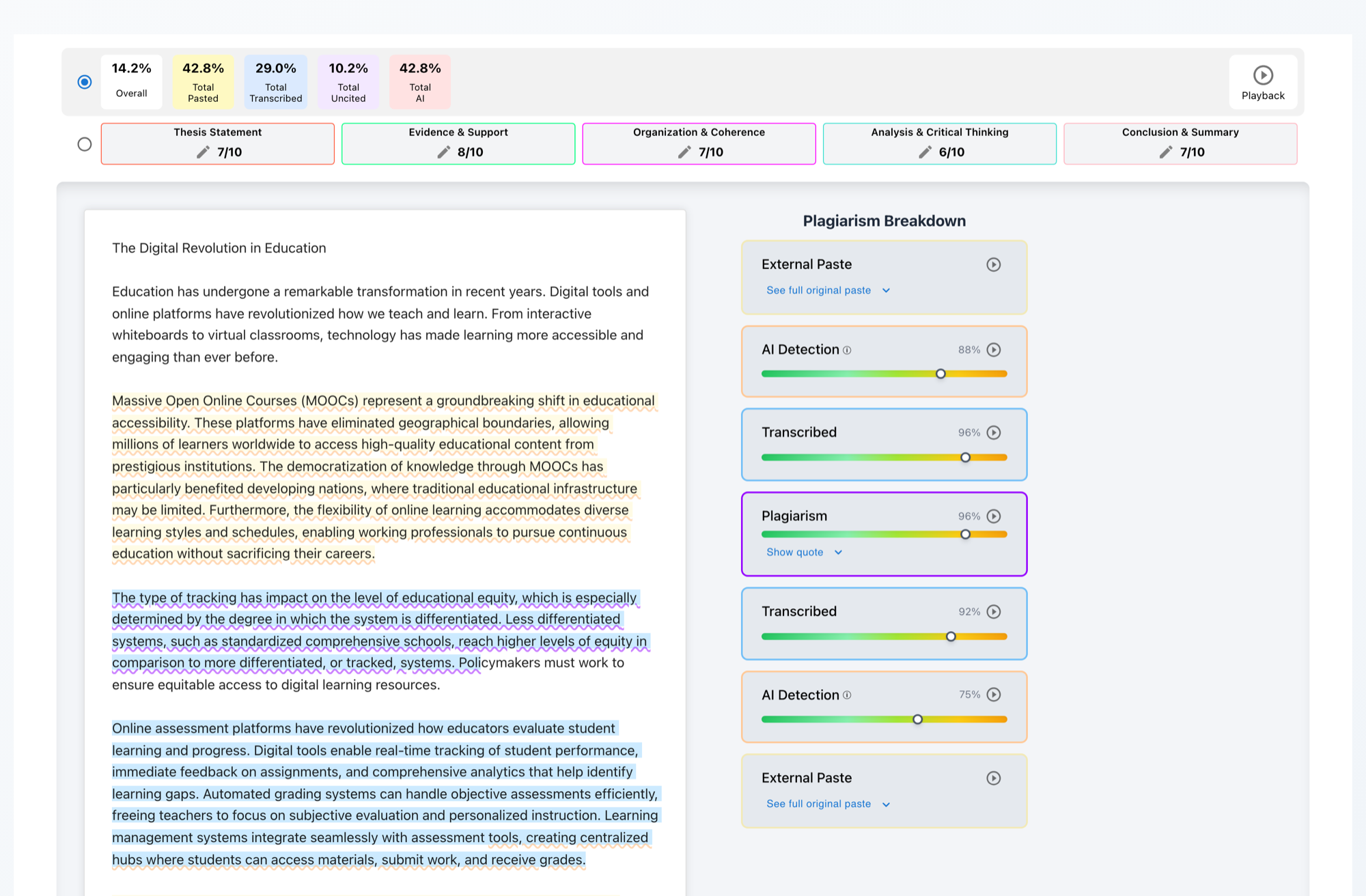
- Inspect the External Paste Buffer: Click on any highlighted paste block in Checkmark. Checkmark's External Paste Inspector reveals the exact raw text copied into the clipboard—even if the student later edited, paraphrased, or deleted every single word. If the raw paste contains telltale LLM artifacts (e.g., "Certainly! Here is a literature review with citations:"), the evidentiary proof is irrefutable.
- Analyze Keystroke Velocity Consistency: Natural human composition proceeds in bursts: rapid typing during a flow state (50–70 WPM) followed by abrupt pauses and heavy backspacing (15–30% deletion ratios) to refine ideas. Machine transcription exhibits an unnaturally uniform, metronomic cadence (35–45 WPM flat with zero structural reorganization).

Phase 4: Restorative Student Integrity Conferences
Checkmark's guiding philosophy is "Stop guessing, start trusting." When objective telemetry indicates artificial generation or fabricated sources, the educator enters the conversation not as an adversary with an arbitrary percentage score, but as a supportive mentor equipped with objective process evidence.
"Let's look at your Essay Playback timeline together. I noticed this 400-word section on the economic lens appeared at 11:42 PM in a single 4-second paste block."
"Could you open your school EBSCO or JSTOR account and show me where you retrieved the 2023 study you cite in your economic lens paragraph? I'd love to look at its original data tables with you."
"If this citation came from an AI summary or generator that confabulated the title, let's address it now during the rough draft window before this is submitted to the AP Digital Portfolio."
"We have 4 days before the draft locks. Your task is to replace these two unverified citations with authentic studies from our library database, and document your synthesis notes directly in the Checkmark editor."
This restorative approach preserves the teacher-student relationship, ensures strict compliance with College Board guidelines, and uses the incident as a profound teaching moment on academic ethics and research methodology.
6. How Checkmark Plagiarism Empowers AP Capstone Educators
Checkmark Plagiarism is engineered specifically to meet the high-stakes evidentiary demands of AP Seminar, AP Research, and advanced secondary humanities programs:
Keystroke-by-keystroke temporal reconstruction of the entire writing session. Visualizes natural composing pauses, research intervals, backspaces, and structural rewrites.
Captures timestamped external paste events instantly. Preserves complete raw clipboard contents even after extensive post-paste student edits.
Scans billions of live web pages, digital encyclopedias, open-access journals, and repositories. Direct clickable source links and quote comparison cards.
Underlines specific passages with granular confidence sliders (Typical Human vs. Typical AI). Honest N/A guardrail on texts under 150 words prevents false positive guessing.
Automatically maps verbatim student prose to AP Seminar analytic rubric rows (30-point IRR, 48-point IWA). Teacher retains final editing authority; one-click grade passback to Canvas, Buzz, & Google.
1. Patent-Pending Essay Playback™
While generic tools analyze static text files after submission, Checkmark records the active drafting journey. Teachers can scrub through a student's entire 1,200-word IRR session like a video at 1x, 2x, 4x, or 8x speed. When an AP Seminar reader sees 14 distinct drafting sessions spanning 18 hours, characterized by hundreds of micro-revisions, organic vocabulary adjustments, and long pauses between paragraphs, the student's authentic authorship is proven beyond all legal and administrative doubt.
2. External Paste Inspector with 100% Buffer Retention
Students attempting to conceal AI generation frequently paste an LLM-drafted paragraph and then spend 15 minutes swapping words, altering sentence openings, and inserting synonyms. Traditional revision histories only display the final edited state. Checkmark's Paste Inspector preserves the exact original clipboard payload at the instant of insertion, providing educators with undeniable receipts.
3. Granular Passage-Level AI Confidence Sliders
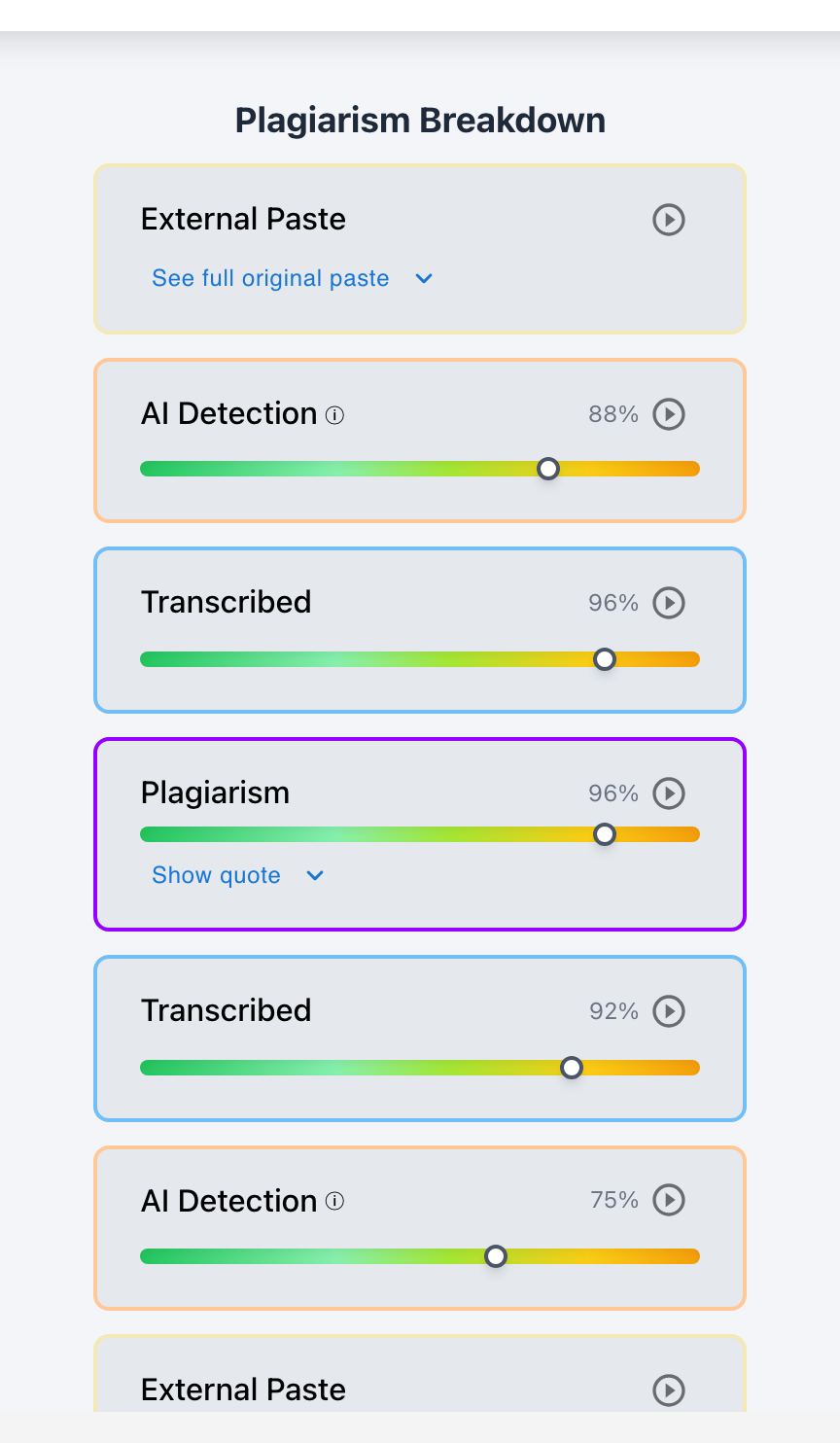
Checkmark abandons the discredited single-percentage whole-paper score. Instead, Checkmark underlines specific sentences and paragraphs, displaying interactive sidebar evidence cards with calibrated confidence sliders:
- Typical Human Writing Pattern: High lexical burstiness, authentic developmental syntax, natural stylistic variation.
- Typical AI Generation Pattern: Rigid perplexity uniformity, formulaic transitions, repetitive sentence structures.
- Honest Guardrails: Submissions or excerpted passages under 150 words display
N/Arather than guessing on statistically insufficient sample sizes.
4. Side-by-Side Live Plagiarism & Source Matching
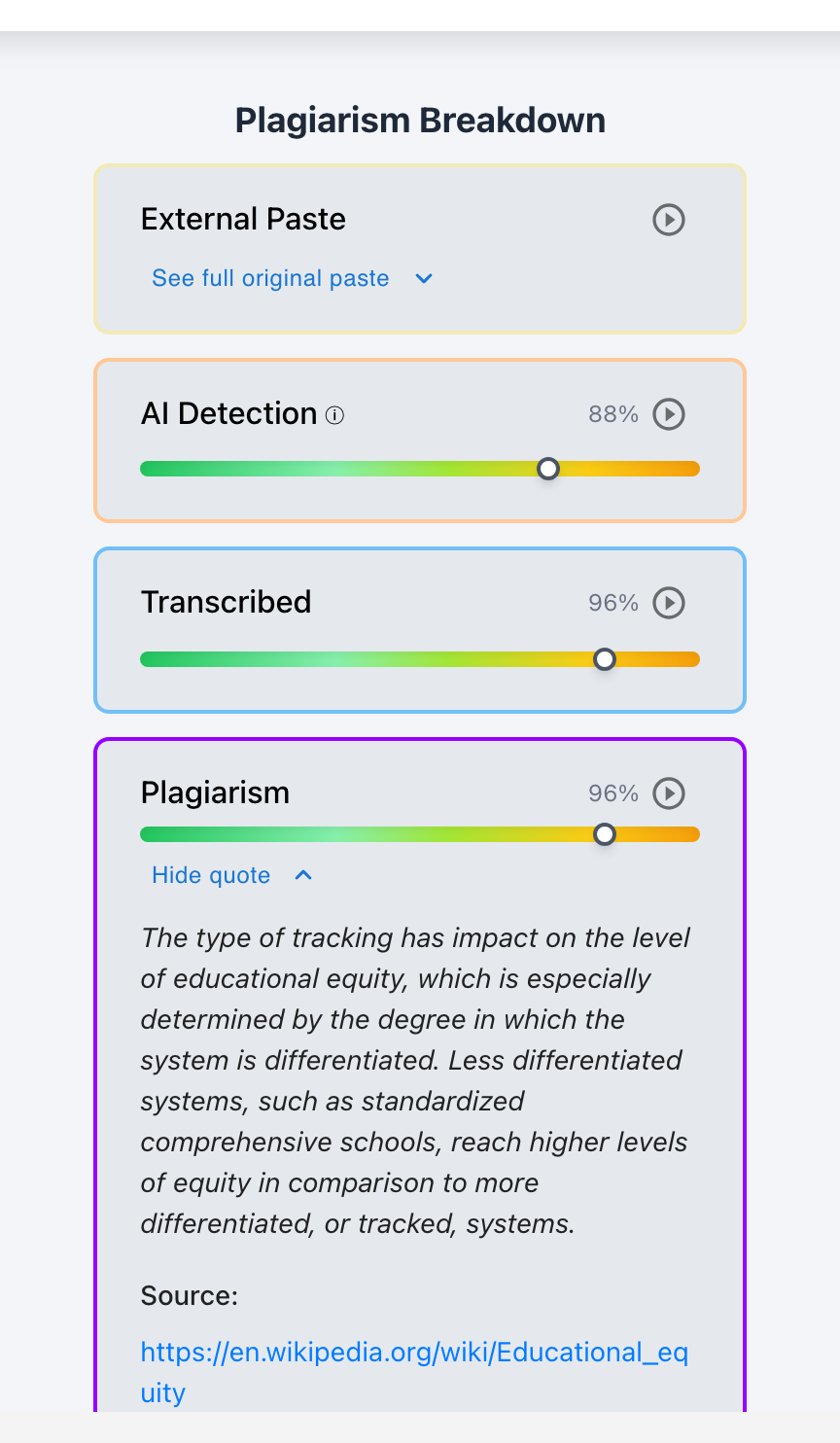
Every detected source match is presented in a two-way linked side-by-side viewer. Clicking a highlighted sentence in the IRR instantly scrolls the sidebar to the corresponding source card with direct clickable hyperlinks to the original academic repository, publication, or website. Furthermore, Checkmark visually isolates Uncited Source Usage from intentional direct plagiarism, enabling teachers to deliver targeted citation formatting coaching rather than initiating punitive integrity referrals.
5. Quote-Anchored Rubric Autograding for First-Draft Accelerations
AP Seminar teachers evaluating 90 rough drafts of the IRR face an overwhelming 45-hour grading bottleneck. Checkmark's AI Autograder parses the official AP Capstone analytic rubric, identifies verbatim student textual evidence corresponding to each rubric row (e.g., extracting the specific sentences where the student contextualizes the issue for Row 1 or analyzes a range of perspectives for Row 4), and generates draft point suggestions with written justifications. The educator reviews, edits, and finalizes all scores in a 3-minute pre-flight moderation console before streaming grades directly back into Canvas LMS, Buzz LMS, or Google Classroom via 1EdTech LTI 1.3 Advantage.
7. Illustrative Classroom Case Scenarios in AP Seminar
The scenarios below are hypothetical examples built from typical classroom situations. The students, sources, and figures in them are invented for illustration and are not reports from real classrooms.
Scenario 1: The "Flawless" Literature Review with Hallucinated Studies
- The Submission: An AP Seminar student submitted a 1,190-word IRR on the ethical and economic impacts of gene-editing therapies (CRISPR-Cas9). The prose was impeccably structured, citing four academic studies with complete APA citations and DOIs.
- The Investigation:
- The teacher noticed a generic AI detector scored the essay at "12% AI" (Passing).
- However, when the teacher clicked the DOIs in Checkmark's Side-by-Side viewer, two DOIs returned
404 Not Found. - A query on CrossRef revealed the lead author named in the citation had never published in the cited journal (American Journal of Human Genetics).
- The teacher opened Checkmark's Essay Playback™ and observed a single 600-word external paste event occurring at 1:14 AM. The Paste Inspector revealed the raw prompt output from an LLM.
- The Resolution: In a restorative conference, the teacher showed the student the playback timeline and explained how LLMs confabulate academic research. The student admitted to prompting ChatGPT for "studies supporting economic gene therapy barriers." The student was granted 72 hours during the rough-draft window to locate authentic PubMed Central studies, document genuine source triangulation, and resubmit without a punitive zero.
Scenario 2: The False-Positive Exoneration of a High-Achieving ELL Student
- The Submission: A non-native English speaker and highly disciplined AP Capstone student submitted a 1,180-word IRR analyzing renewable microgrid resilience in rural Southeast Asia. The paper featured sophisticated, formal vocabulary and complex passive-voice constructions.
- The Investigation:
- A district-mandated generic AI detector flagged the essay at "91% AI-Generated," prompting the department chair to schedule a formal academic dishonesty hearing.
- The AP Seminar teacher requested an evidentiary audit using Checkmark Plagiarism.
- Checkmark's Essay Playback™ revealed 11 distinct drafting sessions spanning 19 total hours.
- Telemetry showed over 1,400 organic backspaces, extensive real-time sentence rephrasing, and dozens of 60-to-120-second pauses corresponding to active reading intervals.
- Checkmark's Side-by-Side Matching verified all 14 cited academic sources existed on IEEE Xplore, ScienceDirect, and ADB.org with exact quote matches.
- The Resolution: The department chair dismissed the cheating allegations entirely. The playback telemetry provided undeniable, empirical proof of authentic authorship, completely protecting the student from an unjust disciplinary record and emotional trauma.
Scenario 3: Paraphrased AI Generation with Recycled DOIs
- The Submission: An IRR on juvenile recidivism rates cited three legitimate government reports from the National Institute of Justice (NIJ). However, the synthesis paragraph attributed direct statistical claims to the reports that were completely absent from the actual documents.
- The Investigation:
- Checkmark's Side-by-Side Source Proof highlighted that while the NIJ reports existed, the specific quotations inside the student's text did not appear anywhere in the indexed source documents.
- Checkmark's Passage-Level AI Confidence Slider flagged the synthesis paragraph as "Typical AI Generation Pattern" due to hyper-uniform perplexity and repetitive sentence openings ("Furthermore, the economic impact... Moreover, the psychological dimension... Additionally, the societal consequence...").
- Essay Playback™ revealed that the student had typed the entire 350-word synthesis block in 7 minutes at a continuous, steady 50 WPM with zero pauses and zero backspaces—classic telemetry of second-screen manual transcription.
- The Resolution: During the debrief, the student demonstrated that they had prompted Claude to "Summarize these three NIJ reports into a synthesis paragraph with quotes." The AI confabulated statistical findings, which the student manually retyped from their iPad. The teacher used Checkmark's quote-anchored rubric feedback to guide the student in extracting real data points directly from the primary NIJ tables.
8. Frequently Asked Questions (FAQs)
Checkmark Plagiarism's Side-by-Side Source Proof automatically queries global academic repository indexes (including CrossRef, PubMed, and open-access publishers). When a student submits an IRR or IWA, Checkmark verifies live source availability and creates direct, clickable links in the Plagiarism Breakdown sidebar. If a cited DOI fails to resolve or links to an entirely unrelated academic field, the system highlights the citation card for immediate teacher review.
Authentic AP research papers demand a formal academic tone, domain-specific terminology, passive-voice constructions, and structured transitions. Generic AI detectors rely on statistical perplexity (word predictability) and burstiness (sentence variation). Because scholarly writing is intentionally precise and disciplined, its perplexity is naturally low, causing generic algorithms to misclassify high-achieving human writing as AI-generated text. Checkmark eliminates this flaw by pairing passage-level analysis with Essay Playback™ keystroke telemetry, proving authentic human drafting.
Only in limited ways. The College Board AP Capstone AI policy allows students to use generative AI as an optional aid for exploring potential topics of inquiry and for initial searches for sources. Taking AI output uncritically, such as using AI to generate a research question or thesis, is not acceptable. Students must read their sources directly and do their own analysis and synthesis, and using AI to write or create any portion of the assignment is prohibited. Fabricated sources or data result in a score of zero on that component.
Authentic synthesis involves heavy cognitive processing: students switch between tabs, pause for 45 to 180 seconds while reading complex academic literature, make frequent typographical errors, and heavily backspace (12–25% of keystrokes) to reorganize sentences. In contrast, manual transcription (reading AI text off a phone or second screen) displays a continuous, metronomic typing cadence (35–50 WPM flat) with minimal pauses (<3 seconds) and almost zero structural deletions.
Unlike black-box detectors that guess on insufficient data, Checkmark applies Honest Short-Text Guardrails. For passages or submissions under ~150 words, the AI detection module displays N/A. This prevents unwarranted accusations on brief introductory paragraphs, abstracts, or concise research questions where statistical sample sizes are too small for reliable pattern analysis.
No. While humanizers alter surface vocabulary and syntax to evade simple perplexity checks, they cannot fake authentic temporal writing history. Checkmark's External Paste Inspector captures the raw clipboard text before paraphrasing took place, while Essay Playback™ exposes the sudden insertion of large text blocks and the absence of organic composing intervals.
Checkmark Plagiarism integrates seamlessly via 1EdTech LTI 1.3 Advantage. Teachers can launch Checkmark directly within Canvas SpeedGrader, Buzz LMS, or Google Classroom. Once the teacher reviews and moderates AI-assisted quote-anchored rubric feedback, finalized scores, criterion breakdowns, and qualitative comments sync directly back to the LMS gradebook with a single click.
9. Conclusion: Moving from Suspicion to Defensible Trust in AP Capstone
The challenge of verifying source triangulation in AP Seminar is not simply an anti-cheating initiative; it is an essential pedagogical mission. The purpose of the AP Capstone Diploma is to prepare high school scholars for the intellectual demands of higher education: teaching them how to evaluate complex evidence, interrogate conflicting perspectives, and construct original, ethical arguments.
When educators rely on opaque, whole-paper AI detection percentages, they foster an environment of suspicion that penalizes dedicated students while failing to catch sophisticated AI confabulations.
By adopting Checkmark Plagiarism's multi-dimensional evidentiary suite—uniting Side-by-Side Source Proof, CrossRef verification, patent-pending Essay Playback™, and quote-anchored rubric autograding—AP Capstone educators can:
- Expose Hallucinated Research: Instantly identify confabulated DOIs, ghost authors, and synthetic smoothing.
- Defend Honest Scholars: Exonerate students from false-positive accusations using immutable keystroke telemetry.
- Accelerate Formative Feedback: Reduce first-draft grading bottlenecks by up to 80% while delivering precise, quote-anchored rubric annotations.
- Foster Restorative Integrity: Transform academic integrity investigations into powerful, supportive mentorship conferences.
Stop guessing, start trusting. Equip your AP Capstone classroom with the transparent, defensible tools needed to champion authentic academic inquiry.
Equip Your AP Seminar Classroom with Defensible Research Verification
Experience how Checkmark's Side-by-Side Live Source Proof, CrossRef verification, patent-pending Essay Playback™, and quote-anchored rubric feedback transform AP Capstone evaluation.