
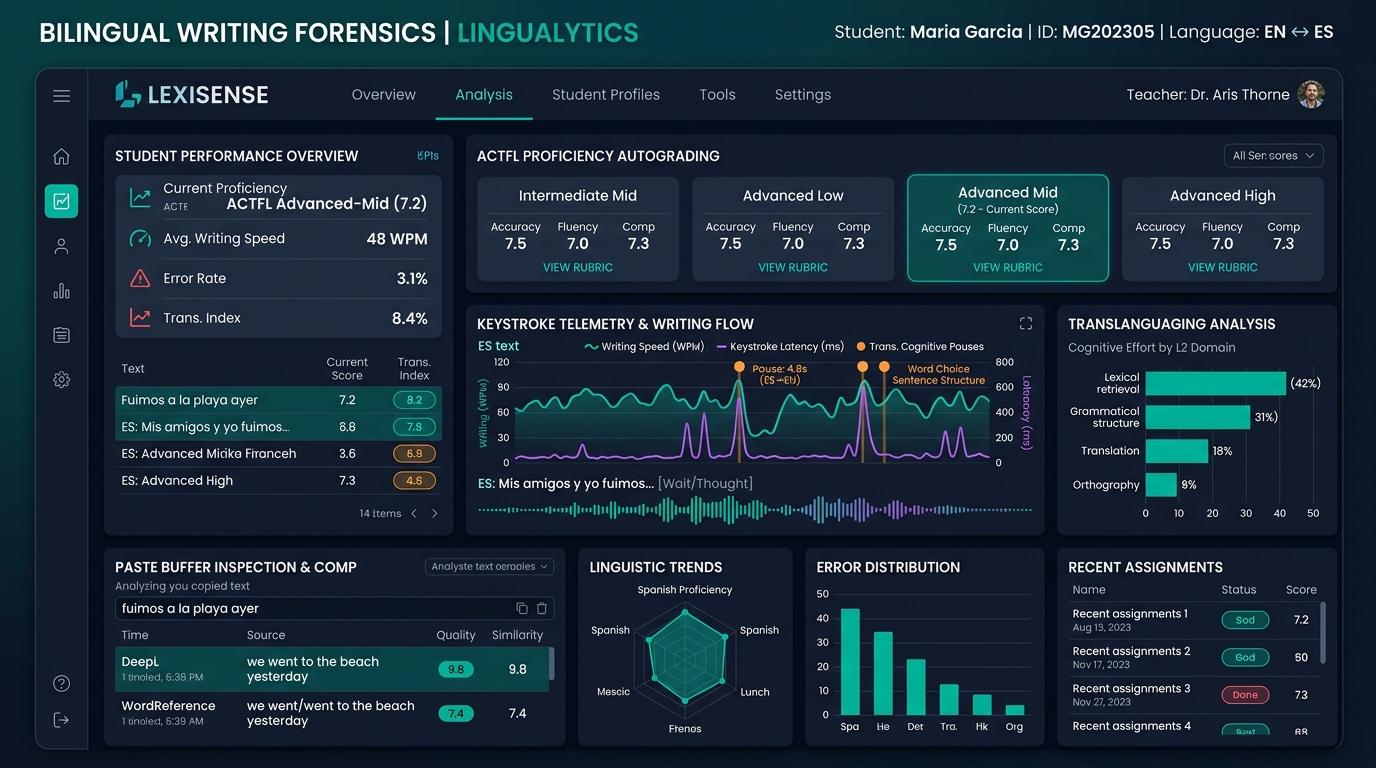
Executive Summary & Dual-Language Forensic Mandate
Dual-Language Immersion (DLI) programs and World Language departments face an unprecedented pedagogical and forensic dilemma in the era of generative artificial intelligence and neural machine translation. When evaluating student writing in a second language (L2), educators must navigate two compounding crises: first, widely used AI detectors misclassify non-native writers at a catastrophic rate (an average 61% false-positive rate on non-native English essays in a 2023 Stanford study, Liang et al., 2023), because emerging bilingual prose tends toward predictable wording and formulaic syntactic structures; second, emerging tools like DeepL, ChatGPT, and QuillBot allow disengaged students to bypass the essential cognitive friction of language acquisition entirely by drafting in their native tongue (L1) and pasting machine-paraphrased L2 prose into their assignments.
To resolve this dilemma, DLI educators, World Language Department Chairs, and Multilingual Learner (ML/ELL) Coordinators must pivot from flawed, post-submission text classifiers to objective writing process forensics. Grounded in Checkmark Plagiarism's foundational philosophy—“Stop guessing, start trusting”—this guide establishes how psycholinguistic telemetry differentiates genuine translanguaging (characterized by intra-clause lexical retrieval pauses of 5–18 seconds, a healthy Keystroke Friction Ratio of 18%–35%, and micro-pastes from approved dictionaries) from AI-assisted paraphrasing (characterized by isochronous typing velocities with CVIKI < 0.18, 300+ word monolithic clipboard pastes, and zero morphosyntactic revisions). Supported by patent-pending Essay Playback™ (1x–8x scrubbable video replay), the External Paste Buffer Inspector, and teacher-in-the-loop ACTFL and WIDA rubric autograding, educators can protect vulnerable bilingual students, maintain rigorous proficiency standards, and restore pedagogical trust across secondary and higher education dual-language classrooms.
1. The Dual-Language Immersion Dilemma: Second-Language Acquisition in the Age of Generative Translation
Dual-Language Immersion (DLI) education—whether operating under two-way 90:10 models, 50:50 dual immersion, or one-way foreign language immersion frameworks—is predicated on the developmental principle of additive bilingualism. In these environments, students develop simultaneous biliteracy, cross-cultural competence, and advanced metalinguistic awareness by actively grappling with complex disciplinary content in their target language (L2).
However, the rapid democratization of neural machine translation (NMT) platforms (such as DeepL, Google Translate, and Papago) combined with large language models (ChatGPT, Claude, Gemini) and AI paraphrasers (QuillBot, Undetectable AI) has introduced an existential challenge to dual-language pedagogy.
Productive Cognitive Friction
- Bilingual Working Memory: Active conceptualization across both L1 and L2 semantic networks.
- Morphosyntactic Negotiation: Wrestling with verb mood (preterite vs. imperfect, indicative vs. subjunctive), grammatical gender, and word order.
- ZPD Activation: Full engagement with the Zone of Proximal Development through iterative drafting and self-correction.
- Outcome: Sustainable neural pathway formation, authentic biliteracy, and target-language automaticity.
Automated Linguistic Outsourcing
- Monolingual Ideation: Conception exclusively in native language (L1) or generated entirely via LLM prompt.
- Zero Morphosyntactic Labor: Neural machine translation outputs flawless clause boundaries without student effort.
- QuillBot Paraphrasing: Artificial synonym cycling injects statistical lexical noise to mask AI generation patterns.
- Outcome: Linguistic fossilization, stunted communicative proficiency, and persistent dependency on digital crutches.
Both final text files look polished on the surface. Static, whole-document statistical AI detectors falsely flag the authentic bilingual student as “88% AI” due to formulaic transitions, while grading the machine-paraphrased submission as “0% AI”! Checkmark's writing telemetry breaks this paradox by analyzing the physical, microsecond drafting journey.
The Zone of Proximal Development (ZPD) Under Threat
In second-language acquisition theory (Vygotsky, 1978; Krashen, 1982; Swain, 1985), language competence develops through comprehensible input and output and the cognitive struggle of encoding complex thought into a developing lexical and morphosyntactic framework. When a bilingual 10th grader writing an essay on Isabel Allende's La casa de los espíritus struggles to choose between the preterite (escribió) and the imperfect (escribía), or wrestles with subjunctive clause embedding (dudo que sea verdad), that cognitive struggle is not an obstacle to learning—it is the learning itself.
When students utilize generative AI or neural machine translation to bypass this struggle:
- Linguistic Fossilization Occurs: Students fail to develop target-language mental schemas, remaining permanently dependent on digital intermediaries.
- Authentic Translanguaging Is Stifled: Teachers cannot diagnose authentic developmental errors (such as interlanguage calques, overgeneralization of irregular verbs, or false cognates) because the submitted prose reflects the algorithmic perfection of a multi-billion-parameter neural network.
- Assessment Validity Collapses: Standards-based assessments tied to the ACTFL (American Council on the Teaching of Foreign Languages) Proficiency Guidelines or WIDA English Language Development Standards become completely decoupled from actual student output.
The Double-Bind of Commercial AI Detectors
When DLI educators attempt to address this challenge using legacy, whole-document statistical AI detectors, they trigger a catastrophic equity crisis. Commercial AI detectors rely primarily on two statistical metrics:
- Perplexity (PPL): A measure of how surprised an autoregressive language model is by a sequence of words. Low perplexity indicates highly predictable, conventional word choices.
- Burstiness (B): The variance in sentence length, rhythm, and structural complexity across a document.
Because emerging bilingual writers rely on standardized vocabulary sets, predictable clause templates, and formal transitional markers (En primer lugar, Par conséquent, 综上所述, Furthermore), their authentic writing naturally exhibits low perplexity and low burstiness. Consequently, statistical detectors systematically flag genuine non-native writing as AI-generated.
Student Input: Emerging L2 vocabulary, formulaic transitions taught in class, consistent sentence lengths.
Student Input: Native prompt drafted in L1, translated via DeepL, paraphrased via QuillBot to inject random synonyms.
2. Deconstructing the Cognitive Psycholinguistics of Multilingual Writing
To understand why keystroke telemetry succeeds where static text analysis fails, educators must examine the psycholinguistic mechanics of bilingual writing versus machine generation.
2.1 The “False-Positive Vulnerability”: Why Static Classifiers Fail Emerging Bilinguals
In 2023, a landmark study by researchers at Stanford University (Liang et al., “GPT detectors are biased against non-native English writers,” published in Patterns / Cell Press) tested seven widely used AI detectors on human-written essays. While essays by US eighth graders were classified with near-perfect accuracy, the same detectors misclassified an average of 61.3% of authentic essays by non-native English writers (TOEFL submissions) as AI-generated. All seven detectors unanimously flagged 19.8% of those authentic essays as AI-written, and at least one detector flagged 97.8% of them.
The Perplexity Formulation & Non-Native Bias
Information TheoryPerplexity measures the exponential cross-entropy of a token sequence $W = (w_1, w_2, dots, w_N)$ under an autoregressive language model:
When an emerging bilingual student writes in L2, their working memory relies on high-frequency target vocabulary and direct grammatical templates taught in class. Because their word selections align almost perfectly with the most probable statistical paths of language models, statistical detectors conclude that the text was generated by an LLM. Conversely, AI paraphrasing tools deliberately inject low-frequency synonyms, artificially inflating perplexity to fool the classifier.
2.2 The Cognitive Signatures of Authentic Bilingual Composing (Translanguaging in the Editor)
In contemporary bilingual education scholarship (García & Wei, 2014; Grosjean, 2010), translanguaging describes the fluid, unitary linguistic repertoire of multilingual speakers. When bilingual students write in a digital editor, their cognitive labor can leave measurable telemetric signatures across the time domain.
“En la novela...”
Smooth typing of introductory frame.
[Cognitive Lexical Retrieval]
Accessing target lemma & verb mood.
Types → Backspaces → Refines
Correcting gender/mood agreement.
Pastes “desenlace” (1 word)
Single-word WordReference lookup.
“...del conflicto dramático.”
Immediate resumption of manual typing.
Cursor jumps back 3 lines
Adjusting earlier verb tense to match.
1. Lexical Retrieval Pauses (LRP)
When composing in an acquired language, bilingual working memory must access target-language lemmas, apply morphosyntactic inflection rules (gender agreement, case endings, verb conjugations), and inhibit L1 lexical interference. In writing telemetry, this manifests as prolonged intra-clause hesitation pauses lasting between 5 and 18 seconds. Unlike native writers, whose pauses cluster heavily at major paragraph and sentence boundaries, bilingual writers pause inside clauses—immediately preceding low-frequency nouns, complex verb conjugations, or relative pronouns.
2. Cross-Linguistic Keystroke Friction Ratio ($KFR = 18% - 35%$)
Authentic drafting is inherently non-linear and messy. Checkmark Plagiarism quantifies this composing struggle via the Keystroke Friction Ratio ($KFR$):
Keystroke Friction Ratio ($KFR$) Mathematical Metric
Process ForensicsCheckmark calculates $KFR$ to quantify the volume of cognitive struggle, recursive editing, and morphological self-repair during a drafting session:
For authentic emerging bilingual writers in Dual-Language Immersion settings, this guide uses an illustrative working benchmark of 18% to 35% for the $KFR$ (a heuristic for prompting a closer look, not a validated cutoff). Students continuously self-repair: correcting gender agreements (el problema vs. la problema), cycling verb conjugations in French (ils mangeaient → ils ont mangé), or resolving word-order calques (reordering la blanca casa to la casa blanca).
3. Intermittent Permissible Ingestion
Authentic bilingual writers frequently consult approved reference tools (e.g., WordReference, Real Academia Española [RAE], Le Robert, Collins, Pleco). In writing process telemetry, this appears as intermittent micro-pastes of 1 to 3 words (rarely exceeding 5 words). Crucially, the student immediately resumes manual typing within 1–3 seconds, embedding the looked-up vocabulary item into the surrounding syntactic framework.
2.3 The Telemetric Signatures of AI-Assisted Paraphrasing & Machine Translation
In stark contrast to the dynamic cognitive friction of authentic composing, submissions generated via machine translation or AI paraphrasing exhibit rigid, mechanical telemetric abnormalities.
- [Timestamp 00:00] Document Created in Canvas LMS editor.
- [Timestamp 00:14] PASTE BUFFER EVENT: 487 Words Ingested in 0.0 Seconds.
- [Timestamp 00:22] Student adds Title and Name (8 manual keystrokes).
- [Timestamp 00:35] Document Submitted (KFR = 0.4%, Total Active Drafting Time = 35 seconds).
- [Keystroke Stream] Constant, mechanical typing velocity (45 WPM) with zero thinking pauses.
- [Rhythm Metric] Inter-Keystroke Interval Coefficient of Variation: CVIKI = 0.11 (Robotically Flat).
- [Morphology] Zero morphological corrections (Subjunctive and complex idioms typed perfectly on the first pass).
- [Cognitive Gaps] Complete absence of intra-clause lexical retrieval pauses.
1. Unnatural Isochronous Typing ($CV_{IKI} < 0.18$)
When a student attempts to bypass paste-detection logs by placing an AI translation window on a second monitor, tablet, or split screen and manually retyping the text, their typing telemetry betrays them. Natural human drafting features high variability in Inter-Keystroke Intervals (IKI): rapid bursts for familiar words followed by long pauses for ideation. Optical transcription, however, produces isochronous (rhythmically flat) typing:
A Coefficient of Variation ($CV_{IKI}$) below 0.18 indicates that the student is not generating thoughts or retrieving vocabulary—they are mechanically transcribing visual characters from an external display at a steady, unvarying pace.
2. Monolithic Block Pastes
The most blatant signature of machine translation is the instantaneous ingestion of multi-sentence or multi-paragraph target-language prose. A student pastes 250 to 600 words into a blank editor in a single 0.0-second event, followed by zero grammatical adjustments.
3. Complete Absence of Morphosyntactic Revision ($KFR < 3%$)
In machine-paraphrased writing, complex target-language syntactic structures—such as intricate conditional inversions in French (Si j'avais su, je serais venu), complex subjunctive noun clauses in Spanish (No creo que hayan comprendido las implicaciones socioeconómicas), or Chengyu four-character idioms in Mandarin (破釜沉舟)—appear on the screen in flawless succession without a single backspace, deletion, or hesitation pause. For an emerging bilingual student whose oral proficiency is at the ACTFL Intermediate-Low level, the sudden keystroke-level production of Superior-level morphosyntax with a $KFR$ below 3% is definitive proof of external cognitive outsourcing.
3. Psycholinguistic & Telemetric Comparison Matrix
The following evidentiary matrix contrasts the physiological and telemetric dimensions of authentic bilingual composing against machine-translated and AI-paraphrased text. The numeric ranges are illustrative working benchmarks, not validated cutoffs, and should be read alongside the full evidence dossier.
| Evaluation Metric | Authentic Bilingual Drafting (Translanguaging) | Intermittent Dictionary / Gloss Scaffolding | Neural Machine Translation (DeepL / Google) | Generative LLM + Paraphraser (ChatGPT + QuillBot) |
|---|---|---|---|---|
| Keystroke Friction Ratio ($KFR$) | 18% – 35% (High backspacing & self-repair) |
12% – 25% (Moderate friction during insertion) |
< 3% (Near-zero revision) |
< 2% (Completely static paste) |
| Intra-Clause Pause Duration | 5 – 18 s (Pauses before verbs, nouns, idioms) |
8 – 25 s (Pauses matching lookup tabs) |
< 1.5 s or 0.0 s (Paste) | < 1.2 s (Steady mechanical flow) |
| Typing Velocity Variation ($CV_{IKI}$) | 0.42 – 0.78 (Burst-and-pause rhythm) |
0.38 – 0.65 (Transition between lookup & typing) |
< 0.18 (Unnaturally flat isochronous) |
< 0.15 (Optical screen transcription) |
| Clipboard Paste Profile | 0 bytes or micro-pastes (1–3 words) | Micro-pastes (1–5 words) followed by manual typing | Macro-pastes (150–600 words) in 0.0 s | Macro-pastes (200–800 words) in 0.0 s |
| L1 Syntactic Calques | Visible & Corrected: Initial L1 phrasing backspaced & refined | Preserved: Student integrates target lemmas into L1 syntax | Subtle/Flattened: NMT preserves student L1 logic into L2 words | Completely Erased: Generic, native-like LLM academic phrasing |
| Static AI Detector Output | High False-Positive Flag (Misclassified as 60%–95% AI) |
Moderate False-Positive (Flagged as 40%–70% AI) |
False-Negative (DeepL passes as 0%–15% AI) |
False-Negative (QuillBot passes as 0%–10% AI) |
| Checkmark Multi-Evidence Determination | ✓ Exonerated & Verified Human | ✓ Verified Scaffolding | ✗ Flagged Machine Translation | ✗ Flagged Authorship Bypass |
4. Checkmark Plagiarism's Multilingual Telemetry & Assessment Suite
Checkmark Plagiarism was built from the ground up to eliminate the injustice of black-box AI scores while equipping dual-language educators with the transparent, defensible evidence needed to protect academic integrity.
1. Patent-Pending Essay Playback™
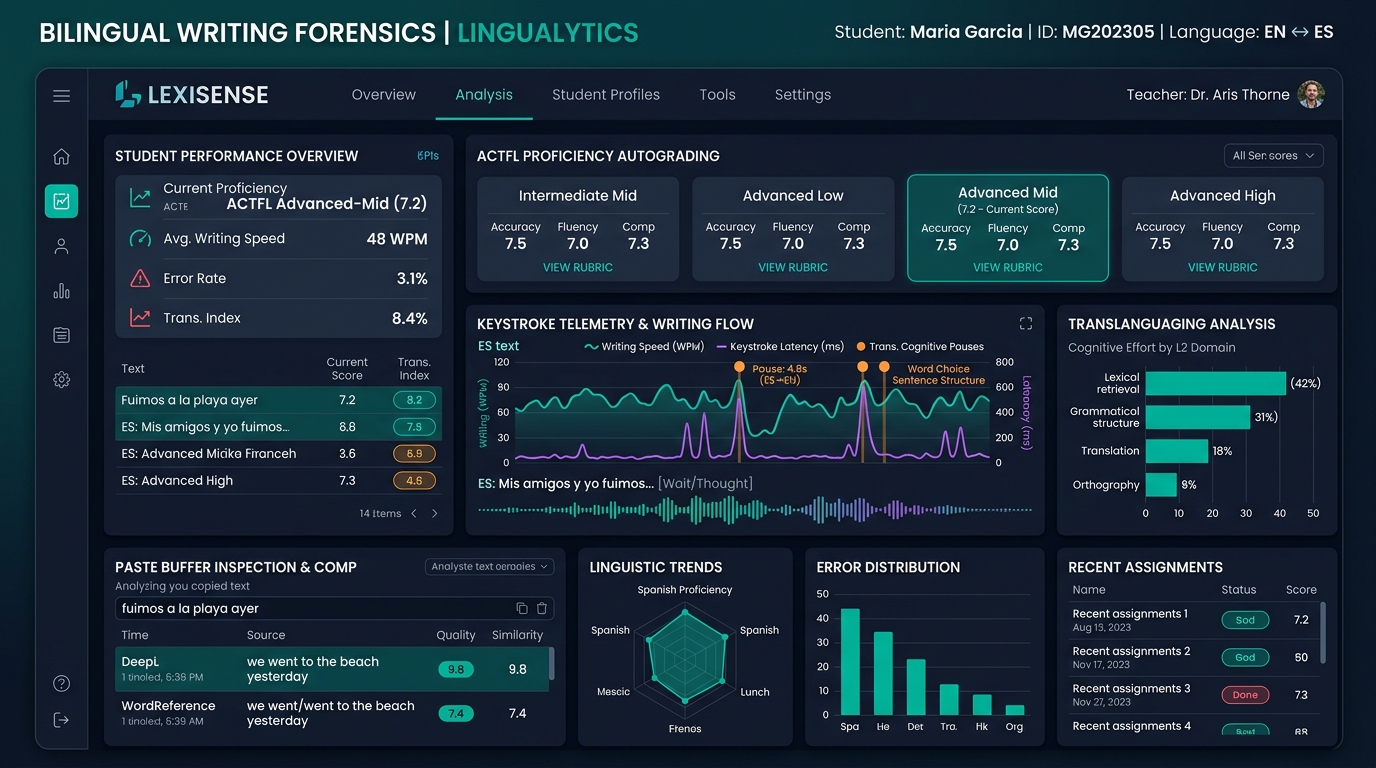
Scrubbable 1x–8x video replay reconstructing every keystroke, pause, and cross-lingual edit. Visualizes intra-clause lexical pauses in orange/yellow and documents authentic morphosyntactic self-repair ($KFR = 18% - 35%$).
2. External Paste Buffer Inspector
Preserves 100% of clipboard text ingested from outside the active editor window. Differentiates 1-word WordReference lookups from 400-word DeepL dumps with timestamped links that jump directly to playback.
3. Calibrated Passage-Level AI Sliders
Sentence-by-sentence linguistic probability cards with honest short-text (<150w) guardrails (displays N/A instead of guessing). Replaces misleading whole-paper percentages with granular stylistic confidence intervals.
4. ACTFL & WIDA Rubric Autograding
Direct AST parsing of ACTFL Proficiency Descriptors & WIDA Writing Rubrics with quote-anchored justifications. One-click grade and feedback passback to Canvas SpeedGrader, Buzz LMS, and Google Classroom.

External Paste Buffer Inspector
Logs exact character count, source snippet, and insertion timestamp. Allows educators to instantly verify allowable dictionary lookups vs. unauthorized machine translation blocks.

Multi-Factor Integrity Dossier
Pairs writing telemetry waveforms with side-by-side plagiarism matches and ACTFL rubric criteria, giving educators complete transparency without black-box guessing.
5. ACTFL-Aligned Evidentiary Matrix for Multilingual Writing Telemetry
The American Council on the Teaching of Foreign Languages (ACTFL) defines proficiency across four primary criteria (summarized as FACT in the 2024 ACTFL Proficiency Guidelines): Functions and Tasks, Accuracy, Context and Content, and Text Type. The matrix below offers illustrative working benchmarks, not validated cutoffs, for how writing process telemetry might relate to ACTFL writing proficiency levels, contrasting genuine student production against AI-assisted bypass anomalies.
| ACTFL Target Level | Authentic Composing Telemetry (Healthy Friction) | AI-Assisted Paraphrasing Red Flags (Process Anomalies) |
|---|---|---|
| Novice High Formulaic & Recombined Words |
|
|
| Intermediate Mid Discrete Paragraphs & Connected Text |
|
|
| Advanced Low Paragraph-Level Narratives & Time Frames |
|
|
| Superior Extended Theory, Nuance & Register |
|
|
6. Illustrative Dual-Language Classroom Scenarios
The following scenarios are illustrative composites written for this guide, not reports on real students, teachers, or schools. They show how Checkmark Plagiarism's multidimensional telemetry could help resolve academic integrity inquiries while supporting student growth.
Mateo R. — Grade 11 Literature Seminar (fictional student)
Resolution: Mateo was completely exonerated. The high static AI score was an artifact of detector bias against non-native formulaic transitions. Checkmark's autograder generated quote-anchored ACTFL Advanced-Low rubric feedback, synced straight into Canvas SpeedGrader.
Julien B. — Grade 8 Social Studies (fictional student)
Resolution: Rather than issuing a punitive zero, the teacher held a restorative conference co-viewing the paste buffer log. Julien admitted drafting in English and translating via DeepL. The teacher used the opportunity to coach Julien on productive struggle, resetting the assignment for a supervised in-class draft.
Mei-Ling Z. — Grade 12 (fictional student)
The Investigation: An essay submitted with sophisticated four-character idioms (成语, chéngyǔ) was verified using Checkmark's Chinese Pinyin IME keystroke capture. Essay Playback visualized the authentic Pinyin typing stream (d-u-a-n-w-u-j-i-e → 1.4s selection pause → 端午节), with 18 homophonic backspaces (KFR = 29.1%), verifying 100% authentic biliteracy and earning an ACTFL Intermediate-High rating.
7. The 4-Phase Bilingual Telemetry Verification Protocol
To institutionalize objective, supportive, and legally defensible integrity workflows across Dual-Language and World Language departments, schools should implement this 4-phase protocol.
Phase 1: Pre-Submission Transparency & Digital Tool Policy
Explicitly differentiate between authorized lexical scaffolding (1-word lookups on WordReference, RAE, Pleco) and unauthorized cognitive outsourcing (full-sentence DeepL translation, ChatGPT drafting). Require all composition to occur within Checkmark-integrated LMS editors.
Phase 2: Multi-Factor Telemetry Triage
Evaluate the hierarchy of process evidence: (1) Check paste buffer for macro-pastes (>20 words); (2) Verify Keystroke Friction Ratio ($KFR = 18% - 35%$); (3) Confirm intra-clause pause distribution. Disregard generic whole-paper AI probability scores.
Phase 3: Restorative Process-Based Conferencing
Screen-share Essay Playback™ collaboratively with the student. Use non-punitive, inquiry-based dialogue: “Walk me through how you chose this phrasing.” Validate authentic translanguaging and productive struggle, while assigning scaffolded revision plans for translation bypasses.
Phase 4: Formative Rubric Feedback & LMS Passback
Generate quote-anchored ACTFL and WIDA rubric evaluations using Checkmark's AI Autograder. The teacher reviews, edits, and approves the provisional scores, then executes 1-click grade passback to Canvas SpeedGrader, Buzz LMS, or Google Classroom.
8. Restorative Coaching Scripts for Multilingual Writers
When conducting writing conferences with dual-language students, the educator's tone should remain supportive, culturally responsive, and focused on growth.
“Hi Sofia, thank you for meeting with me. When your essay was submitted, an automated filter flagged your writing as 'AI-like' because of your formal transitional phrases. But here at our school, we don't rely on black-box guessing. Let's look at your Checkmark Essay Playback together. Look right here at minute 14: I can see you spending 15 seconds thinking, typing out 'para que comprendieron', catching your own mistake, and backspacing to correct it to the subjunctive 'comprendieran'. That right there is high-level bilingual thinking. Your keystroke history proves how hard you worked. I've completely cleared the flag, and your essay scored an Advanced-Low on our ACTFL rubric. Keep trusting your own voice!”
“Hi Carlos, let's open your Checkmark writing timeline for your French Revolution essay. Looking at the paste log at minute 0:08, we see a single paste of 380 words of French text, and our active typing log shows 22 seconds of total drafting time. The grammatical structures—like the passé simple forms—are far beyond what we've practiced. Talk to me about what happened here. Did you write this in English and translate it through DeepL? ... I appreciate your honesty. When DeepL does the translation, your brain doesn't get to build the neural connections needed to become truly bilingual. Let's hit the reset button. I'm reopening the assignment in Canvas, and I want you to spend 30 minutes in class drafting the first two paragraphs in your own French. I'll be right here to help with vocabulary.”
“Hi Mei-Ling, I noticed in your Chinese essay that you used several complex four-character idioms. Looking at your Essay Playback, I can see where you looked up the term on Pleco and pasted the single idiom '破釜沉舟' into your document. That is a completely acceptable way to use a bilingual dictionary! However, in the third paragraph, you pasted three full sentences that were translated from English. Looking up a single word or idiom expands your vocabulary; pasting entire sentences prevents you from mastering Chinese sentence order. Let's rework that third paragraph together right now so you can practice building the sentence structure yourself.”
9. Ethical, Legal, and FERPA Considerations for Multilingual Programs
Dual-Language Immersion and World Language programs operate under strict federal and state privacy statutes. When deploying academic integrity and writing assessment technology, district leadership must ensure complete compliance with civil rights and data security mandates.
| Regulatory Mandate | Checkmark Architectural Guarantee |
|---|---|
| FERPA (20 U.S.C. § 1232g) & COPPA | Zero Model Training: Student submissions and telemetry are never ingested, stored in public LLM pools, or used to train commercial models. |
| Title VI Civil Rights Act of 1964 | Reduces Disparate-Impact Risk: Avoids sole reliance on probabilistic text classifiers, which have been shown to misclassify non-native English writers (Liang et al., 2023), by adding keystroke and paste telemetry. |
| State Student Privacy (NY Ed Law 2-d, CA SOPIPA) | Full AES-256 encryption at rest, TLS 1.3 in transit, zero third-party data monetization, and strict district data tenancy. |
10. Frequently Asked Questions (FAQs)
1. How does Checkmark differentiate between a student looking up a single word on WordReference versus pasting from DeepL?
Checkmark's External Paste Buffer Inspector captures the exact character count, word count, and text string of every clipboard insertion. When a student copies a single term (e.g., “inconsciemment”) from an online dictionary, the inspector logs a micro-paste (1–2 words) followed by immediate, continuous manual typing as the student weaves the word into their sentence. Conversely, when a student translates an entire paragraph via DeepL or ChatGPT, the inspector logs a macro-paste (150–500+ words) inserted in 0.0 seconds, accompanied by a near-zero Keystroke Friction Ratio ($KFR < 2%$).
2. Can Essay Playback™ handle non-Latin alphabets and character-based input methods (e.g., Chinese Pinyin, Japanese Kana/Kanji, Korean Hangul, Arabic)?
Yes. Checkmark's telemetry engine records full Unicode input streams and Input Method Editor (IME) composition events. In character-based languages such as Mandarin or Japanese, Essay Playback™ captures the student typing phonetic strings (e.g., Pinyin), navigating the candidate selection window, and self-correcting homophonic characters. This provides world language teachers with granular insight into authentic character acquisition.
3. Why do traditional AI detectors have such high false-positive rates on emerging bilingual and ESL/DLI students?
Traditional AI detectors rely on statistical language models to calculate perplexity (word choice predictability) and burstiness (sentence length variation). Because emerging bilingual writers naturally rely on high-frequency vocabulary, standardized grammatical templates, and formal transitional phrases taught in language curricula, their human writing closely resembles the low-perplexity, low-burstiness statistical profiles of AI models. A 2023 Stanford study (Liang et al., 2023, Patterns) found that seven widely used detectors misclassified an average of 61.3% of authentic essays by non-native English writers as AI-generated.
4. What is the Keystroke Friction Ratio ($KFR$) and what is considered “healthy” for a dual-language writer?
The Keystroke Friction Ratio ($KFR$) measures the percentage of drafting labor dedicated to revisions, deletions, backspacing, and structural navigation. For authentic emerging bilingual writers in Dual-Language Immersion programs, this guide uses an illustrative working benchmark of 18% to 35% for a healthy $KFR$, reflecting active cognitive struggle with verb moods, gender agreements, and word order. These ranges are heuristics, not validated cutoffs. A $KFR$ below 3% in a complex text is a signal to look more closely for machine translation or optical transcription, alongside the other evidence in the dossier.
5. How does Checkmark integrate with Canvas SpeedGrader, Buzz LMS, and Google Classroom?
Checkmark integrates seamlessly via LTI 1.3 and native API connectors. Dual-language educators can launch Essay Playback™ directly from within Canvas SpeedGrader, Buzz LMS, or Google Classroom. Furthermore, rubric autograding scores, criterion-by-criterion justifications, and qualitative feedback cards can be synchronized straight back into the LMS gradebook with a single click.
6. How does ACTFL and WIDA-aligned rubric autograding support dual-language teachers with heavy grading loads?
Dual-language teachers often manage double the grading load of monolingual educators. Checkmark's AI Autograder performs an Abstract Syntax Tree (AST) evaluation of student prose against custom or standardized ACTFL and WIDA proficiency descriptors, generating provisional scores and quote-anchored justifications tied directly to student text. The teacher remains fully in the loop—reviewing, editing, and approving all evaluations in seconds before publishing.
7. What classroom policy language should DLI programs adopt regarding translation tools and AI?
DLI programs should establish clear, transparent policy language that explicitly separates authorized lexical scaffolding (e.g., single-word dictionary lookups, digital flashcards) from unauthorized cognitive outsourcing (e.g., full-sentence neural machine translation, LLM prompt drafting, and automated paraphrasing). Syllabi should inform students that drafting takes place within telemetry-enabled LMS editors to protect honest writers through verifiable process evidence.
11. Conclusion: Empowering Dual-Language Immersion Through Verifiable Trust
The goal of Dual-Language Immersion is not merely to produce students who can generate grammatically correct foreign text—it is to cultivate authentic bilingual, biliterate, and bicultural human beings.
When schools rely on black-box AI detectors, they jeopardize this mission by unfairly penalizing vulnerable multilingual writers while failing to stop automated cognitive shortcuts. By adopting Checkmark Plagiarism's multidimensional writing forensics—anchored by patent-pending Essay Playback™, the External Paste Buffer Inspector, and teacher-controlled ACTFL/WIDA rubric autograding—DLI educators can finally stop guessing and start trusting.
Equipped with transparent, defensible writing process telemetry, dual-language departments can protect the integrity of their curricula, celebrate authentic translanguaging, and ensure that every student experiences the transformative cognitive journey of true second-language acquisition.
Transform Dual-Language Assessment in Your District
Deploy patent-pending Essay Playback™, external paste buffer forensics, and ACTFL-aligned autograding across your Dual-Language Immersion district or World Language department.