
As secondary English, humanities, and social studies departments adopt generative artificial intelligence (AI) and automated essay grading (AEG) platforms to support high-volume student writing, K–12 school districts face an unprecedented legal, technical, and governance challenge. District Chief Technology Officers (CTOs), School Board Attorneys, Assistant Superintendents of Curriculum, and Data Privacy Officers (DPOs) must navigate a landscape where legacy EdTech vendor contracts quietly expropriate student intellectual property, persistently store student writing in commercial cloud repositories, and route unencrypted student essays through third-party Large Language Model (LLM) Application Programming Interfaces (APIs) for foundation model training and Reinforcement Learning from Human Feedback (RLHF).
Standard commercial click-through Terms of Service (ToS) and generic Data Privacy Agreements (DPAs) fail to protect districts from severe regulatory liabilities under FERPA (34 CFR Part 99), COPPA (16 CFR Part 312), and state-specific student data protection statutes such as New York Education Law § 2-d, Illinois SOPPA (105 ILCS 85/), and California AB 1584. To safeguard student privacy, district intellectual property, and pedagogical integrity, school systems must enforce a 5-Pillar Vendor Service Agreement (VSA) framework that mandates: (1) Cryptographic Zero-Data-Retention (ZDR) with ephemeral in-memory processing vaults; (2) Irrevocable prohibitions against AI model training, fine-tuning, and algorithmic feature extraction; (3) Downstream subprocessor pass-through guarantees with zero-logging mandates for cloud inference endpoints; (4) Mandatory Teacher-in-the-Loop governance prohibiting autonomous black-box grading; and (5) 1EdTech LTI 1.3 Advantage integration (AGS 2.0 / NRPS 2.0) with AES-256 encryption at rest and TLS 1.3 in transit.
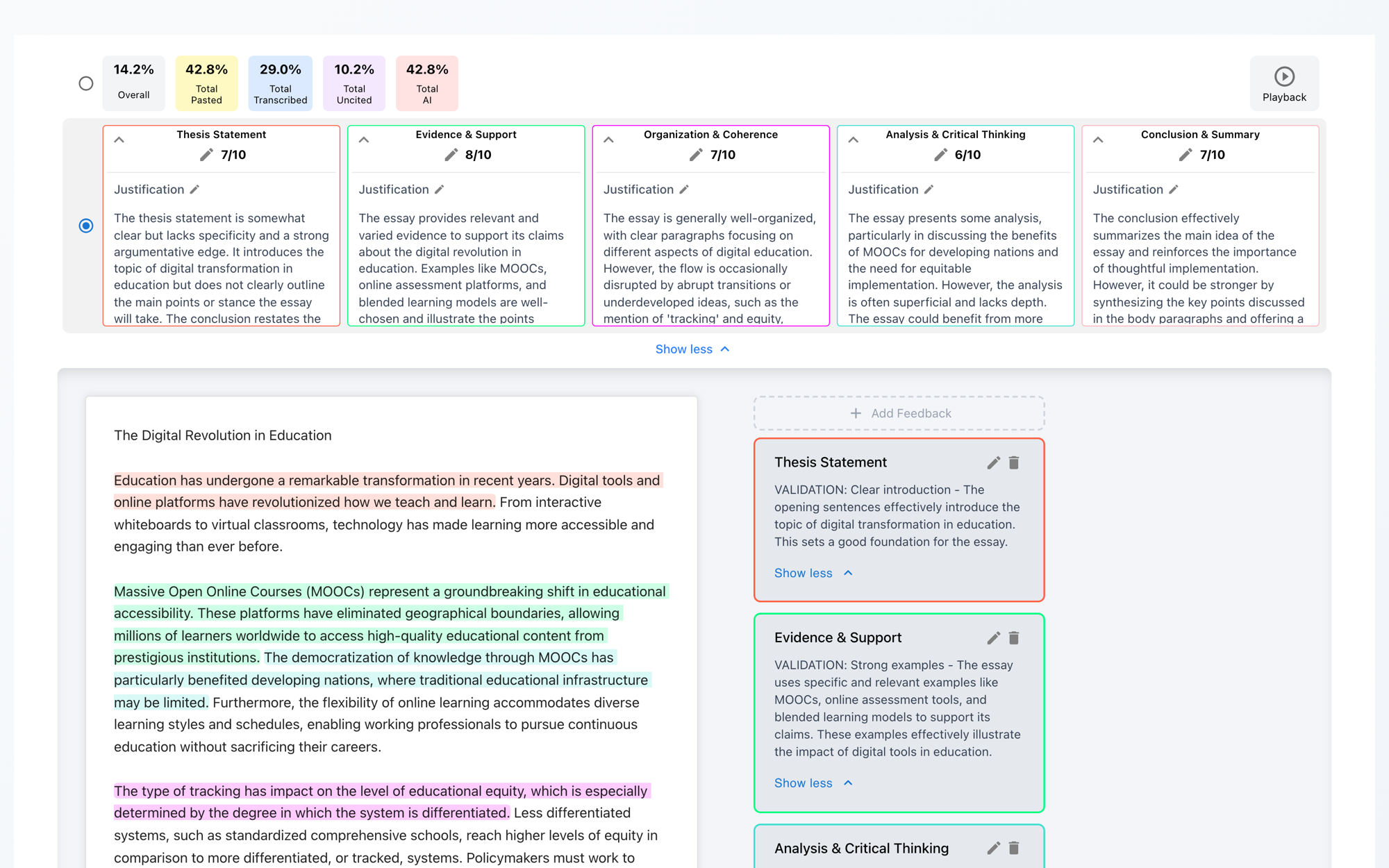
Checkmark Plagiarism (checkmarkplagiarism.com) provides the educational benchmark for this enterprise zero-retention paradigm—combining memory-only rubric autograding, patent-pending Essay Playback™ keystroke dynamics, side-by-side plagiarism source verification, passage-level AI detection, and teacher-approved LMS grade passback directly into Canvas LMS, Agilix Buzz LMS, and Google Classroom. This comprehensive guide provides district leadership with the statutory analysis, technical evaluation rubrics, clause-by-clause contract redline templates, procurement vetting flowcharts, and illustrative scenarios necessary to execute legally defensible, privacy-first AI contracts.
1. The High-Stakes Procurement Dilemma of Automated Essay Grading
The integration of artificial intelligence into formative writing assessment represents one of the most promising yet legally hazardous developments in modern educational technology. In a typical secondary school district, English Language Arts (ELA) educators assign many multi-paragraph compositions each year. With large student caseloads, secondary humanities educators spend a substantial share of their working hours marking student drafts, evaluating thesis construction, correcting grammatical mechanics, and aligning prose against district rubric criteria.
Automated essay grading (AEG) and AI-assisted rubric evaluation engines offer a compelling solution to this structural grading bottleneck. By generating first-draft rubric justifications, identifying structural argumentation gaps, and anchoring actionable feedback cards to specific student sentences, AI grading engines can dramatically accelerate the formative feedback loop. This enables teachers to shift their time from mechanical marking to personalized, one-on-one student writing conferences.
However, behind the promise of automated writing evaluation lies an acute legal, technical, and ethical vulnerability: student essays represent the highest concentration of Personally Identifiable Information (PII), emotional vulnerability, socio-cultural identity, and original intellectual property generated in a K–12 school district.
Anatomy of a K–12 Student Essay: High-Risk Data Composition
Explicit PII & Institutional Data
- Full student legal name & institutional email
- Student identification numbers & grade level
- School, district, and campus names
- Course name, section, and instructor details
- Timestamped document revision metadata
Sensitive Narrative & Disclosures
- Personal trauma, loss, and family grief
- Mental health reflections & social struggles
- Family immigration status & home circumstances
- Political, religious, and philosophical viewpoints
- Socio-cultural identities & personal journals
Student Intellectual Property (IP)
- Original creative writing, prose, and poetry
- Original research, arguments, and capstones
- Copyright protected under 17 U.S.C. § 102
- Vulnerable to involuntary licensing clauses
- Unconsented commercial monetization risk
Unlike standardized multiple-choice assessments—which transmit simple numerical strings or single-character answer keys—student compositions frequently contain:
- Personal Narratives and Lived Experiences: Personal narrative prompts (e.g., college admissions essays, reflective journals) regularly elicit disclosures of family trauma, mental health challenges, sexual orientation, religious beliefs, or immigration status.
- Minor Student Identifiers: Student headers, document metadata, file paths, and citation footnotes contain student names, email addresses, course sections, and institutional identifiers.
- Original Creative and Intellectual Property: Under the United States Copyright Act (17 U.S.C. § 102), students automatically own the exclusive copyright to their original works of authorship from the moment they are fixed in a tangible medium.
When a school district contracts with an EdTech vendor that stores, aggregates, or trains commercial machine learning models on these essays, the district is not merely licensing software—it is surrendering sensitive student records and student intellectual property to private commercial entities. For District Review Committees, establishing an unyielding legal and technical firewall in Vendor Service Agreements (VSAs) is not an optional administrative formality; it is a mandatory statutory duty.
2. Deconstructing the Hidden Legal Traps in Legacy EdTech AI Contracts
District Technology Directors, Purchasing Agents, and School Board Legal Counsel must look past polished vendor sales presentations to scrutinize the hidden legal traps embedded in legacy Master Service Agreements (MSAs), End User License Agreements (EULAs), and click-through Terms of Service. In the modern AI era, these traps center on three pervasive extraction mechanics.
The most ubiquitous contractual loophole in legacy AI EdTech agreements involves the misuse of the term "de-identified data." Vendors frequently include boilerplate provisions stating:
1. Unstructured Student Prose Cannot Be Truly "De-Identified": Unlike structured relational databases—where removing a column of Social Security numbers anonymizes the record—unstructured student writing contains intrinsic contextual PII. A student writing about working at a specific local grocery store, referencing their track coach’s name, or detailing a family medical diagnosis cannot be de-identified by merely stripping headers. Advanced Natural Language Processing (NLP) techniques and model inversion attacks can easily re-identify authors based on idiosyncratic syntactical signatures and narrative markers.
2. The Permanent Parameterization Trap: When a vendor utilizes student essays and paired teacher rubric scores to fine-tune a Large Language Model (LLM) or train a Reinforcement Learning from Human Feedback (RLHF / RLAIF) reward model:
the student's prose is converted into mathematical token embeddings and permanently absorbed into the neural network's billion-parameter weight matrices (θ). Once student data is parameterized into model weights, it is effectively impossible to honor a school's deletion request (for example, under Illinois SOPPA, 105 ILCS 85/15(2)) without deleting and retraining the entire neural model from scratch. The vendor cannot selectively “un-learn” a single student's paragraph. Therefore, any vendor that permits model training on student submissions is structurally unable to honor student data deletion mandates.
Many commercial vendors advertising “cutting-edge AI essay evaluation” do not maintain sovereign machine learning infrastructure. Instead, they operate as simple front-end API wrappers that forward student essays to third-party foundation model providers (such as OpenAI, Anthropic, Google Cloud Vertex AI, or Amazon Bedrock).
Unless the vendor has executed an authenticated Enterprise Zero-Data-Retention (ZDR) Agreement and a comprehensive Data Protection Addendum (DPA) with every upstream subprocessor, those third-party providers default to standard commercial API terms, which include temporary server-side logging (for example, OpenAI retains abuse-monitoring logs for up to 30 days by default, and Anthropic deletes API inputs and outputs within 30 days of receipt) unless a zero-retention arrangement applies. District agreements must explicitly prohibit unregulated subprocessor routing, mandate zero-retention pass-through guarantees across all computational tiers, and demand full visibility into the vendor's architectural subprocessor chain.
Under 17 U.S.C. § 102, original literary works created by students—including argumentative essays, research papers, poetry, and reflective writing—are protected by federal copyright law from the instant of creation. Minors retain full legal and equitable ownership of their intellectual property.
When a school district mandates that students submit work through a platform containing this contractual language, the district becomes complicit in the involuntary forfeiture of student intellectual property. Furthermore, FERPA's school official exception requires that an outside vendor be under the district's “direct control” with respect to the use and maintenance of education records (34 CFR § 99.31(a)(1)(i)(B)(2)). When a vendor claims broad commercial licensing rights over student records, the district risks losing that control and, with it, the basis for the “School Official” exception.
3. Statutory Compliance Matrix for K–12 Automated Essay Grading
District Review Committees must evaluate vendor contracts against an interlocking matrix of federal privacy statutes, state student data protection laws, and educational administrative codes.
| Statute / Jurisdiction | Core Legal Mandate | Mandatory Contractual Requirement |
|---|---|---|
| FERPA (34 CFR Part 99) |
Student Education Records Custody & Purpose Limitation | Direct Control under School Official Exception (§ 99.31); Strict ban on AI model training; Zero Redisclosure (§ 99.33). |
| COPPA (16 CFR Part 312) |
Privacy Protection for Minors Under Age 13 | Strict prohibition on commercial profiling, typing telemetry retention past grading session, and cross-session tracking. |
| PPRA (20 U.S.C. § 1232h) |
Protection of Pupil Rights; Ban on Unconsented Psychological Profiling | Prohibition on psychological analysis, sentiment scoring, emotional classification, or behavioral profiling. |
| NY Education Law § 2-d (8 NYCRR Part 121) |
Mandatory Parents' Bill of Rights; Contractor Breach Notification & Penalties | Alignment with the NIST Cybersecurity Framework (Part 121 names Version 1.1); encryption of PII in motion and at rest; breach notification and reimbursement of notification costs; civil penalties for notification violations (greater of $5,000 or up to $10 per affected person) and up to five-year preclusion. |
| Illinois SOPPA (105 ILCS 85/) |
Ban on Targeted Advertising, Student Profiling, & Sale of Student Data | Written agreement with required terms, posted publicly by the school; breach cost allocation; stated deletion or transfer timeline; vendor breach notice to the school within 30 calendar days at most. |
| California AB 1584 / SOPIPA (Cal. Ed. Code § 49073.1; Cal. Bus. & Prof. Code § 22584) |
Ownership of Pupil Records; Ban on Non-Educational Commercial Mining | Certification of non-retention after contract end; pupil records stay under district control and are not used beyond the contract's purpose; parent review and correction procedures. |
| Texas Education Code (§§ 32.151–32.157) |
Operator Duties for Student Information (HB 2087): No Targeted Advertising, Profiling, or Sale | Written commitment to the statutory prohibitions; reasonable security procedures and practices (§ 32.155); deletion of covered information within 60 days of a district request unless the contract sets another timeline (§ 32.156). |
1. FERPA (Family Educational Rights and Privacy Act, 34 CFR Part 99)
Under FERPA, an essay submitted by a student for academic credit constitutes an Education Record directly related to a student and maintained by an educational agency. For a district to share student writing with an automated essay grading platform without obtaining prior written consent from every parent, the vendor must strictly qualify under the School Official Exception (34 CFR § 99.31(a)(1)(i)(B)).
To maintain this legal exception, the contract must satisfy four non-negotiable statutory pillars:
- Institutional Service Equivalency: The vendor performs an institutional service or function for which the district would otherwise employ its own staff (evaluating student writing against academic standards).
- Direct Control Mandate: The vendor operates under the direct control and authority of the school district regarding the maintenance, processing, and destruction of education records.
- Purpose Limitation (§ 99.33(a)(2)): The vendor uses student education records solely for the specific educational objective defined in the contract (generating formative rubric feedback for the classroom teacher). Any secondary use—including model fine-tuning, system optimization, or telemetry mining—constitutes a federal statutory breach.
- Prohibition on Redisclosure (§ 99.33(a)(1)): The vendor is strictly prohibited from disclosing or transmitting student records to any third party or subprocessor without prior express written authorization from the school district.
If a vendor’s master agreement includes a clause asserting that the vendor owns or may monetize “anonymized analytics,” “derived data,” or “prompt-completion telemetry,” the district may have lost “direct control” over its education records. This can jeopardize the School Official exception, exposing the district to federal compliance scrutiny.
2. COPPA (Children’s Online Privacy Protection Act, 16 CFR Part 312)
In K–8 elementary and middle school settings, students under 13 years of age receive heightened statutory protection under COPPA. While school districts may provide consent on behalf of parents (in loco parentis), federal FTC guidance strictly limits this authority to exclusively educational purposes.
If an automated essay grading vendor tracks minor students across non-educational sessions, builds longitudinal psychometric profiles, or retains student essays longer than is reasonably necessary for the educational purpose (16 CFR § 312.10), the school’s consent may not be valid, exposing the vendor to civil penalties exceeding $50,000 per violation (inflation-adjusted under 15 U.S.C. § 45(m)(1)(A) and 16 CFR § 1.98).
3. State-Specific Student Privacy Mandates
New York Ed Law § 2-d
Requires an executed Parents' Bill of Rights, NIST Cybersecurity Framework alignment, and encryption of PII. Contractors must notify the district of breaches and reimburse notification costs, with civil penalties for notification violations of the greater of $5,000 or up to $10 per student, teacher, and principal whose data was released, and possible preclusion from accessing data for up to five years.
Illinois SOPPA
Prohibits targeted advertising, amassing student profiles outside K-12 school purposes, and selling or renting student information; requires schools to post their operator agreements publicly and requires operators to notify the school of a breach no later than 30 calendar days after determining it occurred.
California SOPIPA / AB 1584
Requires contracts to state that pupil records remain the property of, and under the control of, the local educational agency; requires certification that records are not retained after the contract ends; bars use of pupil records beyond the contract's purpose. SOPIPA separately bars operators from selling student information and requires deletion when the school requests it.
4. Technical Architecture: Plaintext Retentive Systems vs. Checkmark's Zero-Retention Vault
To effectively audit automated grading vendors, District CTOs and Technology Directors must understand the deep architectural differences between legacy retentive platforms and modern zero-retention architectures.
Checkmark’s Enterprise Zero-Retention Architecture
Checkmark Plagiarism was engineered from the ground up to establish an impenetrable data privacy firewall for K–12 school districts and universities:
- Cryptographic Zero-Data-Retention (ZDR) Inference Vault: Checkmark processes student essays in volatile, memory-only execution sandboxes (RAM). Analysis is performed entirely in memory without writing unhashed prose to solid-state disks (SSDs) or relational databases. Upon delivering the feedback payload to the educator’s authenticated browser session, memory buffers are cryptographically zeroized in under 800 milliseconds.
- Strict Zero Model Training Commitment: Checkmark maintains an absolute, legally binding contractual policy: Student submissions, teacher modifications, and rubric grading interactions are never used to train, fine-tune, or validate artificial intelligence models, classifiers, or neural weights. Checkmark’s proprietary models are pre-trained on licensed, public-domain, and synthetically generated benchmark datasets, ensuring complete independence from student educational records.
- 1EdTech LTI 1.3 Advantage & Native Grade Passback: Checkmark integrates seamlessly into district LMS platforms—including Canvas LMS, Buzz LMS, and Google Classroom—via 1EdTech LTI 1.3 Advantage protocols (AGS 2.0 / NRPS 2.0) with OAuth 2.0 and SAML/OIDC Single Sign-On, eliminating vendor custody of student credentials.
- Patent-Pending Essay Playback™ & Writing Process Analysis: Rather than relying on black-box AI detection scores that guess at authorship based on surface text statistics, Checkmark captures the authentic writing process in real time: keystroke replay at 1x–8x speed, cognitive pause analysis, external clipboard paste buffer capture (preserving 100% complete original pasted text), and mechanical transcription detection to exonerate honest students.
- Mandatory Teacher-in-the-Loop Autograding: Checkmark rejects autonomous algorithmic grading. The AI Autograder generates first-draft rubric evaluations—complete with point breakdowns, written criteria justifications anchored to student quotes, and suggested formative feedback cards. All AI-generated scores remain provisional drafts until explicitly reviewed, adjusted, and finalized by the classroom teacher. The teacher retains 100% final pedagogical and grading authority.
| Architectural Feature | Legacy EdTech AI Platforms | Checkmark Plagiarism Suite |
|---|---|---|
| Data Storage Model | Persistent SQL & S3 Disk Storage | 100% Ephemeral In-Memory (RAM) Vault |
| AI Model Training on Essays | Yes (via “De-Identification” clause) | STRICTLY PROHIBITED (Legally Binding ZDR) |
| RLHF Fine-Tuning on Grades | Yes (Captures Teacher Corrections) | NEVER (Zero Training Policy) |
| Subprocessor Logging | Standard 30-Day Logging Defaults | Enforced Zero-Logging Enterprise Pass-Through |
| Student Intellectual Property | Involuntary Perpetual License Grants | 100% Student/District Retained (17 U.S.C. § 102) |
| LMS Integration Protocol | Proprietary / Insecure Legacy LTI 1.1 | Certified 1EdTech LTI 1.3 Advantage (AGS/NRPS) |
| Automated Grading Authority | Autonomous Black-Box Scoring | Teacher-in-the-Loop (Provisional Draft Only) |
| Process Telemetry & Verification | None (Static Surface Text Only) | Patent-Pending Essay Playback™ Keystroke Replay |
| Encryption Standards | Standard AES-128 Cloud Storage | AES-256 at Rest / TLS 1.3 in Transit |
5. The 5-Pillar Vendor Service Agreement (VSA) Procurement Framework
District Review Committees must evaluate every automated essay grading and AI writing vendor against the 5-Pillar VSA Procurement Framework. If a vendor fails to meet the mandatory standard in any single pillar, the district should reject the proposal or issue a formal contract redline requiring full compliance.
Pillar 1: Zero-Data-Retention (ZDR) & Ephemeral Processing Mandate
- Technical Standard: The vendor must execute all essay ingestion, rubric matching, AI detection, and plagiarism analysis within volatile memory (RAM).
- Storage Restriction: No plaintext student text, revision logs, or PII may be persisted to permanent databases, S3 buckets, local file caches, or unencrypted system logs.
- Sanitization Protocol: Volatile memory buffers must be sanitized using cryptographic zeroization protocols (e.g.,
explicit_bzero) immediately upon delivering the analysis payload to the educator's authenticated session.
Pillar 2: Irrevocable Model Training & Derivative Work Prohibition
- Contractual Ban: The contract must explicitly prohibit the vendor from using student essays, teacher rubric adjustments, grading comments, or user interaction telemetry to train, fine-tune, optimize, or evaluate any artificial intelligence model, large language model, classifier, or algorithmic system.
- No "De-Identification" Loophole: The prohibition must explicitly state that stripping student names, metadata, or timestamps does not exempt the vendor from the model training ban.
- No Derivative IP: The vendor acquires zero intellectual property rights, commercial licenses, or derivative asset rights in student submissions.
Pillar 3: Subprocessor Downstream Pass-Through & Audit Verification
- Downstream Enforcement: The vendor must warrant that all third-party subprocessors (cloud hosts, inference providers, API gateways) are bound by contractual data privacy obligations at least as restrictive as the district's VSA.
- Zero-Logging API Configuration: If third-party LLM endpoints are utilized, the vendor must prove active enterprise Zero-Data-Retention (ZDR) agreements that completely disable 30-day API logging, human safety reviews, and telemetry collection.
- Independent Audit Rights: The vendor must provide annual SOC 2 Type II audit reports, third-party penetration test summaries, and allow the district to conduct compliance audits of data destruction logs.
Pillar 4: Teacher-in-the-Loop Governance & Algorithmic Explainability
- Prohibition on Autonomous Grading: The platform must not assign final grades, impose disciplinary flags, or record permanent student evaluative data autonomously.
- Draft-Only AI Feedback: AI rubric scores and written feedback must be presented as editable suggestions that require human educator review, modification, and final authorization.
- Explainable Justifications: The AI autograder must provide clear, quote-anchored justifications tied directly to specific lines of student writing and district rubric criteria, avoiding unexplainable black-box score outputs.
Pillar 5: Data Ownership, Encryption & 1EdTech LTI 1.3 Standards
- District IP Custody: All submitted student essays, teacher feedback, and grading records remain the exclusive property of the school district and the authoring student under 17 U.S.C. § 102.
- End-to-End Encryption: Data must be encrypted in transit using TLS 1.3 and at rest using AES-256.
- Standards-Based Interoperability: The platform must utilize 1EdTech LTI 1.3 Advantage (AGS 2.0 / NRPS 2.0) with OAuth 2.0 and SAML/OIDC Single Sign-On, eliminating vendor custody of student credentials.
6. Ready-to-Use Contract Clause Boilerplate Templates (Legal Redline Toolkit)
School Board Attorneys, Purchasing Directors, and District Technology Counsel can integrate the following legally enforceable clauses directly into their RFPs, Master Service Agreements (MSAs), and Data Protection Addenda (DPAs).
7. Multi-Stage Vendor Vetting Flowchart for District Review Committees
District procurement teams should execute the following systematic 5-step evaluation workflow before authorizing any automated essay grading pilot or enterprise contract.
Contractual Terms & Training Audit
Does vendor claim rights to “De-Identified Data” or AI model training?
Storage Architecture Verification
Does vendor enforce volatile Zero-Data-Retention (ZDR) RAM processing?
Subprocessor Zero-Logging Proof
Does vendor route essays through commercial APIs with executed enterprise ZDR addenda?
Teacher-in-the-Loop Governance
Are all AI grades draft suggestions with quote-anchored justifications and human sign-off?
1EdTech LTI 1.3 Advantage & Process Telemetry
Does vendor provide native Canvas/Buzz passback and patent-pending Essay Playback™?
8. Illustrative District Procurement Scenarios
The following scenarios are hypothetical composites written for illustration. They do not describe specific real districts, vendors, or incidents. They show the risks of unvetted AI grading contracts and how the 5-Pillar VSA Framework applies in practice.
Scenario 1: A Suburban District Audits a Legacy AI Contract
Model Training BreachThe Incident: During contract renewal, the District Data Privacy Officer and Board Legal Counsel discover a newly inserted sub-clause granting a legacy AI grading vendor “a perpetual license to aggregate, de-identify, and utilize user-generated compositions to improve internal natural language understanding models.”
The Finding: A review shows that student compositions, including personal college application essays containing sensitive disclosures, may already have been ingested into the vendor's machine learning training pipeline. When the district demands deletion from model weights, the vendor says it is technically impossible to un-train the neural network.
The Resolution: The School Board votes to terminate the contract and requires any replacement vendor to accept an explicit training ban, ephemeral in-memory processing, and native 1EdTech LTI 1.3 Canvas integration under the 5-Pillar VSA Framework.
Scenario 2: An Urban School System Discovers a Subprocessor Leak
API Logging IncidentThe Incident: A commercial LLM API provider used by a third-party EdTech vendor suffers a cloud misconfiguration exposing raw API request logs. The district discovers the vendor had passed unencrypted student essays directly through standard consumer API endpoints without an enterprise zero-retention DPA.
The Impact: Middle school essays containing student names, school identifiers, and teacher notes may have been logged in plaintext on cloud servers for an extended period, raising potential exposure under COPPA (16 CFR Part 312) and state student privacy laws.
The Resolution: The district revokes vendor access, adopts the 5-Pillar VSA Framework, and selects a replacement vendor that offers certified LTI 1.3 Canvas/Buzz integrations, subprocessor zero-logging pass-through guarantees, and quote-anchored autograding.
Scenario 3: A Regional Educational Service Agency Runs a Consortium RFP
Consortium RFPThe Challenge: A Regional Educational Service Agency (RESA) representing multiple school districts issues a joint RFP for an enterprise academic integrity and automated grading platform that must comply with Illinois SOPPA and New York Ed Law § 2-d.
The Outcome: Vendors that rely on persistent plaintext storage or vague training clauses are disqualified. The consortium awards the contract to a vendor that delivers ephemeral in-memory processing, writing-process telemetry, and one-click LTI 1.3 Canvas/Buzz grade passback across every member district.
9. Step-by-Step District Implementation & Teacher Workflow
To ensure both ironclad data privacy and maximum instructional efficiency, district leadership must establish a standardized administrative and classroom workflow.
Execute 5-Pillar VSA, configure LTI 1.3 keys in Canvas/Buzz, and enforce SSO with Role-Based Access Control (RBAC).
Teachers create writing prompts in SpeedGrader or Buzz and attach district rubrics (6-Trait, AP, state standards).
Checkmark silently captures authentic keystroke dynamics, pauses, and external paste buffers without invasive proctoring.
Memory-only analysis returns quote-anchored rubric feedback, AI passage sliders, and 1x–8x Essay Playback™ scrub.
Teacher reviews/adjusts draft feedback and clicks “Approve & Sync” to push final marks straight into the LMS gradebook.
10. Frequently Asked Questions (District Leadership FAQ)
1. What is the legal and technical difference between "anonymized/de-identified" student data and true Zero-Data-Retention (ZDR)?
“De-identified” data strips direct identifiers (names, IDs), but raw student prose is still stored in persistent databases and utilized for commercial AI model training. In student writing, narrative context allows easy re-identification, and once parameterized into neural weights, it cannot be deleted. In contrast, Zero-Data-Retention (ZDR) guarantees student essays exist solely in volatile RAM for milliseconds during active scoring, after which buffers are cryptographically zeroized with zero disk writes.
2. Can our district allow teachers to use consumer AI tools (e.g., ChatGPT, Claude) to grade student essays?
No. Pasting student essays into consumer AI tools can violate FERPA (34 CFR Part 99), COPPA (16 CFR Part 312), and state privacy statutes. Consumer AI tools generally operate under terms that allow logging and possible use of conversations to improve models, and those terms are not negotiated with the district. Without an executed district DPA and a zero-retention agreement, uploading student writing to consumer AI chatbots puts the district at risk of violating these laws.
3. How does Checkmark Plagiarism ensure upstream LLM inference subprocessors do not retain student essays?
Checkmark enforces strict Enterprise Zero-Data-Retention (ZDR) Pass-Through Agreements with all cloud infrastructure and foundation model partners. Inference calls are routed through authenticated private enterprise endpoints where standard 30-day logging, human safety audits, and model training pipelines are completely disabled by contract and architectural policy.
4. Does using automated essay grading violate FERPA's "School Official" exception?
Automated essay grading complies with FERPA's School Official exception (34 CFR § 99.31(a)(1)(i)(B)) only if the vendor operates under the district's direct control, uses data solely for authorized educational evaluation, and never uses student work for commercial model training. Furthermore, to maintain due process, the system must enforce a Teacher-in-the-Loop model where AI generates provisional draft suggestions while the human educator retains final authority.
5. How does patent-pending Essay Playback™ protect student privacy while capturing keystroke telemetry?
Unlike invasive proctoring software—which records webcam video, eye movements, audio, or desktop screens—Essay Playback™ captures only non-biometric writing telemetry within the document editor itself (character insertions, deletions, composing pauses, and clipboard paste events). It does not access external applications, personal files, or biometric data. All telemetry is encrypted via AES-256 and accessible strictly to authenticated educators in the district LMS.
6. What happens to student intellectual property when an essay is scanned for grading and plagiarism?
Under Checkmark's Master Services Agreement and 17 U.S.C. § 102, students and the school district retain 100% exclusive copyright and ownership of all submitted essays and drafts. Checkmark acquires zero commercial license or derivative asset rights. For peer-to-peer plagiarism matching, Checkmark utilizes district-isolated cryptographic locality-sensitive hashing (MinHash/LSH), allowing similarity matching without pooling or exposing raw student text.
7. What legal and financial penalties do school districts face under state laws for contracting with non-compliant AI vendors?
Under New York Education Law § 2-d (8 NYCRR Part 121), a third-party contractor must notify the district of a breach and reimburse the full cost of notifying affected families. Violating the breach-notification duty carries civil penalties of the greater of $5,000 or up to $10 per affected student, teacher, and principal, and the state Chief Privacy Officer can preclude a contractor responsible for an unauthorized release from accessing data for up to five years. Under Illinois SOPPA (105 ILCS 85/), operators may not engage in targeted advertising, amass student profiles outside K-12 school purposes, or sell student information, and schools must publish their operator agreements and breach lists. Requiring the 5-Pillar VSA helps reduce these risks.
11. Conclusion: Stop Guessing, Start Trusting
The transition to AI-assisted writing instruction does not require school districts to compromise student privacy, forfeit student intellectual property, or subject teachers and students to opaque, punitive black-box algorithms. Educational technology must serve educators and students—fostering transparent, defensible, and growth-oriented learning environments.
By establishing ironclad Vendor Service Agreements built on Cryptographic Zero-Data-Retention (ZDR), strict prohibitions against AI model training, certified 1EdTech LTI 1.3 LMS interoperability, and human-in-the-loop governance, K–12 school districts can safely unlock the immense instructional benefits of automated essay evaluation.
Ready to Upgrade Your District's AI Data Privacy Protections?
Schedule an enterprise architectural security briefing or request custom contract redline templates for your district review committee.