
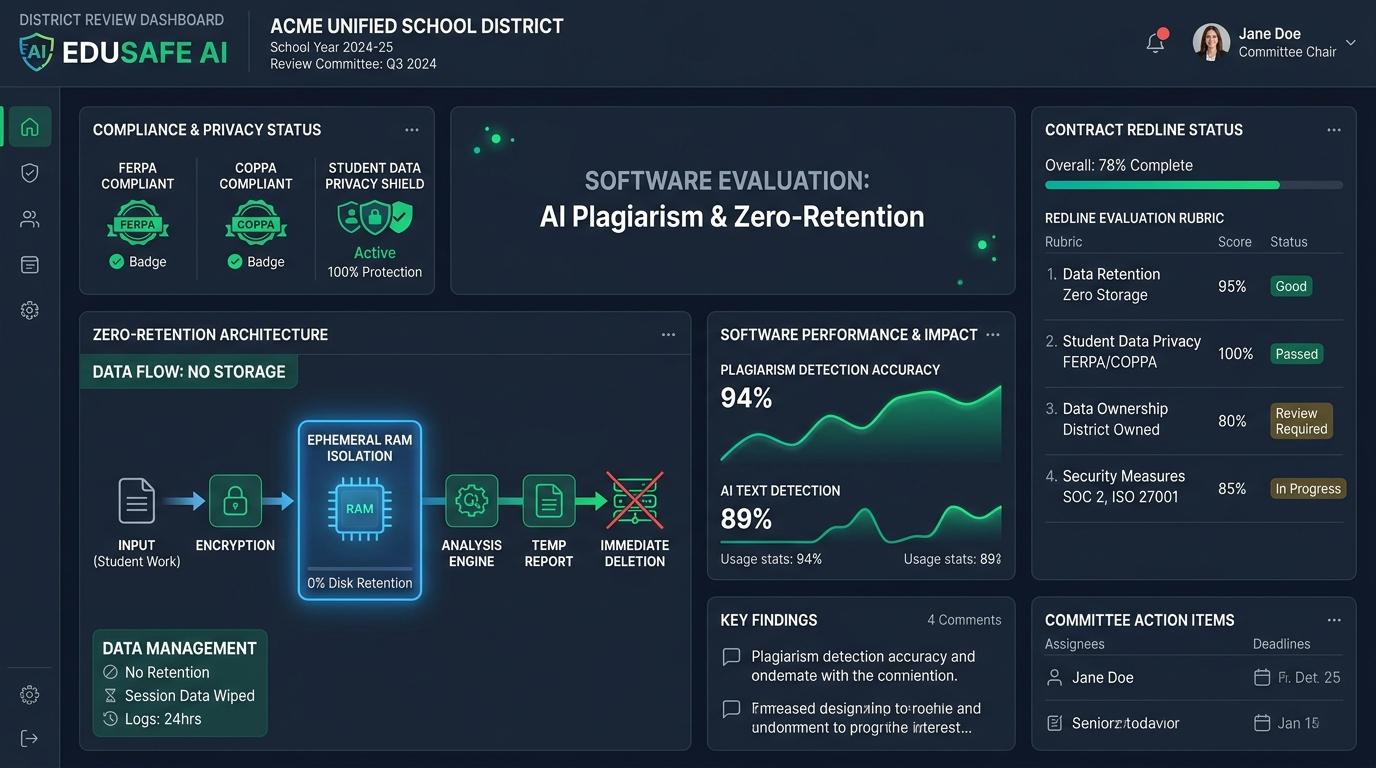
As generative artificial intelligence reshapes classroom instruction and student writing, K–12 school districts and higher education institutions face an unprecedented procurement dilemma. Traditional academic integrity vendors and emerging AI detection platforms frequently rely on contract language that quietly expropriates student intellectual property, stores unencrypted student essays in persistent cloud databases, and routes sensitive text through commercial Large Language Model (LLM) Application Programming Interfaces (APIs) for continuous model training and Reinforcement Learning from Human Feedback (RLHF). For District Review Committees—comprising School Board Trustees, Superintendents, Assistant Superintendents of Curriculum, Chief Technology Officers (CTOs), Legal Counsel, and Data Privacy Officers (DPOs)—procuring an academic integrity solution requires moving beyond vague marketing slogans (“We value student privacy”) to enforce rigorous, legally binding Zero-Data-Retention (ZDR) contract architecture.
Checkmark Plagiarism (checkmarkplagiarism.com) empowers educational leadership to implement defensible writing governance by unifying passage-level AI detection, side-by-side plagiarism verification, rubric-based autograding, and patent-pending Essay Playback™ writing process telemetry within a strict zero-retention, FERPA-compliant infrastructure certified for Canvas LMS and Agilix Buzz LMS.
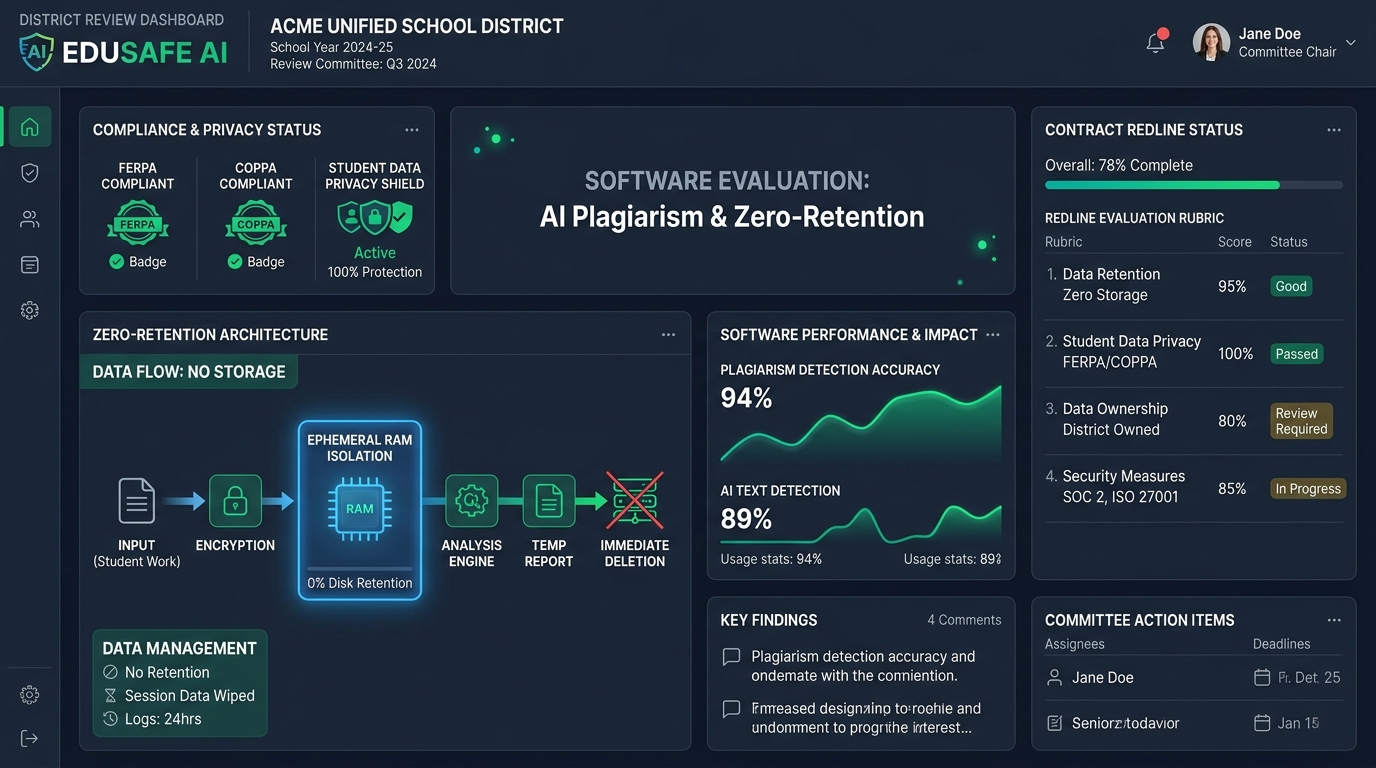
1. The AI Data Privacy Crisis in K–12 and Higher Education Procurement
For over two decades, educational technology procurement treated academic integrity software as a static utility: a student uploads a digital document, a server scans it against a static corpus of web pages and archived student papers, and an instructor receives a similarity score. However, the mass adoption of foundation AI models and generative writing tools has fundamentally destabilized this paradigm. Today, academic integrity platforms operate complex multi-stage pipelines incorporating deep neural networks, transformer architectures, and third-party foundation model APIs.
This technological evolution introduces severe, systemic risks to student data privacy and district legal compliance. When evaluating software vendor contracts, District Review Committees must deconstruct the stark divergence between promotional public relations claims and enforceable contract mechanics.
| Vendor Marketing Claim (“PR Language”) | Binding Contract Reality (“The Fine Print”) |
|---|---|
| “We take student privacy seriously.” | Standard Terms of Service permit “product improvement, feature extraction, and algorithmic training on de-identified or aggregated data.” |
| “Submissions are encrypted and secure.” | Plaintext essays sit in persistent AWS/GCP SQL databases, subject to vendor employee inspection, diagnostic caching, and sub-processor synchronization. |
| “Our AI detector is state-of-the-art.” | Vendor acts as an API proxy, passing raw student text to public LLM endpoints without enterprise Zero-Data-Retention (ZDR) agreements, enabling 30-day cloud logging. |
| “You can request data deletion anytime.” | Once student text updates deep neural network weights, it is permanently parameterized across billions of floating-point tensors and mathematically un-deletable. |
Plaintext Data Custody vs. True Zero-Data-Retention (ZDR)
Most commercial software vendors operate on a Plaintext Data Custody model. When an essay is submitted via an LMS integration (such as Canvas, Buzz, or Google Classroom), the vendor ingests the file, writes the raw text and metadata (student name, email, school ID, timestamp) to a persistent cloud database (e.g., Amazon S3, DynamoDB, PostgreSQL), and maintains that data indefinitely to build a proprietary competitive asset: a global peer comparison repository or a proprietary AI training corpus.
In sharp contrast, a true Zero-Data-Retention (ZDR) architecture enforces absolute data ephemerality:
Ephemeral RAM Lifecycle
The submission exists exclusively in volatile random-access memory (RAM) for the precise duration of the computational analysis (typically 300 to 800 milliseconds).
Hardware Zeroization
Upon completion of the scan and delivery of the report payload to the educator's authenticated LMS interface, memory buffers are explicitly overwritten with null bytes (0x00) and released.
Zero Disk Persistence
No raw text, draft revisions, or student identifiers are ever committed to solid-state disks (SSDs), relational databases, log aggregators, or long-term cloud backups.
The Four Hidden Vectors of Student Data Exploitation
District Technology Directors and Legal Counsel must scrutinize vendor contracts for four specific extraction vectors:
Vendors training proprietary generative models or AI classifiers ingest hundreds of thousands of student essays to expand their training corpora. Minor students' personal reflections, argumentative structures, unique literary styles, and cultural vernacular are permanently subsumed into the training set, transforming student educational records into vendor commercial assets without compensation or consent.
When educators grade essays or correct AI-generated feedback within a platform, unscrupulous vendors capture the paired tuple:
This data is utilized in RLHF and Reinforcement Learning from AI Feedback (RLAIF) pipelines to fine-tune commercial automated grading engines, capitalizing on educator labor and student intellectual work without district authorization.
Many EdTech startups that brand themselves as “AI-powered integrity platforms” do not run local inference engines. Instead, they operate as simple API pass-through wrappers. When a student submits a paper, the vendor forwards the full plaintext to commercial LLM providers (e.g., OpenAI, Anthropic, Cohere, Microsoft Azure, Amazon Bedrock). Unless the vendor has executed binding Enterprise Zero-Data-Retention Agreements with every upstream sub-processor, those foundation model providers default to retaining API requests for up to 30 days (longer where legally required), creating massive secondary breach vulnerabilities outside district oversight.
Once student writing is absorbed into a deep learning neural network during a training run, the data undergoes mathematical tokenization, high-dimensional vector transformation, and gradient descent optimization. The student's text becomes permanently embedded in the network's billion-parameter weight tensors:
At this stage, executing a statutory “Right to be Forgotten” under privacy laws or fulfilling a district or parental data deletion request is technically impossible without destroying and retraining the entire multi-million-dollar neural model from scratch. Vendors cannot “un-train” a specific student's paragraph from model weights. Therefore, any vendor that permits model training on student work is in structural non-compliance with data deletion statutes.
2. Statutory Compliance Deep Dive: Federal, State, and Intellectual Property Mandates
District Review Committees must evaluate academic integrity contracts through an interlocking matrix of federal statutes, state data privacy laws, and federal intellectual property rights.
| Statute / Legal Doctrine | Core Legal Mandate | Mandatory Contractual Requirement |
|---|---|---|
| FERPA (34 CFR Part 99) |
Student Education Records Custody & Purpose Limitation | Direct Control under School Official Exception (§ 99.31); Use limited to the contracted purpose (§ 99.33(a)(2)), with a contractual ban on AI training; Zero Redisclosure (§ 99.33(a)(1)). |
| COPPA (15 U.S.C. §§ 6501–6506) |
Privacy Protection for Minors Under Age 13 | School consent covers educational use only; commercial use of children's data, such as behavioral profiling, requires verifiable parental consent. |
| NY Education Law § 2-d (8 NYCRR Part 121) |
Personally Identifiable Information (PII) Protection & Data Security | Mandatory Parents' Bill of Rights; NIST CSF alignment; civil penalties (greater of $5,000 or up to $10/student) and possible state debarment for breach. |
| Illinois SOPPA (105 ILCS 85/) |
Student Online Personal Protection & Breach Notification | Ban on selling student data and amassing student profiles; mandatory public posting of district agreements; operator breach notice to the school within 30 calendar days at most. |
| California SOPIPA (Cal. Bus. & Prof. Code § 22584) |
Prohibition of Student Profiling and Commercial Data Mining | Ban on targeted advertising, amassing student profiles outside K–12 school purposes, and selling student information; deletion of covered information on school request. |
| U.S. Copyright Act (17 U.S.C. § 102) |
Intellectual Property Ownership of Original Works of Authorship | Student retains copyright in original work; broad clickwrap licenses to create derivative models should be rejected, and licenses from minors are legally vulnerable. |
1. FERPA (Family Educational Rights and Privacy Act, 34 CFR Part 99)
Under FERPA, student essays, laboratory reports, revision histories, and assigned grades constitute protected Education Records containing Personally Identifiable Information (PII). A school district cannot disclose PII to an external software vendor without prior written parental consent unless the vendor qualifies under the strict “School Official” Exception codified in 34 CFR § 99.31(a)(1)(i)(B).
To qualify as a legitimate School Official, the vendor arrangement must satisfy the conditions in 34 CFR § 99.31(a)(1)(i)(B), which incorporate the use and redisclosure limits of § 99.33(a):
- Institutional Service Substitution: The vendor performs an institutional service or function for which the district would otherwise use its own employees (e.g., reviewing academic originality and grading).
- Direct Control Requirement: The vendor must operate under the direct control of the educational agency or institution with respect to the use and maintenance of education records.
- Purpose Limitation (§ 99.33(a)(2)): The vendor may use student data solely for the purposes for which the disclosure was made, here the specific educational purpose authorized in the contract. Using student essays to train commercial AI models, optimize third-party algorithms, or aggregate consumer datasets falls outside that purpose and is inconsistent with this limit.
- Prohibition on Redisclosure (§ 99.33(a)(1)): The vendor cannot redisclose student PII to sub-processors or cloud partners except as the regulation permits, meaning with prior consent or as a further disclosure made on the district's behalf that itself meets § 99.31.
If a vendor’s master services agreement includes a clause asserting a “non-exclusive, perpetual, royalty-free license to use submitted content for algorithmic training and platform optimization,” the district risks losing “direct control” under FERPA § 99.31(a)(1)(i)(B), which undermines its basis for sharing student records without parental consent and can expose it to enforcement action by the U.S. Department of Education's Student Privacy Policy Office (SPPO).
2. COPPA (Children’s Online Privacy Protection Act, 15 U.S.C. §§ 6501–6506)
In elementary and middle school settings (grades K–8), students under 13 years of age are protected under COPPA. While schools can act as the parent's agent to consent to data collection for strictly educational purposes (in loco parentis), this authority is legally conditioned upon the software operator using the personal information exclusively for educational activities and for no other commercial purpose.
If an academic integrity vendor tracks minor students across sessions using persistent tracking cookies, constructs behavioral profiles based on typing cadences or application usage, or utilizes minor submissions to train machine learning models for broader commercial sale, the school's consent does not cover that use under the FTC's COPPA guidance, and verifiable parental consent would be required. Operators who violate the COPPA Rule face civil penalties exceeding $50,000 per violation.
3. State-Level Data Privacy Legislation
New York Ed Law § 2-d
Requires executed Parents' Bill of Rights, NIST Cybersecurity Framework (CSF) alignment, and carries civil penalties of the greater of $5,000 or up to $10 per affected student, alongside possible vendor debarment from state contracts.
Illinois SOPPA
Strictly prohibits student profiling and commercial data aggregation; mandates public posting of signed district agreements within 10 business days, and requires operators to notify schools of a breach no later than 30 calendar days after it is determined.
California SOPIPA
Prohibits operators from using K–12 student data for targeted advertising, amassing profiles outside K–12 school purposes, or selling student information, and requires them to delete covered information when the school or district requests it.
4. Student Copyright and Intellectual Property (17 U.S.C. § 102)
Under Title 17 of the United States Code, original student essays, creative writing, poetry, research papers, and technical projects are protected by federal copyright law immediately upon fixation in a tangible medium of expression. Students (or their legal guardians, in the case of minors) retain exclusive ownership of their intellectual property.
Minors can generally disaffirm (cancel) contracts they enter into, so a broad copyright license taken from a student through forced online clickwrap terms is legally vulnerable. Ingesting student copyright-protected writing into commercial generative AI training corpora without explicit, uncoerced copyright licensing is a legal and reputational risk for both the vendor and the district.
3. Technical Anatomy of a True Zero-Retention Architecture
To verify compliance during the Request for Proposal (RFP) process, the District Review Committee's technical sub-committee (CTO, Network Architects, Security Engineers) must interrogate the vendor's underlying technical architecture.
Ephemeral In-Memory (RAM) Compute Pipelines vs. Persistent Storage Stacks
Checkmark Plagiarism utilizes a Stateless Ephemeral Compute Enclave Architecture. The technical mechanics operate as follows:
- Ingestion via TLS 1.3 with Perfect Forward Secrecy (PFS): Submissions are received over encrypted tunnels utilizing
TLS_AES_256_GCM_SHA384with ephemeral session keys. - Volatile RAM-Only Execution: The entire analysis suite executes exclusively in ephemeral system RAM utilizing isolated AWS Nitro Enclaves. At no point in the lifecycle is student plaintext written to disk storage, swap space, temporary cache volumes (
/tmp), or application log sinks. - Hardware Memory Zeroization (
explicit_bzero): Immediately after the analysis payload is dispatched back to the educator's browser, allocated heap buffers undergo active cryptographic zeroization. - Zero Residual Footprint: Even if a server instance is powered down or imaged by an adversary, zero bytes of student writing or identifiers can be recovered.
Sub-Processor Supply Chain Auditing: Enterprise Zero-Data Retention SLAs
A platform is only as secure as its upstream cloud supply chain. District committees must demand end-to-end transparency regarding every sub-processor.
| Architectural Tier | Sub-Processor Technical Role | Mandatory Zero-Retention SLA Terms |
|---|---|---|
| Cloud Infrastructure (AWS / Google Cloud) |
Compute orchestration, volatile RAM hosting (Nitro Enclaves / Shielded VMs) | SOC 2 Type II, ISO 27001, a binding data processing agreement covering FERPA obligations; zero persistent disk writes. |
| Foundation Model APIs (OpenAI / Anthropic / Bedrock) |
Specialized NLP semantic parsing (grammar, syntax, rubric parsing) | Zero Data Retention (ZDR) Enterprise Addendum; zero 30-day logging; no RLHF. |
| Vector Search Database (Pinecone / Qdrant) |
Plagiarism web & academic matching (web index & public corpora) | Ephemeral query hashing; zero storage of incoming query vector plaintext. |
Privacy-Preserving Peer Plagiarism Detection: District-Isolated Cryptographic Hash Vaults
One of the most complex challenges facing a District Review Committee is resolving the conflict between student-to-student peer plagiarism detection (identifying collusion across different sections or past semesters) and strict student data privacy.
Legacy vendors resolve this by uploading all student essays into a massive, multi-tenant global database where papers from District A are stored in plaintext to catch copying in District B. This practice creates severe FERPA vulnerabilities. Checkmark Plagiarism solves this through District-Isolated Salted Locality-Sensitive Hashing (LSH) and MinHash Cryptography:
[0x8F, 0x12, 0xC4, 0x9A, ...]J(A, B) = |A ∩ B| / |A ∪ B|
4. Enterprise Identity, Interoperability, and Multi-Factor Verification
A modern academic integrity platform must integrate seamlessly into district IT infrastructure while eliminating security friction for teachers and students.
1EdTech LTI 1.3 Advantage Protocol Suite
District Review Committees must insist on certified 1EdTech LTI 1.3 Advantage compliance, which deprecates legacy, insecure OAuth 1.0/LTI 1.1 integrations in favor of modern OAuth 2.0 and JSON Web Token (JWT) asymmetric key architectures.
| LTI 1.3 Core Standard | Technical Protocol Specification | Educational & Administrative Benefit |
|---|---|---|
| LTI Core (OAuth 2.0 / JWT) |
Asymmetric RSA/ECDSA signature verification with OIDC launch flow | Eliminates shared secrets; provides single-click seamless LMS launch inside Canvas SpeedGrader & Buzz. |
| Assignment & Grade Services (AGS 2.0) |
Bidirectional gradebook sync with line item and score payload support | AI autograder suggestions and educator-approved rubric scores push directly to LMS gradebook with 1 click. |
| Names & Role Provisioning (NRPS 2.0) |
Context-scoped roster sync with anonymized pseudonymous identifiers | Privacy-governed roster provisioning without exposing unnecessary external student PII. |
Checkmark’s Multi-Factor Integrity Verification Suite
Rather than relying on arbitrary, punitive whole-document percentage scores from black-box AI detectors, Checkmark Plagiarism provides educators with a comprehensive, transparent evidence ecosystem:
- Keystroke Dynamics: Replay writing at 1x to 8x speed.
- Cognitive Pauses: Measures genuine drafting struggle.
- Paste Capture: Preserves full pasted text buffer.
- Transcription Detection: Flags robotic typing cadence.
- Sentence Underlining: Direct visual text highlights.
- Confidence Sliders: Human vs. AI probability scores.
- <150w Guardrails: Automatically returns N/A on short text.
- Paraphrase Immunity: Catches spun AI text via playback.
- Draft Feedback: Evaluates prose against district rubrics.
- Quote-Anchored Cards: Links scores to student sentences.
- Teacher Final Authority: Grades remain provisional drafts.
- 1-Click Grade Sync: Pushes scores straight into Canvas/Buzz.
5. The 10-Point Technical RFP Evaluation Rubric for District Committees
District Review Committees should evaluate competing vendors using the following weighted 100-point scoring rubric:
| # | Evaluation Criterion | Weight | Technical Verification Method | Minimum Passing Standard |
|---|---|---|---|---|
| 1 | Zero-Data-Retention (ZDR) Compute Architecture | 15 pts | Architectural audit; code review proof; memory zeroization verification. | 100% Ephemeral RAM; zero disk persistence. |
| 2 | Contractual Non-Training Guarantee (Pre-Training & RLHF) | 15 pts | Legal DPA review; explicit model training & fine-tuning exclusion clause. | Absolute prohibition; zero commercial exceptions. |
| 3 | Sub-Processor Supply Chain ZDR SLAs | 10 pts | Executed upstream enterprise addenda with foundation model API providers. | Zero 30-day logging with all upstream LLM vendors. |
| 4 | Privacy-Preserving Peer Plagiarism Matching | 10 pts | Cryptographic architecture review; salted Locality-Sensitive Hashing audit. | Salted MinHash / LSH; zero raw plaintext pools. |
| 5 | Writing Process & Keystroke Dynamics (Essay Playback™) | 10 pts | Live sandbox demonstration of keystroke replay, paste capture, and scrub speed. | Patent-pending Essay Playback™ capability. |
| 6 | Passage-Level Granular AI Detection with Sliders | 10 pts | Live benchmark testing across human, AI, and paraphrased sample essays. | Sidebar evidence cards & <150w guardrails. |
| 7 | Statutory Alignment (FERPA, COPPA, NY 2-d, SOPPA, SOPIPA) | 10 pts | Legal review of State Supplemental DPAs (Parents' Bill of Rights, NIST CSF). | Full statutory compliance; no liability waivers. |
| 8 | 1EdTech LTI 1.3 Advantage & SSO Certification | 10 pts | Official 1EdTech certification directory; SAML 2.0 / Entra ID / Google SSO test. | Certified LTI 1.3 Core, AGS, and NRPS. |
| 9 | Teacher-in-the-Loop Rubric Grading & Quote Feedback | 5 pts | LMS SpeedGrader rubric sync testing; quote-linked feedback card validation. | Provisional drafts; teacher final veto. |
| 10 | SOC 2 Type II, ISO 27001, & Cyber Insurance ($5M+) | 5 pts | Current, unredacted third-party audit reports and Certificates of Insurance. | Annual SOC 2 Type II + $5M cyber policy. |
| TOTAL POSSIBLE SCORE | 100 pts | Minimum Passing Threshold: 85 Points. (Note: Scores below 12/15 on Criteria 1 or 2 result in immediate disqualification). | ||
6. Contract Redlining Guide: Dangerous Clauses vs. Gold Standard Language
District General Counsel and Data Privacy Officers should utilize this side-by-side redline guide during vendor contract negotiations.
Clause 1: Data Ownership and Intellectual Property Licensing
“Customer hereby grants Vendor a non-exclusive, worldwide, royalty-free, perpetual, irrevocable license to use, host, store, reproduce, modify, create derivative works from, and analyze Customer Content and Student Submissions for the purpose of operating, improving, developing, and enhancing Vendor’s machine learning models, artificial intelligence algorithms, and related commercial products.”
“District, its participating educational institutions, and its student authors retain sole and exclusive ownership of, and all intellectual property rights in and to, all Student Data, submissions, essays, revision histories, and associated metadata. Vendor is granted a strictly limited, non-exclusive, revocable license to access and process Student Submissions solely and ephemerally in volatile memory for the direct and exclusive purpose of delivering the contracted analysis to the authenticated District user. Vendor acquires zero ownership, copyright, or residual intellectual property rights in Student Data.”
Clause 2: Prohibition on Artificial Intelligence Model Training and RLHF
“Vendor may use de-identified, anonymized, or aggregated student text to train, fine-tune, optimize, or validate existing or future artificial intelligence algorithms, neural networks, and automated scoring systems without further notice or compensation.”
“Vendor is explicitly and irrevocably prohibited from utilizing Student Data, whether raw, de-identified, pseudonymized, or aggregated, for the purpose of training, fine-tuning, validating, testing, or updating any machine learning model, deep neural network, Large Language Model (LLM), natural language processing classifier, or Reinforcement Learning from Human Feedback (RLHF/RLAIF) pipeline, whether owned by Vendor or any third party. Any such utilization constitutes an incurable material breach of this Agreement and a use of District educational records outside the purposes permitted under FERPA, 34 CFR § 99.33(a)(2).”
Clause 3: Data Retention, Volatile Storage, and Zeroization
“Vendor will store Student Submissions in its secure repository to facilitate ongoing similarity scanning and comparative institutional analysis until such time as Customer terminates its subscription.”
“Vendor shall operate under a strict Zero-Data-Retention (ZDR) architecture. All Student Submissions, keystroke logs, and text payloads must be processed entirely within volatile Random Access Memory (RAM) and shall never be written to non-volatile disk storage, permanent relational databases, or external log aggregators. Upon transmission of the final analysis report to the authenticated District session, all memory buffers allocated for processing shall be cryptographically zeroized (overwritten with null bytes 0x00) within a maximum of six hundred (600) seconds. Student-to-student peer plagiarism matching must be conducted exclusively via one-way, irreversible salted cryptographic MinHash signatures.”
Clause 4: Upstream Sub-Processors and API Pass-Through Guarantees
“Vendor may engage reputable third-party cloud service providers and AI API vendors in the delivery of its services, subject to standard commercial terms.”
“Vendor shall disclose to District all third-party sub-processors and cloud infrastructure providers. Vendor warrants that every upstream foundation model API provider (including but not limited to OpenAI, Anthropic, and AWS) is bound by executed, binding Enterprise Zero-Data-Retention Agreements prohibiting persistent request logging, secondary employee inspection, and model training. Vendor assumes full, joint and several liability for any data privacy breach or unauthorized retention caused by any sub-processor.”
Clause 5: Data Breach Notification, Forensics, and Full Indemnification
“In the event of a confirmed security incident, Vendor will notify Customer within a commercially reasonable time. Vendor's total aggregate liability arising out of or related to this Agreement shall be limited to the total fees paid by Customer in the preceding twelve (12) months.”
“Vendor shall notify District’s Chief Information Officer and Legal Counsel in writing within twenty-four (24) hours of discovering any suspected or confirmed unauthorized access, breach, or leakage of Student Data. Vendor shall bear all costs associated with independent third-party forensic investigations, statutory credit monitoring services for affected individuals, regulatory fines (including New York Ed Law § 2-d penalties), and legal defense costs. Vendor’s indemnification obligations and liability for data privacy violations, FERPA breaches, and IP infringement shall be uncapped and fully covered by a dedicated Cyber Liability Insurance Policy with limits of no less than Five Million Dollars ($5,000,000.00).”
7. Three Illustrative District Procurement Scenarios
The following hypothetical scenarios are illustrative composites, not descriptions of actual customers. The district names, enrollment figures, and results are invented to show how diverse educational agencies might navigate the procurement process to protect student privacy and pedagogical integrity.
Westchester Unified School District
14,000 Students • 12 Campuses • 1:1 Apple 1:1
- Challenge: Internal audit revealed legacy vendor terms permitted essay archiving in a global ML training database. Parents filed complaints under NY Ed Law § 2-d.
- Procurement: Disqualified 3 legacy vendors for refusing to strike model-training clauses. Mandated NIST CSF alignment.
- Outcome: Deployed Checkmark Plagiarism with signed NY Ed Law § 2-d Supplemental DPA and Essay Playback™ for grades 6–12.
Great Lakes Metro School District
48,000 Students • 36 High Schools • Canvas LMS
- Challenge: Generic “78% AI” scores led to contentious disciplinary hearings, disproportionately impacting ELL and neurodivergent students.
- Procurement: Established mandatory technical threshold: passage-level confidence sliders, writing process playback, and isolated peer hashing.
- Outcome: Rolled out Checkmark via LTI 1.3 into Canvas SpeedGrader. Shifted from punitive accusations to supportive coaching conversations.
Prairie State Virtual Academy
18,000 Online Students • 14 Rural Districts • Buzz LMS
- Challenge: Instructors needed rubric assistance for large asynchronous loads, but competitor tools forwarded student work to consumer LLMs without SOPPA DPAs.
- Procurement: Mandated end-to-end data flow topology audits and executed sub-processor ZDR SLAs.
- Outcome: Deployed Checkmark's Teacher-in-the-Loop Autograder in Buzz LMS to speed up rubric feedback, with zero persistent data storage.
8. Step-by-Step District Review Committee Procurement Workflow
District committees should follow this structured, five-phase governance protocol to evaluate, negotiate, and implement a zero-retention academic integrity platform:
Committee Formation & Governance Alignment (Weeks 1–2)
Convene a cross-functional review committee (Assistant Supt. of Curriculum, CTO, DPO, Legal Counsel, English Dept. Chairs, Union reps). Formalize non-negotiable legal baselines: Zero Data Retention, zero AI model training, certified LTI 1.3 Advantage, and restorative pedagogical standards.
Technical RFP Issuance & Sub-Processor Interrogation (Weeks 3–5)
Release competitive RFP incorporating the 10-Point Evaluation Rubric. Require all bidders to submit network topology diagrams, SOC 2 Type II reports, executed upstream LLM ZDR addenda, and state supplemental DPAs.
Live Sandbox Testing & Forensic Keystroke Validation (Weeks 6–7)
Conduct a live pilot with 20–30 educators across Canvas, Buzz, and Google Classroom. Test forensic edge cases: external paste detection, paraphrasing tool (AI humanizer) resistance, and short-text (<150w) disclaimers.
Legal Redlining, DPA Finalization & Board Approval (Weeks 8–9)
Legal Counsel and DPO execute binding Data Privacy Agreements using the Contract Redlining Guide. Ensure $5M Cyber Liability coverage and submit recommendations to the Board of Education for formal adoption.
Enterprise Deployment & Pedagogical Onboarding (Weeks 10–12)
Configure 1EdTech LTI 1.3 Advantage, SAML SSO, and district-isolated MinHash vaults. Deliver teacher professional development focusing on supportive, non-accusatory writing conferences and quote-anchored rubric feedback.
9. Frequently Asked Questions (District Leadership FAQ)
1. Why is a contractual Zero-Data-Retention (ZDR) clause superior to vendor “de-identification”?
“De-identification” is an insufficient safeguard in educational AI applications. Modern natural language processing models can easily re-identify individuals through stylometric analysis, unique biographical references, or contextual classroom prompts embedded within an essay. Furthermore, de-identified text retained in vendor databases remains vulnerable to corporate data breaches, sub-processor leakage, and unauthorized AI training. A strict Zero-Data-Retention (ZDR) clause eliminates these risks entirely by ensuring that text is processed solely in volatile RAM and cryptographically zeroized immediately upon report generation.
2. How can Checkmark detect peer copying between students if it does not store raw student essays?
Checkmark utilizes District-Isolated Salted Locality-Sensitive Hashing (MinHash/LSH). Instead of storing readable plaintext essays, the platform converts student submissions into irreversible 64-bit mathematical hashes salted with a private district key. When another student submits an essay, the platform compares the mathematical overlap of the hashes (Jaccard similarity). If a match is detected within the district’s isolated vault, the instructor is alerted to the exact overlapping passage without the platform ever having stored or exposed the original essay in plaintext.
3. Does FERPA allow a school district to use third-party AI platforms for autograding?
Yes, provided the platform operates strictly under FERPA’s “School Official” Exception (34 CFR § 99.31(a)(1)(i)(B)). The vendor must be under the district’s direct control, use student data solely for the designated educational evaluation, prohibit redisclosure, and maintain a Teacher-in-the-Loop model where all AI-generated grades remain provisional drafts until reviewed, edited, and approved by a certified educator. Checkmark Plagiarism is fully structured around this compliant framework.
4. How does Checkmark protect innocent students from false positive AI accusations?
Generic AI detectors generate a single, opaque whole-document percentage (e.g., “65% AI Probability”) based on statistical word predictability, frequently misidentifying authentic writing by neurodivergent students or English Language Learners. Checkmark prevents false accusations through: (1) Passage-Level Granularity with calibrated confidence sliders; (2) Honest Short-Text Guardrails returning N/A under ~150 words; and (3) Patent-Pending Essay Playback™ providing keystroke-by-keystroke temporal proof of authentic drafting, composing pauses, and revisions.
5. What makes Essay Playback™ legally and pedagogically defensible during student conferences?
Standard revision history tools (such as native Google Docs version history) only capture coarse, periodic cloud snapshots taken every few minutes, often missing intermediate revisions and falsely making rapid drafting look like an external paste. Checkmark’s patent-pending Essay Playback™ captures the granular, real-time keystroke dynamics of the entire writing session. When a teacher and student review a submission together, they can scrub through the timeline at 1x to 8x speed to observe the exact organic evolution of the essay—including phrasing pauses, deletions, structural reorganizations, and paste events. This eliminates guesswork and shifts the conversation from an adversarial confrontation to a constructive, supportive dialogue centered on writing craft and authentic learning.
6. How does Checkmark comply with state laws like NY Ed Law § 2-d and Illinois SOPPA?
Checkmark complies with the nation's most stringent state student data privacy frameworks by executing customized state Supplemental Information DPAs and Parents' Bill of Rights agreements, maintaining strict alignment with the NIST Cybersecurity Framework (CSF), enforcing zero model training, zero commercial data mining, and zero student profiling, storing zero persistent student PII and maintaining isolated cryptographic hash vaults, and carrying comprehensive Cyber Liability and Errors & Omissions insurance with $5,000,000 policy limits.
7. Can our district migrate from a legacy plagiarism vendor to Checkmark mid-academic year?
Yes. Checkmark’s cloud-native architecture and certified 1EdTech LTI 1.3 Advantage protocols enable rapid district-wide deployment in less than 48 hours. District IT administrators can deploy the tool across Canvas LMS, Agilix Buzz, or Google Classroom with zero server provisioning or end-user installation required. Existing course rubrics can be imported instantly via PDF, image, or direct LMS sync, ensuring zero instructional disruption for teachers and students mid-term.
10. Conclusion and District Action Plan
As school districts and universities navigate the complexities of artificial intelligence in education, the decisions made by District Review Committees will define institutional integrity and student data privacy for the next decade. District leaders must reject the false choice between adopting modern instructional AI tools and protecting student privacy rights.
To schedule a technical architecture review, request a customized district RFP evaluation package, or initiate a sandbox pilot for your District Review Committee, visit checkmarkplagiarism.com or contact the Checkmark Enterprise Procurement Team.