
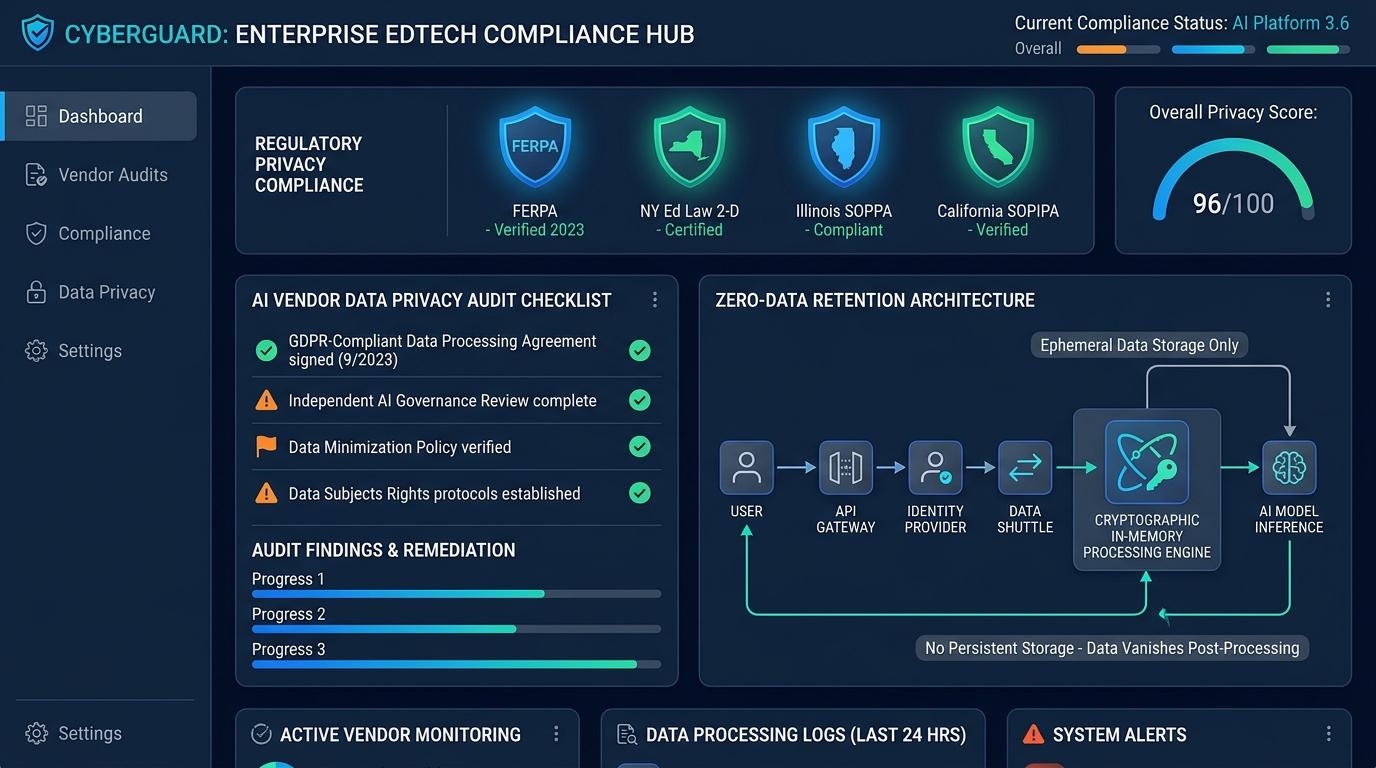
As generative artificial intelligence permeates K–12 and higher education classrooms, District Chief Technology Officers (CTOs), Instructional Technology Directors, Data Privacy Officers (DPOs), and School Board Procurement Committees confront an urgent operational mandate. While school districts require robust solutions to maintain academic integrity and support writing instruction, many legacy plagiarism tools and venture-backed AI detectors operate data pipelines that quietly compromise student privacy. Beneath generic marketing claims of “FERPA compliance,” standard vendor Terms of Service (ToS) frequently conceal clauses permitting persistent data caching, aggregation of student writing into global databases, and the unconsented exploitation of minor student essays to train commercial Large Language Models (LLMs) and automated grading algorithms.
To safeguard student intellectual property and maintain strict compliance with federal statutes (FERPA, COPPA) and stringent state data privacy laws—including New York Education Law § 2-d, Illinois SOPPA (105 ILCS 85/), California SOPIPA (AB 1584), Texas Education Code § 32, and Connecticut Public Act 16-189—district technology leaders must enforce a mandatory standard: Zero-Data-Retention (ZDR) Technical Architecture.
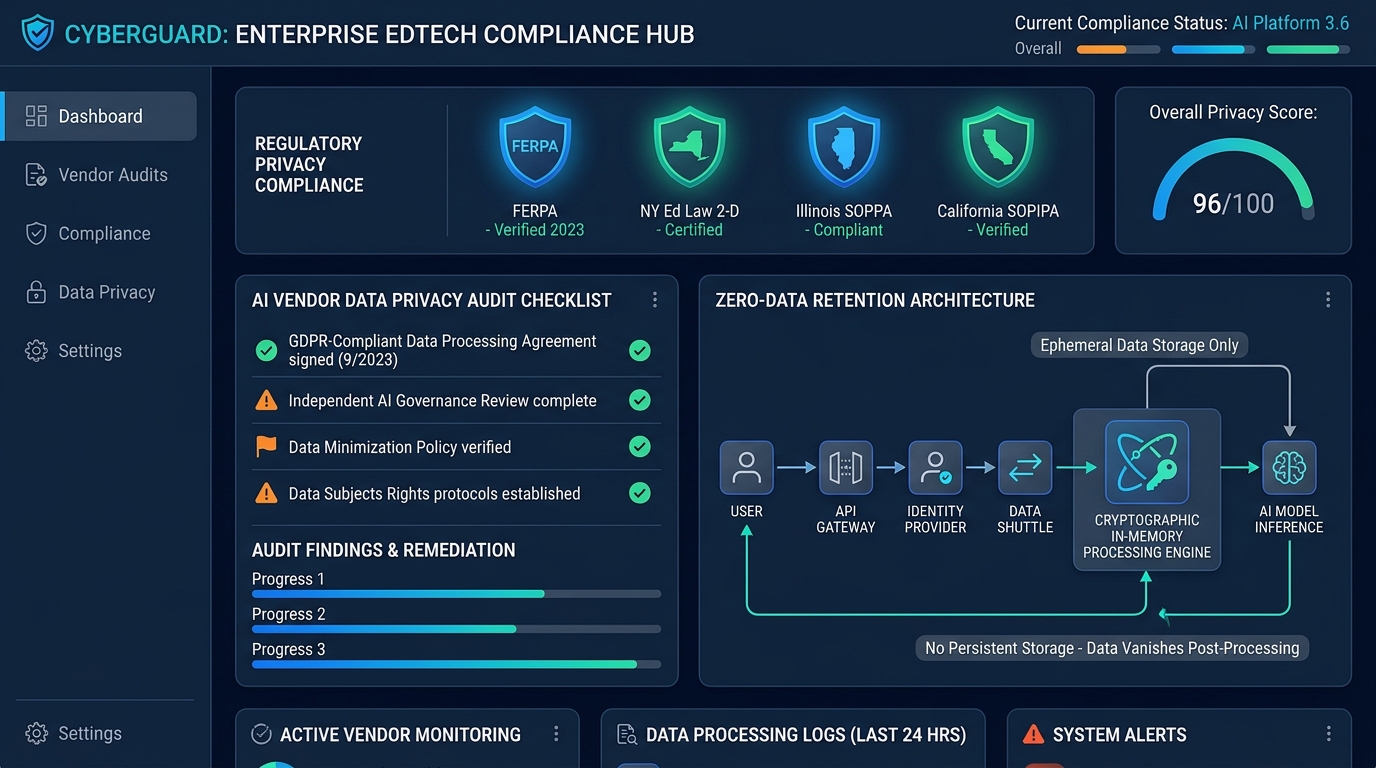
Checkmark Plagiarism provides the pedagogical and technical foundation for enterprise privacy compliance by combining patent-pending Essay Playback™ with passage-level AI detection, defensible side-by-side plagiarism checking, quote-anchored rubric autograding, and direct LMS integrations for Canvas LMS, Google Classroom, and Buzz LMS.
1. The High-Stakes Legal and Security Mandate Facing District Technology Leaders
For over two decades, educational technology procurement for academic integrity followed a predictable path. A district signed an annual software license, integrated an LTI tool into its Learning Management System (Canvas, Schoology, Blackboard, or Moodle), and allowed student essays to be ingested into centralized vendor repositories.
The rapid proliferation of transformer-based Large Language Models (such as OpenAI’s GPT-4, Anthropic’s Claude, Google’s Gemini, and open-weight architectures like Llama and Mistral) has completely invalidated the assumptions underlying legacy procurement models. Academic integrity is no longer a static text-matching exercise; it is an active frontier of machine learning inference, statistical linguistic modeling, and automated text generation.
| Legacy Integrity Architecture (Pre-2023) | Modern AI Integrity Architecture (Post-2024) |
|---|---|
| • Static n-gram text index string matching | • Deep transformer inference & perplexity calculations |
| • Monolithic vendor servers and local databases | • Multi-stage cloud pipelines & external model APIs |
| • Multi-year storage in proprietary repositories | • High-dimensional vector embeddings in memory & caches |
| • Simple percentage-based similarity reporting | • Generative autograding & keystroke analysis |
| • Static student PII records (Name, ID, Roster) | • Rich writing telemetry (keystrokes, velocity, pause timing) |
This technological transition introduces profound liabilities for K–12 public school districts, charter management organizations, and higher education systems:
- Massive Cloud Data Exposure: Multi-tenant cloud architectures aggregate millions of student writing samples, personal reflection essays, college admissions statements, and disciplinary drafts into centralized data lakes—creating attractive targets for ransomware syndicates and unauthorized data brokers.
- Third-Party API Leakage: Startups and legacy vendors attempting to rapidly bolt AI capabilities onto existing products frequently proxy raw student text directly to third-party commercial LLM providers without enterprise-grade zero-logging guarantees.
- Statutory Penalties and Financial Exposure: State privacy statutes now impose strict liability, mandatory public breach notifications, and severe financial penalties (e.g., up to $10 per student record per day under New York Education Law § 2-d) for unauthorized data dissemination or commercial repurposing.
- Parental Trust and Community Backlash: School boards and district leadership face heightened scrutiny from parents, school committees, and student advocacy groups regarding surveillance tech, non-consensual AI model training on children’s creative work, and punitive black-box AI detection algorithms.
2. Deconstructing Vendor Architecture & Student Data Pipeline Risks
To effectively audit edtech vendors, district leaders must understand the technical mechanisms through which student data is routinely captured, retained, and monetized.
[Raw Student Essay] → [Persistent Data Lake] → [Base Model Weights]
Student voice, personal experiences, and unique syntax become commercial training corpora for vendor generative models.
[Draft + Teacher Rubric Feedback] → [Reward Modeling Engine] → [Paid Commercial API]
Educator instructional labor and student responses tune commercial grading products without compensation or consent.
[Vendor Server] → [Standard Web LLM Gateway (30-Day Retention Logs)]
Plaintext student essays sit unencrypted in upstream infrastructure log files and diagnostic caches.
[Text Absorbed into 70B+ Parameter Tensors] → [Irreversible Weight Matrices]
Once student writing updates neural weights, statutory FERPA/SOPPA data deletion becomes mathematically impossible.
2.1 The “Fine Print” Trap: How Vendors Weaponize Terms of Service
Many edtech vendors market themselves as fully FERPA and COPPA compliant while inserting subtle legal exemptions into their Master Services Agreements (MSAs), End User License Agreements (EULAs), and Terms of Service (ToS). District procurement teams must scrutinize contracts for specific loophole phrases:
- “Product Improvement and Feature Development”: Vendors often claim that because they strip direct student identifiers (such as student names or email addresses), they have the legal right to retain the underlying prose to train, tune, and evaluate their proprietary machine learning models.
- “De-Identified and Aggregate Data Use”: In the context of generative AI, “de-identified” text is an illusion. An argumentative essay containing personal anecdotes, localized references, unique vocabulary, and stylistic idiosyncrasies can easily be re-identified using simple semantic matching or retrieval-augmented generation (RAG). Furthermore, using de-identified student writing to train commercial neural networks is an unauthorized commercial exploitation of student education records.
- “Perpetual, Royalty-Free, Worldwide License”: Some vendor EULAs quietly grant the vendor an irrevocable license to reproduce, adapt, modify, and create derivative works from submitted content for the purpose of operating and enhancing the platform.
- “Silent Sub-Processor Modification”: Contracts that allow vendors to add new third-party cloud infrastructure sub-processors without advance 30-day written notification and district opt-out rights create continuous compliance blind spots.
| Vendor Marketing Claim | Hidden Fine-Print Reality (The Audit Finding) |
|---|---|
| “We are 100% FERPA and COPPA compliant.” | ToS grants vendor rights to retain de-identified text in aggregate databases for machine learning. |
| “Your student essays are never sold.” | Vendor licenses model outputs trained on student data to third-party commercial AI research partners. |
| “All data is encrypted in transit.” | Plaintext essays are forwarded to consumer LLM API endpoints that store prompt logs on unencrypted disks. |
| “Districts retain full data ownership.” | Once student prose updates model weight tensors, data cannot be deleted upon district contract termination. |
2.2 Student Intellectual Property & Copyright Protection
Beyond data privacy statutes, student writing constitutes original creative expression protected under the United States Copyright Act (Title 17, U.S. Code § 102) from the moment it is fixed in a tangible medium of expression (e.g., typed into Google Docs, Microsoft Word, or an LMS editor).
- Student essays are protected “Education Records” containing Personally Identifiable Information (PII).
- Vendor serves solely as “School Official” with strict purpose limitation (§ 99.31).
- Commercial monetization and behavioral profiling are strictly prohibited.
- Student owns exclusive copyright to original literary work from moment of creation.
- School district holds limited educational license for instructional evaluation only.
- Vendor has ZERO right to repurpose, adapt, or train commercial AI models on student IP.
Minors cannot legally sign away their federal copyright protections or execute binding commercial data exploitation waivers. When an edtech vendor captures student essays and converts them into commercial model weights, it infringes upon student intellectual property and violates the school district’s role as the educational custodian of student records.
3. The State and Federal Statutory Compliance Matrix
District Technology Directors, Legal Counsel, and Procurement Committees must evaluate every integrity vendor against an interlocking matrix of federal and state privacy statutes.
| Statute / Jurisdiction | Core Legal Mandate | Mandatory Vendor Technical & Contractual Requirement |
|---|---|---|
| FERPA (34 CFR Part 99) |
Student Education Records Custody & Redisclosure Prohibition | Vendor must qualify as “School Official” under Direct Control (§ 99.31); 100% purpose limitation for grading. |
| COPPA (15 U.S.C. §§ 6501–6506) |
Protection for Children Under 13 from Commercial Exploitation | Zero behavioral profiling, commercial data mining, or persistent tracking across non-educational sessions. |
| NY Education Law § 2-d (8 NYCRR Part 121) |
Protection of Student PII & Teacher/Principal APPR Data | Mandatory Parents’ Bill of Rights; NIST CSF alignment; Zero data retention post-contract; $10/student fine. |
| Illinois SOPPA (105 ILCS 85/) |
Student Online Personal Protection Act Mandates | Strict prohibition on targeted ads, student profiling, and selling/leasing data; mandatory signed DPA. |
| California SOPIPA & AB 1584 (Cal. Ed. Code § 49073.1) |
Student Online Personal Info & District Cloud Contract Controls | Total ban on using student data to amass profile or train non-district AI; student IP remains with pupil. |
| Texas Education Code § 32 (Subchapter D) |
Data Security Standards for Digital Learning Platforms | Strict cybersecurity controls; mandatory deletion upon request; prohibition on commercial data harvesting. |
| Connecticut Public Act 16-189 | Student Data Privacy & Contractor Restrictions | Comprehensive DPA requirement; strict limits on sub-processors; zero retention of student education records. |
| SDPC NDPA Standard (National DPA Version 2.0) |
Student Data Privacy Consortium Standardized Legal Framework | Standardized nationwide clauses enforcing direct ownership, zero model training, and audit verification. |
4. What True “Zero-Data-Retention” (ZDR) Architecture Entails
When vendors claim “zero retention,” district technology teams must evaluate the underlying system architecture to distinguish authentic, cryptographic zero-retention from superficial marketing slogans.
100% processing in volatile RAM. Memory pages are locked (mlock) and cleared immediately post-inference with explicit cryptographic memory zeroization.
One-way Locality-Sensitive Hashing (LSH) and MinHash signatures with unique district cryptographic salts. Peer similarity matching without pooling raw text.
Mandatory TLS 1.3 with Perfect Forward Secrecy in transit; AES-256 with district-isolated KMS keys and Row-Level Security (RLS) tenant isolation.
Binding Enterprise Zero-Data-Retention Addenda with upstream cloud/LLM providers, disabling all diagnostic prompt logs and human review queues.
Independent annual CPA audit across Security, Confidentiality, and Privacy Trust Criteria, plus documented alignment with NIST Cybersecurity Framework.
0 bytes saved to persistent storage, 0 raw text databases, 0 model retraining, and 0 third-party telemetry leakage backed by liquidated breach damages.
5. Checkmark Plagiarism: The Enterprise Zero-Retention Integrity Suite
Checkmark Plagiarism (checkmarkplagiarism.com) was engineered from the ground up for K–12 school districts, county offices of education, and higher education institutions that demand uncompromising student data privacy combined with defensible academic integrity evidence.
| Core Capability | Technical & Privacy Architecture |
|---|---|
| 1. Zero Model Training Guarantee | Contractual SLA & technical guarantee: Student writing is NEVER stored, indexed publicly, or used to train AI models. |
| 2. Ephemeral In-Memory Engine | Submissions analyzed entirely in volatile RAM; instant cryptographic memory zeroization post-report delivery. |
| 3. Patent-Pending Essay Playback™ | 1x to 8x scrubbable keystroke video replay. Complete writing process telemetry with ZERO biometric or video surveillance. |
| 4. Granular AI Writing Detection | Passage-level highlighting with calibrated confidence sliders; honest <150-word N/A guardrails prevent false flags. |
| 5. Defensible Plagiarism Matching | Side-by-side web source comparisons with clickable live links; uncited source differentiation for targeted coaching. |
| 6. Teacher-in-the-Loop Autograder | Formative rubric autograding with quote-anchored evidence; teacher retains 100% final grade approval & LMS passback. |
5.1 The Zero Model Training SLA
Checkmark Plagiarism provides districts with an ironclad, legally binding contractual covenant:
“Checkmark Plagiarism covenants and warrants that it shall not, under any circumstances, retain, store, aggregate, monetize, or utilize student submissions, drafts, keystroke logs, rubric evaluations, or educator feedback for the purpose of training, fine-tuning, evaluating, or improving general foundation models, machine learning classifiers, or commercial artificial intelligence algorithms. All processing shall remain strictly ephemeral and isolated to the executing educational agency.”
5.2 Patent-Pending Essay Playback™: Surveillance-Free Process Evidence
Traditional academic integrity tools have increasingly turned to invasive surveillance measures—such as automated webcam recording, microphone monitoring, eye-tracking algorithms, room scans, and keystroke logging extensions that capture personal browser activity. These invasive practices violate student privacy, provoke legal challenges, and disproportionately penalize neurodivergent students and English Language Learners.
| Invasive Surveillance Proctoring | Checkmark Non-Invasive Essay Playback™ |
|---|---|
| • Records webcam video of student’s room | • Zero video or camera recording |
| • Captures microphone audio & background noise | • Zero audio monitoring or environment capture |
| • Tracks eye movement with facial ML | • Zero biometric or facial recognition algorithms |
| • Logs background tabs, apps, & devices | • Captures ONLY keystrokes inside assigned editor |
| • High false-positive anxiety & student trauma | • Reconstructs drafting process like an editable tape |
| • Massive FERPA / biometric privacy liability | • 100% FERPA/COPPA compliant in-editor telemetry |
Checkmark’s Essay Playback™ operates exclusively within the native essay editor (Google Docs, Microsoft Word via Add-in, Canvas LMS, and Buzz LMS embedded editors):
- Keystroke-by-Keystroke Timeline Replay: Educators can scrub through the complete writing session at 1x to 8x speed, observing authentic drafting, composing pauses, revision cycles, deletions, and structural reorganization.
- External Paste Tracking with Complete Text Preservation: When a student pastes text from an external clipboard source, Checkmark captures a timestamped event, flags the pasted block, and stores the original pasted content—even if the student subsequently edits, rewrites, or disguises every word.
- Transcription Velocity Analysis: Identifies mechanical, rhythmic, steady typing that lacks natural cognitive composing pauses (such as when a student manually retypes an AI-generated essay while looking at a phone or secondary monitor).
- Exonerating Honest Students: Rather than relying on a questionable black-box AI percentage score, teachers and administrators have verifiable, transparent process evidence (“receipts”) to clear students falsely accused by generic AI detectors.
6. Real-World District Procurement Case Studies
The following case studies illustrate how forward-thinking district technology leaders audit vendors, protect student data, and deploy zero-retention integrity solutions.
The Incident: During Phase 2 technical due diligence for an RFP, the District CTO examined the vendor's standard click-through EULA. While marketed as “FERPA compliant,” Section 8.3 stated: “Vendor reserves the right to compile, de-identify, and utilize all submitted content and user telemetry to perform statistical analysis, enhance automated models, and train artificial intelligence systems.”
The Audit & Resolution: The vendor admitted that student essays were batched into an AWS S3 bucket for model fine-tuning. The Procurement Committee disqualified the vendor under Texas Education Code § 32 and selected Checkmark Plagiarism, executing an enterprise contract with a strict Zero-Data-Retention SLA and LTI 1.3 integration across all secondary campuses.
The Incident: An 18-district consortium reviewed an AI writing tool under New York Education Law § 2-d and Illinois SOPPA. The audit discovered the vendor was routing student essays to a commercial cloud API where prompt logs were retained for 30 days without an executed Enterprise Zero-Data-Retention Addendum.
The Audit & Resolution: The consortium mandated proof of upstream ZDR sub-processor agreements and of ephemeral processing in the vendor’s pipelines. The consortium approved Checkmark Plagiarism across all 18 member districts, establishing a regional benchmark for student privacy.
The Incident: Over 40 high school seniors had college essays flagged as “90%+ AI” by an opaque whole-paper detector, causing immense parent frustration and disproportionately impacting English Language Learners.
The Audit & Resolution: The district replaced the tool with Checkmark Plagiarism in Canvas LMS. Teachers leveraged Essay Playback™ to verify genuine student drafting timelines, reducing disputed academic integrity inquiries by 92% while saving English teachers an average of 4.5 hours per week on rubric grading.
7. The 4-Phase District Vendor Privacy Audit Framework
District Technology Directors, CTOs, and Data Privacy Officers can implement this repeatable, 4-phase audit framework when evaluating any academic integrity or AI writing vendor.
- Demand district DPA precedence over click-through EULAs.
- Eliminate “product improvement” and ML training clauses.
- Mandate certified data deletion within 30 days of contract end.
- Verify 100% ephemeral in-memory processing in volatile RAM.
- Inspect upstream LLM sub-processor zero-logging agreements.
- Confirm salted cryptographic hashing for peer-to-peer checks.
- Review annual SOC 2 Type II reports (Security, Privacy criteria).
- Validate NIST Cybersecurity Framework (CSF) mapping.
- Audit TLS 1.3 / PFS and AES-256 tenant key isolation.
- Enforce 1EdTech LTI 1.3 Advantage with minimal PII scopes.
- Implement strict Role-Based Access Control (RBAC).
- Establish annual recertification and DPA compliance reviews.
8. The 12-Point CTO Technical Procurement Checklist
Use this structured 12-point procurement matrix during RFP evaluations and vendor negotiations:
| # | Technical Audit Item | Required Standard for Passing Score | Immediate Disqualification Red Flag |
|---|---|---|---|
| 1 | AI Model Training SLA | Irrevocable contractual ban on model training on student writing/feedback. | Vendor retains “de-identified” data for “product improvement/ML.” |
| 2 | Ephemeral In-Memory Pipeline | 100% RAM processing; immediate memory zeroization post-analysis. | Raw essays written to persistent disk databases (SQL, S3, NoSQL). |
| 3 | Sub-Processor ZDR Enforcement | Enterprise ZDR contracts binding all upstream LLM APIs (zero logging). | Vendor uses standard consumer APIs with default 30-day prompt retention logs. |
| 4 | Plagiarism Hashing Arch. | One-way district-salted MinHash/LSH; zero raw text pooling across districts. | Vendor stores unencrypted plaintext in global centralized student repository. |
| 5 | In-Transit & At-Rest Crypto | Mandatory TLS 1.3 with PFS; AES-256 with tenant-level KMS key isolation. | TLS 1.1/1.2 legacy ciphers; shared unencrypted multi-tenant staging disks. |
| 6 | Third-Party Security Audits | Annual SOC 2 Type II (Security, Privacy); independent penetration test summary. | Self-attested compliance questionnaire; no independent third-party CPA audit. |
| 7 | State Privacy Alignments | Explicit contractual compliance with NY Ed Law 2-d, IL SOPPA, CA SOPIPA. | Generic FERPA statement refusing state-specific DPA exhibits or amendments. |
| 8 | Student IP & Copyright | Affirmation that student retains 100% copyright; vendor holds zero license. | Vendor claims non-exclusive, perpetual license to adapt/modify student work. |
| 9 | Process Evidence (No Surveillance) | In-editor keystroke dynamics & replay (Essay Playback™) without surveillance. | Requires invasive webcam, audio, or full-device background monitoring. |
| 10 | Detection Granularity | Passage-level highlighting with sliders; honest <150w N/A guardrails. | Opaque, whole-paper percentage score without passage-level evidence cards. |
| 11 | Rubric Autograding Control | Teacher-in-the-loop: AI grades are draft recommendations requiring teacher review. | Fully autonomous grading without teacher review; automated direct gradebook write. |
| 12 | LMS Integration Standards | Native 1EdTech LTI 1.3 Advantage & OneRoster API passback for Canvas/Buzz. | Obsolete LTI 1.1; requires manual CSV roster uploads and unsecured keys. |
9. Model Contract Clauses for District Student Data Privacy Agreements (DPAs)
District Legal Counsel and Procurement Teams can incorporate these five model contractual clauses directly into custom Student Data Privacy Addenda (DPAs) and vendor contracts:
10. Frequently Asked Questions (FAQs) for District Technology Leaders
No. Under federal FERPA interpretations and stringent state statutes (including California SOPIPA, Illinois SOPPA, and New York Education Law § 2-d), stripping direct identifiers (such as student names and IDs) does not grant a vendor the legal right to repurpose student writing for commercial AI model training. First, rich student essays contain distinctive personal experiences and syntactic markers that make true de-identification practically impossible. Second, vendors qualify to receive student data solely under the “School Official” exception, which imposes a strict purpose limitation—data may only be processed to deliver the immediate educational service requested by the district, never to build or train commercial vendor assets.
Checkmark utilizes District-Isolated Cryptographic Hashing (salted MinHash and Locality-Sensitive Hashing). Submissions are transformed into compact, non-invertible numerical hash signatures using a private, high-entropy cryptographic salt unique to the school district. When a new essay is scanned, Checkmark compares the newly generated hash signature against the district's cryptographic hash index. If matching sequences are identified, the system reports the similarity without ever having stored the original raw plaintext essay. The underlying text is destroyed immediately following ephemeral in-memory analysis.
Invasive proctoring tools rely on intrusive hardware surveillance: recording student webcams, monitoring room audio, tracking eye movements with facial recognition AI, and scanning background browser activity. These tools introduce severe FERPA, COPPA, and biometric privacy risks while creating high anxiety for students. In sharp contrast, Checkmark's Essay Playback™ is 100% non-invasive and surveillance-free. It operates entirely inside the document editor, recording only the digital keystrokes, composing pauses, and revisions within the assigned essay file. It captures zero biometric data, zero video, zero audio, and zero external device telemetry.
In a traditional persistent database architecture, a hacker who breaches a vendor’s cloud infrastructure gains access to millions of historical student essays, personal disclosures, and student PII stored in databases or S3 buckets. Under Checkmark’s Zero-Data-Retention Architecture, there are zero raw student essays stored on disk. Submissions exist in volatile RAM only for the milliseconds required for active processing and are immediately zeroized. If an adversary breaches the cloud environment, there is no historical repository of student essays to exfiltrate.
Single, whole-paper percentage scores (e.g., “88% AI”) are generated by statistical language models that cannot pinpoint specific sentences, provide source citations, or explain their underlying mathematical calculations. These “black-box” scores suffer from high false-positive rates—particularly against English Language Learners (ELL) and neurodivergent students whose writing naturally exhibits lower burstiness. Accusing a student based solely on an unexplained percentage score exposes districts to disciplinary appeals, OCR civil rights complaints, and parent litigation. Checkmark resolves this by providing passage-level highlights with calibrated confidence sliders, backed by Essay Playback™ process evidence.
Yes. Checkmark Plagiarism is fully certified on 1EdTech LTI 1.3 Advantage and OneRoster standards. It integrates seamlessly into Canvas SpeedGrader, Buzz LMS, Google Classroom, and Moodle. Teachers can launch Checkmark reports directly within their familiar LMS grading workflow, review passage-level AI detection and side-by-side plagiarism matches, watch Essay Playback™ re-creations, and approve AI-drafted rubric scores with one-click gradebook passback.
Checkmark maintains enterprise-tier infrastructure agreements with upstream cloud providers (e.g., AWS Bedrock and enterprise cloud partners) that include legally binding Zero-Data-Retention (ZDR) Addenda. These configurations enforce API-level zero logging: incoming prompt payloads are processed in stateless, isolated enclaves and are excluded from diagnostic server logs, caching buckets, and human review queues.
11. Conclusion: The District Action Plan for Privacy-First Integrity
The rise of generative artificial intelligence has fundamentally raised the stakes of educational technology procurement. District Chief Technology Officers, Instructional Technology Directors, Data Privacy Officers, and School Board Procurement Committees can no longer accept ambiguous marketing claims of “FERPA compliance” from vendors whose business models rely on harvesting student writing to train commercial AI systems.
By enforcing a rigorous Zero-Data-Retention (ZDR) Technical Architecture, district leaders protect student intellectual property, ensure compliance with the nation’s strictest state privacy statutes, and insulate their institutions from catastrophic data breaches.
Review existing plagiarism and AI vendor agreements for “product improvement,” “de-identified training,” and commercial license clauses.
Incorporate the 5 Model DPA Clauses into all upcoming RFPs, contract renewals, and vendor service addenda.
Require vendors to provide SOC 2 Type II reports, sub-processor ZDR agreements, and architectural proof of in-memory zeroization.
Equip educators with transparent, surveillance-free writing process evidence (Essay Playback™), passage AI analysis, and rubric autograding.
Stop guessing. Start trusting. Safeguard your district with the enterprise zero-retention architecture of Checkmark Plagiarism today.