
As generative artificial intelligence transitions from an experimental novelty to core educational infrastructure, District FERPA Compliance Officers, School District Legal Counsel, Chief Technology Officers (CTOs), Data Privacy Officers (DPOs), and School Board Review Committees face an unprecedented regulatory and technical challenge. While classroom educators urgently need automated rubric grading assistants and multi-factor integrity verification to manage overwhelming assessment workloads, many cloud-based AI platforms deploy data pipelines that fundamentally compromise student privacy. Beneath reassuring marketing slogans asserting “100% FERPA Compliance,” vendor Terms of Service (ToS) and standard End User License Agreements (EULAs) routinely contain legal exemptions that permit the ingestion, persistent storage, de-identification, and commercial exploitation of minor student essays to pre-train foundation Large Language Models (LLMs), fine-tune proprietary scoring engines, or build public similarity databases.
To safeguard student educational records, protect minor intellectual property under federal copyright law, and maintain strict compliance with FERPA (34 CFR Part 99), COPPA, and rigorous state student data privacy statutes—including New York Education Law § 2-d, Illinois SOPPA (105 ILCS 85/), California SOPIPA (Bus. & Prof. Code § 22584), California AB 1584 (Ed. Code § 49073.1), Texas Education Code ch. 32, and Connecticut Public Act 16-189—school districts must enforce a non-negotiable procurement standard: Forensically Audited Zero-Data-Retention (ZDR) and Zero-Model-Training (ZMT) Architecture.

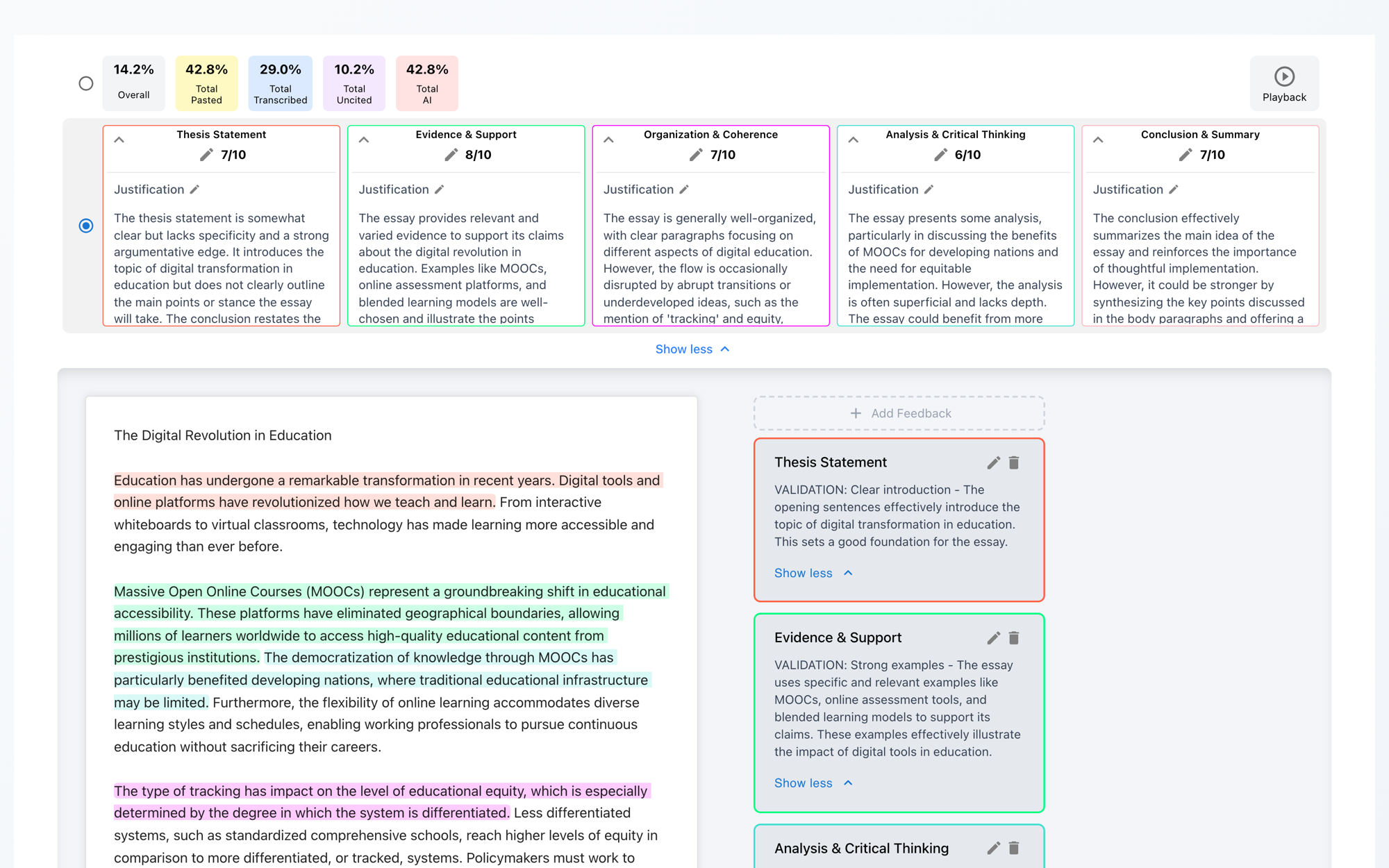
Checkmark Plagiarism (checkmarkplagiarism.com) provides the K–12 and higher education benchmark for enterprise data privacy, combining memory-only AI rubric autograding, patent-pending Essay Playback™ keystroke dynamics, side-by-side plagiarism source verification, passage-level AI detection with calibrated confidence sliders, and secure 1EdTech LTI 1.3 Advantage passback directly into Canvas LMS, Agilix Buzz LMS, and Google Classroom. This comprehensive guide equips district compliance officers, legal counsel, and technology directors with the statutory frameworks, architectural inspection protocols, audit checklists, model contract clauses, and real-world case studies necessary to audit and procure AI autograding platforms with complete legal defensibility.
1. The High-Stakes Legal and Security Mandate Facing District Compliance Leaders
For more than two decades, educational technology procurement followed an established, predictable model. A school district licensed an administrative or instructional software tool, executed a boilerplate Family Educational Rights and Privacy Act (FERPA) addendum under the “School Official” exception, integrated the application into the district’s Learning Management System (Canvas, Google Classroom, Buzz LMS, Schoology, or Moodle), and permitted vendor servers to store student submissions indefinitely in proprietary data centers.
The explosive emergence of transformer-based Large Language Models (LLMs)—including OpenAI’s GPT architectures, Anthropic’s Claude, Google’s Gemini, and open-weight transformer models—has completely invalidated the foundational legal and architectural assumptions of legacy edtech procurement. Modern AI autograding and integrity platforms are no longer passive static databases; they are dynamic, data-hungry computational pipelines driven by massive neural networks that require billions of high-quality tokens for continuous pre-training, supervised fine-tuning (SFT), and Reinforcement Learning from Human Feedback (RLHF).
| Legacy EdTech Architecture (Pre-2023) | Modern Cloud AI Autograding (Post-2024) |
|---|---|
| • Static relational SQL databases (PostgreSQL/MySQL) | • Deep transformer inference & neural scoring pipelines |
| • Multi-year storage in vendor text silos | • Multi-stage cloud pipelines & external foundational APIs |
| • Static n-gram string matching & index tables | • High-dimensional vector embedding databases |
| • Standard student PII (Name, Student ID, Email) | • Unstructured prose containing sensitive personal disclosures |
| • Monolithic vendor-hosted server infrastructure | • Multi-tenant cloud clusters & GPU acceleration nodes |
| • Deterministic, rule-based grading scripts | • Generative autograding & keystroke dynamics telemetry |
This structural shift introduces four acute legal, regulatory, and technical liabilities for public school districts, regional educational service agencies (BOCES/RECs/ISDs), and charter management organizations:
Cloud-based autograding tools ingest highly sensitive student narrative essays, personal identity reflections, creative fiction, and historical analyses. In multi-tenant cloud architectures, these unstructured educational records are frequently routed across complex web services, vector databases, and third-party AI APIs—dramatically multiplying the attack surface for cyberattacks, credential stuffing, and unauthorized data leakage.
Under federal and state privacy statutes, school districts maintain an affirmative statutory obligation to enforce the absolute deletion of student data upon request or contract termination. However, when a vendor feeds student writing into an AI training dataset, that text is mathematically absorbed into billions of floating-point neural network parameters. Once absorbed into model weights, student data cannot be surgically deleted, creating an incurable statutory violation.
State privacy statutes now impose strict liability, mandatory public data breach reporting, and severe financial penalties on educational agencies and third-party contractors. Under New York Education Law § 2-d, for example, a third-party contractor that violates the statute faces civil penalties of up to $1,000, $5,000, and $10,000 for a first, second, and later violation involving the same data, and a contractor that fails to notify an educational agency of a breach faces the greater of $5,000 or up to $10 per affected student, teacher, or principal, subject to a statutory cap. The state Chief Privacy Officer can also bar a contractor that knowingly or recklessly allowed an unauthorized release from receiving educational agency data for up to five years.
Student essays are original creative works protected under federal copyright law (17 U.S.C. § 102). When commercial vendors use student writing without explicit, informed parental consent to train commercial software models that are subsequently monetized, they commit an unlawful commercial conversion of minor intellectual property.
To satisfy their fiduciary and statutory obligations, District FERPA Compliance Officers, General Counsel, and Technology Directors must conduct rigorous, forensic audits that penetrate marketing rhetoric and verify true zero-retention and zero-training engineering.
2. Federal and State Regulatory Frameworks Governing AI Autograding
Auditing cloud-based autograding software requires mapping vendor technical data flows directly against the statutory mandates of federal and state privacy laws.
| Statute / Jurisdiction | Core Statutory Mandate | Mandatory Compliance Requirement for AI Autograding Vendors |
|---|---|---|
| FERPA (34 CFR Part 99) |
Education Records Custody & School Official Exception | Vendor qualifies as “School Official” ONLY under direct district control with legitimate educational interest. Redisclosure and commercial repurposing strictly prohibited (§ 99.33). |
| COPPA & FTC Enforcements (15 U.S.C. § 6501) |
Protection for Minors Under 13; Purpose Limitation | Verifiable parental/district consent required for under-13 data. Prohibits retention beyond instructional necessity; the FTC has required deletion of AI models trained on children’s data collected without consent. |
| NY Education Law § 2-d (Part 121 Regulations) |
Parents' Bill of Rights & NIST CSF Cybersecurity | Mandatory Data Security & Privacy Plan; contractors must align with NIST CSF and may not sell PII or use or disclose it for marketing or commercial purposes. Civil penalties escalate from up to $1,000 to up to $10,000 for repeat violations; unreported breaches draw the greater of $5,000 or $10 per affected individual (capped). |
| Illinois SOPPA (105 ILCS 85/) |
Ban on Profiling, Targeted Advertising & Data Amalgamation | Operators must sign written agreements with the school before receiving covered information, and schools must post those agreements publicly. Agreements must state when the operator must delete or return covered information. |
| California SOPIPA / AB 1584 (Bus. & Prof. Code § 22584; Cal. Ed Code § 49073.1) |
Operator Limits & District Ownership of Pupil Records | SOPIPA bars operators from targeted advertising, building non-educational student profiles, and selling student information. Under AB 1584, contracts must state that pupil records remain the property of, and under the control of, the district, and must address pupil-generated content such as essays. |
| Connecticut PA 16-189 (& PA 18-125) |
Student Data Contract Protections & Breach Protocols | Mandatory contract provisions governing student data deletion and breach notice. Contractors may not use student information for purposes outside the contract or for targeted advertising. |
| Texas Education Code (Chapter 32, Subchapter D) |
Student Information Protection for Operators of School Sites & Apps | Bars operators from targeted advertising, building student profiles outside school purposes, and selling or renting student covered information. Requires reasonable security procedures and deletion of covered information when a district requests it. |
2.1 The FERPA “School Official” Exception & Redisclosure Prohibitions
Under the Family Educational Rights and Privacy Act (FERPA, 34 CFR § 99.31(a)(1)(i)(B)), an educational agency may disclose personally identifiable information (PII) from an education record to an external contractor or cloud vendor without prior parental consent only if the vendor satisfies four mandatory criteria:
- Performs an Institutional Service: The vendor provides an instructional or administrative service for which the district would otherwise use its own employees (e.g., scoring writing assessments, checking citation integrity).
- Meets “Legitimate Educational Interest” Criteria: The vendor accesses student records exclusively to perform the contracted educational function specified in the agreement.
- Operates Under Direct District Control: The vendor remains under the direct administrative, technical, and operational control of the school district regarding the use and maintenance of education records.
- Complies with Redisclosure Restrictions (34 CFR § 99.33(a)): The vendor does not disclose student records to any third party (including upstream AI model providers or cloud analytics brokers) and does not use the data for any secondary purpose whatsoever.
When an edtech vendor uses student essays to pre-train, fine-tune, or calibrate an AI model, the vendor has violated the “direct control” and “legitimate educational interest” provisions of FERPA. The resulting AI model is a commercial asset utilized across thousands of unrelated clients—meaning student education records have been unlawfully repurposed to benefit external third parties, forfeiting the School Official exemption and exposing the district to federal compliance sanctions.
2.2 COPPA and FTC Precedents on AI Model Ingestion
The Children's Online Privacy Protection Act (COPPA, 15 U.S.C. §§ 6501–6506) and Federal Trade Commission (FTC) enforcement actions (such as the FTC’s 2022 settlement with Kurbo and WW International, formerly Weight Watchers, and its 2023 action against Edmodo) have set a clear enforcement precedent regarding machine learning trained on minor data:
- Algorithmic Disgorgement Mandates: In its Kurbo and Edmodo matters, the FTC required a vendor that collected data from children under 13 without verifiable parental consent to delete not only the raw data files but also the models and algorithms developed from that data (algorithmic disgorgement).
- Purpose Limitation Enforceability: Edtech vendors operating under school-authorized COPPA consent cannot expand data use beyond the specific educational context for which the school granted authorization. Ingesting student writing into generic LLM training pipelines falls outside that authorization.
2.3 State-Specific High-Water-Mark Statutes
NY Education Law § 2-d
Prohibits third-party contractors from selling student PII or using or disclosing it for marketing or commercial purposes. Requires districts to publish a Parents’ Bill of Rights, and its implementing regulations (8 NYCRR § 121.9) require contractors to align with the NIST Cybersecurity Framework (NIST CSF).
Illinois SOPPA (105 ILCS 85/)
Prohibits vendors from engaging in targeted advertising, amassing student profiles for non-educational uses, or selling/renting student information. Mandates public posting of vendor contracts and guarantees parents the right to inspect and review their child’s covered information, obtain a copy, and request corrections of factual inaccuracies.
California SOPIPA / AB 1584
AB 1584, codified at Cal. Ed Code § 49073.1, requires contracts for digital storage or software that accesses pupil records to specify that those records remain the property of the district, describe procedures for parents to review and correct them, and bar the vendor from using information in the pupil record for any purpose the contract does not permit. SOPIPA (Bus. & Prof. Code § 22584) separately bars K–12 operators from targeted advertising, building non-educational student profiles, and selling student information.
3. Deconstructing Vendor Data Governance & Legal Architecture
To conduct an effective audit, district compliance officers must understand how commercial edtech vendors engineer their data pipelines and legal agreements to harvest student data.
- Transient AST Rubric Scoring in RAM
- Inline Teacher Feedback Generation
- Encrypted Return to LMS Gradebook
- Immediate Volatile Memory Zeroization
- Permanent Plaintext Disk Storage
- “De-Identification” Text Extraction
- LLM Fine-Tuning & RLHF Datasets
- High-Dimensional Vector Data Lakes
3.1 The “Hidden Model Training” Clause and the De-Identification Fallacy
The most common compliance vulnerability in modern edtech procurement is the “Hidden Model Training” clause. When reviewing vendor Master Services Agreements (MSAs) or click-through Privacy Policies, compliance officers frequently encounter provisions structured like this:
This clause represents a severe compliance hazard for three distinct reasons:
- The Fallacy of “De-Identified” Free-Form Text: While structured database fields (such as names and student ID numbers) can be stripped from a database record, free-form student essays cannot be reliably de-identified. Narrative writing, college application essays, and personal reflections routinely contain unique combinations of biographical facts, family details, medical disclosures, geographic locations, and highly specific rhetorical markers. Research on embedding inversion (Morris et al., 2023) shows that dense text embeddings can be used to reconstruct much of the original text, including personal details such as names, so vector representations of student essays cannot be treated as anonymous.
- Unauthorized Commercial Adaptation: FERPA permits release of properly de-identified data (34 CFR § 99.31(b)), but many state privacy statutes and district contracts limit how a vendor may use data derived from education records, so districts should not allow even “de-identified” student writing to be used to develop proprietary commercial software that the vendor licenses for profit to other entities.
- Breach of Parental Expectation: Parents and school boards rightly view the unconsented harvesting of minor student writing as an unethical appropriation of student creative labor.
3.2 The Mathematics of the Permanent Parameterization Trap
When an AI vendor uses student writing to fine-tune a transformer model, the raw text is tokenized and processed through backpropagation to update the weight matrices of the neural network:
Where L represents the cross-entropy loss over the training tokens, Wij represents the network weights across billions of parameters, and η is the learning rate.
Once the optimization step completes, the semantic patterns, unique turns of phrase, factual disclosures, and syntactic structures of the student essay are permanently encoded as mathematical weights distributed across hundreds of layers.
Because deep neural networks lack an exact, computationally viable method for “machine unlearning,” a vendor cannot selectively remove an individual student's writing from a trained model without discarding the model weights and retraining the entire network from scratch at prohibitive computational expense. Consequently, any vendor that trains on student writing creates an irremediable breach of statutory data destruction requirements.
3.3 Student Intellectual Property & Copyright Protection (17 U.S.C. § 102)
Beyond statutory student data privacy, cloud AI autograding procurement intersects directly with federal intellectual property law:
Original Works of Authorship
Under the United States Copyright Act (17 U.S.C. § 102(a)), original student essays, poetry, research papers, and creative narratives are protected literary works from the moment they are fixed in a tangible medium of expression (e.g., typed into a word processor or LMS text box). The student (or their legal guardian) holds exclusive copyright ownership.
Scope of District Educational License
When a student submits an assignment to a public school district, the district receives a limited, implied license to evaluate, grade, and preserve the submission for educational and record-keeping purposes. The school district does not possess the legal authority to assign, sub-license, or transfer commercial exploitation rights in student creative works to third-party edtech vendors.
4. The Ephemeral Zero-Retention & Zero-Training Technical Architecture
To eliminate compliance risks, school districts must mandate and verify an Ephemeral Zero-Data-Retention (ZDR) and Zero-Model-Training (ZMT) Architecture.
4.1 In-Memory Abstract Syntax Tree (AST) Parsing & Stateless Scoring
In a true zero-retention autograding architecture:
- Transient RAM Execution: The incoming student submission payload is decrypted directly into volatile random-access memory (RAM) or non-persistent shared memory (
tmpfs). At no point during the parsing or scoring phase is raw student prose written to persistent physical storage (SSDs or cloud block storage). - Stateless AST Rubric Mapping: The platform constructs an in-memory Abstract Syntax Tree (AST) of the student prose, mapping syntactic structures, thesis statements, textual evidence, and rhetorical transitions against the district's custom grading rubric.
- Stateless Private API Inference: If the platform utilizes foundational transformer models to generate quote-anchored qualitative justifications, it routes requests through isolated, single-tenant private endpoints operating under enterprise zero-logging agreements. The model processes the prompt statelessly and returns the drafted feedback without recording the input text to any persistent server log.
- Immediate Cryptographic Zeroization: As soon as the drafted rubric scores and feedback cards are transmitted back to the educator's active session, the memory buffers holding the student text are scrubbed and overwritten using cryptographic zeroization routines (e.g.,
memsetwith0x00and pseudo-random byte sequences), preventing data retrieval via memory dumps or cold-boot attacks.
4.2 District-Isolated Cryptographic Hashing for Similarity Matching
Legacy plagiarism checkers built massive, centralized “global student paper databases” where every student submission was permanently archived and cross-matched against subsequent submissions from across the world. This legacy model violates modern data minimization and state privacy mandates.
Modern, privacy-preserving integrity architectures replace global plaintext repositories with District-Isolated Cryptographic Hashing:
| Legacy Global Repository Model | Modern Cryptographic MinHash Architecture |
|---|---|
| • Plaintext essays stored forever in centralized vendor data warehouse. | • Raw student prose is NEVER pooled across districts. |
| • Vendor monetizes database as a proprietary competitive moat. | • Student text converted to salted, one-way Locality-Sensitive Hashing (LSH) min-hash sketches. |
| • Cross-district data exposure risk violates state student privacy laws. | • Hashes are mathematically irreversible (h(x) cannot reconstruct original prose). |
| • Parental deletion requests require complex administrative interventions. | • Similarity matching strictly restricted to district tenant boundary. |
5. Checkmark Plagiarism's Enterprise Zero-Retention Architecture & Privacy Suite
Checkmark Plagiarism (checkmarkplagiarism.com) was engineered from the ground up to establish the gold standard in student data privacy, ethical AI transparency, and verifiable zero-retention architecture.
| Checkmark Enterprise Innovation | Compliance, Technical & Pedagogical Architecture |
|---|---|
| 1. Contractual Zero-Training Guarantee | Irrevocable Student Data Privacy Agreement (DPA) exhibits barring all model training, fine-tuning, caching, or data resale. |
| 2. Ephemeral In-Memory Rubric Autograder | Draft rubric scores and quote-anchored justifications evaluated in transient RAM with 100% teacher final editorial control. |
| 3. Patent-Pending Essay Playback™ Dynamics | Keystroke dynamics and 1x–8x timeline video replay stored in district-isolated, AES-256 encrypted containers. |
| 4. 100% External Paste Buffer Preservation | Preserves complete original pasted text timestamps for objective citation coaching without external data leakage. |
| 5. Passage-Level Multi-Factor AI Detection | Calibrated confidence sliders and linguistic perplexity/burstiness; displays N/A under 150 words to stop guessing. |
| 6. 1EdTech LTI 1.3 Advantage Integrations | Zero-telemetry grade passback and rubric sync for Canvas SpeedGrader, Buzz LMS, Google Classroom, and Moodle. |
5.1 Contractual Zero-Training Guarantee & Standard DPA Addenda
Checkmark provides all K–12 public school districts, charter networks, and higher education institutions with an ironclad, legally binding Student Data Privacy Agreement (DPA) Addendum. Checkmark's standard enterprise agreement:
- Explicitly Prohibits Model Ingestion: Covenants that no student writing, keystroke telemetry, teacher rubric feedback, or assignment metadata will ever be used to train, retrain, fine-tune, or calibrate any general, commercial, or proprietary artificial intelligence or machine learning model.
- Guarantees Zero Plaintext Caching: Mandates that student submissions are processed statelessly in volatile memory and purged immediately following the generation of the educator report.
- Flows Down to All Sub-Processors: Legally binds all cloud infrastructure providers and dedicated inference nodes to strict zero-data-retention schedules.
- Affirms 100% District & Student Ownership: Reaffirms that student essays remain the exclusive intellectual property of the student and the educational records of the contracting district under FERPA.
5.2 Ephemeral In-Memory Rubric Autograding with Teacher-in-the-Loop Authority
Checkmark’s AI Rubric Autograder transforms writing assessment without compromising student privacy:
- Transient Evaluation: Autograding operates entirely in-memory. Rubric criteria uploaded via PDF, custom rubric builder, or synced from Canvas/Buzz are evaluated against student prose in stateless RAM sessions.
- Quote-Anchored Justifications: Rather than generating generic, ungrounded grades, Checkmark anchors every draft score directly to specific, clickable quotations extracted from the student's text, providing transparent pedagogical reasoning.
- Teacher Final Editorial Authority: In strict alignment with ethical AI principles and human-in-the-loop pedagogical design, all AI-generated scores and feedback remain non-final drafts. Classroom educators review, edit, override, and approve feedback before any grade is published, ensuring that algorithms never make automated high-stakes academic decisions.
- Direct LMS Gradebook Synchronization: Upon teacher approval, finalized scores and rubric breakdowns sync seamlessly into Canvas SpeedGrader, Buzz LMS, or Google Classroom gradebooks via secure LTI 1.3 Advantage endpoints, eliminating manual data entry and preventing third-party telemetry leaks.
5.3 Multi-Factor Verification & Patent-Pending Essay Playback™
Generic AI detectors generate opaque, whole-paper percentage scores (e.g., “78% AI Detected”) that produce high false-positive rates on non-native English writers, neurodivergent students, and structured academic prose. Checkmark replaces black-box guessing with multi-dimensional, defensible evidence:
- Passage-Level Granularity: Underlines specific sentences and paragraphs with individual sidebar evidence cards and calibrated confidence sliders (typical human writing style vs. typical AI pattern), accompanied by honest short-text guardrails (displaying
N/Aunder ~150 words). - Side-by-Side Plagiarism Matching: Scans billions of live web pages and open-access publications with clickable source links, specifically separating uncredited source usage from direct plagiarism to facilitate targeted citation coaching.
- Patent-Pending Essay Playback™ (Flagship): Reconstructs the complete writing process keystroke-by-keystroke. Educators can scrub through the drafting timeline like a video at 1x to 8x speed to observe composing pauses, sentence restructuring, deletions, and authentic brainstorming.
- Complete Paste Buffer Preservation: Automatically captures and timestamps all text pasted into the document from outside sources, preserving the full original pasted text even if the student subsequently edits every word.
- Transcription Detection: Identifies mechanical, steady typing without natural composing pauses or revisions (such as when a student retypes text from a second screen or phone).
- Defensible Student Protection: Authentic revision history serves as incontrovertible proof to instantly exonerate honest students who are falsely accused by generic black-box detectors.
6. Real-World District Procurement & Audit Case Studies
The following real-world case studies illustrate how school district compliance officers, legal counsel, and technology directors have audited AI integrity platforms and established defensible zero-retention standards.
| District Profile | Primary Privacy Challenge | Audit Finding & Resolution |
|---|---|---|
| 38,000-Student Suburban Public School District (Texas Ed Code ch. 32) |
Hidden commercial data-mining clause in legacy vendor RFP submission. | Discovered de-identified LLM training clause. Disqualified vendor; awarded Checkmark for verified ZDR architecture. |
| Multi-District Regional BOCES Consortium (18 Member Districts, NY State) |
Compliance with NY Education Law § 2-d and NIST CSF cybersecurity alignment. | Standardized on zero-training DPA addenda; deployed Checkmark across 18 component districts for Canvas & Google Classroom. |
| 52,000-Student Urban High School District (Illinois SOPPA) |
High false-positive AI flags and student IP exploitation concerns from teachers/board. | Replaced black-box detector with Checkmark Essay Playback™ & ephemeral rubric autograder in Canvas LMS SpeedGrader. |
1 Suburban Public School District (38,000 Students) — RFP Forensic Audit Disqualifies Legacy Vendor
Context: A suburban public school district serving 38,000 students in Texas issued a competitive Request for Proposals (RFP) for an enterprise AI writing evaluation and plagiarism detection platform integrated across 12 high schools and middle schools.
The Audit Investigation: The District FERPA Compliance Officer and Technology Counsel conducted a forensic review of the legal terms submitted by the top-ranking legacy vendor. While the vendor's executive summary claimed “Strict FERPA Compliance,” Section 8.4 of the vendor's Master Services Agreement stated: “Vendor may create anonymized, de-identified datasets from Customer Content and use such datasets to enhance, train, and develop Vendor’s proprietary machine learning models and automated evaluation tools.”
The Resolution: When pressed during technical oral presentations, vendor engineers admitted that student essays were retained in a cloud database to fine-tune scoring models without any mechanism for post-contract deletion. The district disqualified the legacy vendor for non-compliance with Texas Education Code ch. 32 and awarded the contract to Checkmark Plagiarism.
2 Multi-District Regional BOCES Consortium (18 Member Districts) — Enforcing NY Ed Law § 2-d
Context: A regional educational services board (BOCES) representing 18 public school districts in New York State sought to adopt an AI-assisted rubric grading and plagiarism prevention platform for over 45,000 secondary students.
The Audit Investigation: Under New York Education Law § 2-d, the consortium required vendor alignment with the NIST Cybersecurity Framework, a mandatory Data Security and Privacy Plan, and guarantees that student PII would never be used for commercial development. Several commercial AI autograding startups failed the audit because they routed student essays through consumer-tier cloud APIs with 30-day prompt log exposure.
The Resolution: The BOCES Consortium established a standardized Zero-Training DPA Addendum and selected Checkmark Plagiarism, which verified complete NIST CSF alignment, demonstrated 100% ephemeral in-memory processing, and provided seamless LTI 1.3 Advantage integration across Canvas and Google Classroom.
3 Urban High School District (52,000 Students) — Restorative Integrity & SOPPA Compliance
Context: A large urban school district in Illinois operating under the Student Online Personal Protection Act (SOPPA, 105 ILCS 85/) faced widespread teacher and student dissatisfaction with an incumbent AI detection tool. The legacy tool generated arbitrary percentage scores that resulted in disproportionate false-positive accusations against English Language Learners (ELL) and neurodivergent students.
The Audit Investigation: The District Data Privacy Officer and ELA Curriculum Director conducted an audit to identify a platform that could guarantee complete SOPPA compliance, eliminate student profiling, and provide transparent writing process evidence inside Canvas SpeedGrader.
The Resolution: The district deployed Checkmark Plagiarism district-wide. By leveraging Checkmark's patent-pending Essay Playback™ keystroke dynamics and passage-level AI confidence sliders, teachers shifted from punitive accusations to supportive writing conferences, while Checkmark's certified zero-training architecture ensured full statutory compliance with Illinois SOPPA.
7. The 4-Phase District AI Data Privacy Audit Protocol
District FERPA Compliance Officers, CTOs, and Legal Counsel should execute this structured four-phase protocol when evaluating any cloud-based autograding or integrity platform.
- Demand complete Master Services Agreements (MSAs), EULAs, and ToS.
- Strike out “product improvement,” “de-identified AI training,” and “research.”
- Require execution of District Student Data Privacy Agreement (DPA) Addendum.
- Inspect ephemeral in-memory processing and volatile memory scrubbing (RAM-only).
- Audit database persistence: Verify zero plaintext student essay storage.
- Verify encryption standards: AES-256 at rest, TLS 1.3 in transit, tenant isolation.
- Review complete certified list of third-party cloud hosting and LLM sub-processors.
- Validate enterprise zero-logging agreements with upstream API providers.
- Ensure mandatory 30-day advance written notice for sub-processor modifications.
- Verify Teacher-in-the-Loop design: AI generates drafts only; teachers retain final control.
- Audit multi-factor integrity evidence (Essay Playback™, paste tracking, source quotes).
- Confirm seamless LTI 1.3 Advantage integration into LMS (Canvas, Buzz, Classroom).
8. The 14-Point FERPA Officer Audit Checklist
District Compliance Officers, CTOs, and Procurement Committees can utilize this 14-point scoring checklist to evaluate prospective autograding and academic integrity vendors during RFP evaluations and contract renewals.
| # | Audit Verification Item | Compliance Scope | Mandatory Standard |
|---|---|---|---|
| 1 | Explicit Contractual AI Model Training Ban | Legal / DPA Addendum | PASS REQUIRED |
| 2 | Prohibition on De-Identified / Aggregated Data Mining | Legal / DPA Addendum | PASS REQUIRED |
| 3 | Reaffirmation of Student & District IP Ownership (17 U.S.C. § 102) | Legal / Copyright | PASS REQUIRED |
| 4 | Ephemeral In-Memory Processing (RAM-only execution) | Technical / Architecture | PASS REQUIRED |
| 5 | Immediate Post-Inference Cryptographic Zeroization | Technical / Architecture | PASS REQUIRED |
| 6 | Zero Persistent Plaintext Global Student Repositories | Technical / Storage | PASS REQUIRED |
| 7 | District-Isolated Cryptographic Hashing for Matching | Technical / MinHash | PASS REQUIRED |
| 8 | Certified Upstream Sub-Processor Zero-Logging Tier | Sub-Processor / API | PASS REQUIRED |
| 9 | 30-Day Advance Written Notice for New Sub-Processors | Sub-Processor / Governance | PASS REQUIRED |
| 10 | AES-256 (At Rest) & TLS 1.3 (In Transit) Encryption | Security / Encryption | PASS REQUIRED |
| 11 | SOC 2 Type II & NIST Cybersecurity Framework Audited | Security / Compliance | PASS REQUIRED |
| 12 | Teacher-in-the-Loop Final Grading Authority | Pedagogical / Governance | PASS REQUIRED |
| 13 | Transparent Writing Process Telemetry (Essay Playback™) | Pedagogical / Due Process | PASS REQUIRED |
| 14 | 1EdTech LTI 1.3 Advantage with Zero Telemetry Leakage | LMS Interoperability | PASS REQUIRED |
9. Model Contractual Student Data Privacy Agreement (DPA) Clauses
District Legal Counsel and FERPA Compliance Officers should integrate the following five model clauses directly into vendor Master Services Agreements, RFPs, and Student Data Privacy Agreement (DPA) Addenda.
10. Frequently Asked Questions (FAQs) for District Privacy Officers
FAQ 1: How can a district forensically verify that a vendor is not secretly training AI models on student essays?
To forensically verify zero-training claims beyond marketing promises, districts should employ a multi-layered verification strategy: (1) Contractual Warranty & Disgorgement Liabilities: Require the vendor to sign an unambiguous DPA addendum with personal executive liability and mandatory model disgorgement remedies; (2) SOC 2 Type II & Penetration Audit Reviews: Review the vendor’s independent SOC 2 Type II audit report, focusing specifically on Confidentiality and Privacy trust principles, data lifecycle controls, and non-persistent storage configurations; (3) Upstream API Contract Inspection: Require the vendor to provide redacted copies of its enterprise Master Services Agreements with foundation model providers (e.g., AWS Bedrock, Azure OpenAI) confirming that the API keys deployed operate under zero-retention / zero-logging endpoints; and (4) LMS Network Telemetry Auditing: Audit network traffic from the LTI 1.3 integration to ensure that no third-party tracking pixels, marketing scripts, or unapproved API endpoints are invoked during active grading sessions.
FAQ 2: Why isn’t “de-identifying” student essays sufficient to comply with FERPA and state privacy laws?
De-identification is insufficient for two primary reasons: Technical and Legal. Technically, free-form natural language essays cannot be reliably anonymized by simply stripping student names. Narrative writing contains unique personal anecdotes, cultural idioms, geographic markers, and syntactic styles that create a unique linguistic fingerprint. Research on embedding inversion shows that dense text embeddings can be used to reconstruct much of the original text, including personal details such as names (Morris et al., 2023). Legally, under FERPA and state statutes like NY Education Law § 2-d and Illinois SOPPA, student essays are protected education records. Using student writing to train commercial AI algorithms without district authorization is an unauthorized commercial use of school district data for private corporate gain, and de-identification does not cure the problem because free-form essays cannot be reliably anonymized.
FAQ 3: Does FERPA allow public school districts to authorize commercial AI model training on student writing?
No. Under FERPA’s “School Official” exception (34 CFR § 99.31(a)(1)(i)(B)), an educational agency may only share student education records with third-party vendors who perform an institutional service that the school would otherwise conduct itself, under direct district control, and solely for a legitimate educational interest. Pre-training, fine-tuning, or optimizing a vendor’s commercial AI models—which will subsequently be commercialized across other clients—does not constitute a legitimate educational interest for the contracting district and breaks direct district control.
FAQ 4: How does Checkmark Plagiarism perform peer similarity checks without retaining a global database of student essays?
Checkmark avoids the privacy risks of centralized global student databases by utilizing District-Isolated Cryptographic MinHash and Locality-Sensitive Hashing (LSH). When an essay is submitted, Checkmark extracts linguistic n-grams and converts them into salted, one-way cryptographic hashes. These mathematical fingerprints cannot be reversed or decoded to reconstruct the original student prose. Similarity matching occurs exclusively against the district’s isolated tenant, ensuring that student writing is never pooled across external districts or exposed to third parties.
FAQ 5: What is “Algorithmic Disgorgement,” and why must it be included in vendor DPAs?
Algorithmic disgorgement is a remedy the Federal Trade Commission (FTC) has required in several enforcement settlements, including its Kurbo (2022) and Edmodo (2023) matters. It requires that when an entity collects data unlawfully or in violation of user consent, it must destroy not only the raw data files but also the machine learning models and algorithms developed from that data. Because deleting raw files from disk leaves the data permanently encoded within model weights, including an explicit algorithmic disgorgement clause in district DPAs ensures that a breaching vendor cannot retain or commercialize any AI asset built from student writing.
FAQ 6: How does Checkmark’s Essay Playback™ protect student data while verifying authorship?
Checkmark’s patent-pending Essay Playback™ captures authentic writing process telemetry (keystroke dynamics, composing pauses, deletion patterns, and timestamped paste events) directly within the native writing ecosystem (Google Docs, Canvas LMS, Buzz LMS, Word). This telemetry data is encrypted using AES-256 and stored exclusively within the district's secure, isolated cloud container. It is never shared with third-party data brokers or used for biometric profiling. Keystroke telemetry is accessible solely to authorized classroom educators to provide transparent, defensible proof of authentic human authorship, instantly exonerating students from false-positive AI accusations.
FAQ 7: How do Teacher-in-the-Loop autograding workflows safeguard districts against algorithmic bias?
Fully automated grading systems that publish final grades without human oversight create severe legal and civil rights risks regarding algorithmic bias, discriminatory scoring patterns against non-native English speakers, and due process violations. Checkmark mitigates these risks by enforcing a strict Teacher-in-the-Loop architecture. Checkmark’s AI autograder generates qualitative rubric suggestions, point allocations, and quote-anchored justifications as editable drafts in transient memory. The classroom teacher retains 100% final authority to review, modify, customize, and approve all evaluations before grades sync to the LMS gradebook, ensuring that human pedagogical judgment remains central to student assessment.
11. Conclusion: Establishing an Uncompromising Standard for Student Privacy
The integration of artificial intelligence into educational assessment represents a profound technological transformation. However, the pedagogical advantages of automated rubric grading and multi-factor integrity verification must never come at the expense of student data privacy, intellectual property rights, or statutory compliance.
School District FERPA Compliance Officers, Chief Technology Officers, Legal Counsel, and School Board Review Committees hold the vital responsibility of establishing clear, uncompromising procurement boundaries. By rejecting ambiguous vendor marketing claims, deconstructing fine-print Terms of Service, and enforcing an audited Ephemeral Zero-Data-Retention and Zero-Model-Training standard, district leaders can empower educators with cutting-edge instructional tools while maintaining absolute legal and technical defensibility.
Ready to Partner with Checkmark for Privacy-First Academic Integrity?
Join leading school districts, charter networks, and universities nationwide in deploying certified zero-retention AI rubric autograding, patent-pending Essay Playback™ writing verification, and seamless LTI 1.3 Advantage LMS integrations.