
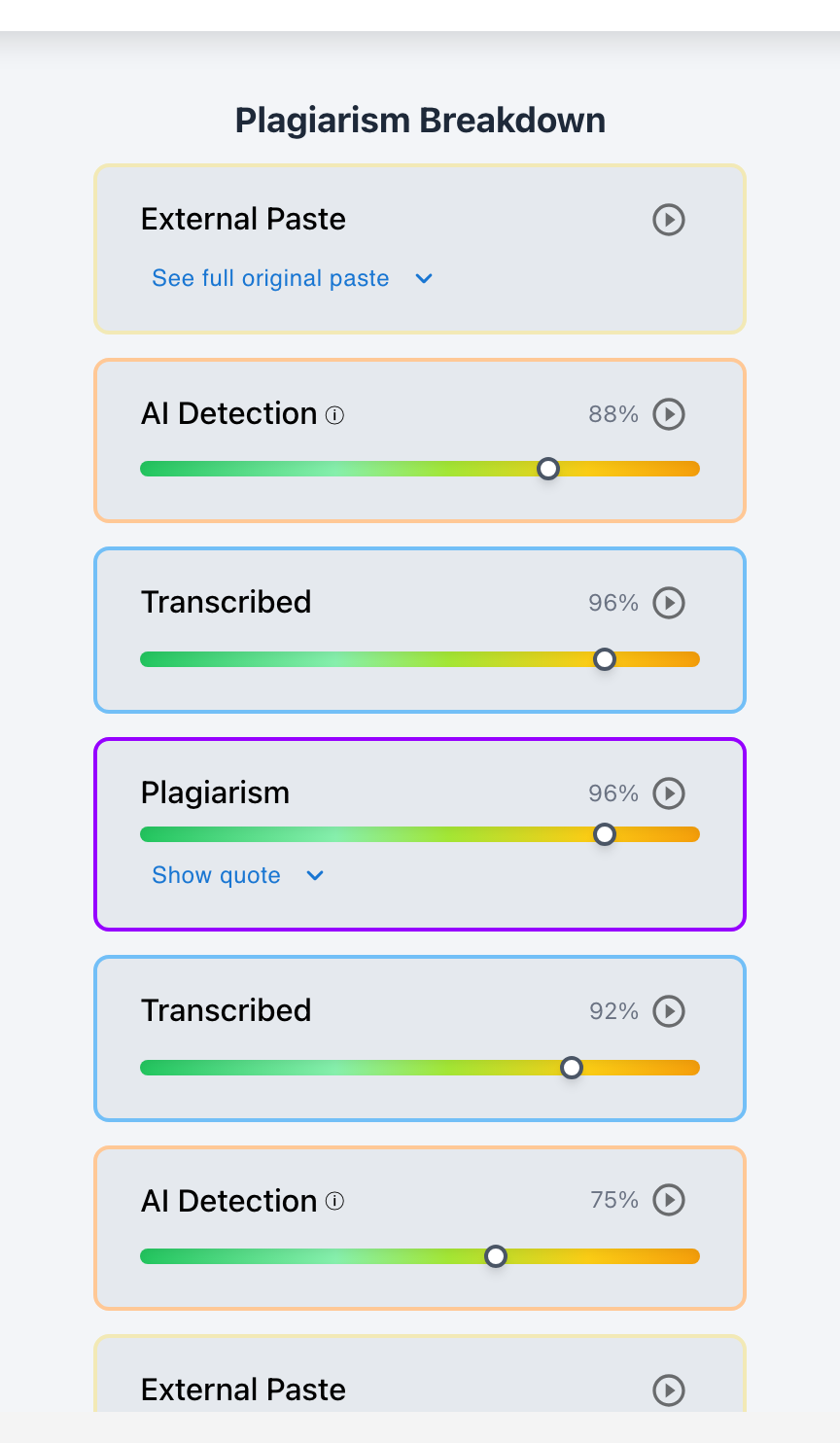
Before accusing a student of AI use, teachers must complete a 4-step pre-accusation verification audit: first, inspect writing playback telemetry in Checkmark (verifying active drafting duration, deletion rates, and clipboard paste payloads); second, compare the submission against the student's in-class diagnostic baseline; third, verify that cited sources and DOIs physically exist; and fourth, check whether the student submitted an AI disclosure statement or used permitted editing tools.
Falsely accusing a student of using generative AI is one of the most damaging mistakes an educator can make. It shatters student-teacher trust, causes severe academic anxiety, and creates contentious administrative disputes. Because standalone AI detector percentages carry documented false positive risks—especially for neurodivergent writers and English Language Learners—a percentage score alone is never sufficient justification for an accusation. By completing a systematic pre-accusation checklist, teachers ensure that every conversation is backed by undeniable physical evidence.
Below is the definitive pre-accusation checklist for educators before initiating any academic integrity inquiry.
Checkmark Plagiarism protects student due process by pairing AI detection with essay writing playback, plagiarism detection, autograding, and integrations with Canvas and Google Classroom.
The 4 Essential Pre-Accusation Verification Checks
Check 1: Keystroke Writing Playback
Open Checkmark Playback in SpeedGrader: verify whether the student spent 3+ active hours typing with 15–25% backspaces, or if text appeared in a 0.05-second paste payload.
Check 2: Longitudinal Baseline Alignment
Cross-examine the essay's vocabulary tier and syntax against the student's Week 1 In-Class Diagnostic writing sample to identify genuine stylistic anomalies.
Check 3: Citation & Source Verification
Query cited DOIs on doi.org and titles on Google Scholar to determine whether the paper contains authentic scholarship or synthetic AI hallucinations.
Check 4: Syllabus & Disclosure Review
Check whether the student submitted an AI Disclosure Statement detailing permitted brainstorming or grammar proofreading according to your rubric.
Why You Should Never Accuse Based on Detector Scores Alone
Understanding the legal and pedagogical risks of unverified accusations:
- The False Positive Hazard: Highly articulate students and non-native English writers naturally write with lower linguistic perplexity, often scoring high on static detectors despite writing 100% authentically.
- Physical Process Evidence Is Incontrovertible: If a student has 4 hours of recorded keystrokes and hundreds of backspaces in Checkmark Playback, they wrote the paper—period.
- The Supportive Conversation Approach: Reframe the meeting from an adversarial interrogation into a curious, evidence-backed check-in.
Read more in how Checkmark writing process analysis works.
Comparison: Premature Accusation vs. Evidence-First Verification
Evidence-First Verification (Checkmark Protocol)
- Audits keystroke hours and backspaces before meeting.
- Checks baseline portfolio and citation existence.
- Meeting framed as a supportive 2-minute review.
- Protects student due process and teacher integrity.
Premature Accusation (High Risk & Conflict)
- Confronts student based solely on an 85% AI detector score.
- Ignores 4 hours of authentic student typing history.
- Triggers defensive breakdown and parent escalation.
- Damages teacher-student relationship irreparably.
A 5-Step Pre-Accusation Educator Protocol
Pre-Accusation Due Diligence Checklist:
- 1. Open the student's submission in Checkmark Plagiarism inside Canvas SpeedGrader.
- 2. Review the Active Typing Duration: verify if active drafting time is under 15 minutes.
- 3. Inspect the Clipboard Paste Log: check for wholesale text payloads matching the AI score.
- 4. Check the Source Verification Card: test 2 cited DOIs to verify paper existence.
- 5. If multi-signal evidence confirms unauthorized shortcuts, schedule a private 2-minute conference.
How Checkmark Plagiarism Powers Pre-Accusation Due Diligence
Checkmark Plagiarism combines **AI detection, essay writing playback, static AI detection, plagiarism detection, autograding, and Canvas/Google Classroom integrations** to aggregate all forensic data into a single, unified due process report before any conversation occurs.
Frequently Asked Questions
What is the biggest mistake teachers make when suspecting AI use?
Confronting a student based solely on a statistical AI percentage score without checking their keystroke drafting history or source citations first.
What if a student has an 85% AI score but 4 hours of typing history in Playback?
Trust the keystroke telemetry: the student wrote the paper organically, and the high AI score is a false positive caused by formal syntax or grammar editing.
How can teachers verify if cited sources are real?
Checkmark automatically verifies DOIs and titles against Crossref and Google Scholar, highlighting unresolvable citations in red.
What should a teacher say when opening the conference?
Say: "Let's take a quick look at your writing playback in Canvas together. I noticed this section appeared all at once. Can you walk me through your drafting process?"
How does Checkmark Plagiarism integrate with Canvas LMS?
Checkmark provides certified LTI 1.3 integration, SpeedGrader sidebar embeds, two-way grade passback, and single sign-on (SSO).
Can students see their own writing playback before the meeting?
Yes. When enabled, students can review their own playback timeline, making it easy to explain their authentic drafting process during conferences.
What if a student drafted offline in Microsoft Word?
Ask the student to email the original Word file (.docx) to inspect creation timestamps and incremental version history.
How long should a pre-accusation review take?
With Checkmark's unified report in SpeedGrader, reviewing active hours, paste logs, and source cards takes less than 60 seconds.
What is an evidence-first integrity standard?
It is an institutional policy requiring physical proof (keystrokes, fake citations, oral defense) before disciplinary actions can be taken.
Why is due diligence essential for school culture?
Because ensuring fairness protects innocent students, prevents contentious grade appeals, and maintains community trust in academic rigor.
Grounding Academic Integrity in Truth and Due Process
Fairness is the foundation of effective education. By completing a thorough pre-accusation audit with Checkmark Plagiarism, educators ensure that honest students are always protected, false alarms are eliminated, and academic standards are upheld with absolute integrity.
Checkmark Plagiarism supports this comprehensive approach with AI detection, essay writing playback, static AI detection, plagiarism detection, autograding, and integrations with Canvas and Google Classroom.
See how Checkmark pairs writing playback with multi-signal detection to support pre-accusation due diligence. View a sample report or request a demonstration.