
If two students submit nearly identical essays, follow a 4-step investigative protocol: first, freeze grading and avoid making premature public accusations; second, open Checkmark Plagiarism in Canvas SpeedGrader to inspect both students' keystroke writing playback (active drafting hours, backspaces, and paste logs); third, hold separate, private conferences with each student using objective playback video; and fourth, apply course honor code policies based on whether the case represents unapproved collaboration, file theft, or co-prompting the same AI model.
Discovering two nearly identical papers in the grading stack is one of the most frustrating scenarios for any educator. Accusing both students equally can punish an innocent victim whose draft was copied without permission, while failing to investigate thoroughly undermines classroom fairness. By following a structured, evidence-first resolution roadmap, teachers can identify the exact nature of the overlap, protect innocent students, and document policy violations with total legal defensibility.
Below is a comprehensive guide on investigating and resolving identical student submissions.
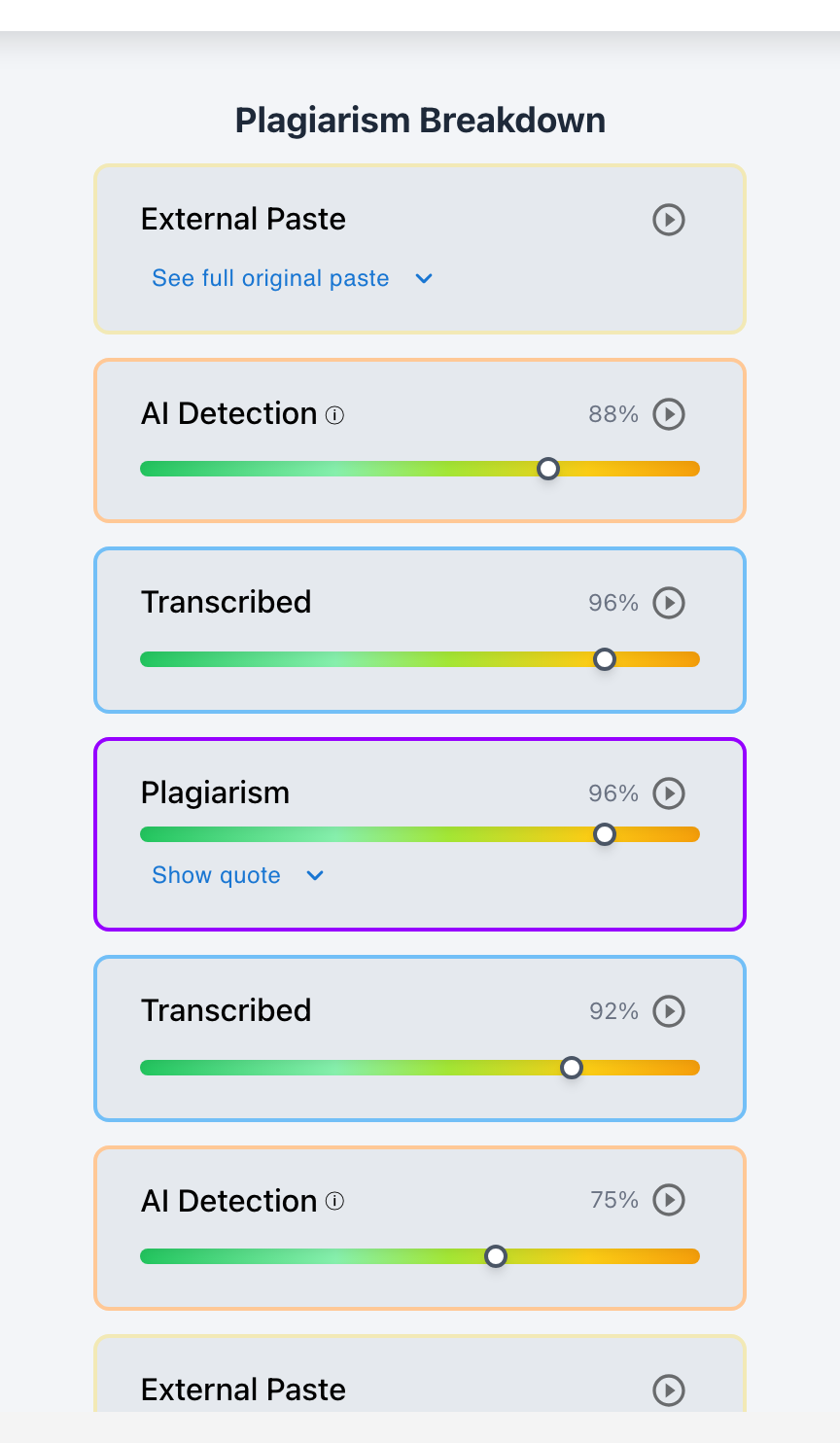
Checkmark Plagiarism resolves matching submissions by pairing plagiarism detection with AI detection, essay writing playback, autograding, and integrations with Canvas and Google Classroom.
The 4 Scenarios Behind Identical Student Papers
1. Direct Document Theft
Student A shared their draft for proofreading, or left their Google Doc open on a library computer, and Student B copied and submitted it without consent.
2. Unauthorized Collusion
Both students worked together on a shared document or divided paragraphs between them, unaware that independent individual authorship was required.
3. Co-Prompting the Same AI Model
Both students sat together and fed the exact same assignment prompt into ChatGPT, receiving nearly identical synthetic text outputs.
4. Reusing a Shared Frat/Sorority File
Both students downloaded the same archived assignment from an online repository or past student drive without realizing they were both in the same course section.
Why Separate Conferences Are Critical
Understanding the investigative dynamics of peer plagiarism reviews:
- Avoid Group Confrontations: Interviewing both students together allows the dishonest student to mirror the honest student's narrative or pressure them into accepting shared blame.
- Ask Independent Specifics: Ask each student to define three specific vocabulary words and explain why they chose the second supporting evidence point in paragraph 4.
- Let Playback Speak for Itself: Showing the 15-second time-lapse replay of both papers immediately clarifies who drafted the text organically.
Read more in how Checkmark writing process analysis works.
Comparison: Direct Theft vs. Collusion vs. Shared AI Prompting
Direct Theft (One Victim)
Student A has 4+ hours of active typing and revisions; Student B has a 0.05-second clipboard paste payload. Student A is exonerated.
Collusion (Shared Effort)
Both students share parts of the text, each having drafted half. Both students violated individual submission policies.
Shared AI Prompting
Both files have 0 drafting hours, high AI probability scores, and near-zero backspaces. Both are penalized for unauthorized AI use.
A 5-Step Educator Protocol for Resolving Identical Submissions
Identical Paper Investigation Checklist:
- 1. Place both grades on temporary hold in Canvas SpeedGrader without notifying the class.
- 2. Open Checkmark's Peer Submission Match report: compare side-by-side keystroke timelines.
- 3. Schedule two separate 2-minute private conferences back-to-back.
- 4. Show each student their individual writing playback replay and ask open-ended questions about their drafting process.
- 5. Apply the institutional honor code policy appropriate to the verified scenario (theft, collusion, or AI co-generation).
How Checkmark Plagiarism Powers Identical Paper Forensics
Checkmark Plagiarism combines **AI detection, essay writing playback, static AI detection, plagiarism detection, autograding, and Canvas/Google Classroom integrations** to automatically cross-check peer submissions across classes and display side-by-side timeline forensics.
Frequently Asked Questions
What is the first step when two students submit matching essays?
Pause grading and open Checkmark Playback in SpeedGrader to inspect active drafting hours and backspaces before contacting either student.
Should I interview the two students together or separately?
Always interview students separately; separate conferences prevent collusion narratives and allow the real author's authentic knowledge to shine.
What if both students claim they wrote it independently and it was a coincidence?
Complex essays cannot have identical phrasing and paragraph structures by coincidence; the probability of two independent writers producing identical 100-word passages is effectively zero.
What is the difference between collusion and plagiarism?
Plagiarism is taking someone else's work without permission or citation; collusion is unauthorized cooperation between two or more students on an individual assignment.
How does Checkmark Plagiarism integrate with Canvas LMS?
Checkmark provides certified LTI 1.3 integration, SpeedGrader sidebar embeds, two-way grade passback, and single sign-on (SSO).
What if both students used ChatGPT with the same prompt?
Checkmark will flag high AI probability scores and zero drafting hours in Playback for both students, identifying shared AI generation.
How can an innocent student prove their paper was stolen?
Checkmark Playback proves the innocent student spent hours actively typing and revising the draft days before the copier pasted it.
Can writing playback be exported for department chair reviews?
Yes. Checkmark exports side-by-side PDF audit dossiers including video replay links and keystroke telemetry charts.
What should a teacher do if both students contributed equally?
Explain that group collaboration was unauthorized for this task, assign a required individual rewrite on a new prompt, and award appropriate collusion penalties.
Why is writing playback essential for peer match disputes?
Because it provides objective, verifiable physical proof of how the text entered each document, eliminating subjective disputes entirely.
Fairness, Clarity, and Due Process in Every Case
Resolving matching student submissions requires calm, objective evidence. By utilizing Checkmark Plagiarism's peer matching and keystroke playback telemetry, educators can protect honest students, address dishonesty with clarity, and maintain an equitable academic environment.
Checkmark Plagiarism supports this comprehensive approach with AI detection, essay writing playback, static AI detection, plagiarism detection, autograding, and integrations with Canvas and Google Classroom.
See how Checkmark pairs peer submission matching with writing playback to investigate identical student essays. View a sample report or request a demonstration.