
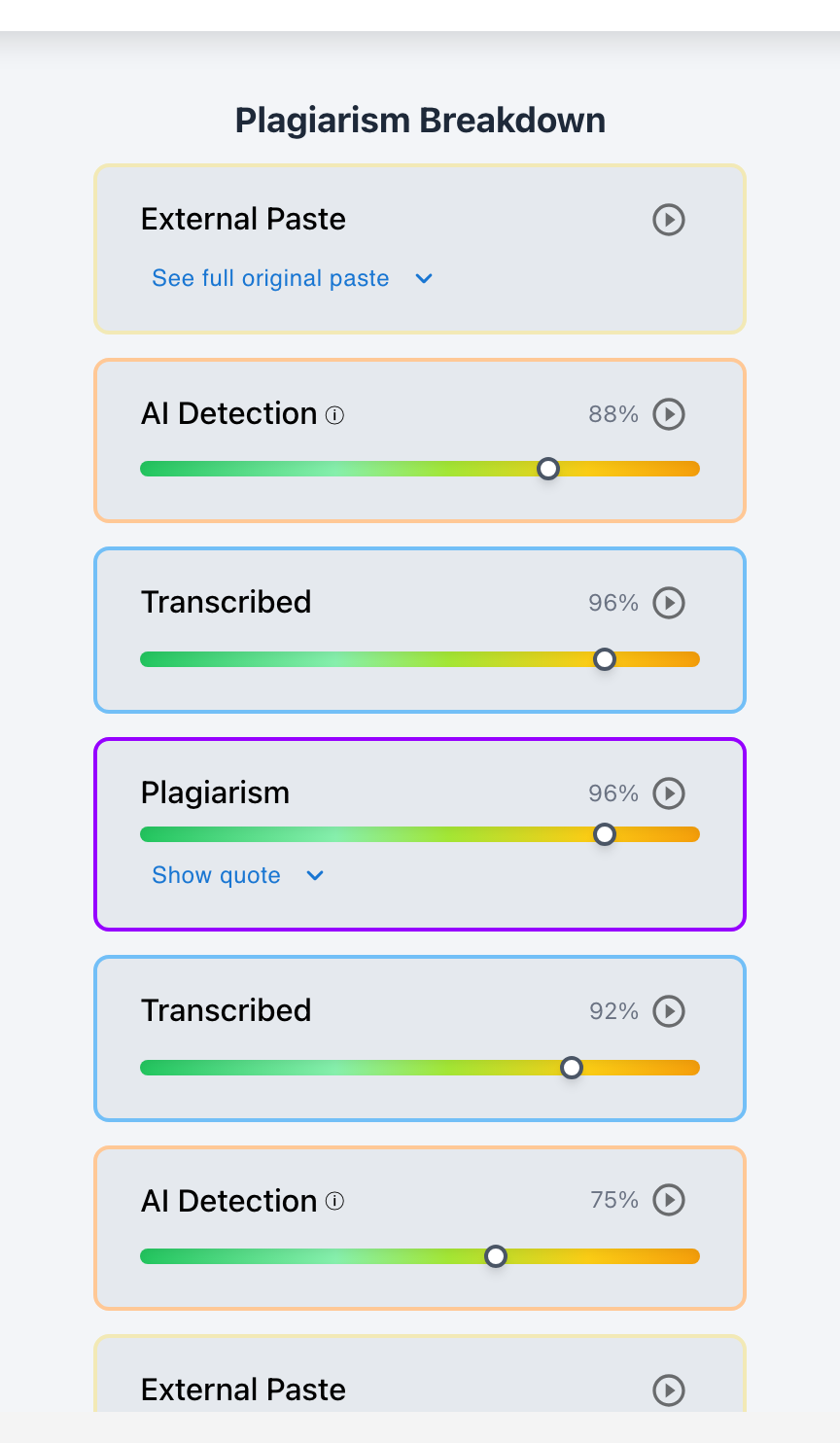
If a student's citation does not support their claim, teachers should first determine the root cause: an honest reading comprehension error, a decontextualized Google search snippet, or an AI hallucination where ChatGPT fabricated an argument and falsely attached an author's name. Address the mismatch through a supportive 2-minute conference, review Checkmark's automated source alignment cards, and require an evidence revision.
When grading research essays, discovering that a cited source contradicts or completely ignores the student's argument is increasingly common. In some cases, a well-meaning student read only an abstract or misunderstood nuanced scholarly prose. In other cases, the student prompted an AI model to "write an essay with sources," and the AI generated plausible claims while citing real authors whose work actually argues the opposite. Knowing how to diagnose the reason behind citation misalignment allows teachers to turn integrity red flags into powerful teaching moments.
Below is a comprehensive guide on investigating and resolving citation-claim mismatches.
Checkmark Plagiarism verifies source alignment by pairing plagiarism detection with AI detection, essay writing playback, autograding, and integrations with Canvas and Google Classroom.
The 4 Root Causes of Citation-Claim Misalignment
1. Generative AI Source Attribution
ChatGPT generates a claim and attributes it to a real author, even though that author never wrote or published that specific finding.
2. Decontextualized Search Snippets
The student copied a sentence from Google without reading the article, quoting an author summarizing an opponent's counterargument as their own view.
3. Honest Reading Comprehension Struggles
The student genuinely struggled to interpret complex academic jargon, misinterpreting statistical correlations or conditional hypotheses as proven facts.
4. Deliberate Citation Padding
The student randomly inserted citations from a bibliography to meet a required minimum source count without checking if they applied to the paragraph.
How to Differentiate AI Hallucinations from Student Misreading
Understanding how process telemetry reveals what occurred:
- The AI Attribution Signature: High AI probability scores across the paragraph paired with zero drafting hours in Playback and an in-text citation that links a real author to a completely fictitious conclusion.
- The Student Misreading Signature: Checkmark Playback shows 3+ hours of active typing with backspaces and search pauses, and the student can explain what they *thought* the author meant during a check-in.
- The Google Snippet Signature: The quote was pasted in a 0.05-second clipboard event directly from a search engine result without opening the full-text PDF.
Read more in how Checkmark writing process analysis works.
Comparison: Honest Student Misreading vs. AI Citation Fabrication
Honest Student Misreading (Pedagogical Issue)
- Student can produce the original PDF or book.
- Student points to the exact sentence they misread.
- Playback shows multi-hour drafting and typing effort.
- Action: Guide the student on proper scholarly analysis.
AI Citation Fabrication (Integrity Issue)
- Student has no idea what journal or book was cited.
- Author never wrote the cited claim anywhere.
- Playback shows instant paste or zero drafting hours.
- Action: Require full paper rewrite on an original topic.
A 5-Step Educator Protocol for Citation Mismatch Inquiries
Citation Mismatch Resolution Checklist:
- 1. Open the student's submission in Checkmark Plagiarism inside Canvas SpeedGrader.
- 2. Review the Source Evidence Card: check the original text of the cited source.
- 3. Inspect Writing Playback: check if the paragraph was drafted with thinking pauses or pasted in bulk.
- 4. Hold a supportive conference: "Let's look at page 42 of this source together. How did you interpret this finding?"
- 5. If genuine misinterpretation, award feedback points and request revision; if AI fabrication, apply academic policy.
How Checkmark Plagiarism Powers Claim Verification
Checkmark Plagiarism combines **AI detection, essay writing playback, static AI detection, plagiarism detection, autograding, and Canvas/Google Classroom integrations** to automatically match student claims against original source text snippets for fast verification.
Frequently Asked Questions
Is citing a source that doesn't support your claim considered cheating?
If done through deliberate fabrication or AI generation, yes. If done through an honest reading misinterpretation, it is a grading/comprehension issue rather than academic dishonesty.
How does ChatGPT create fake source connections?
ChatGPT predicts words based on statistical likelihood, often pairing well-known researchers with popular arguments even if that researcher never conducted that study.
What is 'contextual quoting error'?
It occurs when a student quotes an author summarizing an opponent's counterargument, mistakenly attributing the counterargument to the author themselves.
How does Checkmark verify claim-to-source alignment?
Checkmark indexes source repositories, extracting the cited paragraph and displaying a side-by-side comparison card directly in Canvas SpeedGrader.
What if a student cited a source from Wikipedia's bibliography?
Wikipedia citation copying often leads to mismatches because students copy the reference without reading the underlying source material.
How does Checkmark Plagiarism integrate with Canvas LMS?
Checkmark provides certified LTI 1.3 integration, SpeedGrader sidebar embeds, two-way grade passback, and single sign-on (SSO).
What should a teacher do when a student genuinely misinterprets a source?
Use it as a teaching moment: show the student how to read academic abstracts, identify counterarguments, and qualify claims with evidence.
Can writing playback show if a student consulted a source?
Yes. Playback logs research pauses (15–45 minutes) where the student was reading the source before resuming keyboard drafting.
What questions reveal if a student understood a source?
Ask: "What was the author's primary research question?" and "What evidence did they use to support this point?"
Why is source claim verification essential for academic integrity?
Because accurate attribution is the foundation of scholarship, ensuring that student arguments are grounded in factual, verified evidence.
Fostering Accurate and Honest Scholarly Attribution
Teaching students how to accurately cite and synthesize scholarship is central to academic growth. By using Checkmark Plagiarism to verify source alignment and analyze drafting process telemetry, educators can support developing researchers while upholding uncompromising academic integrity.
Checkmark Plagiarism supports this comprehensive approach with AI detection, essay writing playback, static AI detection, plagiarism detection, autograding, and integrations with Canvas and Google Classroom.
See how Checkmark pairs source claim verification with multi-signal detection to evaluate student citations. View a sample report or request a demonstration.