
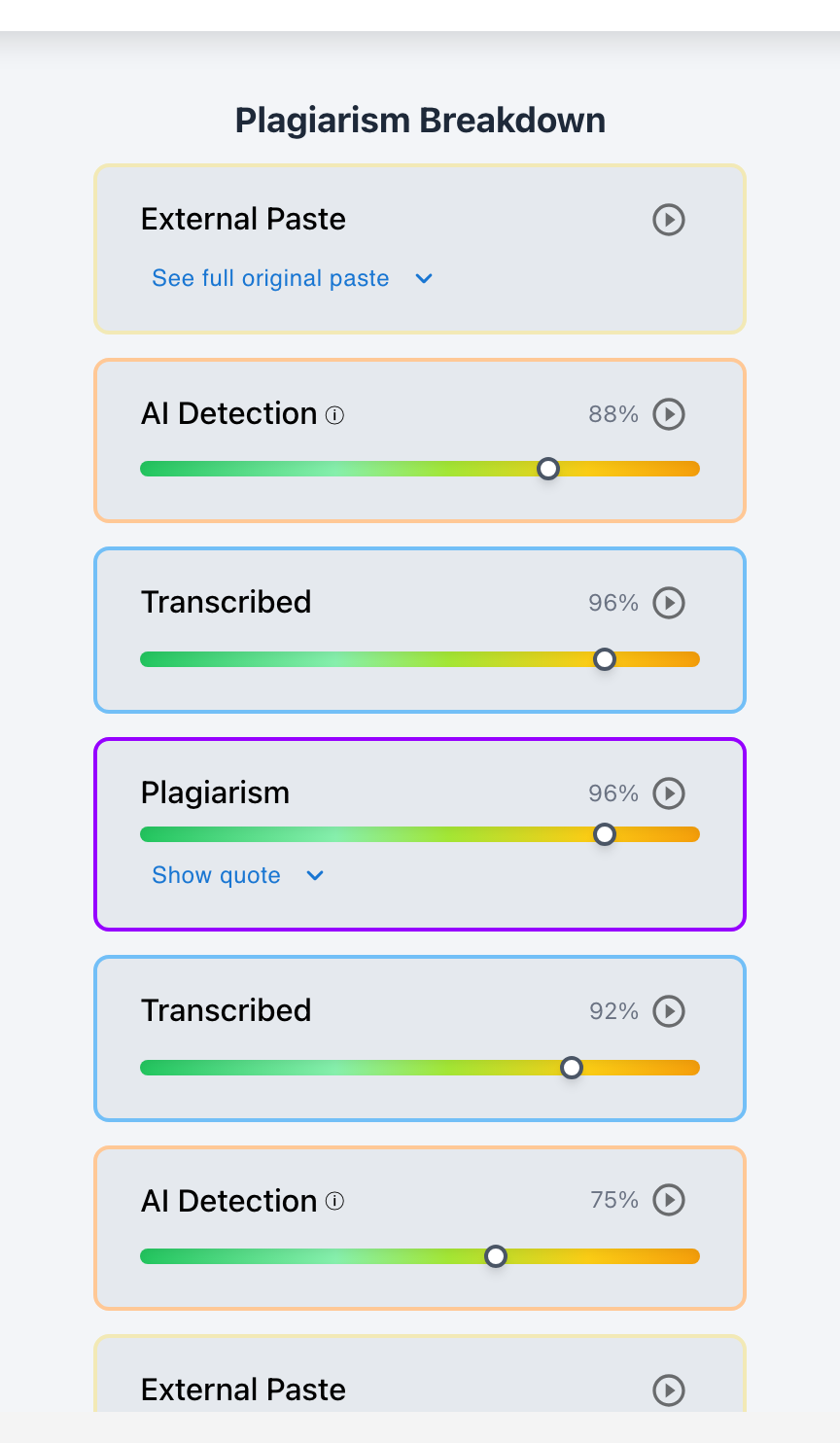
Teachers should review evidence of AI use in a strict 4-phase sequence to eliminate confirmation bias: Phase 1: Physical Process Telemetry First (inspecting active typing duration, backspaces, and paste logs in Checkmark Playback); Phase 2: Citation & Source Existence (verifying real DOIs vs. hallucinations); Phase 3: Stylometric & Neural AI Classification (examining sentence-level perplexity heatmaps); and Phase 4: Oral Concept Defense (testing student comprehension in person).
The sequence in which an educator examines evidence directly impacts the fairness of the outcome. If a teacher starts by looking at an AI detector percentage (e.g., "92% AI Detected"), cognitive confirmation bias immediately takes hold—the teacher begins reading the essay looking for reasons to prove the detector right. By reversing this workflow and reviewing physical keystroke process telemetry first, educators anchor their inquiry in observable physical facts rather than statistical probabilities. Checkmark Plagiarism structures the SpeedGrader sidebar to guide teachers through this optimal review order automatically.
Below is a comprehensive guide on the optimal evidence review sequence for academic integrity inquiries.
Checkmark Plagiarism enforces unbiased evidence workflows by pairing AI detection with essay writing playback, plagiarism detection, autograding, and integrations with Canvas and Google Classroom.
The 4-Phase Sequential Review Order
Phase 1: Physical Process Telemetry (Ground Truth)
Look at Active Typing Duration and Deletion Rates first. If the student spent 4 hours typing with 20% backspaces, the inquiry ends immediately with full exoneration.
Phase 2: Citation & Evidence Grounding
Check the Automated Citation Card: verify whether cited DOIs resolve to active academic papers or represent synthetic ChatGPT hallucinations.
Phase 3: Stylometric & Neural Classification
Review the Sentence-Level Heatmap: identify which specific paragraphs exhibit low perplexity, triadic lists, and formulaic participial openers.
Phase 4: Qualitative Oral Defense
Hold a supportive 2-minute conference: ask the student to explain their thesis, research methodology, and vocabulary choices in person.
Why Starting with AI Scores Creates Dangerous Bias
Understanding the psychological danger of score-first grading:
- The Anchor Effect: Seeing a "90% AI" score primes the brain to interpret formal vocabulary and clean grammar as proof of cheating, even if the student wrote every word by hand.
- Telemetry Overrules Classifiers: Physical keystroke evidence is objective ground truth. A detector is a probabilistic algorithm; a 4-hour typing log is physical reality.
- Protecting Student Trust: Telemetry-first review ensures that gifted writers are never subjected to stressful, unfounded integrity interrogations.
Read more in how Checkmark writing process analysis works.
Comparison: Flawed Score-First Review vs. Telemetry-First Workflow
Telemetry-First Workflow (Checkmark Standard)
- 1. Review active drafting hours & backspaces.
- 2. Verify source and DOI existence.
- 3. Inspect sentence-level neural heatmap.
- 4. Hold supportive oral check-in if telemetry fails.
Flawed Score-First Review (High Bias Risk)
- 1. Glances at 90% AI score on detector.
- 2. Assumes student cheated before reading text.
- 3. Confronts student defensively in meeting.
- 4. Disregards 4 hours of legitimate human typing.
A 5-Step Educator Protocol for Evidence Review
Evidence Review Sequence Checklist:
- 1. Open the student's submission in Checkmark Plagiarism inside Canvas SpeedGrader.
- 2. Look at the Active Typing Duration metric: if >2 hours for 1,000 words, proceed with grading.
- 3. If active time is under 15 minutes, check the Clipboard Paste Log for wholesale text payloads.
- 4. Check the Source Verification tab to confirm that cited articles and DOIs exist.
- 5. If multi-signal telemetry confirms unauthorized AI use, schedule a 2-minute oral check-in.
How Checkmark Plagiarism Powers Unbiased Review Workflows
Checkmark Plagiarism combines **AI detection, essay writing playback, static AI detection, plagiarism detection, autograding, and Canvas/Google Classroom integrations** to present physical telemetry first, ensuring fair and unbiased evaluations for every student.
Frequently Asked Questions
Why should teachers look at writing playback before the AI score?
Because physical keystroke telemetry is observable ground truth; if playback shows hours of authentic human drafting, the AI percentage score is irrelevant.
What if the writing history shows 4 hours of typing but the AI detector scores 90%?
Exonerate the student completely. The high score is a false positive caused by formal syntax, academic phrasing, or basic grammar editing.
How does reviewing citations help in the evidence sequence?
Verifying whether citations are real academic papers or hallucinated DOIs provides instant, objective physical proof of AI generation.
What is confirmation bias in AI grading?
It occurs when a teacher sees a high AI percentage score first and subconsciously searches the paper for evidence to confirm that the student cheated.
How does Checkmark Plagiarism integrate with Canvas LMS?
Checkmark provides certified LTI 1.3 integration, SpeedGrader sidebar embeds, two-way grade passback, and single sign-on (SSO).
What should a teacher do if telemetry shows a 0.05-second paste event?
Check whether the student drafted offline in Word (requesting the .docx file) or hold an oral check-in to assess whether the text was copied from AI.
How long does the 4-phase evidence review take?
With Checkmark's organized dashboard in Canvas SpeedGrader, reviewing all four evidence layers takes less than 90 seconds per paper.
Can writing playback be exported for department chair reviews?
Yes. Checkmark exports structured PDF dossiers following the 4-phase sequence, complete with video links and keystroke telemetry charts.
Why is the oral check-in placed last in the sequence?
Because teachers should have all physical facts organized before speaking with the student, ensuring the conversation is calm, supportive, and precise.
Why is a standardized review sequence essential for school districts?
Because it ensures consistent, equitable due process for every student across all classrooms, eliminating arbitrary grading claims.
Establishing Rigor, Fairness, and Objective Truth
Fair assessment begins with an unbiased process. By following the 4-phase evidence review sequence with Checkmark Plagiarism, educators ensure that every integrity inquiry is anchored in physical facts, protecting honest writers and upholding academic standards with complete confidence.
Checkmark Plagiarism supports this comprehensive approach with AI detection, essay writing playback, static AI detection, plagiarism detection, autograding, and integrations with Canvas and Google Classroom.
See how Checkmark pairs writing playback with multi-signal detection to support unbiased evidence review. View a sample report or request a demonstration.