
As high school and postsecondary students increasingly utilize multi-monitor desktop workstations, dual-display laptop setups, split-screen window tiling, and companion tablets for academic writing, educators face a profound diagnostic and pedagogical challenge: How do we reliably distinguish between a student authentically synthesizing primary research notes across screens, and a student manually transcribing an AI-generated essay character-by-character from a secondary display to evade paste detectors?
Traditional academic integrity approaches fail decisively in this scenario. Probabilistic, whole-document AI detectors frequently trigger false positives against authentic research papers due to their dense academic vocabulary, while remaining completely blind to optical transcription because no clipboard pasting occurs. Standard learning management system (LMS) revision histories lack the temporal resolution to capture typing cadence, leaving educators stranded in subjective speculation. Checkmark Plagiarism resolves this crisis through psycholinguistically grounded keystroke telemetry and patent-pending Essay Playback™. By analyzing the micro-mechanics of the composing process—specifically the Inter-Key Interval Coefficient of Variation (CVIKI), the Keystroke Friction Ratio (KFR), Clause-Boundary Pause Topography, and Non-Linear Navigation Trajectories—instructors gain verifiable, timestamped "receipts" of cognitive labor.
Checkmark Plagiarism solves this dual-screen verification crisis by integrating patent-pending Essay Playback™ with passage-level AI detection, comprehensive plagiarism checking, teacher-in-the-loop rubric autograding, and seamless multi-LMS integrations across Canvas SpeedGrader, Buzz LMS, and Google Classroom.
1. The Dual-Screen Conundrum: The New Frontier of Academic Authorship
The physical and digital geometry of student writing has evolved dramatically. A decade ago, student writing occurred primarily within a single full-screen word processor on a single display. Today, secondary and collegiate writing environments are overwhelmingly multi-window and multi-device ecosystems:
- Dual-Monitor Desktops & Laptop Extensions: Students display primary source PDF articles, JSTOR databases, digital archives, and Google Docs side by side.
- Split-Screen Operating System Tiling: Windows Snap, macOS Split View, and ChromeOS split-screen modes allow simultaneous viewing of assignment prompts, lecture slides, and drafting editors.
- Companion Mobile Devices & Tablets: An iPad or smartphone propped next to a laptop keyboard displays reading notes, outlines, or—increasingly—generative AI chat interfaces (e.g., ChatGPT, Claude 3.5 Sonnet, Google Gemini).
The Spectrum of Dual-Screen Digital Composition
Pathway 1: Genuine Note Synthesis (High Friction)
- Secondary Screen Content: 18th-century historical archives, JSTOR PDFs, empirical data tables, personal handwritten notes.
- Cognitive Translation: Semantic translation, deconstruction, and active cognitive restructuring.
- Pause Topography: Extended formulation pauses (8–25s) occurring strictly at macro-syntactic clause boundaries.
- Revision Depth: Heavy revision, backspacing, and clause reorganization (KFR: 18%–38%).
- Cursor Trajectory: Non-linear cursor jumping, retroactive citation insertion, thesis refinement.
- Biometric Verdict: 🟢 Verified Authentic Human Cognitive Labor
Pathway 2: Optical AI Transcription (Mechanical)
- Secondary Screen Content: Full AI-generated response from ChatGPT, Claude 3.5 Sonnet, or Undetectable AI.
- Cognitive Translation: Zero conceptual translation; simple motor-perceptual copy typing.
- Pause Topography: Saccadic gaze-shift pauses (0.8–2.0s) occurring randomly mid-word and mid-phrase.
- Revision Depth: Monotonic character progression with near-zero backspacing (KFR < 3.0%).
- Cursor Trajectory: Strictly linear progression from character 0 to character N.
- Biometric Verdict: 🔴 AI Authorship Fraud / Retype Bypass
The Emergence of "Optical AI Transcription"
When generative AI text generation became widespread, academic institutions initially responded by installing basic clipboard paste listeners and relying on static AI detectors. In response, student social media channels and essay mills quickly popularized a technique designed to circumvent these superficial controls: Optical Transcription (colloquially termed "retyping," "screen-to-screen transcription," or "the human mechanical printer method").
In optical transcription, a student prompts a large language model (LLM) on a secondary device or side-by-side browser window, generates a complete response, and manually retypes the AI's output character-by-character into their assigned document editor.
Because the student never triggers a native CTRL+V or Paste event, traditional clipboard listeners register zero pasted characters. Furthermore, standard revision history snapshots in tools like Google Docs or Microsoft Word merely capture aggregate character growth across coarse multi-minute intervals, creating the illusion of steady human typing.
Why Legacy Academic Integrity Systems Fail
When confronted with dual-screen composition, traditional tools collapse into two equally damaging failure modes:
- The False-Positive Trap of Static AI Detectors: Static AI classifiers analyze submitted text solely through statistical linguistic heuristics—specifically perplexity (word choice predictability) and burstiness (sentence length variation). Authentic academic research synthesis inherently produces elevated formal register, standardized discipline-specific terminology, and structured argumentative transitions. Consequently, generic AI detectors routinely flag honest, high-performing students who synthesize complex scholarly sources across multiple monitors as "highly likely AI-generated."
- The Blind-Spot Vulnerability of Paste-Only Detectors: Software that relies entirely on clipboard event hooks is completely bypassed by optical transcription. To a naive paste detector, a student who manually retypes 2,500 words of Claude-generated prose over 45 minutes appears indistinguishable from a student typing their own thoughts.
To resolve this impasse, educational institutions must transition from evaluating static text artifacts to analyzing temporal writing telemetry—the real-time, behavioral biomechanics of how text is produced.
2. The Cognitive Psycholinguistics of Written Composition vs. Mechanical Transcription
To understand why keystroke telemetry provides definitive proof of authorship, we must examine the established cognitive models of written language production. Writing is not merely a motor task; it is one of the most cognitively demanding executive functions the human brain performs.
1. Visual Input & Propositional Extraction
Reads multi-page PDF on Screen 2; decodes complex empirical claims.
2. Central Executive & Working Memory
Deconstructs arguments, reconciles thesis contradictions, plans novel syntax. Cognitive Pause: 8–25 Seconds
3. Motor Translation & Burst Drafting
Transfers planned linguistic string to keyboard (Variable 50–90 WPM bursts).
4. Diagnostic Monitoring & Recursive Revision
Immediate backspacing, word substitution, and retroactive citation insertion. Keystroke Friction Ratio: 15%–35%+
1. Visual Fixation (4–6 Word Chunk)
Eyes fixate on ready-made Claude/ChatGPT output on secondary screen.
2. Phonological Buffer Hold
Pure acoustic/graphemic rehearsal with zero semantic translation.
3. Motor Copy Execution
Metronomic typing burst; negligible error rate. Gaze-Shift Pause: 0.8–2.0s (Mid-Clause)
4. Telemetric Signature
Uninterrupted monotonic progression (0 → N). KFR < 2.5% | CVIKI < 0.20 | Metronomic
The Cognitive Architecture of Authentic Source Synthesis
According to the classical Hayes & Flower Writing Model and Ronald Kellogg’s Working Memory Model in Written Composition, genuine synthesis of external sources requires continuous coordination among three cognitive subsystems:
- The Central Executive (Formulation & Planning): When a student reads a primary source on Screen 2, their working memory must extract abstract propositions, evaluate their relevance to the research question, reconcile contradictions between sources, and plan a novel syntactic structure. This intense cognitive load generates long formulation pauses (8 to 25 seconds). Crucially, these pauses occur at macro-syntactic boundaries—before initiating a new paragraph, at the start of a sentence, or before an intricate subordinate clause.
- The Translation & Execution Stage (Drafting): Once an idea is formulated, the writer executes a burst of rapid keystrokes (often 50 to 90 words per minute) as the planned linguistic string is transferred from the phonological loop to the keyboard.
- The Monitoring & Diagnostic Loop (Reviewing & Revising): As text appears on Screen 1, the student continuously monitors their prose against their internal communicative intention. This triggers immediate recursive revision: pausing mid-sentence to delete a redundant adjective, swapping a weak verb for a precise academic term, restructuring a misplaced modifier, or jumping the cursor back three sentences to insert a parenthetical citation. This natural cognitive friction results in a healthy Keystroke Friction Ratio (KFR) between 15% and 35%.
The Psycholinguistics of Optical AI Transcription: "The Decoupled Motor Actuator"
In sharp contrast, when a student engages in optical transcription, the central executive is almost entirely bypassed:
- Elimination of Syntactic Formulation: The LLM on the secondary screen has already performed all planning, lexical selection, grammatical structuring, and rhetorical pacing.
- The Gaze-Shift Saccadic Loop: The student's task is reduced to a basic sensory-motor loop: (a) glance at the secondary screen to read a short chunk of 4 to 8 words, (b) hold that string in the short-term phonological buffer for 1 to 2 seconds, (c) glance down at the keyboard/primary screen and type the chunk, and (d) glance back at the secondary screen to acquire the next visual chunk.
- Absence of Conceptual Monitoring: Because the student did not author the thoughts, they do not evaluate whether the argument aligns with a broader thesis. They do not pause to reconsider word choice or sentence structure. Characters are typed in an uninterrupted, forward-only progression (0 to N), yielding a Keystroke Friction Ratio (KFR) typically below 3%.
- Syntactically Decoupled Pause Topography: In genuine writing, pauses align with grammar (periods, semicolons, paragraph breaks). In optical transcription, the pauses occur wherever the student's visual working memory ran out of words—frequently in the middle of prepositional phrases, between helper verbs and participles, or even directly inside multi-syllabic words as their eyes saccade between monitors.
3. Mathematical & Biometric Telemetry Metrics: Quantifying the Difference
To move from theoretical cognitive science to legally and pedagogically defensible evidence, Checkmark Plagiarism computes four core biometric and telemetric metrics across every drafting session.
μ = 185ms, σ = 28ms, CVIKI = 0.15 (Metronomic & robotic)
Unnatural Gaussian collapse with zero burstiness.
μ = 240ms, σ = 145ms, CVIKI = 0.60 (Organic cognitive burstiness)
Dynamic variation: rapid motor bursts + deliberate formulation intervals.
1. Inter-Key Interval Coefficient of Variation (CVIKI)
Cadence Dispersion- Authentic Synthesis (0.45 ≤ CVIKI ≤ 0.85): Wide variance between 80ms motor bursts on familiar words and 500ms+ lexical retrieval pauses.
- AI Transcription (CVIKI < 0.22): Metronomic cadence with standard deviation σIKI dropping below 45ms.
2. Keystroke Friction Ratio (KFR)
Revision Entropy- Authentic Synthesis (15% ≤ KFR ≤ 40%): Recursive restructuring, deletions, word substitutions, and citation adjustments.
- AI Transcription (KFR ≤ 3.5%): Pre-polished syntax with near-zero backspacing and monotonic forward character growth.
3. Clause-Boundary Pause Correlation Index (CBPCI)
Syntactic Alignment- Authentic Synthesis (CBPCI ≥ 82%): Pauses occur at periods, semicolons, conjunctions, and paragraph indentations while consulting Screen 2.
- AI Transcription (CBPCI ≤ 25%): Pauses occur mid-word and intra-phrase due to visual saccades between monitors.
4. Drafting Trajectory Linearity (DTL)
Temporal Geometry- Authentic Synthesis: Jagged, staircase trajectory featuring multi-minute reading plateaus and negative deletion dips.
- AI Transcription (DTL > 0.96): Constant-slope linear vector with uninterrupted character growth.
Comprehensive Telemetric Calibration Matrix
The following matrix contrasts the telemetric signatures of authentic dual-monitor research synthesis against various deceptive, assisted, and accessibility workflows:
| Telemetric Dimension | Authentic Dual-Screen Synthesis | Optical AI Transcription | Direct AI Copy-Paste | Speech-to-Text Dictation | Pre-Drafted Script Retyping |
|---|---|---|---|---|---|
| Keystroke Friction (KFR) | 18% – 38% (High churn) | < 3.0% (Near-zero) | 0.0% on pasted block | 5% – 12% (Voice cleanup) | 2% – 6% (Minor typos) |
| Cadence Variance (CVIKI) | 0.48 – 0.82 (Dynamic) | 0.12 – 0.22 (Metronomic) | N/A (Instantaneous) | Bimodal (Spoken blocks) | 0.20 – 0.32 (Moderately flat) |
| Primary Pause Locations | Sentence starts, paragraph breaks | Mid-word, intra-phrase, random | Pre-paste navigation | Speech engine latency gaps | Phrase & line breaks |
| Mean Cognitive Pause | 8.0s – 28.0s (Source reading) | 0.8s – 2.2s (Gaze shifts) | 5.0s – 45.0s (Prompting) | 2.0s – 6.0s (Vocal pauses) | 1.2s – 3.5s (Note reading) |
| Cursor Navigation Trajectory | Non-linear (Jumps across paragraphs) | Linear monotonic (0 → N) | Single-point insertion | Linear with voice cursor moves | Highly linear |
| External Paste Buffer | 0–5 small quotes with citations | 0 external paste events | Complete essay pasted | 0 paste events | 0 paste events |
| Linguistic Perplexity | Variable (Quotes + Analysis) | Uniformly low (LLM baseline) | Uniformly low (LLM baseline) | High / Colloquial spoken | Matches source script |
| Diagnostic Verdict | 🟢 Authentic Human Synthesis | 🔴 AI Authorship Fraud | 🔴 Uncredited AI Ingestion | 🟡 Authorized Accessibility | 🟡 Pre-Draft Transcribing |
4. Checkmark Plagiarism’s Telemetric Forensics & Essay Playback™ Suite
To empower educators and honor boards with objective, transparent evidence, Checkmark Plagiarism integrates real-time writing telemetry directly into the educator workflow. Rather than generating an arbitrary, punitive black-box percentage, Checkmark captures the entire physical lifecycle of a submission.
While early mercantilist frameworks prioritized physical bullion accumulation [PAUSE: 14.2s], later colonial trade [CURSOR JUMP TO LINE 1] [INSERT CITATION: (Smith, 1776)] subsequent empirical analyses proved that domestic productivity drove sustained wealth...
1. Patent-Pending Essay Playback™ (1x–8x Scrubbable Video Replay)
At the center of Checkmark's forensic suite is Essay Playback™. Educators can scrub through the entire writing session at 1x, 2x, 4x, or 8x speed, watching the document assemble keystroke-by-keystroke.
- Real-Time Velocity Curves: Displays interactive WPM graphs synchronized with the text canvas, highlighting active typing bursts versus reflective pauses.
- Pause Topography Heatmaps: Color-codes pauses across the text. Green markers indicate healthy macro-syntactic pauses at sentence boundaries; red flags highlight suspicious, metronomic mid-word pauses indicative of optical transcription.
- Jump-to-Event Navigation: Allows instructors to instantly jump to significant editing milestones, large deletions, paste events, or multi-minute drafting pauses.
2. Biometric Transcription Cadence Analytics
Checkmark's backend engine continuously evaluates CVIKI, KFR, and CBPCI in real time. If a submission displays the telltale markers of optical transcription (e.g., KFR < 3%, CVIKI < 0.20, and low clause-boundary correlation), Checkmark flags the anomaly in the Educator-Only Integrity Sidebar.
Importantly, this flag is strictly private to the instructor, preventing premature or automated student accusations and serving as a diagnostic trigger for supportive inquiry.
3. Forensic External Paste Buffer Inspector
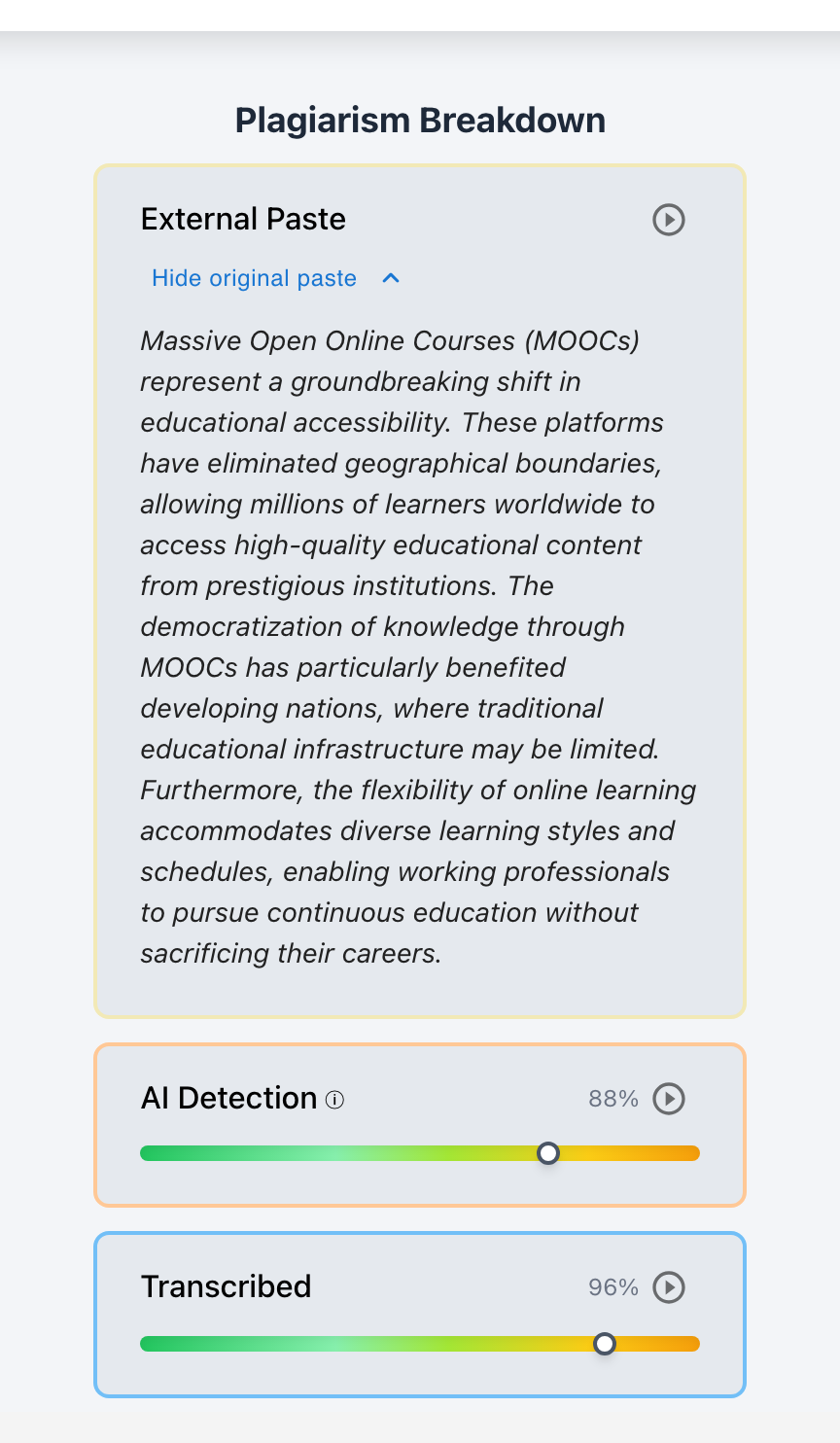
When a student legitimately pastes research notes, quotations, or data from a secondary screen, Checkmark’s 100% External Paste Buffer Inspector captures the exact string inserted from the system clipboard.
- Full Text Preservation: Preserves the complete pasted text even if the student subsequently edits, rewrites, or deletes every individual word.
- Source Differentiation: Distinguishes between legitimate, quoted research snippets (which display dedicated quotation badges linked to web/database sources) and unauthorized whole-paragraph text dumps.
- Side-by-Side Verification: Allows instructors to compare pasted research notes against the final synthesized prose to verify authentic paraphrasing.
4. Teacher-in-the-Loop AI Autograder & Multi-LMS Grade Passback
Checkmark bridges academic integrity and formative assessment through its Teacher-in-the-Loop AI Autograder:
- Quote-Anchored Rubric Justifications: Generates draft grading suggestions aligned with institutional rubrics (e.g., Thesis Clarity, Evidence Integration, Syntactic Sophistication), anchoring every point score to specific passages in the student’s text.
- Teacher Final Authority: All automated scores and comments remain provisional drafts until reviewed, edited, and approved by the educator.
- Seamless LMS Grade Passback: With a single click, approved rubric scores, qualitative feedback, and Essay Playback links synchronize directly into Canvas SpeedGrader, Buzz LMS, Google Classroom, and Moodle.
5. Enterprise Privacy, FERPA, and COPPA Compliance
Checkmark operates under a strict Zero-Data-Retention & Zero-Model-Training architecture:
- Student submissions, keystroke telemetry streams, and clipboard logs are never used to train commercial AI models or shared with third parties.
- Full compliance with FERPA (34 CFR Part 99) and COPPA, featuring end-to-end encryption at rest (AES-256) and in transit (TLS 1.3).
5. Real-World Case Studies: Adjudicating Dual-Screen Workflows
To illustrate how keystroke dynamics operate in practice, consider three authentic institutional scenarios evaluated using Checkmark Plagiarism:
AP Capstone Research Paper (4,000 Words)
Assignment & Setup: 4,000-word independent paper on municipal wastewater management. Dual 27-inch monitors (Monitor 1: Checkmark Editor; Monitor 2: 14 JSTOR PDF studies & EPA data tables).
The Dilemma: A legacy static AI detector flagged the submission as "68% AI-Generated" due to formal passive syntax and empirical terminology.
Checkmark Forensic Findings:
• Active Drafting Time: 11.4 hours across 9 distinct sessions.
• Keystroke Friction: KFR = 28.4% (4,120 backspaces & extensive clause refactoring).
• Pause Topography: 38 extended pauses (15–30s) placed exactly before citing EPA data.
• Non-Linear Editing: Thesis rewritten on page 2 midway through drafting page 8.
College Composition I (1,500 Words)
Assignment & Setup: Comparative analysis of The Great Gatsby and Passing. Laptop with companion iPad displaying live Claude 3.5 Sonnet.
The Dilemma: Student submitted in 45 minutes. A generic AI detector reported 14% AI (bypassed by conversational prompting). LMS logs showed 0 pastes.
Checkmark Forensic Findings:
• Cadence: Linear 42-minute session from char 0 to 8,420 at continuous 48 WPM.
• Telemetry: KFR = 1.1% (only 14 single-char typo backspaces across 1,500 words).
• Pause Mapping: 142 short pauses (0.9–1.4s) distributed mid-clause (gaze shifts).
• Resolution: Student admitted optical transcription; completed supervised rewrite.
High School AP U.S. History DBQ (Timed Essay)
Assignment & Setup: Timed DBQ synthesizing 7 primary source documents. 13-inch split-screen Chromebook (Doc on left, PDF packet on right).
The Dilemma: Student (native Spanish speaker) relied on formal sentence stems; static AI detector assigned an 81% AI probability score.
Checkmark Forensic Findings:
• Reading Phase: 18 initial minutes spent reading the split-screen PDF before typing.
• Friction: KFR = 21.3% (repeatedly refactored English verb tenses).
• Source Synthesis: 12 multi-minute reading pauses before quoting document authors.
• Resolution: AI flag dismissed; autograder used for historical argumentation feedback.
6. The 4-Phase Telemetry Investigation Protocol
When reviewing submissions generated in multi-screen environments, writing program administrators and instructors should adhere to Checkmark’s 4-Phase Telemetry Investigation Protocol. This protocol guarantees due process, eliminates bias, and maintains a strictly pedagogical, supportive stance.
Phase 1: Automated Triage & Signal Screening
Inspect the Checkmark Plagiarism summary dashboard inside Canvas SpeedGrader, Buzz LMS, or the standalone educator portal.
- Evaluate the Keystroke Friction Ratio (KFR): Is it healthy (15%–40%) or collapsed (< 3.5%)?
- Check the Cadence Variance (CVIKI): Is it dynamic (> 0.40) or flatline mechanical (< 0.22)?
- Review the 100% Clipboard Buffer Inspector for external uncredited paste dumps.
- If all indicators reflect natural human friction, dismiss the inquiry immediately regardless of static AI scores.
Phase 2: Micro-Forensic Playback & Pause Mapping
If telemetry metrics indicate potential optical transcription, launch Essay Playback™ for micro-forensic review.
- Scrub the timeline at 4x speed to observe drafting geometry: Recursive hopping vs. monotonic forward march.
- Examine the Pause Topography Heatmap: Do pauses cluster at sentence starts (synthesis) or mid-clause (saccades)?
- Verify whether external pasted text matches properly formatted and cited block quotations.
Phase 3: The Supportive, Restorative Student Conference
Schedule a brief 10-minute conference framed around metacognitive exploration rather than accusatory confrontation.
- Open with process inquiry: "Can you walk me through how you set up your monitors and synthesized these sources?"
- Screen-share Essay Playback™ collaboratively as an objective, neutral mirror of the composing session.
- Invite the student to explain telemetric patterns, review their research notes, or present offline handwritten drafts.
Phase 4: Remediation, Policy Calibration, & LMS Passback
Close the feedback loop with clear pedagogical outcomes and automated gradebook synchronization.
- If Authentic: Exonerate student; utilize Teacher-in-the-Loop Autograder to transmit criterion feedback to LMS.
- If Optical Transcription: Assign a structured 48-hour revision with active keystroke logging and synthesis coaching.
- Export the complete Checkmark Telemetry Dossier to SIS/LMS records for transparent institutional documentation.
7. Educator Dialogue Scripts for Restorative Conferencing
The following field-tested dialogue scripts demonstrate how instructors can navigate conferences involving dual-screen composition without triggering defensive hostility:
Restorative Conferencing Dialogue Framework
Instructor: "Thanks for meeting with me, Jordan. I was really interested in the historical arguments you developed in your final research paper. To start, could you walk me through how you set up your workspace when researching and drafting this assignment?"
Student: "I usually work at my desk at home. I have my laptop plugged into a second monitor with my articles on one screen and my document on the other."
Instructor: "That dual-screen setup is very common among researchers. In our course, we use Checkmark Plagiarism to look at how papers are composed. Let's take a look at your drafting timeline together." [Opens Checkmark Essay Playback™ on shared screen]
Instructor: "When we look at authentic research synthesis across two screens, we typically see students typing in bursts, stopping for 20 or 30 seconds to read their notes, making lots of edits and word choices, and jumping back to revise earlier sections. On your timeline, we notice that this entire 1,800-word essay was typed in a single 38-minute session with only 12 backspaces, and with brief 1-second pauses every few words right in the middle of sentences. Can you help me understand what was happening on your screens during this session?"
Student: "I had Claude open on my second monitor. I asked it to outline and draft the paragraphs, and then I was looking over and typing what it wrote so it wouldn't count as a copy-paste."
Instructor: "I appreciate your honesty in sharing that. The reason this assignment exists is for you to develop your own ability to evaluate and synthesize contradictory evidence. When an AI does that synthesis, your brain misses out on that critical cognitive struggle. Let's look at your primary sources together, and I'll show you how to synthesize those notes in your own words for a revised submission."
8. Frequently Asked Questions (Educator & Administrator FAQs)
1. How does Checkmark differentiate between a fast touch typist and an AI transcriber?
While an experienced touch typist may type at 80 to 110 WPM, their cognitive writing dynamics remain fundamentally human. Fast human typists exhibit high CVIKI (varying cadence between complex words and simple function words), produce frequent backspacing and word corrections (KFR > 15%), execute multi-second cognitive pauses at sentence and paragraph boundaries, and frequently jump their cursor backward to edit earlier prose. An optical transcriber, regardless of typing speed, displays a collapsed CVIKI (< 0.20), near-zero backspaces (KFR < 3%), and short gaze pauses distributed randomly mid-sentence.
2. What if a student writes their draft by hand on paper first and then retypes it?
This is a recognized, legitimate offline drafting workflow. When a student retypes handwritten notes, their telemetry will indeed show low revision friction (KFR), but the pause topography and typing cadence will differ significantly from AI transcription. Students typing from handwritten notes pause at paragraph boundaries to turn pages, type in irregular semantic chunks corresponding to handwriting familiarity, and exhibit natural typing fatigue curves. Furthermore, during a Phase 3 conference, the student can simply present their handwritten notebook, which Checkmark allows instructors to attach directly to the submission record.
3. Can students game telemetry by deliberately injecting fake typos and backspaces?
Defeating biometric telemetry requires simulating a complex, multi-dimensional psycholinguistic system simultaneously: (1) varying micro-millisecond Inter-Key Intervals to match natural linguistic perplexity distributions, (2) placing long cognitive pauses strictly at macro-syntactic clause boundaries rather than where eyes shift screens, and (3) performing non-linear structural reorganizations across paragraphs. Simulating genuine cognitive friction in real time requires more mental effort than simply composing the essay authentically.
4. How does Checkmark ensure compliance with FERPA, COPPA, and student privacy laws?
Checkmark operates on strict Zero-Data-Retention and Zero-Model-Training principles. Student telemetry streams, keystroke dynamics, and clipboard captures are encrypted in transit (TLS 1.3) and at rest (AES-256) inside an isolated, school-district-owned partition. Checkmark never sells student data, never builds advertising profiles, and never uses student writing or keystrokes to train commercial machine learning models. All data remains the exclusive educational property of the subscribing institution under FERPA (34 CFR Part 99).
5. How does Essay Playback™ integrate with Canvas SpeedGrader, Buzz LMS, and Google Classroom?
Checkmark embeds directly into existing LMS workflows via modern LTI 1.3 standards. Inside Canvas SpeedGrader, instructors see a dedicated Checkmark tab displaying the interactive Essay Playback™ timeline, velocity graph, and telemetry summary directly alongside the standard rubric. In Buzz LMS and Google Classroom, teachers can click an SSO link that opens the student's playback session in a synchronized overlay. All rubric grades, criterion justifications, and qualitative feedback drafted with Checkmark’s Teacher-in-the-Loop Autograder synchronize back into the LMS gradebook with a single click.
6. Why are static whole-document AI detection percentages so dangerous on research papers?
Static AI detectors rely entirely on surface-level statistical predictability (perplexity and burstiness). High-level academic synthesis naturally requires specialized disciplinary vocabulary, formal syntax, and standard transition phrasing—the exact linguistic features that cause static detectors to predict high AI probabilities. Accusing a student of misconduct based solely on a monolithic "85% AI" score punishes rigorous academic register while failing to provide any verifiable factual proof. Keystroke telemetry replaces statistical guesswork with objective historical facts.
7. What baseline Keystroke Friction Ratio (KFR) should educators expect across grade levels?
Empirical telemetry benchmarks across secondary and collegiate writing reveal consistent baseline ranges: Middle School (12%–25%), High School AP/IB Courses (18%–32%), Collegiate Undergraduate Essays (20%–38%), and Timed In-Class Bluebook Exams (10%–20%). Any formal academic research paper exhibiting a KFR < 4.0% warrants routine telemetric inspection.
9. Conclusion: Shifting from Adversarial Policing to Restorative Trust
The proliferation of multi-monitor workstations, split-screen displays, and generative AI interfaces has permanently altered the landscape of academic writing. In this environment, relying on opaque, static AI detection scores or naive paste listeners does a grave disservice to educators and students alike—falsely penalizing diligent researchers while missing sophisticated optical transcription.
By capturing the living, temporal reality of the writing process through Essay Playback™, Keystroke Cadence Biometrics, and 100% Clipboard Provenance, Checkmark Plagiarism provides writing instructors, department chairs, and academic deans with the objective evidence required to make fair, defensible, and pedagogically sound decisions.
When educators have access to clear, unassailable receipts of cognitive effort, the classroom dynamic shifts from adversarial policing to supportive mentorship. We stop guessing, and we start trusting.
Ready to Bring Transparent Writing Telemetry to Your School or District?
Discover how Checkmark Plagiarism transforms academic integrity with patent-pending Essay Playback™, passage-level AI detection, and teacher-in-the-loop rubric grading.